Every wine festival is an opportunity to tell a story – not just through the wines poured, but through the very look and feel of the event. A label-inspired brand identity can transform a wine festival from a mere tasting event into an immersive vineyard-to-glass experience. By borrowing typographic cues, capsule colors, and iconography familiar to wine lovers, organizers can create a visual system that resonates deeply with their audience. The end result? Signage that is as beautiful as it is functional, easily legible from the back of the queue, and event materials (like menus and maps) that feel like they belong in a cozy winery tasting room.
The Importance of a Cohesive Visual Identity
A wine festival’s brand identity is more than just a logo or a color scheme – it’s the personality of the event on display. From the entrance archway to the wine list brochure, every visual element should communicate the festival’s theme and ethos. Cohesive branding helps attendees immediately recognize what the festival is about and builds excitement and trust. For instance, a visitor at a boutique Pinot Noir festival in Oregon or a large international wine expo in Singapore should instantly sense the event’s character – whether it’s rustic and traditional, sleek and modern, or playful and experimental – just from the visuals on-site. Consistency in design across event tickets sold with Stripe, wristbands, signage, and digital screens reinforces the theme. It not only makes the event look professional, but it also guides attendees intuitively, because they learn to associate certain colors, fonts, and symbols with information or areas around the festival.
Moreover, strong visual identity distinguishes your festival in a crowded market. Wine lovers often attend many events; a memorable brand identity (inspired by wine culture) can make your festival stand out in their minds and in media coverage. It turns the festival into a brand of its own – one that can be recognized from a social media photo or a souvenir poster on someone’s wall.
Drawing Inspiration from Wine Labels
Wine enthusiasts spend a lot of time examining bottle labels. Those labels carry heritage, style, and clues about the wine’s personality – and they can inspire festival branding in powerful ways. Think about the typography on wine labels: old-world vineyards (like French Bordeaux or Italian Barolo) often use elegant serif fonts and ornate flourishes that suggest tradition and prestige, whereas new-world wineries might use bold sans-serif typography or quirky hand-drawn lettering to signal innovation or playfulness. These typographic cues immediately set a tone. A festival can mirror this by choosing a typeface or set of fonts that echo the wines it celebrates. For example, if the festival focuses on heritage wines or a historic wine region, a classic serif font similar to those on traditional labels will evoke that legacy. On the other hand, a festival highlighting avant-garde or natural wines might use clean, modern lettering or even creative script that feels artisanal and fresh.
Go Cashless With RFID Technology
Enable contactless payments, faster entry, and real-time spending analytics with RFID wristbands and NFC-enabled ticketing for your events.
It’s important, however, to balance decorative typography with legibility. While a vine-inspired script might look beautiful and authentic on a poster or logo, it could become hard to read on directional signs or name badges. One lesson from experience: an Australian wine festival once printed all its wayfinding signs in a fancy cursive reminiscent of a 19th-century wine label – and attendees struggled to decipher them from a distance. The organizers quickly learned to reserve the fanciest fonts for titles and decorative use, and selected a complementary easy-to-read font for functional text. The takeaway is to use label-inspired fonts strategically – deploy the wine label elegance in the branding and headline text, but ensure that any informational text, especially on signage, is in a clear, high-contrast typeface.
Beyond fonts, label layouts and graphics can guide design. Many labels feature coats of arms, sketches of chateaus or vineyards, vintage year badges, or gold-embossed borders. Incorporating analogous design elements into festival visuals can reinforce the theme. For instance, a Spanish wine festival might use a border on signage that resembles the edging of a Rioja wine label, or a background texture on banners that mimics parchment paper used on vintage bottle labels. These touches create a subtle familiarity – wine lovers might not consciously realize it, but they’ll feel that the environment “speaks the same language” as their favorite bottles.
Planning a Festival?
Ticket Fairy's festival ticketing platform handles multi-day passes, RFID wristbands, and complex festival operations.
Keep cultural differences in mind too. Wine label aesthetics vary across regions, and if your festival has an international audience, blending styles might be wise. As compared to classic Old World wine labels, which often stick to time-honored designs (cream paper, ornate serif lettering, family crests), New World wine labels tend to be more experimental. They frequently use bold colors and modern graphic elements while sometimes borrowing Old World cues like serif fonts or traditional motifs, a trend often observed in the semiotics of New World wine labels. If your festival features wines from around the globe, aim for a design personality that respects tradition but feels contemporary and inclusive. This could mean pairing a refined vintage font for the festival name with cleaner typography for schedules and info, achieving a balance that appeals to both old-school oenophiles and new-generation wine drinkers.
Using Capsule Colors as a Design Palette
Every wine lover is familiar with the colorful foil capsule at the top of a wine bottle – the capsule’s hue often becomes part of a winery’s signature look. Those capsule colors (along with the rich tones of the wines themselves) can serve as the backbone for a festival’s color palette. Many classic wine capsules come in deep reds, golds, greens, or black, depending on the tradition (for example, Bordeaux wines often sport crimson or forest green foils, Champagne houses use gold or silvery foil, etc.). Borrowing these colors instantly anchors your festival’s visuals in wine culture.
For example, imagine a Rosé festival adopting the soft pink and rose-gold tones of a rosé bottle’s capsule and wine color throughout its branding – from staff T-shirts to stage backdrops – creating a cohesive blush-tinted atmosphere. Or consider a general wine festival that designates sections by wine type: the sparkling wine pavilion might use a champagne-gold color accent, the red wine zone features burgundy red banners, and the white wine area is marked by shades of golden straw yellow. These choices are not arbitrary – they reflect colors attendees already associate with those wines, making navigation intuitive. An attendee might not consciously think “the signs with the purple stripe likely lead to red wines,” but on some level the color guides them to the right place.
Consistency is key: once you’ve chosen a palette (inspired by capsules or wine varieties), apply it across all materials. The festival map, the website, the credentials, and even the trash bins and recycling station signs can carry these colors. This kind of design continuity is something packaging designers emphasize for wine bottles as well – color is often cited as the most vital design element in creating a unified look, according to packaging design insights from Wine Business Analytics. Just as a wine’s capsule color complements its label to tie the whole package together, your festival’s color choices should complement the logo and overall design, tying the entire event space together visually.
Turn Fans Into Your Marketing Team
Ticket Fairy's built-in referral rewards system incentivizes attendees to share your event, delivering 15-25% sales boosts and 30x ROI vs paid ads.
One practical tip: get physical swatches of your chosen colors and test them on actual signage material before finalizing. Colors can look different on a computer screen versus printed vinyl or fabric. For instance, a deep Merlot-red may appear brownish in low light or when printed on matte paper. During one event’s preparations, organizers discovered that the elegant dark green they picked (inspired by a Napa winery’s capsule) became nearly invisible on a shady outdoor sign. They adjusted by choosing a slightly brighter green for better contrast without losing the wine reference. Testing in real conditions – daylight, indoor tent lighting, nighttime illumination – ensures your capsule-inspired hues remain eye-catching and legible wherever they’re seen.
Iconography That Speaks to Wine Lovers
Icons and symbols are the silent ambassadors of your festival’s messaging. Using iconography familiar to wine lovers can instantly convey ideas without a word. Think of the universal symbols in wine culture: grape clusters, wine glasses, corkscrews, oak barrels, vineyard rows, or even regional landmarks like a silhouette of rolling hills or a chateau. By integrating these into wayfinding and decor, you tap into imagery the audience already associates with wine, deepening their immersion in the theme.
Need Festival Funding?
Get the capital you need to book headliners, secure venues, and scale your festival production.
When designing the icon set, maintain a consistent style. For instance, if you opt for a line-art style icon of a wine glass for the signage, ensure your other icons (a grape bunch, an arrow, a bottle) are also line-art with similar stroke thickness. This avoids a patchwork look and makes the icons feel like part of one family. Many festivals hire graphic designers to create a bespoke set of pictograms for exactly this reason – customized icons for restrooms, exits, info points, and different wine experiences (tasting zones, seminar rooms, food pairings) that all echo the festival’s personality.
Icons can also help with practical communication across language barriers. At a large international wine festival in Germany, for example, organizers might supplement or even replace text on some directional signs with clear icons (a simple wine glass symbol for tasting area, a fork-and-knife for food court, a music note for the live band stage). This way a visitor from Japan or Brazil can navigate just as easily, even if they don’t speak the local language. The familiarity of a grape icon leading to the vineyard tour or a bottle icon marking the shop is comforting and efficient.
It’s easy to get carried away with cute graphics, so always circle back to function: each icon should be immediately recognizable and used consistently. A tiny cluster of grapes sticker on a map marker, a large sculptural corkscrew at the festival entrance, or a series of flags each with a different varietal icon – however you implement iconography, make sure it complements text, not confuses it. And remember, less can be more. A few well-placed symbols that attendees learn to spot are better than an overload of images everywhere.
Wayfinding Signage: Marrying Aesthetics and Legibility
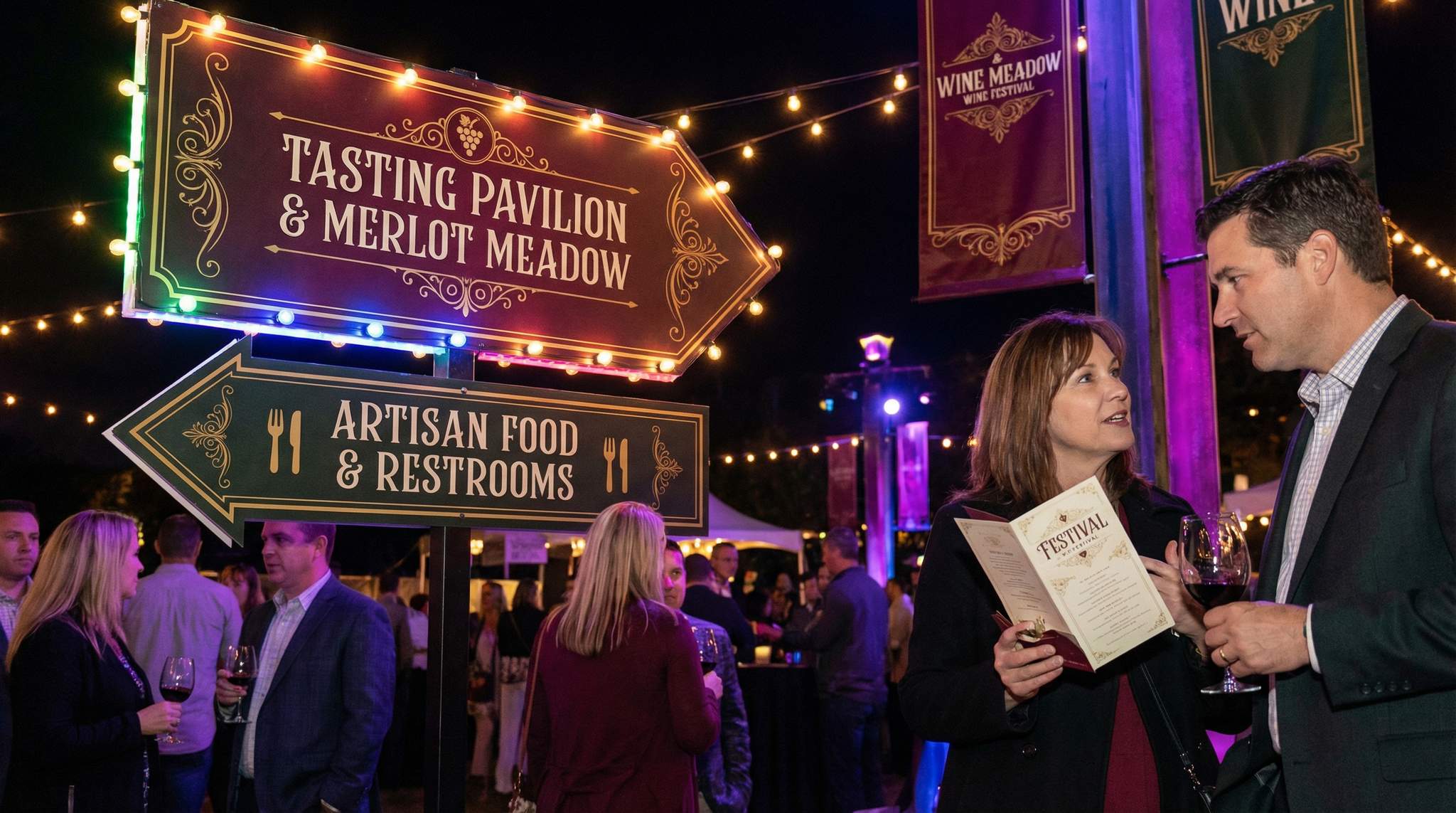
Wayfinding is where festival branding truly meets practicality. Attendees need to know where to go – whether it’s finding the Chardonnay seminar tent, the nearest restroom, or the exit – and often they need to do so at a glance, from several yards away, possibly after a few wine samples! Designing signage that fits the wine-centric brand identity and stays highly legible is a critical task for festival organizers.
Start with size and contrast. In a festival environment (crowded, possibly outdoors, varying light conditions), bigger is better for text. High contrast between text and background is non-negotiable – think dark text on a light background or vice-versa, avoiding any subtle color-on-color that could fade into illegibility under sunlight. A good rule of thumb is that 1 inch (2.54 cm) of letter height is readable from about 10 feet (3 m) away for clear text, and up to roughly 30 feet (9 m) in ideal conditions, based on Hemlock Display’s signage readability standards. This means if you expect people standing 20 feet from a sign (perhaps a menu board at a busy booth or a direction sign seen from across an aisle), use letters at least 2 inches (5 cm) high. For major directional signs that people might seek from 50+ feet away (15+ m), go even larger – large festivals often use lettering 6 inches (15 cm) or taller on their primary wayfinding placards.
Equally important is font choice and formatting. As discussed earlier, save the most stylized typefaces for decorative contexts. Your wayfinding signs should employ the most legible font in your palette – often a bold sans-serif or a clean serif – in a straightforward layout. Use short, universally understood words or pictograms. For example, instead of a verbose “This way to the exclusive Grand Cru tasting experience,” a sign might simply say “Grand Cru Tasting ?” with a wine glass icon, in large letters, and perhaps the same text in a secondary language below if needed. Attendees will appreciate the brevity when they’re trying to scan signage quickly.
Consider sightlines and height. Signs need to be placed where people can see them over the crowd. This can mean tall signposts or banners hung high. At one outdoor wine festival in France, the organizers cleverly used inflatable wine bottle replicas that stood 15 feet tall as signposts – each bottle had an arrow and the name of the zone (e.g., “Champagne Terrace”) clearly printed on it. This not only fit the theme perfectly but also elevated the signs above the throng. If novelty sign shapes aren’t in budget, simple large banners or boards on poles will do, as long as they’re consistently styled (using those capsule-inspired colors and winey fonts in a readable way).
Don’t forget night-time or low-light scenarios. If your festival extends into the evening or is indoors in dim lighting, ensure signs are lit or use retroreflective materials. A beautiful sign that’s on-brand but invisible after sunset doesn’t help anyone. Testing visibility at different times of day during setup is vital – walk the grounds at dusk and check that your directional arrows and area labels remain obvious.
Finally, reduce sign clutter by combining messages where possible and using your icon system. Too many signs can be as bad as none at all if attendees get information overload. A well-placed directory board at the entrance, for instance, can employ the festival’s full visual theme to orient guests (with a map and legend of icons/colors), so that individual signs around the venue can be simpler. When someone has seen on the map that the Merlot Meadow is coded with a purple grape icon and a burgundy color, then a simple arrow sign down the path that’s burgundy with a grape icon and the word “Merlot Meadow” is instantly understood.
Menus and Collateral That Feel Like a Tasting Room
One hallmark of a great wine festival is when the printed materials in your hand feel almost like they were picked up at a winery’s own tasting room. This means paying special attention to the design of menus, program booklets, tasting cards, and any other collateral that attendees use. They should reflect the festival’s brand identity while also invoking the charm and sophistication of a winery visit.
Menu cards – whether for individual winery booths, wine-and-food pairing stations, or the festival’s own curated tasting flights – deserve as much thought as the festival signage. In a tasting room, menus are often elegantly designed: maybe a heavy cardstock with a subtle embossed winery logo, or a clean layout with ample white space and easy-to-read descriptions of each wine. Festival menus should strive for that same quality feel. This could mean using a thicker paper stock for printed menus or lanyard-attached tasting pass cards that attendees carry. A flimsy photocopied sheet won’t do justice to a premium wine tasting experience; instead, a well-designed menu card can become a keepsake. For example, one New Zealand wine festival created pocket-size “tasting notebooks” – beautifully branded booklets with the festival logo and a wine label-inspired cover – where each page had the list of wines from each vendor with room for the attendee to jot down tasting notes. Attendees loved it, and many kept it as a souvenir of the event (and a reminder of wines they enjoyed).
In terms of graphics and layout, carry over those label-inspired elements here too. Perhaps each menu card has a header that looks like the top of a wine label (with the festival’s crest or logo and the event name in that signature font). The content can be laid out in columns or sections reminiscent of a wine tasting sheet – for instance, listing wine names, vintages, varietals, with small icons or color accents denoting their type. By doing this, a seasoned wine enthusiast will find it intuitive and aesthetically pleasing, as it mirrors the format they see at wineries. Meanwhile, newcomers find it organized and professional.
Legibility remains crucial on printed collateral too. At festivals, people often refer to menus while holding food and drink, maybe in low evening light under a tent, and sometimes without reading glasses on hand. Choose a font size that doesn’t require squinting – body text should be comfortably readable at arm’s length. Avoid printing text over busy backgrounds or colors that could impede readability. If your festival is outdoors, also think about durability: printing on slightly water-resistant paper or providing holders can save your menus from spills or light rain. Some events use chalkboard-style menus at booths for a rustic look (which can be great and on-theme), but if you go this route, ensure the handwriting or chalk font is neat and bold, and have a consistent style for all chalkboards to maintain cohesion.
Beyond menus, consider other collateral: signage for seminars or workshops, wine glass tags, even the design of the tasting glass itself (many festivals have branded wine glasses). All these items are part of the attendee experience and are a canvas for branding. A wine glass etched with a tasteful logo and perhaps an iconic grapevine graphic feels like a quality touch – and it reminds the guest of the event each time they reuse it at home. Directional signs to workshops might include a motif border that echoes the festival tickets’ design. Even staff name badges or volunteer T-shirts can be styled to fit the theme (imagine festival staff wearing aprons similar to winery staff aprons, complete with the festival emblem).
The goal is to make the attendee feel like the festival is an extension of the wineries they love. When every printed piece and sign feels thoughtfully designed, attendees subconsciously perceive the event as well-organized, premium, and respectful of the wine it’s celebrating.
Ensuring Consistency and Implementation
Designing a fantastic label-inspired identity and wayfinding system is half the battle – implementing it consistently across the festival is the other half. Festivals are complex, with many moving parts and contributors, so it’s crucial to communicate the visual guidelines clearly to everyone involved.
Start by developing a simple brand style guide for the event. This doesn’t need to be a massive document; even a few pages of key pointers can help. Include the exact colors (with hex/RGB codes or Pantone references for accuracy), font names and usage examples, icon graphics, and sample layouts for signs and print materials. Distribute this to all stakeholders: the signage printing company, booth vendors (especially if they are making their own displays or menus to hand out), the decorators, and the marketing team handling digital assets. When everyone is literally on the same page about the look and feel, you avoid rogue elements that clash with your branding – like a vendor hanging up an off-theme banner or using an unreadable script for their wine list.
During setup, do walk-throughs specifically to audit branding consistency. Perhaps designate a “brand ambassador” on the team whose job is to roam the site checking that, for example, the directional signs are all using the official arrow icon and not a mix of different ones, or that any ad-hoc printed notices (there are always a few last-minute ones) were made with the approved font and colors. It’s easy in the rush of opening day for someone to whip up a quick “Sold Out” sign or a schedule change poster that doesn’t fit the style – having some pre-made templates for these scenarios can save the day.
Flexibility is also part of consistency. If something isn’t working – say, a particular sign isn’t catching people’s attention or a color code is unintentionally confusing – be prepared to adjust while still staying true to your overall theme. For instance, at a wine and cheese festival in Canada, organizers noticed on day one that attendees kept missing the water stations because the signs were too subtle (they had used a small droplet icon and text in a light color). The fix was to print a couple of bolder signs using the festival’s font but in a bright contrasting color from the palette, and add the universal water symbol. They managed to stay on-brand while quickly improving visibility. Post-event, such feedback is gold: it helps refine the branding playbook for the next year.
Lastly, consider longevity and reuse. If your wine festival is recurring annually, investing in durable signage (with timeless design that won’t look dated by next year) can be cost-effective. Banners, flagpoles, and signboards that can be stored and reused save budget and ensure continuity year to year. Attendees will start to recognize, “Ah, I remember those signs from last year – now I know where the Pinot Parlour is!” Familiarity breeds comfort, which is exactly what you want when building a loyal festival following.
Frequently Asked Questions
How can wine festivals use label-inspired typography effectively?
Wine festivals can use label-inspired typography by balancing decorative fonts for branding with legible typefaces for information. Organizers might select elegant serif fonts to evoke Old World tradition or bold sans-serifs for modern themes. Crucially, functional text on signage must remain high-contrast and easy to read from a distance.
How do capsule colors influence wine festival design palettes?
Capsule colors, the foils found on wine bottles, provide a natural, authentic color palette for festival branding. Organizers can use specific hues like Bordeaux red, Champagne gold, or straw yellow to color-code different zones. This helps attendees intuitively navigate areas based on wine varieties while anchoring the visuals in wine culture.
What are the readability standards for wine festival wayfinding signage?
Effective wayfinding signage requires high contrast and specific text sizing based on viewing distance. A general rule is that one inch of letter height is readable from 10 feet away. For primary directional signs intended to be seen from over 50 feet, lettering should be at least 6 inches tall to ensure visibility.
Why is iconography important for international wine festival navigation?
Iconography serves as a universal language that helps attendees navigate without relying solely on text. Using consistent symbols like wine glasses, grapes, or forks allows visitors to locate tasting zones, restrooms, and food courts instantly. This approach is particularly effective for overcoming language barriers at events with diverse international audiences.
How can festival organizers design menus that feel like a winery experience?
Organizers should design menus using high-quality materials that mimic a winery tasting room, such as thick cardstock and ample white space. Layouts can include label-inspired headers and organized columns for varietals. Providing items like branded tasting notebooks allows attendees to record notes, turning functional collateral into premium keepsakes.
Why is a cohesive visual identity critical for wine festivals?
A cohesive visual identity communicates the festival’s theme and builds trust with attendees immediately upon arrival. By consistently applying design elements across tickets, wristbands, and signage, organizers guide guests intuitively and distinguish the event in a crowded market. This turns the festival into a recognizable brand that resonates with wine lovers.