For many electronic music festivalgoers, the campground is as much a part of the experience as the stages and DJs. It’s where friendships form over late-night jam sessions, and where exhausted dancers retreat for rest. Organizing a safe and comfortable camping and glamping environment for an electronic festival audience requires a careful balance between energy and recovery. Festival producers around the world have learned that thoughtful planning – from zoning quiet and party areas to ensuring abundant amenities – can make the difference between a chaotic campsite and an unforgettable extended festival experience.
Zoning Quiet and Party Camping Areas
One size does not fit all when it comes to festival camping. Attendees have different preferences: some want to dance and socialize into the early hours, while others (or even those same partiers, eventually!) need a quiet place to recharge. Successful festival organizers create distinct camping zones to accommodate these needs: a “party” camping area for the night owls and a “quiet” camping area for those who value sleep. By separating these zones – ideally with some distance, natural barriers (like tree lines or berms), or even just an open buffer space – you can contain most of the noise to one part of the site.
- Clear Communication: Ensure that ticket buyers know about the different camping zones in advance. Many events offer a choice when purchasing camping passes (e.g. standard vs. quiet camping). Modern ticketing platforms (such as Ticket Fairy) allow organizers to set up multiple campground options or add-ons during checkout, which encourages attendees to self-select their preferred zone in advance. Signage and maps on-site should clearly label Quiet Camp versus Party Camp, so attendees set up in the right area from day one.
- Quiet Zones in Action: Some festivals have designated “quiet hours” areas where loud music or amplified sound is forbidden late at night. For example, Rampage Open Air in Belgium offers a dedicated Quiet Camping zone and forbids amplified music between certain hours to guarantee a good night’s sleep, as outlined in their camping accommodation rules. Placing family camping or glamping areas in these quieter sections can also help, since those guests often expect a calmer atmosphere.
- Party Zones with Boundaries: Conversely, let the revelers have their fun – within limits. In a party-designated campground, minor late-night music or campfire singalongs can be tolerated (or an official small stage could be nearby, as discussed later). Still, be mindful of boundaries: even in party zones, extremely loud sound setups should be discouraged right next to quiet areas. Utilize sound buffers like positioning RVs or vendor trucks as barriers, or orient speakers inward toward the festival site rather than toward other camps.
International mega-festivals have embraced this zoning approach. At Tomorrowland in Belgium, for instance, the vast DreamVille campground effectively becomes a city with sections for different tastes – including chill-out spots away from the main bustle. In the UK, Creamfields and Glastonbury’s camping areas include family or quiet fields set apart from rowdier general camping. By designing the campsite like a neighborhood with districts, festival producers can satisfy both the hardcore all-night dancers and those craving some shut-eye.
Enforcing Generator and Sound Curfews
Even in party-friendly camping zones, there comes a point when noise must be curtailed for safety and sanity. Establishing and enforcing sound curfews is critical. This typically means setting a time (e.g. 1:00 AM or 2:00 AM) after which no loud music or amplified sound is allowed in the campgrounds, especially in or near quiet zones. Many festivals worldwide institute “quiet hours” during the early morning – not unlike national parks or traditional campgrounds – to ensure campers can actually sleep before the next day’s festivities.
Smooth Entry With Mobile Check-In
Scan tickets and manage entry with our mobile check-in app. Supports photo ID verification, real-time capacity tracking, and multi-gate coordination.
Generator use should be addressed in these rules as well. Portable generators can be a nuisance due to constant engine noise (and fumes), so consider strict policies: for example, no generators running after a certain evening hour, or even a full ban on personal generators in general camping areas. Some festivals only allow battery-inverter generators or have designated charging stations so attendees don’t bring noisy equipment. Notably, Parookaville’s glamping site in Germany bans power generators entirely, both to reduce noise and eliminate fire hazards near tents.
To enforce these curfews effectively, consider the following steps:
Planning a Festival?
Ticket Fairy's festival ticketing platform handles multi-day passes, RFID wristbands, and complex festival operations.
- Announce Quiet Hours: Publish quiet hours and generator curfew times in the festival guide, camp rules, and pre-event emails. For instance, you might specify that “No amplified music, drumming, or generator use is permitted in any camping area between 2:00–8:00 AM.” Reinforce this on signage at campground entrances.
- Roaming Staff & Signage: Deploy roaming campground staff or security teams to gently remind anyone violating quiet hours. It helps to have these staff visible and friendly earlier in the evening, educating campers about the upcoming quiet period. Consider handing out free earplugs during check-in or via info kiosks as a goodwill gesture – this communicates the expectation of late-night noise reduction and helps light sleepers.
- Designated Power Cut-offs: If your campground offers powered RV spots or official generator towers, consider cutting those feeds during quiet hours (except for essential services). This encourages compliance organically. For personal generators, staff may need to intervene and ask owners to shut them off at quiet time. As a last resort, be prepared to confiscate noisemaking equipment (or revoke camping privileges) if individuals refuse to comply – but often, clear rules and early warnings prevent most issues.
Remember that local community relations and permits can depend on your noise management. Many rural festival sites in places like the United States, UK, or Australia have sound curfews mandated by local authorities. By policing your campground’s noise proactively, you not only keep attendees happy but also demonstrate to neighbors and officials that your festival respects its surroundings.
Late-Night Amenities Outside the Arena
One hallmark of electronic music festivals is an audience that doesn’t necessarily go to bed when the main stages close. Rather than leaving these night owls to create ad-hoc parties by their tents (and potentially disturb others), smart festival organizers provide late-night amenities and entertainment just outside the main arena or in a central camping hub. This gives revelers a place to gather, have fun, and blow off steam without penetrating the designated quiet zones.
Consider setting up an after-hours area in the campground featuring controlled, lower-volume entertainment and essential services, such as:
- Late-Night Food & Drink: Hungry campers will seek snacks at 2 AM. Keep a few food trucks or concession stands open late in the camping village. Offer warm drinks, water, and quick bites. Festivals like Canada’s Shambhala or Australia’s Rainbow Serpent often have communal kitchens or 24-hour café tents in the campgrounds, fostering a safe late-night hangout spot.
- Chill-Out & Activity Zones: Create spaces where people can relax or play rather than party noisily. For example, set up a chill-out tent with ambient music or a bonfire circle (safety permitting) where attendees can quietly socialize. Some global festivals have gotten creative – EDC Las Vegas’s Camp EDC introduced The Mesa, a communal space with wellness classes by day and silent disco DJs by night, giving campers a fun outlet after the main stages went dark. Similarly, Belgium’s Tomorrowland DreamVille features its own after-party on the opening night and a marketplace that stays active into the night, so the energy doesn’t die down completely.
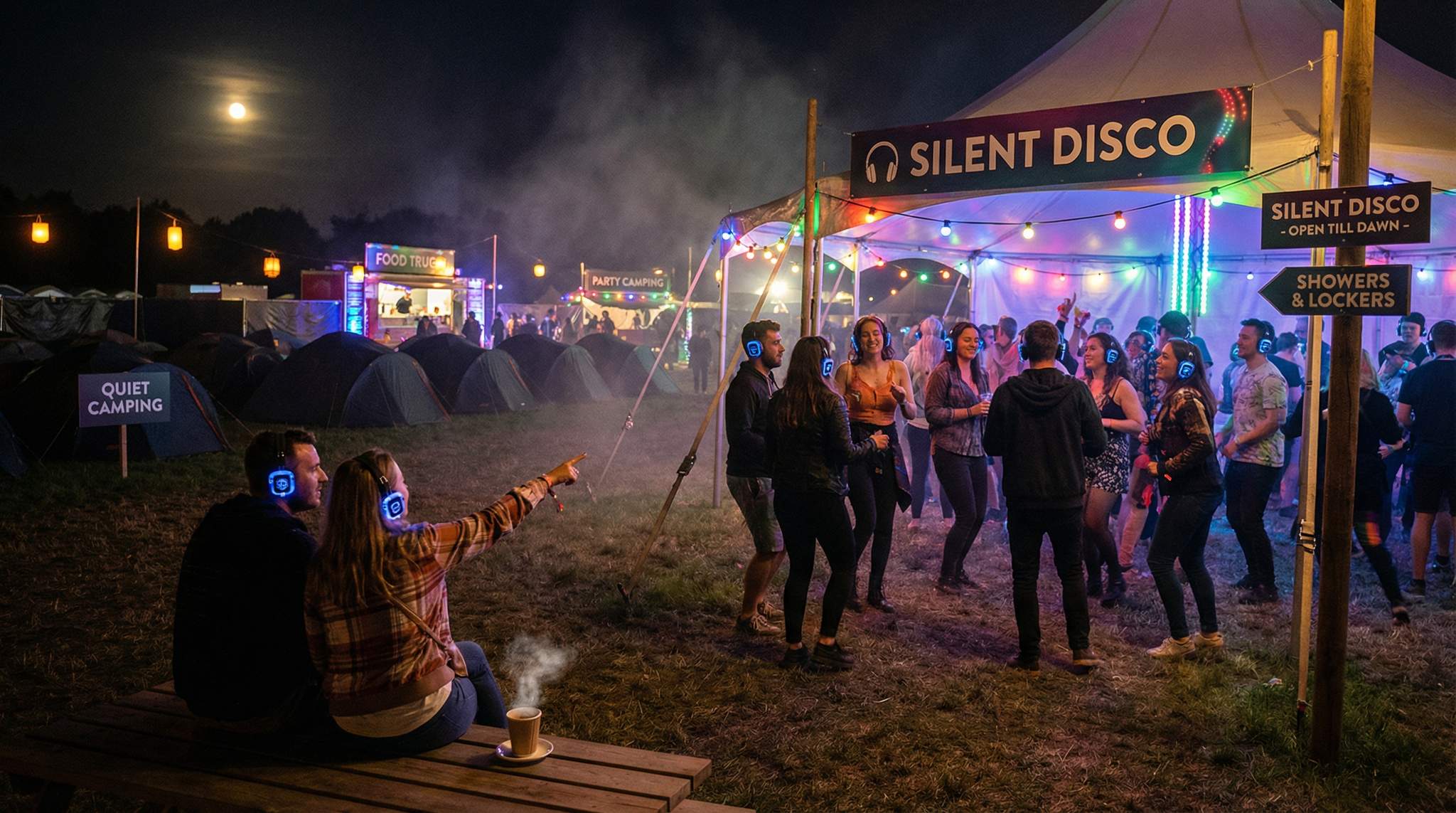
- Quiet Entertainment: If you want to offer music in the wee hours without breaching noise curfews, think about a silent disco or headphone party. This way, those who want to dance till dawn can tune in, while those trying to sleep nearby hear only minimal noise. Silent discos have become popular at festivals in noise-sensitive locations – from urban festivals in Singapore to forest gatherings in the U.S. – as a creative solution to keep the music going past curfew.
When designing late-night amenities, position them carefully. They should be outside the main arena (so you don’t need to keep large stages open) but still far enough from official “quiet” camps. A central location within the camping area, or a corner of the site that’s naturally insulated (by trees, hills, or even sound berms), works well. Also ensure you provide seating, lighting, and waste bins there – a functional late-night area means people are less likely to wander through dark campsites looking for fun (or trouble).
Turn Fans Into Your Marketing Team
Ticket Fairy's built-in referral rewards system incentivizes attendees to share your event, delivering 15-25% sales boosts and 30x ROI vs paid ads.
Facilities for Comfort: Showers, Lockers, and Charging Stations
A comfortable camper is a happy camper – and at an electronic festival, attendees truly appreciate infrastructure that keeps them refreshed and their valuables safe. Key facilities like showers, secure lockers, and phone-charging stations can make the difference between a miserable camping experience and a great one. However, these amenities must be planned with sufficient capacity and smart placement; otherwise, long lines and bottlenecks can create new problems (nobody wants a line of people waiting for showers blocking an emergency access road!).
Showers: Providing a way for people to clean up each day is especially important at multi-day summer events or dusty locations. Calculate your expected camper-to-shower ratio and err on the side of more showers, even if they’re simple portable shower trailers. Distribute shower facilities in multiple locations around the campground if possible – this decentralization prevents one huge queue. For instance, Glastonbury Festival (UK), which sees over 200,000 attendees, places several shower blocks around its vast campsites and even partners with charities to run some shower stations. If water supply is limited, consider scheduling: some festivals post peak usage times and encourage off-peak showers, or offer cold water rinse stations as quick alternatives.
Need Festival Funding?
Get the capital you need to book headliners, secure venues, and scale your festival production.
- Tip: Locate shower units so that any inevitable lines form inside a fenced area or along a less-trafficked path. Lines should not snake into roads or major walkways. Use barriers or staff during busy morning hours to organize queues and keep them orderly. Also, provide some lighting and maybe a canopy at shower queues – if people line up before dawn to beat the rush, they feel safer and more comfortable waiting in a well-lit, sheltered area.
Lockers: Festival campers often worry about the security of their belongings when they’re off at the stages. Offering lockers for rent is a great way to give peace of mind. Place locker banks near major campground entrances or info points, not too far from where people camp (they should be convenient, but you might avoid putting them inside a dense camping area to prevent noise/clutter). Make sure the locker area is supervised or routinely patrolled, and that it’s illuminated at night. If feasible, having more than one locker location (e.g., one by each major gate, or one in general camping and one in glamping) can reduce crowding. Remember to advertise locker availability beforehand through your ticketing platform – attendees will reserve them eagerly if they know about it.
Phone-Charging Stations: In the era of smartphones, keeping devices charged is crucial – for cameras, communication, and digital tickets or payment apps. You can approach charging in a few ways:
- Provide free charging zones where people can plug into outlets or USB hubs (this requires running generators or grid power, and staff oversight).
- Offer portable battery rentals or swaps (a growing trend at festivals worldwide). Attendees either rent a high-capacity battery pack or pay a small fee to swap their depleted battery for a charged one.
- Encourage campers to use solar chargers or bring their own battery packs, but still offer charging for those in need.
Whichever method, plan enough capacity. If using charging stations, have multiple locations or a large enough tent with dozens of outlets. Queues for charging should be managed so they don’t block foot paths; for example, set up a roped line system inside a charging tent or use an SMS-based waitlist. Some festivals also integrate charging with lockers – a locker with a built-in USB port kills two birds with one stone (security and power). Ultimately, a well-charged attendee is more likely to use your festival app, share photos (free promotion!), and feel secure in an emergency, so this amenity indirectly benefits the event’s success.
Glamping Done Right: Luxury Camping Without the Letdown
In recent years, glamping – glamorous camping – has become a popular offering at festivals worldwide, including electronic music events from California to Goa. Festival producers provide pre-pitched tents, boutique tipis, or even deluxe cabins for attendees willing to pay a premium for comfort. To make glamping successful, it’s crucial to deliver on expectations and provide a hassle-free experience that justifies the higher price:
- Dedicated Glamping Zones: Situate the glamping area slightly apart from the loudest general camps. Glamping guests typically expect a calmer environment (and they’re often among an event’s older or VIP attendees). Many festivals create a separate “boutique camping” enclave with its own fencing and entrance. This not only grants exclusivity but also makes it easier to offer tailored services (and to secure the area).
- Enhanced Amenities: Glamping should come with perks. Common upgrades include real beds or cots, electricity (or charging outlets) in tents, private or less crowded showers and flush toilets, a lounge tent or community marquee, and 24-hour reception/concierge service. For example, at Parookaville in Germany, the glamping packages include free showers, chill-out areas, and even wellness options, ensuring it doesn’t stop being glamorous even in a field. Similarly, festivals in the UK and Australia with boutique camping often provide morning coffee/breakfast for glampers and shaded relaxation spaces away from the masses.
- Check-In & Info: Have a smooth check-in process exclusively for glamping guests so they don’t wait in the general line. Staff or signage should be available to escort them to their tent and explain the amenities. Providing an info sheet or even a welcome pack (bottled water, earplugs, a map of the glamp site) adds a nice touch.
- Security and Access: Because glamping areas can contain higher-value items (nicer tents, personal belongings, maybe even onsite lockers in tents), keep security tight. Issue special wristbands for glamping and station security or support staff at the glamping entrance at all times. A friendly concierge desk can double as security – glampers will appreciate knowing staff are always nearby.
- Don’t Overpromise: Perhaps the biggest rule in glamping is to set realistic expectations and meet them. The infamous Fyre Festival in 2017 stands as a warning – it marketed ultra-luxury villas and catered meals but delivered disaster-relief tents and cheese sandwiches, a failure documented extensively by Time Magazine. Attendees were furious at the gap between the promise and reality. While few festivals would fail as spectacularly, even small disappointments (like not enough showers or flimsy tent quality for VIP prices) can generate bad press and unhappy customers. It’s far better to over-deliver small surprises than to have disgruntled glampers. If you promise air-conditioned tents, make sure the AC units and power supply are truly capable in the expected weather. If you advertise “luxury bathrooms,” ensure they are clean, regularly serviced trailer units or better.
When done right, glamping can be a win-win: attendees enjoy comfort and exclusivity, and festivals benefit from additional revenue and a prestige boost. Just remember that glamping guests are likely to be vocal about their experience – treat them as an investment in word-of-mouth marketing. A deluxe experience can turn those attendees into your festival’s biggest ambassadors.
Nighttime Wayfinding and Lighting
When darkness falls on a sprawling festival campground, finding one’s tent (or the nearest toilet) can become an adventure of its own. Good nighttime wayfinding is essential for safety and camper comfort. This means thinking about lighting, signage, and even creative markers to help people navigate the site after sunset.
Start with a solid lighting plan for the campground paths and key areas. Tower lights or string lights can illuminate main walkways, but be mindful of light pollution in quiet sleeping zones. A common approach is to have low-level lighting along paths (such as solar stake lights or LED ropes on the ground) which provide guidance without flooding someone’s tent with bright light. Important nodes – restroom areas, showers, info booths, medical tents, and security posts – should be well-lit and clearly marked by signs that are visible at night (consider reflective paint or battery-powered illuminated signs).
Signage and Landmarks: In daylight, colored banners or flags can denote different sections of the campsite; at night, you might use color-changing LED beacons or inflatable lit towers as landmarks. Number or name the campground sections in a logical way (for example, sectors A, B, C or themed names), and ensure every tent row has some identifier. Festivals with massive campgrounds like Tomorrowland or Germany’s Parookaville create a mini-map of their “camping city,” assigning street names or neighborhood titles to various areas. Handing out these maps to campers and posting large “You Are Here” boards near entrances can save a lot of wandering confusion at 3 AM.
Modern tech can help too: many festivals’ mobile apps now allow attendees to drop a GPS pin for their tent location or use augmented reality to navigate back to their campsite. However, never rely solely on technology – phone batteries die (hence your charging stations come into play), and not everyone will use the app. Physical wayfinding aids are a must. Consider these extra touches:
- Use reflective tape to mark the edges of common paths or guide wires (so people don’t trip on tent ropes in the dark).
- Encourage or distribute inexpensive LED string lights for campers to decorate their tents – this not only looks festive but helps individuals recognize their spot. Some events do contests for “best lit campsite” to incentivize this!
- Setup a few reference beacons that are tall or unique (a balloon light, an art installation, a high-flying flag) that are visible from multiple campground angles. People will say “meet by the giant glowing totem” which aids orientation.
Finally, ensure maps and directional info are part of your communications. A first-timer at a festival in a foreign country might not speak the local language, so use universal symbols on signs (e.g., tent icon for camping sections, flashlight icon for info booth at night, etc.). With proper wayfinding, even a huge campground can feel navigable and less intimidating after dark.
Neighborhood-Style Security and Safety
A campsite housing thousands of excited festival attendees can feel like a city that never sleeps – which means you need a security strategy akin to a community policing or neighborhood watch approach. Instead of concentrating security only at the front gate, it’s vital to have a distributed, friendly security presence throughout the camping areas, day and night.
“Neighborhood” Security Teams: Divide the campground into sectors (by geography or zone type) and assign specific security teams or staff to each. This way, they become familiar faces in that “neighborhood” and campers know where to find help quickly. For example, one team might patrol the quiet camp sections, ensuring noise rules are respected and checking on any medical or safety concerns among sleepers. Another team can focus on the lively camp areas, diffusing any rowdiness before it escalates and keeping an eye out for unauthorized sound systems or open fires. This focused approach often works better than random patrols, because the security personnel build rapport with campers and can spot unusual activity more readily.
Training and Approachability: The best festival security in campgrounds often act more like guides and helpers than enforcers (until truly needed). Train your security staff and volunteers to be approachable, to give directions, and to assist people who may be disoriented or in distress. A festival in Mexico or India might have a very diverse international crowd, so ensure you have some multilingual staff or at least printed info in multiple languages at security tents. A well-run security team also coordinates with medical services – for instance, patrolling medics or on-call EMTs can join the neighborhood teams so that response to any incident (like an injury in a tent, or someone overdoing substances) is swift.
Access Control: Good campground security also means controlling who enters the camping area. Use wristbands or RFID passes that distinguish campers from day-ticket holders, and have checkpoints at campground entrances staffed 24/7. This keeps out anyone who doesn’t belong, reducing thefts and unwelcome visitors. Some festivals even create a secondary perimeter around glamping or family areas with additional checks, since those guests expect a higher level of security and privacy.
Community Watch & Amenities: Beyond hired security, consider ways to involve the community of campers in safety. Large festivals in Europe like Poland’s Pol’and’Rock (formerly Woodstock Poland) have volunteer patrols (“Peace Patrol”) working alongside official security to help attendees. While you may not formalize that, you can foster a neighborly mindset by encouraging campers to look out for one another. Provide an easy way for attendees to contact security (an emergency number, or texting system, or flag-down points). Also, having small “Info Kiosks” or help desks in different campground sectors can make security more accessible — these could be just small tents with a couple of staff available to answer questions or summon assistance.
Lastly, nighttime security deserves special attention. Increase patrol frequency in the early morning hours when people are most vulnerable (asleep or intoxicated) and visibility is low. Ensure that your security teams use appropriate lighting (flashlights, headlamps) but also maintain some stealth to not wake everyone up. The concept of “neighborhood-style” means they are present but not overbearing — a reassuring sight at 4 AM for someone walking back to their tent, but not a source of intimidation. By cultivating a safe atmosphere in the campgrounds, you help festival-goers feel at ease, which enhances their overall festival experience and willingness to return next year.
Frequently Asked Questions
How can electronic music festivals manage noise in camping areas?
Organizers create distinct zones like party and quiet camping areas separated by distance, open buffers, or natural barriers. Ticket platforms allow attendees to self-select their preferred zone in advance, while clear signage and maps label these areas on-site. This separation ensures night owls and those valuing sleep are situated in appropriate environments.
Why do festivals enforce generator curfews in camping zones?
Festivals enforce generator curfews to reduce constant engine noise and fumes that disturb sleeping campers during quiet hours. Strict policies often ban personal generators after specific times, such as 2:00 AM, or require battery-inverter models. Some events ban them entirely to eliminate fire hazards and ensure a peaceful environment for recovery.
What late-night amenities keep festival campers entertained after main stages close?
Organizers provide after-hours areas outside the main arena featuring low-volume entertainment like silent discos or chill-out tents. Essential services such as 24-hour food trucks, communal kitchens, and warm drink stations allow revelers to socialize and decompress without disturbing designated quiet zones or wandering through dark campsites looking for trouble.
What amenities are typically included in festival glamping packages?
Glamping packages offer enhanced comfort through pre-pitched tents or cabins equipped with real beds, electricity, and private access to less crowded showers and flush toilets. Dedicated zones often feature 24-hour concierge service, exclusive lounge areas, and separate check-in processes to ensure a hassle-free, premium experience for attendees willing to pay extra.
How can festivals improve nighttime wayfinding in large campgrounds?
Effective nighttime wayfinding utilizes low-level lighting along paths and distinct landmarks like LED beacons or inflatable towers to guide campers. Numbered sectors with street names, large maps, and reflective tape on walkways help attendees navigate safely. Mobile apps with GPS pins also assist in locating tents in the dark without relying solely on memory.
How does neighborhood-style security work in festival campgrounds?
Neighborhood-style security divides campgrounds into specific sectors with dedicated teams assigned to each zone. This approach allows staff to build rapport with campers, manage noise levels in quiet areas, and respond quickly to medical issues. It creates a distributed, friendly presence throughout the site rather than concentrating enforcement solely at the main gates.