Planning a festival means planning for the unexpected. From surprise weather disasters to sudden venue issues or health crises, even the best-laid festival plans can be upended overnight. Postponing an event – instead of canceling outright – can be a smart lifeline if handled correctly. It allows the show to go on at a later date, preserving your ticket revenue and fans’ anticipation. But rescheduling a festival is a high-wire act: communicate poorly or fumble the logistics, and you risk eroding hard-won trust “overnight” by navigating last-minute cancellations and postponements. This playbook draws on veteran producers’ wisdom to show how to postpone with minimal fallout – keeping fans on board, finances stable, and your festival’s reputation intact.
Deciding to Postpone: Safety, Reputation, and Timing
When faced with a major disruption, festival organizers must swiftly decide: postpone or cancel? Safety comes first – if conditions jeopardize attendee or crew wellbeing, the show cannot go on as planned. Seasoned producers have pre-defined triggers for such scenarios (e.g. lightning within X miles, flood alerts) and know who has authority to make the call regarding festival cancellation and refund protocols. For example, if a hurricane is forecast or a government order bans large gatherings, postponement may be the only responsible choice. The key is making the call early – delays in decision-making can shrink your options and undermine public confidence.
Real-World Scenario: In September 2023, days of severe rain flooded the grounds of South Africa’s Rocking the Daisies festival. Rather than risk a quagmire, organizers announced a six-week postponement to November, citing “devastating floods” and an unsafe site, as reported when Rocking the Daisies was postponed to November. By acting decisively during their build phase, they put safety first and preserved the event rather than canceling it outright.
Understanding the exact threshold where a delay is no longer viable is critical. While pushing dates back is preferable, a complete festival cancellation becomes unavoidable when site infrastructure is irreparably damaged or local authorities revoke permits for the season. Promoters must weigh the sunk costs of a canceled event against the brand damage of hosting a compromised, unsafe gathering. Having a clear matrix for when to pull the plug entirely protects your organization from escalating liabilities.
Keep Tickets in Fans' Hands
Our secure resale marketplace lets attendees exchange tickets at face value, eliminating scalping while keeping you in control of the secondary market.
Beyond safety, weigh financial and reputational factors. Postponing can save your festival from total financial loss – you get to keep ticket revenue (assuming fans hold onto tickets) and avoid writing off months of planning. It also signals to fans and sponsors that the festival will happen, just later. However, postponement isn’t pain-free. It brings added costs (extended rentals, rebooking fees) and potential refund requests. Consider whether key components – venue, headliners, essential vendors – are likely available on a future date. If not, a postponement might lead to a watered-down event. Also, assess fan sentiment: will your audience support a new date or have many made immovable travel plans? Remember that a last-minute change “puts your brand relationship on the line”—a poorly handled cancellation can blow up your brand – fans have arranged travel, time off, and hyped themselves up. Canceling on them late could erode years of goodwill if mishandled. Thus, if you can safely execute a quality festival on a new date, postponement is often worth the effort. But if the core experience would be irreparably compromised, sometimes cancellation (with full refunds and a fresh start next year) may be the lesser of two evils.
When evaluating your options, it helps to categorize common show postponement reasons to justify the move to stakeholders. Typical drivers include severe weather threats, sudden venue structural failures, or the unexpected loss of a headliner. In some cases, the postponement of a musical group’s second performance during a multi-weekend festival might be required due to illness or travel logistics, forcing organizers to shift schedules rather than execute a full festival cancellation. Documenting these specific drivers ensures your insurance claims and public messaging remain consistent.
When communicating any reason for event rescheduling to your partners, clarity is paramount. Whether the delay stems from a sudden loss of site access, a severe public health directive, or critical supply chain failures, documenting the exact reasons for event rescheduling protects your organization legally. Promoters should maintain a detailed log of the conditions that forced the change, as this documentation will be scrutinized by insurers, venue operators, and local permitting agencies when negotiating contract rollovers.
Establishing a definitive live event postponement reason early in the crisis management process is essential for aligning your team. When multiple factors contribute to the delay, pinpointing the primary driver—such as a compromised main stage structure versus general bad weather—helps tailor your public messaging. Furthermore, tracking secondary event postponement reasons allows producers to build better risk assessment models for future festival editions, ensuring that similar vulnerabilities are mitigated before they threaten another show.
Safety and Stakeholder Consensus
Ultimately, the decision to postpone should be made in consultation with safety officials, venue management, and other key stakeholders. If weather is the issue, look to objective data (forecast severity, on-site conditions) and predefined thresholds. Public authorities or permitting agencies might even mandate your event not proceed under certain conditions. It’s crucial to involve them early – if you proactively raise concerns and propose postponement for safety, regulators will see you as a responsible operator rather than forcing your hand last-minute. Additionally, loop in your production heads and security team; they can provide ground-level insight on whether mitigation (e.g. delaying a day or adjusting programming) is possible or if a full date move is necessary. Once there’s consensus that proceeding as planned isn’t feasible, commit to the postponement and pivot everyone’s efforts toward the new plan. Industry veterans note that when disaster looms, “don’t delay tough decisions” – calling a halt or date change early, rather than hoping problems resolve, gives you more time to execute Plan B and protect your event when things go wrong.
Securing a New Date and Venue Logistics
Rescheduling a festival is like solving a multidimensional puzzle under pressure. Your first move after deciding to postpone is to lock in the new dates and confirm your critical components can align. Start with the venue: can the site accommodate your festival on the proposed new dates? If it’s an outdoor space or park, check local calendars for conflicts (another event, local holidays, farming schedules, etc.). For built venues or fairgrounds, coordinate with the venue owner for availability. Many contracts have clauses covering a “postponement date” – some venues will agree to offer the next comparable opening at no extra rental fee if force majeure strikes, a key component of festival force majeure clauses. (If your contract doesn’t, now’s the time to negotiate, appealing to your venue partner to roll over your deposit to the new date.) Have a backup date (or two) in mind as well, in case your first choice isn’t workable.
Next, line up your headliners and artists. Immediately reach out to artists’ agents with the tentative new date before you announce it publicly. You need to know who from your lineup is available. Ideally, you’ll reschedule with the same lineup – consistent talent keeps ticket holders satisfied. In reality, some artists may have conflicts. Prioritize your headliners and most popular acts; if even a few can’t do the new date, consider whether you can replace them with equal-caliber names (and get those replacements penciled in early). Communicate to agents that the postponement is due to uncontrollable circumstances and that you value their artist’s participation on the new date. Many artist contracts treat a weather or crisis postponement like a cancellation, meaning artists keep any deposit and have no obligation to play the rescheduled show unless a new deal is struck regarding rescheduling and obligation to perform. This is where negotiation and goodwill come in: ask if they’ll honor the booking on the new date for the same fee (most will if available, as it means an easy rebook rather than a lost gig). Be prepared that some might require an additional hold date or slight fee increase, especially if the postponement is far out – that’s often cheaper than canceling and contracting a brand-new artist.
Simultaneously, coordinate with key vendors and crew. Your staging, lighting, sound, and power providers are mission-critical – reach out within hours of the postponement decision to see if they can accommodate the new timeline. It’s possible some vendors have another client that weekend; if so, you may need to find substitutes quickly (perhaps your backup choices from initial planning). Prioritize anything that involves long lead times or heavy infrastructure (stage scaffolding, generators, fencing). If you anticipate a months-long delay, discuss storage of equipment or decor that was already delivered to the site – some suppliers might charge warehousing fees for holding gear until the new date. Also talk to your staff and volunteers: key team members should be informed privately as soon as you decide to postpone, so they don’t hear it in the press. Gauge their availability for the new dates and start adjusting staff schedules accordingly. It’s wise to preserve your core production team through the delay (if budget allows) so you’re not hiring and training a new crew from scratch.
Planning a Festival?
Ticket Fairy's festival ticketing platform handles multi-day passes, RFID wristbands, and complex festival operations.
Engaging Stakeholders and Authorities
Don’t overlook permits and local authorities in the rush to reschedule. Notify your permitting office or any authorities (health department, city council, police, fire) about the date change as soon as you have a tentative plan. Usually permits can be amended for a new date rather than refiled from scratch, but there may be paperwork to update. Make sure emergency services and contractors like medical teams or traffic control can adjust their schedules too. Many regions require formal sign-off on any significant event change; by keeping officials in the loop you show professionalism and ensure continued support. In some jurisdictions, event cancellation insurance or contingency plans are mandated for permits, so understanding insurance contracts for winter festival risks is vital – if that applies, involve your insurer early (more on insurance below).
Open communication with sponsors and partners at this stage as well. Major sponsors should get a phone call from you or your sponsorship manager explaining the situation and emphasizing that the festival will happen at the later date. Most sponsors will understand that postponements can happen (especially due to weather or global events) and will stay on board as long as you keep delivering value. Be prepared to adjust sponsor deliverables to the new timeline – for instance, promotions that were timed to go live during the original dates will need rescheduling. Reassure partners by sharing your plan to keep fan excitement high during the interim (so their branding still gets exposure). You might even offer a little extra value to sponsors for their flexibility – e.g. additional VIP perks or more on-site branding when the festival happens – as a goodwill gesture that can pay dividends in long-term loyalty.
Finally, as you juggle all these pieces, document the new plan. Build an updated production timeline counting down to the new date, including load-in schedules, new deadlines for orders, and revised promotion calendars. Treat it like a reboot of your festival project – essentially, you’re running a mini-edition of your planning phase condensed to the weeks or months before the new show. A delay can actually be put to good use: address any weaknesses from your initial timeline. (Were you rushing certain preparations? Now you have a second chance to do them right.) Stay organized with frequent team check-ins so nothing falls through the cracks in the shuffle. Veteran festival PMs advise remapping your critical path and “locking in new drop-dead dates” for every must-have task to get your festival planning back on track and avoid postponing the event further – treating the postponement period as tightly as the original schedule.
Communication Strategy: Announcing the Change
Once the logistics are lining up, the most public part of your postponement playbook begins: communicating the date change to ticket buyers, media, and the world. How you announce and message the postponement will make all the difference in preserving fan goodwill. The goals: transparency, empathy, and speed. Attendees should hear the news from you first – not via rumor or a third-party. That means the announcement needs to go out promptly across all major channels as soon as you’ve finalized the basics (new date and at least a rough promise of refund options). Aim to break the news no later than 24 hours after making the decision (sooner if the festival was imminent). Many top festivals keep a pre-drafted postponement announcement template on hand for various scenarios, so they can plug in specifics and publish quickly.
Free Tool: Will the Money Be There in Time?
Map your deposits and balances against when ticket money reaches you. See your lowest balance and how much you need to find before it arrives.
Notifying Ticket Holders with Transparency
Your core message should answer the crucial questions upfront: why the event is postponed, when it will now take place, and what options ticket holders have. Be clear and factual about the reason – whether it’s severe weather, a safety issue, or something like a national emergency. Fans appreciate honesty; vague or evasive language breeds frustration and rumors. For example, one New Zealand festival’s organizers put it plainly in their announcement: “From site flooding, to high winds… we are unable to safely and logistically deliver [the event]” as noted by the New Zealand Events Association. Explaining the why shows attendees you’re acting in their interest (safety) and not postponing on a whim.
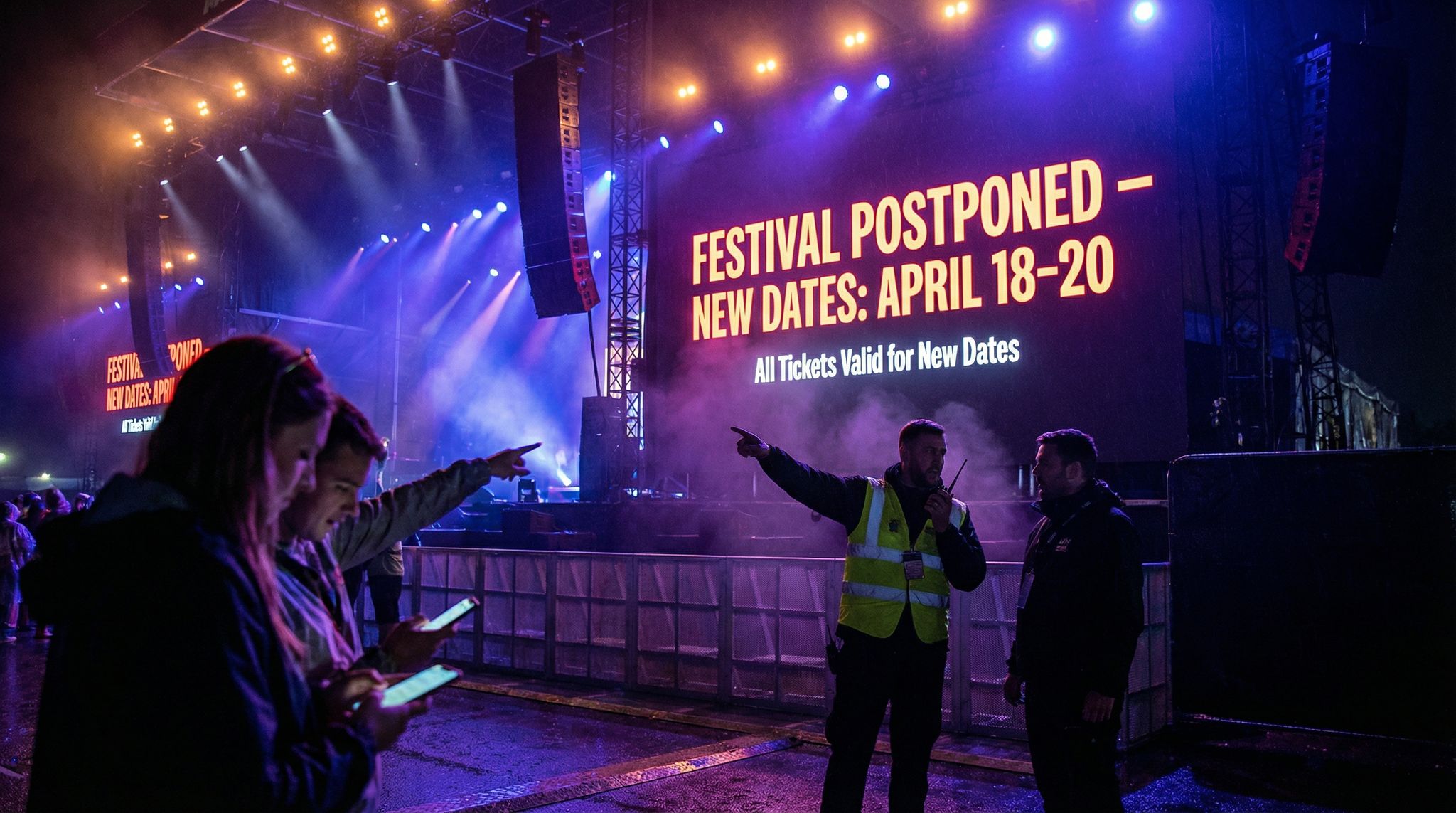
Crafting a formal event postponement announcement requires balancing legal clarity with brand empathy. A well-structured notice should serve as the definitive source of truth, preventing rumors from filling the void. Whether you are dealing with a complete site shutdown or just the postponement of a musical group’s second appearance, your announcement must immediately clarify which dates are affected, which tickets remain valid, and where fans can find ongoing updates.
Need Festival Funding?
Get the capital you need to book headliners, secure venues, and scale your festival production.
Next, hit the when: state the new dates (or if still to be determined, say so and promise updates soon). If the venue or city changes, include that too. Highlight that all tickets will be honored for the new date – this assures fans their purchase is still valid. In 2020 when Coachella was first postponed, organizers immediately announced the new weekend dates and that “All 2020 passes will be honored in 2021,” as reported when Coachella issued a statement about the 2020 cancellation. This kind of clarity helps quell anxieties. In your announcement, directly address the ticket options: tell fans if they don’t want or can’t attend the rescheduled event, what should they do. Common wording might be: “Your current tickets will be valid for the new dates. If you are unable to attend, you may request a full refund by [process]before [deadline].” (We’ll cover refund logistics in the next section.) By providing specific instructions in the initial announcement, you reduce the flood of questions coming your way.
Choose your communication channels deliberately. Blast the news everywhere your attendees would look: an email to all ticket buyers, announcements on all social media profiles, a prominent notice on your official website, and app push notifications if available. The New Zealand Events Association advises using every medium at hand and even getting your artists and suppliers to amplify the message. A unified message across platforms prevents confusion. Make sure the info is consistent in every post – conflicting details or typos (like the wrong rescheduled date) will create chaos. Many festivals pin the announcement post to the top of their profiles and update their website homepage with a banner about the postponement. This way, anyone searching for your event sees the update immediately.
Tone matters: be empathetic, not just factual. A postponement is disappointing for fans; acknowledge that. Express that you share their disappointment and did not make this decision lightly. For instance, veteran promoters stress using an honest, human tone – “Acknowledge fan disappointment and show you care” as part of crisis marketing strategies to save your event. A sentence in your announcement like “We know how excited you all were for this event, and we’re so sorry to have to wait a little longer” goes a long way to soften hearts. Avoid a cold corporate tone or, worse, sounding defensive. If applicable, reassure fans with a silver lining – e.g. “We promise the festival in [month]will be worth the wait, and we’re working on some special additions to thank you for your understanding.” This hints that you might make the next event even better (only say this if you do plan some sort of bonus or improvement).
Finally, anticipate questions and answer them proactively. In the announcement or an attached FAQ, cover things like: Will the lineup remain the same? What if I can’t attend the new date? How do refunds work? What about travel packages or accommodations? The more specifics you provide, the fewer individual inquiries you’ll receive. Attendees will want to know you’ve thought of their situation. According to event industry guidance, “the more specific you are, the less questions will come flying back” at you, a key tip from the New Zealand Events Association. If your festival has an app or a text alert system, use it for a concise update linking to the full details on your site – this ensures even on-site campers or those not checking email get the message.
Free Tool: When Should You Announce?
Pick your event date and genre — the free planner outputs a recommended announce, presale, on-sale and reminder schedule anchored to how your audience actually buys.
Pro Tip: If your ticketing platform supports it, utilize built-in communication tools for speed. For example, Ticket Fairy’s system allows festival organizers to send an instant email blast and push notification to all ticket holders as soon as a major update hits. Leveraging such tools can reach everyone in minutes, avoiding delays or missed posts. Many festivals also coordinate with media outlets – sending a press release or directly informing local news – so that the news is broadcast widely and accurately. The narrative should be you postponing for good reasons, not rumor mills suggesting the festival “might be canceled.” By owning the message swiftly, you’ll maintain control of the story and project professionalism.
Aligning with Artists, Crew, and Sponsors
While ticket holders are the most visible audience, don’t neglect communication with your internal and industry stakeholders. Artists and their teams should get a personal reach-out (agent or manager) before you go public, if possible. It’s discourteous for an artist to learn the festival they’re booked at moved dates via Instagram! Coordinate with them on announcing their participation for the new date – some may happily post, “We’ll see you in [new month]!” which reinforces your message to fans. Provide your crew, staff, and volunteers with a clear update and any instructions on next steps (like revised call times or new training dates). Keep your tone appreciative – thank them for their flexibility and emphasize that their safety or the attendees’ safety was paramount in this decision.
Sponsors and business partners (food vendors, marketplace sellers, etc.) should receive a professional but reassuring notice. Send an email or call major partners outlining: the reason for postponement, the new event date, confirmation that their agreements will carry over, and any changes in deliverables or schedules. Much like with fans, honesty and proactiveness are key. If you expect any logistical challenges (say, a sponsor’s activation was date-specific), address it and propose solutions. Most partners will be understanding as long as you keep them in the loop. You might even publicly thank sponsors in your communications for “standing by us” – showing fans that your community of partners is united can bolster overall confidence.
Importantly, monitor the public response after your announcement. Be ready on social media and customer support channels to field replies. Pinpoint common concerns (for example, people asking “What if I can’t make the new date?” or “How do I get my refund?”) and have templated friendly answers ready. If misinformation starts spreading (“I heard the festival is canceled!”), quickly correct it with the facts (“We’re NOT canceled, just moved to September 10th – all tickets valid”). In the age of instantaneous online chatter, catching and addressing fan concerns in real time is part of your crisis comms. Some organizers even hold a brief live Q&A on Instagram or Facebook after a postponement announcement, to directly reassure fans. Listening and responding shows that you care and helps maintain trust. As one industry analysis noted, with social media amplifying reactions, how you respond in hours or even minutes can define whether you’re seen as a hero or a cautionary tale when navigating last-minute cancellations and postponements.
Managing Tickets: Rollovers, Refunds & Goodwill
One of the most delicate aspects of a postponement is handling ticket holders’ money. Fans have essentially given you an interest-free loan by buying tickets in advance – now you’re asking them to keep that money with you for a longer period and change their plans. Managing this well will determine if you “lose fans or funds.” The good news: if you execute properly, you shouldn’t lose much of either. Many fans will hold onto their tickets for the new date, especially if the lineup is preserved and they trust the event. Industry reports from the pandemic era showed a large majority of ticket buyers kept tickets for rescheduled shows rather than requesting refunds, partly out of loyalty and anticipation. Major promoters even cited the “loyalty of people who held their tickets for years” as a reason to reward fans and not exploit them, according to IQ Magazine’s report on the big return to the fields. Your job is to make honoring tickets easy, offer fair refunds where needed, and maybe throw in some appreciation for the supporters who stick with you.
Default action – tickets stay valid: In almost all cases, you’ll want to automatically transfer all existing tickets to the new date. Announce clearly that current tickets (and add-ons like camping or parking passes) will be honored. This assures fans they don’t have to do anything extra if they still plan to attend. Your ticketing provider can typically adjust the event date in their system so that the barcodes/QR codes remain the same for the new date, or reissue updated e-tickets. (Using a modern festival ticketing platform like Ticket Fairy makes this seamless – the event date change propagates to all tickets, and attendees can even add the new date to their digital wallets.) Make sure your FAQ confirms that ticket buyers will not need to reconfirm or pick up new tickets – reducing unnecessary support tickets.
When executing a fast ticket postponed status update, speed and system flexibility are paramount. Organizers need a ticketing platform that allows them to quickly change the event date globally while giving attendees self-service options. By establishing a clear rescheduling policy, you can enable ticket holders to log into their accounts, view their bookings dashboard, and easily select the event to edit their attendance status—whether that means confirming their rollover, transferring the pass to a friend, or initiating a refund request. Empowering fans with these self-serve tools drastically reduces the customer support load on your team.
To further streamline operations during a major schedule shift, organizers should configure their ticketing platform to handle high-volume changes automatically. By directing attendees to a centralized portal where they can manage their own reservations—allowing them to view their bookings, select the affected event, and edit their ticket status—you drastically reduce the burden on your customer service team. A robust cancellation and rescheduling policy, clearly linked within this portal, ensures fans understand their options before they finalize their choice.
For organizers running multi-weekend series or recurring outdoor events, a common challenge is figuring out how to manage outdoor program registrations when weather keeps canceling sessions. If you are dealing with a season plagued by rainouts, the administrative burden of manually moving attendees can become overwhelming. The most effective strategy is to implement a flexible, season-long pass system or a self-serve transfer architecture. When attendees can easily log in, navigate to their bookings, select the specific rained-out event, and edit their attendance to a future makeup date, you eliminate the friction of manual rebooking. This automated rollover approach prevents your box office from drowning in emails while giving attendees the autonomy to choose a session that fits their schedule.
Offering refunds (the right way): Despite many fans hanging on to tickets, you should always offer a refund option. For both ethical and PR reasons, it’s wise to honor refund requests for those who truly can’t make the new dates. (Note: Check your terms and conditions or local consumer laws – in some places, you may be legally required to refund if an event is postponed beyond a certain timeframe or if the date change is significant.) Even if not required, offering refunds is a goodwill investment. As one festival legal guide notes, even if force majeure clauses let you off the hook, offering refunds or credits shows goodwill. Determine a reasonable refund window – commonly a 7- or 14-day period – during which ticket holders can claim a full refund if they can’t attend the rescheduled show. Communicate this window loudly and clearly in your announcement and follow-up emails. For example, Rocking the Daisies 2023 rolled all tickets over to the new date and then opened a refund window via their ticketing partner from Oct 3–6 after Rocking the Daisies was postponed to November. The limited window creates urgency so you’re not dealing with refund requests indefinitely.
Process refunds as efficiently as possible. Ideally, automate it: provide a direct link or form for ticket holders to initiate their refund (many ticketing platforms can email unique links to each buyer). If you’re using Ticket Fairy, the platform can handle refunds in bulk for you – deducting the refunded tickets from your payout and releasing those tickets back into inventory if you choose. Note that offering refunds will mean an immediate cash outflow. Be prepared for that in your budget (more on finance in a moment). Track how many people actually request refunds versus keep their tickets. If you see a very high refund rate, it might indicate issues (e.g. new date is unpopular or conflicts with something big) that you need to address with extra marketing or communication.
Setting clear expectations around the timeline for returning funds is critical to minimizing customer support tickets. When communicating with attendees, it can be helpful to draw parallels to familiar financial processes—for instance, reminding them that while most taxpayers get refunds within 21 days of filing, but dates vary, ticket reimbursements follow a similar banking timeline. Let fans know that while you will process requests immediately at the end of the refund window, bank processing times mean it could take several weeks for the money to actually appear in their accounts.
Boost Revenue With Smart Upsells
Sell merchandise, VIP upgrades, parking passes, and add-ons during checkout and via post-purchase emails. Increase average order value by up to 220%.
Encourage rollovers and reward loyalty: To minimize refunds, reassure fans that the event on the new date will be just as good or better. If possible, announce any added value you’ll provide. Maybe you secured an extra performer, or you’ll throw in a free merchandise item or drink voucher for all original ticket holders as a thank-you for sticking with the festival. These gestures can sway fence-sitters to hold onto their tickets. Some festivals have offered small loyalty discounts on next year’s tickets for those who didn’t refund this year, framing it as a perk for their most dedicated fans. Be creative but also realistic with what you can afford.
Another strategy for those who can’t attend: facilitate ticket transfers or resale. Not everyone will be free on the new date, but they might be happy to transfer their ticket to a friend or sell it to another fan rather than get a refund. Providing an official, safe way to do this keeps money in your ecosystem and fans happy. For example, allow ticket name changes or offer a face-value resale platform. Ticket Fairy’s system, for instance, includes a fan-to-fan resale feature that lets ticket holders list their tickets for face value to approved buyers, ensuring secure transfers and preventing scalping. In fact, experienced organizers suggest “when outright refunds aren’t viable, facilitate fan-to-fan ticket resale so unhappy fans can safely recoup their cost” as a crisis marketing strategy to save your event. This way, you retain the sale (the new buyer takes the ticket) and the original fan isn’t left out of pocket.
Below is a quick overview of ticket-holder options during a postponement and how to handle each:
| Ticket Holder Option | What It Means | How to Handle It |
|---|---|---|
| Keep Ticket (Default) | Ticket remains valid for new date. | No action needed by fan. Clearly announce that all tickets are valid for the rescheduled event. Emphasize the great experience awaiting to encourage retention. |
| Request Refund | Fan chooses to get their money back. | Provide a simple refund process and a clear deadline (e.g. submit request within 10 days via provided link). Issue full refunds promptly. Communicate that this is available for those who truly can’t attend, to show fairness. |
| Transfer or Resell | Fan finds someone else to use/buy the ticket. | Allow easy name transfers or provide an official resale marketplace. This gives an option to recoup costs without refund from organizer. Use a secure system to prevent scalpers (e.g. Ticket Fairy’s face-value resale feature). |
| Credit for Future (if offered) | Fan applies ticket value to a future event instead. | If you run multiple events or an annual festival, you can offer to roll the ticket to next year or another festival you produce. Provide a mechanism (coupon code, etc.) and possibly a bonus (like small credit extra) to make this attractive. |
Your postponement communication should outline these options so fans immediately know what to do. After the initial announcement, send a reminder a few days before the refund deadline to any ticket buyers who haven’t responded, to ensure they don’t miss their chance if they need it. Expect that the majority will likely keep their tickets if you’ve maintained their excitement and trust. For example, many European festivals in 2021/2022 saw 80%+ of ticket holders keep their passes for rescheduled dates, a testament to fan loyalty when organizers handled changes transparently. By combining automatic rollovers with an easy-out refund policy, you cater to everyone and defuse most anger.
One more consideration: third-party tickets and travel packages. If you have authorized resellers or partners (tour operators, hotel bundles, etc.), coordinate with them so that customers who bought through those channels get the same information and options. Unify your policies so that, say, a fan who bought a festival + hotel package can either shift their booking to the new date or get a refund per your terms. Work out the arrangements with hotels or travel partners – many will allow date moves without penalty in such circumstances, but it takes communication. Include a line in your FAQ like, “If you purchased via XYZ Tours, rest assured your package is transferable to the new dates – contact them or us for assistance.” This prevents a scenario where a subset of attendees feels left in the dark.
From a financial risk perspective, having a reserve fund or access to credit is important when processing refunds. If you’ve already been paid out most ticket revenue, you need enough cash on hand to cover the refund requests. Some ticketing platforms (Ticketmaster, etc.) hold funds in escrow until after the event – in those cases, refunds simply reduce the payout, but your immediate production cash might not be affected. However, if you have the money (like with Ticket Fairy’s model of daily payouts), ensure you segregated a portion for contingencies or can quickly obtain funds to refund fans. On the flip side, daily payouts mean you’ve had use of the money already to pay vendors, which is helpful as long as you can still meet refund obligations. Many festivals survived pandemic postponements thanks to government grants or loans bridging the gap; in less dire cases, you might use rainy-day funds or short-term financing to handle refunds and then recoup when the festival happens on the new date. In fact, today there are industry services for this – Ticket Fairy offers a Capital advance program that can front organizers $10,000 up to $3M based on ticket sales, useful if you need liquidity to cover costs through a postponement. The bottom line: treat refunds and rollovers with the seriousness they deserve. Fans will remember how you handled their money in a crisis, and doing right by them now builds trust that can last well beyond this year’s festival.
Free Tool: Size Your Festival Site
Zoned capacity planning for arena, campsite, parking and entry lanes — against UK Purple Guide and NFPA density standards. Finds your bottleneck zone.
Renegotiating Contracts and Vendors for the New Date
Rescheduling a festival isn’t just about appeasing fans – behind the scenes, your contracts and vendors may need serious shuffling. To “stop the bleeding” financially, you’ll want to preserve as many deposits and agreements as possible for the new date. Here’s how seasoned festival organizers tackle the contractual maze of postponement:
First, review all your vendor contracts and supplier agreements for clauses about delays, cancellations, or force majeure. Many will have some language addressing what happens if the event date changes due to unforeseen events. For example, does your staging company require an extra fee to hold equipment for a later date? Is your catering vendor available next month or are they booked solid (and if so, can they refund your deposit or apply it to next year)? You’ll likely find contracts all over the map – some might obligate the vendor to attempt rescheduling, others might be silent on it, and a few could treat postponement as a cancellation allowing them to keep deposits, depending on your festival force majeure clauses. Armed with this knowledge, prioritize renegotiation discussions with the most crucial or high-cost vendors first.
Approach each vendor with a collaborative tone: you’re in this together, and you want to keep them hired for the new date. Most vendors would rather keep your business even if delayed, than lose it. Start by confirming their availability for the new date as early as possible. If they are available, great – discuss how the existing contract rolls over. It’s wise to get a short written addendum stating that “the services will be delivered on [new date]with all other terms (price, scope) unchanged,” just to avoid any confusion. If a vendor is not available on the new date, you have a couple options: see if they can help you find a substitute (industry networks can be tight – your staging vendor might recommend a colleague who can step in), and negotiate what happens with any payments you’ve made. In some cases, a vendor might refund part of your deposit if they can re-book their team on another job that day; in others, deposits are unfortunately non-refundable. This is where your relationship and the circumstances matter – because the festival is postponed due to a force majeure event, many vendors will show goodwill and not penalize you too harshly. As one guide puts it, building a reputation for honoring your agreements fairly – and expecting the same of vendors – is key to long-term trust in the industry and protecting your event when things go wrong.
Pay special attention to your venue contract and insurance policies, as these often carry the biggest financial implications. Does the venue contract have a force majeure clause that explicitly covers the scenario and allows rescheduling rather than full cancellation? Savvy festival organizers now insist on clauses giving them the right to re-book the venue on a later date if an event is postponed due to force majeure, a crucial aspect of festival force majeure clauses. If you had that foresight, exercise that right formally in writing. If not, you’re essentially asking for a favor – but venues frequently oblige, offering the next comparable date and carrying over your payments. Make sure to confirm whether any additional costs apply (for example, if staffing rates at the venue go up in the next season, or if a different weekend has different rent). Get any new terms in writing.
Now, artist contracts are a category of their own. For headline talent, you’re dealing with booking agreements that might be handled through major agencies. Many artist contracts have a force majeure (FM) or “cancellation” clause which dictates what happens if the festival doesn’t occur as planned – often the artist keeps the deposit (50% is standard) and the contract is nullified if the event is canceled for FM reasons. Postponement is a grey area: if you move the date, is the artist obliged to play, or is it essentially a new booking? If the contract doesn’t specify, you must re-confirm each artist. In practice, agents will treat it as a new offer for the new date, usually honoring the original fee if the artist is open. Negotiate to apply any deposits you’ve already paid to the new date (so you don’t double-pay). For instance, if you gave a $50k deposit to DJ X, and you both agree to shift to the new date, have the agent send you an email or amended contract stating the $50k deposit is retained and the balance will be paid per the usual schedule before the new performance. If an artist cannot make the new date, then that contract will likely be canceled – depending on terms, you might lose the deposit, or you might have clauses allowing you to get it back if the whole festival was called off due to FM. Top tip: some festivals negotiate a clause in artist deals saying if the festival is postponed, the artist will make a good faith effort to perform on the rescheduled date before treating it as a cancellation. This kind of clause (if you can get it agreed on) gives you leverage to keep artists on board. At minimum, try to secure “first right of refusal” for your headliners on the new dates, so agents know you want them back.
Don’t forget support services in your renegotiation list. This includes security firms, medical teams, shuttle bus companies, portable toilet suppliers, generators/fuel, etc. They all need to be looped in. Update rental periods for equipment – e.g., if you had generators delivered, will they stay on site (incurring extra rental days) or be picked up and re-delivered later (possibly for an added delivery fee)? Often, vendors will charge only for one delivery if the postponement is short and they can simply leave things in place, but if it’s a long delay, they’ll remove and redeliver, impacting cost. Work out what’s cheaper for you and coordinate accordingly. Some festivals facing short postponements (say a week or two) have negotiated discounts for the extended rental since the gear was already idle on site; others, with months-long delays, had to end contracts and start new ones later.
Free Tool: Project Your Bar Revenue
Per-head spend benchmarks by event type turned into projected bar and food revenue, with a stock-mix estimate and gross-margin line. Free calculator.
The cheat-sheet below summarizes key contract and vendor areas to address when postponing, with considerations for each:
| Contract / Vendor Area | Key Considerations for Rescheduling |
|---|---|
| Venue Contract | Availability: Secure the venue for the new date (get written confirmation). Financials: Negotiate carry-over of deposits/rent to the new date. Aim for no additional venue fee if postponement was force majeure – some venues offer the next available date at no extra charge in their contracts, as seen in festival force majeure clauses. Permits: Work with the venue and authorities to adjust permit dates; ensure all licenses (liquor, noise, etc.) extend to new date. |
| Artists & Entertainment | Lineup: Confirm which artists can play the new date. Focus on retaining headliners or finding comparable replacements before announcement. Contracts: Check force majeure clauses – many artist contracts require new negotiations if dates change. Try to apply existing deposits to rebooked dates rather than paying twice. Get agents to agree in writing that the artist will perform on the new date for the originally contracted fee. Replacements: If you must swap artists, announce the changes ASAP and highlight any exciting new additions to offset disappointment. |
| Production Vendors (Staging, Sound, Lighting, etc.) | Availability: Immediately contact all major vendors to reschedule services. If a vendor is unavailable, tap your network for reputable substitutes and secure them quickly. Deposits/Payments: Negotiate to roll over any deposits or prepayments to the new date. Most vendors will oblige if they can accommodate the change. Contracts: Sign addendums confirming the new date and any adjusted terms (delivery dates, extended equipment rental periods). Backups: Have backup vendors on standby in case any original vendor falls through or goes out of business by the new date (a lesson learned during COVID). |
| Operational Services (Security, Medical, Transport) | Staffing: Ensure security companies, medical teams, and transportation providers (shuttles, parking staff) can staff the new dates. These suppliers often have more scheduling flexibility – but confirm early. Contracts: Update agreements or schedules in writing. If you prepaid overtime or specific dates, adjust those terms. Authorities: Re-confirm police, fire, and emergency service arrangements. For example, if police were scheduled for traffic control, get them to commit to the new date officially. |
| Vendors & Merchants (Food trucks, market stalls) | Communication: Inform all food and market vendors of the new dates and see if they can still participate. Many small vendors plan rosters months out, so early notice helps. Fees: If you charged stall fees, decide whether to roll them to new date (most fair) or refund and recharge later. Rolling over is simplest – just make it clear their slot is guaranteed on the new date. Replacements: If some vendors drop out (e.g. scheduling conflict), you have extra time to recruit new ones. Promote open spots to local businesses if needed. |
| Sponsors & Partners | Contracts: Review sponsorship agreements for any date-specific obligations. Most will simply carry over, but you may need to append new dates to formal contracts. Deliverables: If a sponsor’s activation was tied to the original date (e.g. a contest or promo), develop a revised plan and get their sign-off. Goodwill: Thank sponsors for their flexibility both publicly and privately. Consider offering a little extra branding or engagement opportunity on the new date to ensure they feel valued despite the change. |
| Insurance (Event Cancellation Insurance) | Policy Terms: Notify your insurer immediately about the postponement – a requirement in most policies. Ask whether coverage extends to the new date or if an endorsement is needed. Claims: Understand that if the event is ultimately held, a cancellation policy may not pay out for lost profits, since the loss was mitigated. However, some policies cover additional expenses to avoid a cancellation. Keep receipts of extra costs due to postponement (extended rentals, reprinting signage, etc.) in case those can form a claim. Future Coverage: If you didn’t have cancellation insurance, strongly consider getting it for the rescheduled event (if available) or for next year, now that you’ve seen how valuable it can be when “Mother Nature loves throwing surprises” your way, highlighting the need for insurance contracts for winter festival risks. |
In renegotiating, documentation is your friend. Confirm all changes in writing (email is fine, formal letters or contract addenda even better). This avoids any “he said, she said” months later about what was agreed. Keep a spreadsheet or tracker of all vendors and the status of their rescheduling so nothing falls through the cracks.
A special note on financial negotiations: Postponements can impact cash flow, as you may have to pay some vendors again before getting revenue from the event (especially if you allow many refunds or if ticket sales stall until closer to the new date). Be upfront with vendors about the situation – many will be willing to adjust payment schedules to help. For instance, a staging company might delay the next payment until two weeks before the new date instead of the originally scheduled date. Vendors would rather have a late payment than a cancellation and no payment at all. Also, explore if any disaster relief funds or industry grants are available (in the case of widespread crises like hurricanes or pandemics, sometimes governments offer support to affected events). And as mentioned, consider short-term financing if needed: Ticket Fairy’s Capital program or other event financing services can inject funds now and be repaid from ticket sales later, which might save the festival if you’re facing a cash crunch to re-book everything.
Throughout these negotiations, maintain a respectful and appreciative tone. Remember, the whole live events industry went through a gauntlet of postponements in 2020–2021 and many relationships were strained or strengthened in how those were handled. Aim to be in the category of organizers who handled it well – the ones who paid vendors what was fair, communicated clearly, and worked together to find solutions. That reputation will stick, and vendors will be more eager to work with you in the future, knowing you’re a reliable partner even in tough times.
Maintaining Fan Trust and Momentum Until Showtime
Postponing a festival isn’t just a logistical juggling act – it’s a test of your community management and marketing savvy. After the initial announcement and flurry of changes, you might have a gap of weeks or months before the new event date. The risk is that excitement fades, or worse, frustration festers if fans feel disconnected. To avoid an “out of sight, out of mind” scenario, you should treat the postponement period as a chance to double-down on fan engagement. Your mission: keep ticket holders informed, excited, and feeling appreciated from now until they finally walk through the festival gates.
Regular updates are essential. Even if everything is on track, drop your ticket holders a line every so often. A good cadence might be biweekly or monthly emails/newsletters, plus social media posts whenever there’s something interesting to share. Content can include: behind-the-scenes looks at how you’re improving the festival for the new date (e.g. photos of the site drying out or upgrades you’re installing), spotlights on artists (re-interview a headliner about how excited they are to still perform for your crowd), and practical info like revised travel/accommodation tips. Transparency is part of trust – if the reason for postponement was, say, a weather issue or safety fix, give updates on that too (“The ground has been reinforced and we’ve added drainage – we’re confident mud won’t stop us in October!”). This reassures fans that the problem is being solved, not just kicked down the road.
Use your original event dates (the ones that got postponed) as a moment to engage fans, rather than going silent. For example, if your festival was supposed to happen July 15–17 but is now in September, do something special in July: a live streamed DJ set, a throwback post of last year’s highlights, or a simple heartfelt message on what would’ve been “Day 1” thanking everyone for their support and saying you can’t wait to see them soon. Some festivals have even held mini virtual festivals or pop-up events on the original dates – for instance, hosting local artists in a small club or an online fan meetup – to celebrate the community and keep the vibe alive. The idea is to acknowledge that “we miss you” and keep the spark lit.
Leverage social media creatively to maintain momentum. Encourage fans to share their excitement for the new date: maybe run a photo contest (“post a pic of you in your favorite festival outfit, win a merch pack on the new dates!”) or a countdown campaign as the date approaches again. Engage in “social listening” to catch any brewing discontent – for example, if you see comments like “I’m worried the festival might still get canceled,” address them publicly with confidence about your plans when navigating last-minute cancellations and postponements. Promptly squashing unfounded rumors or concerns shows attentive customer care. On the flip side, amplify positive fan posts. When fans post things like “So glad the festival is still happening, can’t wait until November!”, reshare those. It creates a bandwagon effect of optimism.
As the new date draws closer, ramp your marketing back up. Treat it almost like a re-launch: about 4–6 weeks out, begin a fresh promotional push to drive any new ticket sales (for those who refunded or newcomers) and to remind existing ticket holders to get prepared. Update your advertising with the new dates and any lineup changes. Re-ignite media partnerships – for instance, if local radio was going to do giveaways or coverage, reschedule those. The goal is to build back the crescendo of excitement so that by the week-of, fans feel the same buzz (or stronger) as they did originally. Fortunately, you have an engaged base already – use tools like targeted social ads to reach people who had shown interest before, making sure they know “It’s really happening on X date – don’t miss out!” If you lost a bit of trust due to the change, this is the time to underscore all the improvements and fun awaiting to win back any doubters.
Trust-building through action: Perhaps the most crucial trust factor is following through on your promises and being visibly proactive. For example, if the postponement was due to a safety concern, demonstrate the steps you’ve taken to ensure safety on the new date (new weather monitoring systems, extra safety drills with staff, etc.). Show that you learned from the situation. Many veteran organizers turn a postponement into a positive narrative: how the team overcame a challenge to deliver an even better festival. If you can swing it, consider adding a special element to the rescheduled event as a “thank you” to attendees. This could be a surprise guest performance, a free evening pre-party for ticket holders, or simply commemorative swag (even a small “The Show Must Go On – [Festival Name] 2024” pin or bandana given at the gate can become a cherished symbol of solidarity). Such gestures make attendees feel like they’re part of a story, not just a transaction.
Also key is sustaining media and community relations. Touch base with local community leaders or residents if applicable – let them know the festival is still on and any community arrangements (like noise control or neighborhood notices) are updated. Sometimes postponement can raise community concerns (e.g., harvest season at a farm venue, or overlapping with a school calendar); addressing those diplomatically will protect your long-term viability. With the press, be open and available. If there’s interest, do an interview about how you managed the postponement. This can actually earn you respect – a well-handled save of a festival is newsworthy in a positive way. Emphasize in any press how the fan support was incredible (never paint fans as whiners, even if some were upset) and how you’re committed to delivering a fantastic event for them. This stance not only helps ticket sales, it shows any onlookers (investors, local officials, future sponsors) that your festival is resilient and well-run.
Finally, when the new festival date arrives and the event successfully takes place, celebrate your community’s perseverance. During the festival, thank the crowd sincerely for sticking with it. Artists can even give shout-outs – it creates a bonding moment (“We know you waited an extra few months for this… let’s make it worth it!”). After the event, consider a post-event message to all attendees acknowledging the journey and highlighting the success (e.g., “We finally did it – and it was magical. Thank you for believing in us!”). These touches turn a potentially negative episode into a story of triumph and loyalty, which can strengthen the festival’s brand. Fans who went through it with you often become even more dedicated, feeling like insiders who survived something together. You’ve proven that when challenges arise, you care about your fans and will deliver the experience they were promised, even if delayed. In an industry where trust is everything, that’s the kind of reputation that money can’t buy.
Frequently Asked Questions
When should a festival organizer decide to postpone an event?
Festival organizers must postpone immediately when safety is compromised by severe weather, health crises, or government mandates. Decisions should rely on pre-defined triggers, such as lightning proximity or flood alerts, and be made early to preserve options. Consulting safety officials and local authorities ensures the choice is objective and responsible.
How should organizers announce a festival postponement to attendees?
Organizers should announce a postponement across all channels—email, social media, and website—within 24 hours of the decision. The message must prioritize transparency and empathy, clearly stating the reason for the delay, the new dates, and ticket options. Providing specific instructions immediately reduces confusion and preserves fan goodwill.
Are festival organizers required to offer refunds for postponed events?
While policies vary by jurisdiction, offering a refund window is standard industry practice to maintain trust and avoid disputes. Organizers typically provide a 7-to-14-day period for ticket holders to request full refunds if they cannot attend the new date. Alternatively, facilitating secure ticket transfers or face-value resale helps fans recoup costs without direct refunds.
How are artist contracts handled when a festival is rescheduled?
Artist contracts often treat postponement as a cancellation unless specific force majeure clauses exist, potentially allowing artists to retain deposits. Organizers must immediately contact agents to renegotiate, aiming to apply existing deposits to the new date. Securing a written addendum confirms the artist’s obligation to perform on the rescheduled date without additional fees.
What are the benefits of postponing a festival instead of canceling?
Postponing allows organizers to retain ticket revenue and preserve months of planning work rather than facing total financial loss. It signals to fans and sponsors that the event will still occur, maintaining brand reputation. However, success depends on the ability to secure key lineup components and the venue for a viable future date.
How does a force majeure clause affect festival venue contracts?
A robust force majeure clause in a venue contract protects organizers by outlining rights during uncontrollable events like natural disasters. Ideally, this clause permits rescheduling the event to the next comparable open date without penalty or additional rental fees. If absent, organizers must negotiate to roll over deposits to the new timeline.
How can festivals manage cash flow and refunds during a postponement?
Managing cash flow requires maintaining a reserve fund or accessing short-term financing to cover immediate refund requests. Organizers should utilize ticketing platforms that automate the refund process to reduce administrative burden. Services offering capital advances based on ticket sales can provide necessary liquidity to bridge the gap between the postponement and the new event date.
How can organizers maintain fan engagement between a postponement and the new date?
Maintaining engagement involves consistent communication through newsletters and social media updates about festival improvements or artist spotlights. Organizers can leverage the original event dates for virtual events or community appreciation posts to keep the momentum alive. Interactive content, such as photo contests or countdowns, helps sustain excitement until the rescheduled event takes place.
What should be included in an official event postponement announcement?
A comprehensive event postponement announcement should clearly state the reason for the delay, the exact new dates (or a timeline for when they will be revealed), and the status of existing tickets. It must also outline the refund window and process for those unable to attend the rescheduled dates, ensuring fans have all the necessary information upfront.
What are the most common show postponement reasons organizers face?
The most frequent drivers for delaying an event include severe weather threats (like lightning or flooding), sudden venue structural issues, public health emergencies, and the unexpected loss of a major headliner. Documenting these specific causes is essential for communicating transparently with fans and processing event cancellation insurance claims.
How should a festival handle the postponement of a musical group’s second performance?
If an artist cannot make a subsequent appearance during a multi-weekend festival due to illness or travel logistics, organizers should immediately communicate the isolated change. Rather than a full festival cancellation, promoters can shift set times, secure a replacement act, and offer partial credits or perks to appease fans specifically attending for that artist’s second appearance.
What are the primary financial triggers for a complete festival cancellation?
A complete festival cancellation is typically triggered when the cost of rescheduling exceeds the projected retained revenue, or when critical infrastructure cannot be secured for alternative dates. Organizers must analyze non-refundable vendor deposits, the availability of headline talent, and the limits of their event cancellation insurance to determine if absorbing the loss of a canceled event is more financially sound than funding a compromised postponement.
How should organizers document the reasons for event rescheduling?
Organizers must meticulously document every reason for event rescheduling to satisfy insurance requirements and stakeholder inquiries. This includes saving weather reports, official government mandates, and correspondence regarding venue or talent unavailability. Having a clear, verifiable record of the reasons for event rescheduling ensures smoother contract renegotiations and protects the festival from liability claims.
How does a specific live event postponement reason impact insurance claims?
The exact live event postponement reason dictates whether your contingency policy will cover the associated costs. Insurers require precise documentation—such as meteorological reports for weather delays or official notices for government-mandated closures. Clearly defining the reasons for event postponement ensures that claims for extended rentals, rebooking fees, and lost revenue are processed smoothly without contractual disputes.
How do I manage outdoor program registrations when weather keeps canceling sessions?
When dealing with recurring weather disruptions, the best approach is to utilize a self-serve ticketing platform. Allow attendees to log into their accounts, view their bookings, select the canceled event, and edit their registration to transfer their ticket to a future date. Automating this process reduces administrative overhead and keeps attendees satisfied despite the unpredictable conditions.