Introduction
Organising a reggae music festival in a dense urban neighbourhood can be a delicate balancing act between keeping the vibes high and the noise complaints low. Recent festival seasons have seen noise complaints hit headlines, with uncontrolled sound spilling miles beyond event sites, a phenomenon noted by Martin Audio’s analysis of the 2023 summer season. In extreme cases, frustrated residents have even formed associations to protest festival noise – Barcelona locals, for example, threatened to sue the city over Primavera Sound’s volume, saying “we can’t take it anymore”, as reported by Catalan News regarding the backlash. It’s no wonder that industry groups are stepping in to help: in 2025 the UK’s Association of Independent Festivals launched a free noise management helpline for promoters to get expert guidance, a partnership detailed by the Association of Association Executives. All this underscores that noise diplomacy – proactively managing sound and community relations – is now a critical skill for any festival producer. The goal is simple: deliver an amazing experience without becoming the neighborhood’s worst nightmare.
Luckily, many festivals have pioneered practical solutions to keep peace with their neighbours. From major UK events to reggae festivals across the globe, successful organisers invest in sound modelling, smart stage layout, innovative audio tech and open communication to prevent noise issues before they arise. This guide shares hard-earned wisdom on managing sound in urban environments – with real examples, actionable tips, and lessons learned from both triumphs and missteps. Whether producing a small local reggae fest or a multi-stage international event, the principles of noise diplomacy can help ensure the music stays loud, but only where it’s supposed to.
Plan Ahead with Sound Modeling and Site Design
Effective noise control starts long before show day. The most experienced festival organisers model sound in advance – essentially predicting how noise will travel beyond the venue. By identifying “receptor points” (nearby homes, schools, businesses, etc.), you can map out where sound might leak. Acoustic consultants or software tools allow producers to simulate different stage setups and speaker configurations to see projected decibel levels at those receptor locations. This planning phase is crucial for urban reggae festivals where neighbours might be just a street or two away.
One key strategy is orienting stages inward, facing the loudspeakers towards the centre of the venue and away from residential boundaries. Many city festivals design their site layout so that open sides or natural buffers (like hills, stands of trees, or even rows of vendor tents) are at the perimeter, and stages “point” toward the most insulated part of the site. For example, a concert in a city park might position the main stage at the edge nearest a commercial district and aim it inward, so that far fewer decibels reach the quiet neighbourhood on the other side. Similarly, if prevailing winds tend to carry sound in a certain direction, factor that into stage orientation – you don’t want the breeze boosting your bass straight into a housing block. Thoughtful site design can dramatically reduce off-site noise before any high-tech solutions even come into play.
Accept Payments Across 8 Global Markets
Local currency processing in the US, UK, Canada, Australia, New Zealand, India, Indonesia, and Mexico with region-specific payment methods.
Proper planning also means checking local noise regulations early. Different regions set different limits on event sound – for instance, some UK cities cap festival noise at a certain decibel level at the nearest residence after 11 pm, while places like Jamaica enforce strict cutoff times under their Noise Abatement laws. Know the rules in your area and use them as design parameters. If your reggae festival is in a residential part of London, for example, it will likely have an evening dB limit to meet at the closest flats; planning with that target in mind (and modelling to ensure you meet it) can save a lot of headaches later. In short: do your homework and design with noise in mind.
Technology: Barriers, Directional Speakers and Subwoofer Steering
Even with good layout, a high-energy reggae festival will pump out serious sound – and bass frequencies in particular love to wander. Low frequencies can travel far and tend to pass through walls or reflect off buildings, so they’re notoriously tough to contain. To combat this, savvy producers deploy acoustic technology that helps contain and target the audio where it should be.
Planning a Festival?
Ticket Fairy's festival ticketing platform handles multi-day passes, RFID wristbands, and complex festival operations.
Sound barriers are a straightforward but effective tool for mid- and high-range noise. These can be temporary acoustic panels or walls (often adapted from construction noise-control systems) placed around stages or along the venue perimeter. By blocking the direct line-of-sight from speakers to sensitive areas, barriers absorb and deflect a lot of the sound that would otherwise escape. In fact, portable barrier systems have been shown to greatly reduce sound leakage – one acoustic barrier manufacturer claims their panels can cut noise bleeding out of venues by as much as 90%, based on Echo Barrier’s performance data. As a bonus, well-placed barriers between stages can improve on-site audio quality too, preventing different stages’ music from interfering with each other, which enhances the overall audio clarity. It’s a win-win: fans get cleaner sound, neighbours get less noise.
For low frequencies (sub-bass), physical barriers are less effective (deep bass will go around or even through most walls), so audio engineers use clever speaker configurations to steer and cancel bass in unwanted directions. One common method is deploying cardioid subwoofer arrays – arranging subwoofers in a pattern (with some units facing backward or using time delays) so that the bass energy largely cancels out behind the stack and reinforces toward the audience. Many large festivals and concerts use these “sub steering” techniques; for example, outdoor stages at Glastonbury and other big events have used cardioid or end-fire sub arrays to significantly reduce bass rumble spilling into surrounding areas.
Some modern PA systems also come with built-in optimization software to shape and aim the sound. For instance, the Martin Audio MLA line arrays introduced in the 2010s allow sound designers to digitally program exactly where they want the output to drop off, leveraging Martin Audio’s optimization technology. Such systems can keep volume intense on the dancefloor while tapering it off at the boundaries of the site. Whether through advanced tech or judicious speaker placement, the guiding principle is aim your sound where the people are, not where the people sleep. By using a combination of barriers, directional speakers, and tuned subwoofer arrays, you can dramatically reduce how much reggae bass escapes to the neighbourhood – without turning down the music for your core audience.
Real-Time Monitoring and Adaptive Control
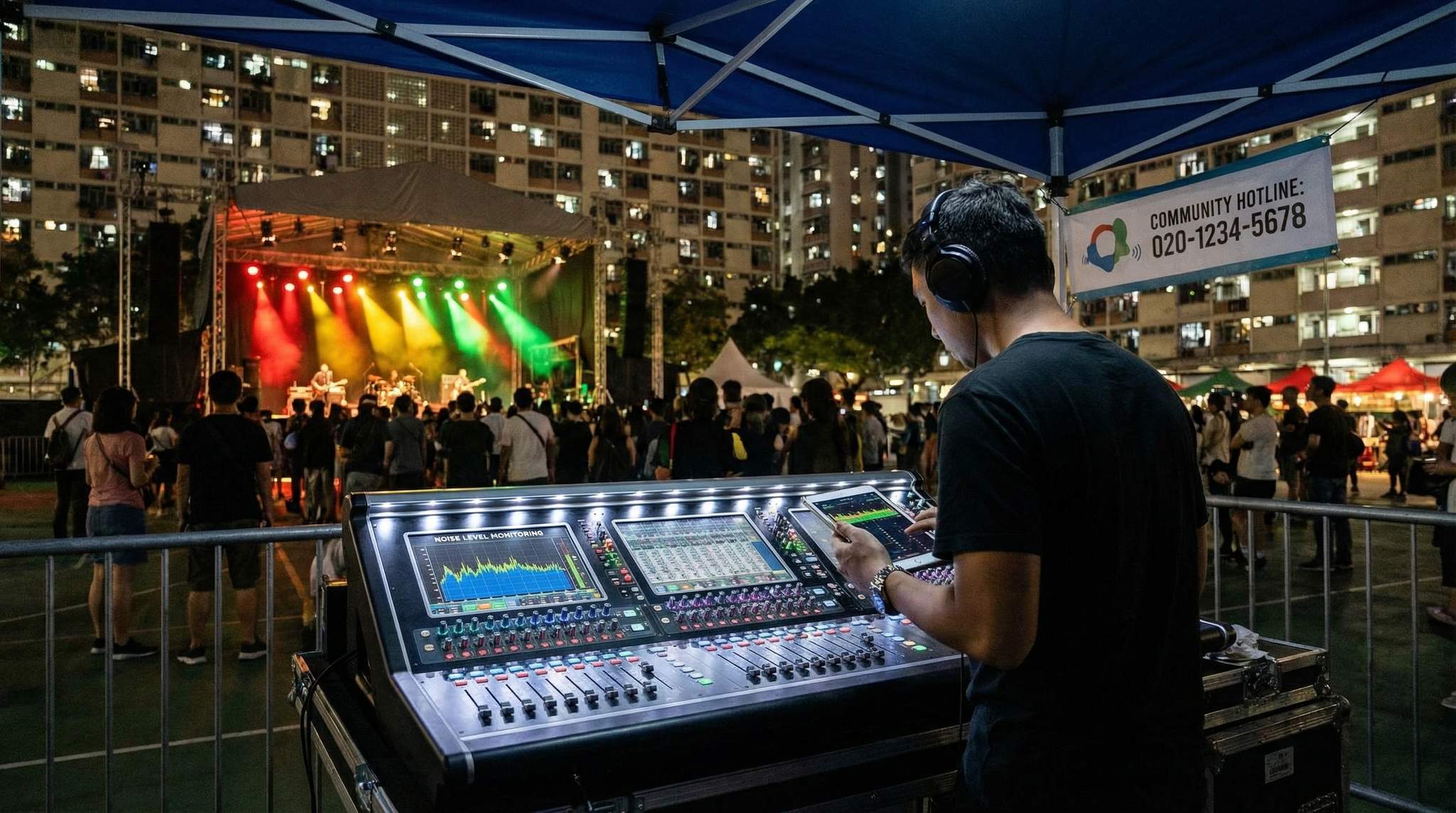
No matter how well you plan, real-time monitoring is essential once the festival is underway. Weather conditions (like temperature inversions or wind shifts) can suddenly carry sound farther than expected, and what works on paper sometimes needs adjustment on the fly. Professional noise management involves setting up sound level meters at key points around the site (especially near those critical receptor locations identified earlier). Many festivals hire noise control consultants or dedicate a staff member to continuously monitor decibel readings at the perimeter. The goal is to ensure you’re staying within allowed limits at all times, and to catch any creeping issues early.
Link your monitoring to your control center and protocol. If readings at the north fence start spiking above the permitted level during a bass-heavy set, your noise officer should alert audio engineers immediately to dial things back a notch. It’s a delicate dance: you want to maintain a great show atmosphere, but a small reduction (say, a few decibels off the subwoofers) might be barely noticeable to the crowd yet significantly reduces the impact in nearby living rooms. Make sure your mixing engineers and stage managers are briefed that late-night sets may require volume trims if needed. Some events even implement automated limiters on the system that kick in if output approaches a threshold – though be careful, as heavy-handed limiting can affect sound quality. Often a human touch, guided by live data, works best for balancing on-site excitement with off-site comfort.
One powerful tool in noise diplomacy is having a community hotline during the event. This is a phone number that residents can call if they’re being disturbed by festival noise (or other issues), and it needs to be staffed by someone who can actually do something in real time. Empower your hotline team to communicate directly with production or audio control. For example, if three different households from the west side all report that the reggae stage’s bass is rattling their windows, the hotline staff can relay this to the sound team and get an immediate volume trim or EQ adjustment on that stage. Then, follow up with the callers if possible to see if the change helped. This rapid response builds enormous goodwill. As one neighbour put it after a loud concert, “that’s all you can ask. Just give them awareness and that they are mindful of the bass and how far it is traveling”, a resident told WRAL News. Simply knowing that the festival team is listening and ready to act makes people much more forgiving of occasional noise issues.
Need Festival Funding?
Get the capital you need to book headliners, secure venues, and scale your festival production.
Some best practices for an effective hotline include:
- Advertise it to residents beforehand. Send a friendly letter or email to the surrounding community with the hotline number, its hours of operation, and perhaps an alternate contact like an event community liaison. Let them know you care about their comfort and take noise seriously.
- Staff it adequately and professionally. Don’t just park a cellphone with a single busy staffer. For instance, London’s Community Festival in Finsbury Park provided three dedicated hotline lines in 2022 so calls would always be answered promptly, as detailed in Community Festival’s resident information. Ensure the people answering are calm, courteous, and trained to handle complaints empathetically.
- Log every call and action. Note the time, caller location (if given), and details of the issue. Write down exactly what response was taken (e.g., “9:10 PM: Lowered Stage 2 master volume by 2 dB after complaint from Oak Street”). These logs are crucial for post-event analysis and demonstrating responsiveness.
- Coordinate with on-site teams. The hotline is only useful if it triggers real action. Set up a clear line of communication (via radio or a messaging group) between the hotline operator and the festival control center or audio crew. That way, if a call comes in, the issue can be relayed and addressed within minutes.
Logging, Lessons, and Continuous Improvement
Documentation is a festival producer’s best friend when it comes to community noise management. Throughout your event, maintain a noise log: record measured sound levels at set intervals at each monitor point, and keep notes of any incidents or complaints. If a neighbour hotline call comes in, log the timestamp, what area it came from, and what was done (e.g., “10:30 pm: Resident on Maple Ave reported excessive bass from Stage 2. Lowered subwoofer output by 3 dB. 10:45 pm: Called resident back, they reported improvement.”). These detailed logs serve multiple purposes.
Firstly, they’re invaluable for post-event analysis. You might discover patterns – say, most complaints came after 9 pm and mostly from the west side, or that Saturday night had more issues than Friday. This data helps you tweak next year’s noise mitigation plan (maybe Stage 2 needs an earlier curfew or different orientation, or you need to deploy additional subwoofer steering for the late shows). Secondly, thorough records demonstrate your responsible management to stakeholders like city councils or licensing boards. If someone claims “the festival music went on past midnight and kept us up,” you can show your logs (and even automated sound meter data) proving that the last song ended at 11:00 pm with all levels within the permitted limits. Transparency and factual reporting can pre-empt a lot of post-event controversy by separating fact from feeling.
Equally important is the debrief and follow-up with the community. Many festivals hold a residents’ forum or circulate a community feedback survey after the event. If possible, meet with the neighbours (and local officials) to review how things went. Share what your team did in terms of noise control – e.g., “We set up four monitoring stations and responded to six hotline calls in under 10 minutes each.” Be sure to highlight successes (like “Friday we had zero noise complaints thanks to the new speaker layout!”) and also own up to any snags (“On Saturday a unexpected weather shift caused more noise travel; we responded by lowering Stage 2’s bass and will improve our plan for that contingency next year”). When neighbors see that their feedback is heard and that you’re committed to improvement, it builds trust for the future.
Also, don’t forget to give kudos to partners who helped make the noise plan work – whether it’s the sound company that implemented the cardioid subs or the local council that advised on monitoring, acknowledge them. This not only shows the community that experts were involved, but also maintains good relationships with those partners for next time. If despite all efforts something didn’t go as planned (maybe one stage had an equipment issue and got louder than intended at one point), be frank and apologise to the community for that disturbance. A little honesty and humility can go a long way in maintaining goodwill.
Community Engagement and Goodwill Initiatives
Noise diplomacy isn’t only about technology and measurements – it’s also about human relationships. Successful festival organisers treat nearby residents as key stakeholders, not adversaries. In practice, this means engaging the community early and often. Long before the sound system is set up, make sure local people are aware of the event, know what to expect, and have channels to voice concerns or ask questions. Many seasoned producers will attend neighbourhood council meetings or host their own “town hall” session with residents weeks or months in advance of a big festival. Come prepared to share your noise mitigation plan: show maps of the stage orientation, describe the barriers and bass steering you’ll use, and outline the event schedule and curfew times. When neighbours see that you’ve put serious thought into protecting their peace, they’re more likely to support the festival (or at least not actively oppose it).
Another smart move is to turn neighbors into fans whenever possible. If you can allocate some budget for it, consider offering a handful of free or discounted festival tickets to residents in the immediate vicinity. Inviting them to enjoy a day of reggae music can transform their perspective – now they feel like participants in the fun rather than outsiders subjected to noise. Some festivals also partner with the community on local projects or charity efforts as a goodwill gesture. For example, a reggae festival in Kingston might sponsor improvements to a neighborhood community center, or an event in Jakarta could coordinate with local food vendors to ensure the neighbourhood benefits economically. These kinds of initiatives don’t directly lower decibels, but they increase tolerance. A neighbor who feels respected and included is far less likely to lodge a complaint unless the situation is truly unbearable – and even then, they’ll probably reach out to the provided hotline or contact person first, rather than calling the authorities or blasting the event on social media.
Finally, always remember to keep listening. Noise diplomacy is an ongoing conversation, not a one-and-done deal. Each community has its own tolerances and pet peeves. One neighbourhood might not mind music during the day but expects silence by 10 pm sharp; another might be okay with the festival running late on weekends but not on a Sunday night before work. By understanding these local sensitivities, you can adjust aspects of your event plan (from scheduling to onsite signage about quiet departures) to address them. And when it comes to the noise itself, if despite all your efforts a resident is still unhappy, sometimes a personal touch helps – send a community liaison over to talk face-to-face or at least call them to empathise and explain what steps are being taken. Showing genuine care can turn a critic into an ally. Remember the golden rule: neighbors forgive plans that work and people who listen. If you demonstrate that you have a solid plan and a willingness to hear and address concerns, you’ll go a long way toward keeping the peace in even the densest of neighbourhoods.
Frequently Asked Questions
What is noise diplomacy in festival production?
Noise diplomacy involves proactively managing sound and community relations to prevent noise complaints during urban events. It requires balancing high-quality audio for attendees with peace for neighbors through advanced sound modeling, smart site design, and open communication. This strategy ensures festivals deliver great experiences without becoming a neighborhood nuisance.
How can festivals reduce bass noise for neighbors?
Organizers reduce bass leakage by using cardioid subwoofer arrays that steer low frequencies toward the audience and cancel them out behind the stage. Unlike physical barriers which bass easily penetrates, these directional speaker configurations and digital optimization software effectively contain low-end energy within the venue boundaries.
How does stage orientation affect festival noise levels?
Orienting stages inward, facing away from residential areas, significantly reduces off-site noise levels. Planners position stages so loudspeakers point toward the center of the venue or natural buffers like hills, ensuring the loudest sound is contained within the site rather than projecting directly into nearby homes or businesses.
Do acoustic barriers work for outdoor music festivals?
Acoustic barriers effectively block mid- and high-range frequencies, reducing sound leakage by up to 90% when placed around stages or perimeters. While less effective for deep bass, these panels absorb and deflect direct sound lines, protecting sensitive areas and improving on-site audio clarity by preventing stage interference.
What is the purpose of a festival community hotline?
A community hotline provides residents a direct channel to report noise disturbances in real time, allowing organizers to address issues immediately. Staffed by professionals connected to audio engineers, the hotline enables rapid volume adjustments or EQ changes, building trust and demonstrating that the festival takes neighborhood comfort seriously.
Why is sound modeling important for urban events?
Sound modeling predicts how noise propagates beyond a venue before the event begins, identifying potential receptor points like homes or schools. By simulating different stage setups and speaker configurations, organizers can visualize projected decibel levels and adjust site designs to meet local regulations and prevent noise complaints.
How can festival organizers improve community relations regarding noise?
Organizers improve relations by engaging neighbors early through town hall meetings and sharing detailed noise mitigation plans. Offering free tickets, supporting local projects, and maintaining transparent communication channels like hotlines transforms residents from outsiders into participants, increasing their tolerance for occasional noise and fostering long-term goodwill.
How do weather conditions affect festival sound travel?
Weather factors like wind shifts and temperature inversions can carry sound much farther than expected, bypassing initial models. Real-time monitoring allows audio teams to detect these environmental changes immediately and adjust volume levels or EQ settings on the fly to maintain compliance with noise regulations despite changing conditions.