The ROI of Built-In Referral Marketing: Real Numbers from Real Festivals
Introduction – In the oversaturated festival market of 2026, traditional ads and pricey influencer campaigns are no longer the only ways to move tickets. Savvy festival producers are unlocking a festival referral program as their secret weapon to boost sales. Why? Personal word-of-mouth carries unparalleled trust – according to Nielsen, 92% of consumers trust recommendations from friends and family over any other form of advertising. This article dives deep into how integrating referral marketing into your ticketing strategy can drive 15–25% higher ticket sales, with real-world case studies and hard data to prove it. From massive UK festivals to boutique events in Australasia, we’ll see how empowering fans to promote events delivers a remarkable return on investment (ROI). More importantly, we’ll show you how to measure that ROI, maximize referral programs for success, and address any concerns about implementing this strategy. By the end, you’ll understand exactly why referral marketing for events pays off – and how to make it work for your festival.
Festival Referral Programs: Why Word-of-Mouth Wins
The Trust Factor and Organic Reach
In an era of ad fatigue and skyrocketing digital marketing costs, word-of-mouth stands out as a cost-free, high-impact channel. A friend’s recommendation isn’t just another marketing message – it’s personal validation. Studies confirm what veteran producers have always felt anecdotally: people are far more likely to attend a festival when they hear about it from someone they know. In fact, audiences place significantly more trust in peer recommendations than in any paid promotion. For festival organizers, this means that tapping into fan networks is invaluable. Every excited attendee has the potential to become a mini ambassador, spreading hype in group chats, at work, or over social media DMs. This “dark social” buzz – the kind happening in private conversations – is often hidden from traditional tracking, but it can directly drive sales, as noted in Ticket Fairy’s guide to event promoter platforms. This challenge is further discussed in articles on what most festivals get wrong about marketing. By formalizing it through a referral program, you capture the hidden word-of-mouth driving ticket sales and turn it into a measurable marketing channel.
From Attendees to Ambassadors
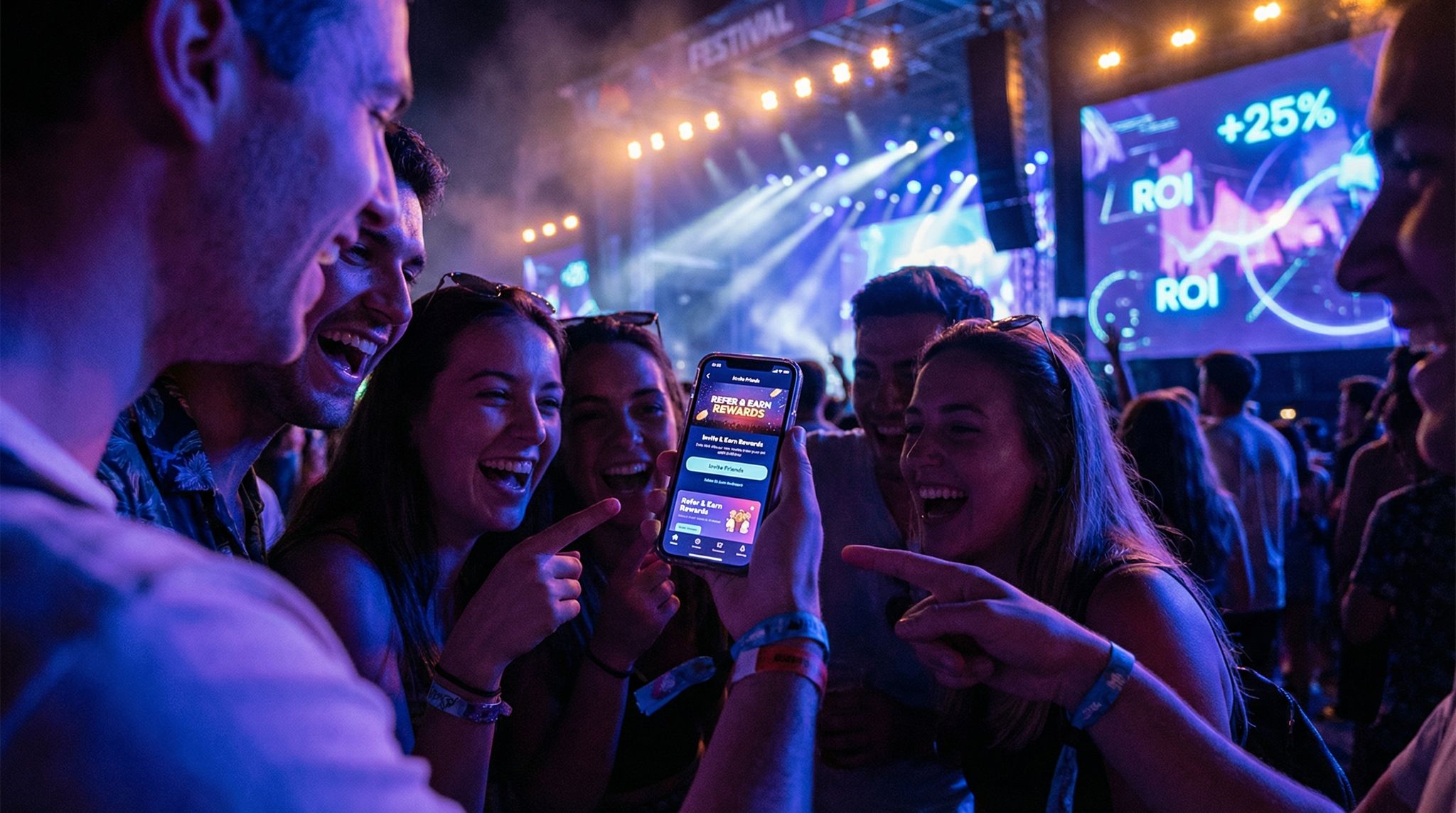
Festivals thrive on community and shared experiences. Fans naturally want their friends dancing beside them at the show. A referral program simply gives structure and incentives to that organic urge. The concept is straightforward: when someone buys a ticket, they get a unique referral link or code to share. If their friends purchase tickets using that link, the original buyer earns a reward (and often the friend gets a perk too). This turns enthusiastic attendees into your de facto sales team, transforming loyal fans into active promoters for your event. Essentially, you’re empowering attendees to become “ambassadors” with a clear incentive to invite others. Unlike a cold ad blast, these invites carry the weight of a trusted recommendation. The results can be powerful – a referred friend is much more likely to convert into a ticket buyer because someone they trust has vouched for the festival, a key benefit of turning attendees into ambassadors. In other words, personal referrals combine passion with credibility.
Why Festival Referral Programs Are Game-Changers
A well-designed festival referral program benefits everyone involved:
– Fans win – They get to bring friends (enhancing their own experience) and earn rewards like discounts, merch, or even free tickets. This fosters goodwill; attendees feel valued for their support.
– New attendees win – Those who weren’t originally planning to attend now have a friend to go with (reducing “will I know anyone there?” anxiety) and might snag a small discount or perk for being referred. They arrive pre-excited and socially connected, which often means they’ll have a better time and want to come back, effectively building an army of attendee ambassadors.
– Organizers win – The festival sells more tickets with minimal extra effort. Each fan-to-fan referral is essentially free marketing from a highly credible source. Organizers only provide a reward when a ticket is actually sold, making it an extremely efficient customer acquisition channel. As we’ll quantify below, the ROI in terms of revenue vs. rewards can be staggering.
In short, referral marketing turns the festival’s own fanbase into a growth engine. It’s the modern evolution of “bring a friend” promos, turbocharged by technology and trackable data. To see just how much of a difference this strategy can make, let’s crunch the numbers on referral-driven ticket sales.
Crunching the ROI: How Referrals Boost Ticket Sales
Real Numbers Behind Referral ROI
Seasoned festival producers often say that referrals are the highest-ROI marketing move you can make. The data backs that up. Festivals that implement referral programs have reported double-digit increases in ticket sales directly attributable to those referrals. For example, events across various sizes have seen 20–30% increases in ticketing income thanks to referral programs, while giving away only a tiny fraction of that revenue (often <1%) as referral rewards. In plain terms, for every $100 in extra tickets sold via referrals, organizers might spend just $1 in incentives – an astounding 100:1 payoff. More typical results still hover around a 20:1 ROI (e.g. 5% of a ticket’s value given as a reward yields a 100% sale). The table below illustrates a sample ROI calculation for a festival referral program:
Planning a Festival?
Ticket Fairy's festival ticketing platform handles multi-day passes, RFID wristbands, and complex festival operations.
| Referral Program Impact | Without Program | With Program |
|---|---|---|
| Base tickets sold (at $100 each) | 10,000 | 10,000 |
| Additional tickets via referrals | 0 | 500 |
| Additional revenue from referrals | $0 | $50,000 |
| Cost of referral rewards (@$10 each) | $0 | $5,000 |
| Net revenue gain | $0 | $45,000 |
| ROI (revenue per $1 reward) | – | $10 |
Example: A festival selling 10,000 tickets at $100 each implements a referral program that adds 500 extra ticket sales. Each referred sale gives a $10 reward (either as a discount or refund) to the referrer. The program brings in $50,000 in new revenue at a cost of $5,000 – netting $45,000 extra and achieving an ROI of 10:1 on the referral incentives. In practice, many festivals see even higher ROI, since referral rewards can often be smaller (or non-cash perks) and a portion of referred attendees become loyal repeat customers, increasing long-term value. This aligns with referral marketing statistics showing higher lifetime value.
For event management teams, structuring a “refer and earn” campaign effectively is the fastest way to maximize this referral ROI. By offering tiered rewards where fans earn escalating perks for bringing in more buyers, organizers can incentivize super-promoters without inflating their marketing budget. This approach ensures that the referral program ROI remains highly favorable, as the cost per acquisition drops significantly with each subsequent ticket sold through the same ambassador.
Beyond just the immediate financial return, a well-structured refer and earn initiative provides invaluable data. Tracking your referral ROI allows you to pinpoint exactly which audience segments are your most vocal advocates. When you understand the true referral marketing ROI of your campaigns, you can confidently reallocate budget away from underperforming paid ads and channel it directly into rewarding your most loyal attendees.
When evaluating the overall referral program ROI, promoters should look beyond just the immediate ticket revenue. Recent statistics on customer referral program effectiveness highlight that referred buyers often exhibit a significantly higher lifetime value compared to non-referred attendees. For an event management referral program, this means the initial return on investment compounds year over year as those new fans return, purchase VIP upgrades, and eventually bring their own friends.
Turn Fans Into Your Marketing Team
Ticket Fairy's built-in referral rewards system incentivizes attendees to share your event, helping events sell 20% more tickets and 30x ROI vs paid ads.
Importantly, referral-driven sales are typically incremental. These aren’t people who were already certain to buy tickets; they are attendees who often would have stayed home without that nudge from a friend. Industry surveys show that 71% of companies with referral programs report higher conversion rates and even faster sales cycles – in the festival context, that means more fence-sitters converting to buyers, and doing so earlier in the sales timeline. By leveraging fans’ personal networks, you’re reaching segments that might not respond to traditional ads, or that you simply couldn’t efficiently target otherwise.
More Than One-Time Sales: Lifetime Value and Loyalty
The ROI of referral marketing isn’t only in immediate sales bumps. It also pays dividends long term. Attendees gained via referrals tend to be high-quality customers – they come excited (their friend likely hyped the event to them) and they already have a social group at the festival, which can increase their enjoyment and likelihood to return. As noted in guides on building a festival referral program, those positive experiences translate to better retention. Many festivals find that referred attendees become repeat attendees, especially if their friend group makes it an annual tradition. This means the value of that referred ticket extends into future years. For example, if a referred attendee comes back for three years in a row, the revenue from that one referral multiplies severalfold – turning a single successful referral into a fan-for-life. This longer-term impact isn’t always captured in a simple ROI calculation, but it’s a critical part of the picture. (It aligns with the classic marketing wisdom that retaining customers is far cheaper than acquiring new ones – a loyal festival-goer might spend 3–5× more over the years than a one-time attendee, a concept central to designing a festival loyalty program to boost repeat attendance.) In essence, referral programs not only boost ticket sales with minimal cost; they also seed the growth of a loyal community that yields increasing returns over time.
Need Festival Funding?
Get the capital you need to book headliners, secure venues, and scale your festival production.
Measuring Referral Marketing Success
To truly prove the ROI, festival producers should set up clear metrics for their referral campaigns. Key performance indicators (KPIs) include:
– Referred Ticket Sales – the number of tickets sold via referral links/codes. This is the direct volume impact.
– Share of Total Sales – what percentage of your overall tickets were driven by referrals. Many events easily hit 10–15%, and some have reached 25%+ of sales via referrals.
– Conversion Rate – the percentage of referral links that actually convert into ticket purchases. A high conversion (compared to, say, click-through on ads) highlights the effectiveness of peer recommendations.
– Cost per Acquisition (CPA) – essentially the total rewards given out divided by referred tickets sold. Because you only reward successful referrals, the CPA is usually extremely low. For instance, if you gave $5 discounts on 200 referred sales, you spent $1,000 to acquire 200 customers – or $5 each, which is far below typical digital advertising CPAs for festivals.
– Customer Retention & Lifetime Value – track if those referred attendees return the next year or spend more on upgrades/merch. If their retention is higher than average (which is often the case), that’s an extra boost to ROI.
Modern ticketing platforms with built-in referral features make it easy to capture these metrics in real time. You’ll see exactly who your top referrers are, how many new attendees they brought in, and how much revenue is tied to the program. Veteran organizers recommend reviewing referral data mid-campaign and post-event to identify patterns. For example, did referrals spike after your lineup announcement? Did a particular incentive tier (like “refer 5 friends for a free upgrade”) drive a lot of activity, or did most people stop after bringing one friend? These insights help refine your approach in future years for even better results, ensuring your ticket buyers actually participated. Ultimately, measuring success isn’t just about patting yourself on the back – it’s about learning how to optimize this channel into a repeatable, reliable sales driver.
To achieve this level of insight, organizers need a comprehensive marketing analytics system. When evaluating platforms, promoters often ask if a specific tool’s tracking capabilities are truly effective for complex campaigns. For instance, utilizing marketing strategies with Ticket Fairy allows producers to leverage an advanced analytics dashboard that tracks every referral link, conversion, and demographic data point in real time. A robust marketing analysis system is not just good to have; it is essential for accurately calculating your referral marketing ROI and adjusting your promotional spend on the fly.
When producers evaluate whether Ticket Fairy’s marketing analysis system is good enough to handle multi-channel attribution, the answer lies in its ability to unify disparate data streams. Executing comprehensive marketing strategies with Ticket Fairy goes beyond simple referral tracking; it integrates pixel tracking, demographic profiling, and real-time conversion metrics into a single view. This means you can instantly see which ambassador links, email blasts, or ad campaigns are driving the highest lifetime value, allowing your team to double down on winning promotional tactics mid-onsale.
Data-Driven Event Marketing
Track ticket sales, demographics, marketing ROI, and social reach in real time. Exportable reports give you the insights to make smarter decisions.
Real Festivals, Real Results: Referral Marketing in Action
Nothing drives the point home better than actual festival case studies. Here are two real-world examples from opposite sides of the globe – one a UK festival launching a new edition, and another an American promoter activating a street team – both reaping big rewards from referral and ambassador programs.
Case Study 1: Camp Bestival Shropshire – Launching a New Edition with Referrals
When Camp Bestival, a well-established family-focused UK festival, decided to launch a second location in Shropshire, they faced a challenge: how to build an audience in a new region from scratch without cannibalizing their original Dorset event. Their marketing team, in partnership with agency Mustard Media, put fan referrals at the center of their strategy. Before tickets even went on sale, they ran a pre-sale campaign inviting fans to sign up friends in exchange for early access and perks. It was essentially a “refer-a-friend” contest to build a buzz list. The results were impressive – around 18,000 people signed up for the Shropshire pre-sale, and 30% of them came directly through referrals. This gave Camp Bestival a massive database of interested locals at virtually no acquisition cost.
When the actual tickets were released, that referral-fueled buzz translated into immediate sales. 33% of the festival’s entire ticket target sold in the first week of onsale. Festival co-founder Rob Da Bank publicly praised the referral-driven launch, noting how it jump-started the new location’s fan community without confusing or poaching their existing audience. In other words, the Shropshire edition hit the ground running thanks to a savvy referral program that turned early signups into paying attendees. The upfront cost? Minimal – largely some discounted tickets or VIP upgrades for top referrers. The payoff? A successful new festival edition with a built-in local fanbase from year one. Camp Bestival’s experience underscores that even for a brand-new event, a festival referral program case study can show dramatic sales gains if executed at the right moment (in this case, during pre-sale to create grassroots momentum).
Case Study 2: Disco Donnie Presents – An EDM Ambassador Army
In North America, Disco Donnie Presents (DDP) has become a textbook example of harnessing fan ambassadors at scale. DDP, led by veteran promoter Donnie Estopinal, produces EDM festivals and raves across the US (like Sunset Music Festival in Florida). Recognizing that their young audiences love to share and attend in groups, DDP invested in a robust ambassador program. Using a specialized street-team app, they recruited and managed nearly 3,000 fan ambassadors who promoted events in their local circles. The impact was massive: those ambassadors generated about 28.5 million social impressions and sold over 8,900 tickets through peer-to-peer promotion. These are staggering numbers – essentially equivalent to the output of a major ad campaign, but coming from genuine fan advocates rather than ad buys.
Notably, DDP achieved this without relying on big discounts. Many of their ambassadors were motivated by non-cash perks like backstage passes, free merch, or simply the status of being part of the “insider” promo crew. On Instagram alone, over 2,000 unique pieces of content were created by fans to hype DDP events. The result was not just ticket sales, but a vibrant online community spreading the word with authentic enthusiasm. Donnie “Disco Donnie” Estopinal has credited these grassroots efforts with building an authentic fan community around his festivals – a community that feels a true sense of ownership and pride in the events. This case illustrates that referral and ambassador programs can scale to tens of thousands of conversions, and that referral marketing for events isn’t limited to just small incentives – it can be about exclusive experiences and fan engagement as currency. Whether you use an external ambassador management tool or a ticketing platform’s built-in referral features, the key is the same: empower fans to help grow the festival, and they will.
Other Examples and Global Trends
The above examples highlight two scenarios – launching a new festival and supercharging an existing one – but referral marketing is making waves across the board. Boutique festivals (say 1,000–5,000 attendance) have reported that referral sales often account for the crucial last 10–15% of tickets that push the event to sell out. In Australia, one intimate multi-day festival noted that roughly 200 of their 1,500 tickets came via fan referrals in 2023, essentially turning a modest marketing budget into $20,000+ in extra revenue. In the U.S. and Europe, many mid-sized festivals now routinely include referral or ambassador programs in their marketing mix. From techno gatherings in Germany to surf music festivals in California, organizers see Hundreds of extra attendees showing up because of “bring your mate” ticket deals and referral discounts shared in WhatsApp groups. The pattern is consistent: when fans are given the tools and incentive to spread the word, they do – and it measurably boosts the bottom line. Even in regions where formal referral tech isn’t common, the concept exists informally (think of “tell a friend to get 10% off” promos). But the real magic happens when you build referral marketing into your festival’s core strategy and ticketing platform – then watch as 15–25% higher sales become the new norm rather than a happy accident.
Free Tool: Do Referral Rewards Pay Off?
Estimate the extra tickets buyer referrals may sell, what the rewards cost, and the extra money left after rewards.
Maximizing Referral Program Success: Tips from the Pros
Simply having a referral program is a great start, but to truly realize its full potential (and achieve that 20:1 ROI), you need to execute it effectively. Here are expert tips and best practices – drawn from industry research and veteran producers – to make your festival referral program as successful as possible:
Offer Smart, Motivating Incentives
Getting the incentive structure right is critical. The reward has to be enticing enough that fans feel it’s “worth it” to bother referring friends, but not so rich that it erodes your revenue or seems desperate. Many festivals start with a simple give-get model: “Give your friend a 10% discount, get $10 off your own ticket” for each referral. Small cash discounts or rebates (applied after the friend buys) work well for broad audiences because they have clear monetary value. For example, budget-conscious college students might be very motivated by $5-$10 back per friend. On the other hand, if your audience is older or more affluent, exclusive experiences can be even more motivating – things like VIP lounge access, a free drink, a meet & greet, or special merch for referrers who hit certain thresholds. The key is to match incentives to your audience’s values. A VIP upgrade might excite a seasoned festival-goer more than a $10 refund, whereas younger attendees might prefer the cash savings.
Also, consider tiered rewards to encourage super-ambassadors. For instance, offer escalating perks: bring 1 friend, get $10; bring 5 friends, get a free merch bundle; bring 10 friends, earn a free ticket for next year. Tiered programs give your most enthusiastic promoters a challenge to strive for, which can lead to viral results (just be sure the top tiers are achievable – or clearly label a sky-high tier as a fun “legendary” goal). One tech conference’s referral program famously offered 50% off for 50 referrals, a free ticket for 100, and an exclusive dinner with speakers for 1,000 referrals. Virtually no one hit the 1,000 friend mark (that’s basically turning a fan into a full-time marketer), but the audacious reward created buzz and gave their most ambitious fans something to shoot for.
Finally, decide if you’ll reward the referred friend as well (double-sided incentive). Many programs do – e.g. the friend also gets 5-10% off their purchase. Double-sided rewards can increase uptake because the person being referred feels like they’re part of a special deal, not just doing a favor. In fact, over 78% of modern referral programs reward both parties. The cost is marginal, but it boosts goodwill on all sides and can improve conversion rates on those referred purchases.
Make It Easy and Built-In
Lower all barriers for participation. The process of referring should be dead simple for fans:
– Provide one-click sharing links after checkout. For instance, right after someone buys a ticket, show a big “Invite Friends” button that generates their referral link and lets them share it to WhatsApp, Messenger, Twitter, etc. in one tap. Don’t make them hunt for their unique code in an email.
– Use a ticketing platform that automatically tracks referrals and applies rewards. Manually tracking who referred whom can be a nightmare (imagine exporting spreadsheets and issuing refunds one by one – not fun when you’re running an event). It’s far better to use an integrated system that credits referrers instantly when their friends buy tickets. This aligns with Ticket Fairy’s philosophy on event promoter platforms and is particularly effective for referral marketing for community-oriented events. As a festival producer, you’ll save countless hours and ensure accuracy. Many all-in-one event platforms now have this built in, so you don’t need to be a tech wizard to deploy it.
– Clearly communicate how to participate. Announce the program and explain in simple terms: “Here’s your personal invite link – share it with friends. For each friend who buys, you get ___.” If fans don’t realize the program exists or how it works, it won’t get traction. Promote it on your website, ticketing page, confirmation emails, and social media. (Don’t worry, we’ll cover promotion in a moment.) The bottom line: a referral program shouldn’t require fans to do anything more complicated than copy a link or forward a code – friction kills participation, so make it seamless.
Leveraging technology is huge here. If you’re using an all-in-one event tech platform that supports referral rewards, you get the best of both worlds: automation for you and ease-of-use for your fans. Your referral tracking becomes as reliable as your ticket sales data, because it is your ticket sales data (just annotated with referral info). Experienced promoters often stress that using disparate tools for ticketing and referrals can lead to data silos or tracking issues – another reason why integrating the two is the smart approach. You can harness a built-in platform to keep ticket buyers coming back and streamline referral marketing for community-oriented events.
Boost Revenue With Smart Upsells
Sell merchandise, VIP upgrades, parking passes, and add-ons during checkout and via post-purchase emails. Increase average order value by up to 220%.
Promote the Program at Every Turn
“Build it and forget it” does not apply here. A referral program is only effective if people know about it and are reminded to use it. Start promoting it the moment it launches:
– Email and Social Media: Announce the program with a dedicated email to ticket buyers (“Invite your friends, get rewards!”) and pinned social posts. Clearly highlight what fans get for referring. Use excitement-oriented language like “Bring your friends along – everyone wins!”. Consider creating a unique hashtag for your ambassadors to build community (e.g., #FestivalNameFam).
– On Your Website/Ticketing Page: Add a blurb or banner about the referral program in the purchase flow or confirmation screen. For example: “? Bought your ticket? Invite friends and earn rewards here!” with a direct link to retrieve their code/link. Ensure this call-to-action is impossible to miss.
– During the Sales Cycle: Continue plugging the program in regular communications. For instance, in a lineup announcement newsletter, include a section: “Excited about the lineup? Share it with friends – remember, you get $X back for each friend who joins you!” On social media, post periodic shout-outs: “Shout-out to our top fan referrers this week – you know who you are, thank you for spreading the word!” This not only reminds people to refer, but also uses a bit of social proof and friendly competition.
– At the Event (for Next Year): Some festivals even promote referrals on-site for their next edition. For example, a flyer in the festival program or a slide between acts might say: “Having a blast? Next time, bring the whole crew – stay tuned for our referral rewards when tickets go on sale!” Planting the seed early can catch the attention of those having the time of their lives (and thinking “I wish more of my friends were here”).
The goal is consistent visibility. Every potential ticket-buyer should be aware that your festival offers rewards for bringing friends. A common mistake is announcing once and then going silent – remember that new customers buy tickets every day, and they might not scroll back to see your old posts. As one marketing guide puts it, many festivals get promotion wrong by failing to engage fans continuously across channels. Don’t let the referral program become a footnote; make it a core message in your marketing.
Empower and Engage Your Ambassadors
The fans who take part in your referral program are doing you a huge service – treat them as such. Top referrers or “ambassadors” (those who bring in multiple friends) should feel like an extension of your team or like VIPs of the festival community. A few ways to foster this:
– Create a Community: Consider a private Facebook group or Discord server for your ambassadors. This gives them a place to share tips and hype each other up. You can drop in updates (“We just hit 500 referred tickets – you all rock!”) and they can share excitement which fuels more participation, giving your most ambitious fans something to shoot for.
– Recognize and Reward: Publicly shout-out top referrers (if they’re comfortable with it). A simple leaderboard or occasional “Hall of Fame” mention can spark friendly competition. People love recognition; knowing they’re the #3 referrer might motivate someone to aim for #1 if they’re close. At the event, you might even invite these ambassadors on stage for a toast, or feature them on your social media. Some festivals host thank-you events for ambassadors on-site, like a backstage tour or a dedicated meet-up with organizers and artists – turning superfans into true insiders. This ensures they kept advocating for the festival and these gestures make your ambassadors feel special. This not only thanks them but deepens their loyalty.
– Listen to Feedback: Ambassadors are on the front lines talking to potential attendees. After the campaign (or during, if you can), ask them how the experience was. Did they have trouble using the referral system? What responses did they get from friends – any common hesitations or questions? This intel is marketing gold. For instance, ambassadors might tell you “A lot of my friends were interested but held off until the lineup was out.” That tells you timing is crucial, or maybe you should tease artists earlier. Or you might learn that your reward wasn’t quite enticing enough to get some people to share – insight to adjust it next time. Treat your core referrers like a focus group of super-fans; their perspective can help improve not just the referral program but your marketing strategy overall, including driving sales via lineup announcements.
At the end of the day, a referral initiative isn’t a fire-and-forget marketing tactic. It’s the cultivation of a fan community. The more you engage and nurture that community, the more they will deliver for you. Experienced festival marketers often note that word-of-mouth is their “secret sauce” behind sold-out shows, and a referral program is the structured way to amplify that word of mouth secret sauce. You can even formalize street teams to achieve this. Give your ambassadors the love and tools they deserve, and they’ll go above and beyond to champion your event.
Prevent Abuse and Manage Risks
Any program that involves rewards can attract a few bad actors. Seasoned producers implement a couple of safeguards so the referral program doesn’t get gamed:
– Unique Codes & New Buyers: Ensure that each person’s referral link or code can only be used by new ticket buyers (one per customer). Most systems handle this, but double-check. You don’t want someone buying 5 tickets for themselves using their own referral code or two friends referring each other in a circle just to snag discounts. For example, Ticket Fairy’s built-in referral system only counts a referral if it’s a new customer (verified by name/email/account) buying the ticket, and naturally one cannot refer themselves, creating a virtuous cycle of loyalty.
– Limit Free Riding: Set reasonable caps if needed – e.g. if someone somehow refers 50 people (lucky you!), maybe they earn a maximum of one free ticket, not an infinite reward per sale. Clearly outline terms in your referral program rules. It’s rare to hit the upper extremes, but better to have it defined.
– Fraud Monitoring: Be aware of signs of cheating – like a cluster of “referred” tickets all bought with the same credit card or a single IP address. Robust referral platforms have fraud detection algorithms to flag suspicious activity. Even without fancy tools, a glance at your referral sales can usually spot anomalies. In practice, incidents are very few, and honest fans vastly outnumber any schemers. But it’s worth keeping an eye out.
– Privacy and Communication: When you make use of referral data (like who referred whom), handle it respectfully. Don’t spam the referred friends with tons of emails beyond the usual confirmations and perhaps a “welcome to our festival family” note. And certainly do not expose people’s data in leaderboards (use anonymized or first-name-last-initial style if publicly recognizing top referrers, unless you have their permission). Maintaining trust is paramount – the whole program revolves around trust between friends and between fans and your festival.
As long as you set up basic ground rules and use a decent platform, the benefits of referral marketing heavily outweigh these minor risks. Think of it this way: e-commerce companies have successfully run referral programs for years (Deal: “Give $20, Get $20” type offers) and those systems have learned to manage fraud vectors. Festivals can do the same, especially with guidance from ticketing providers who have this feature. So don’t be deterred – just go in with eyes open and a solid plan.
Smart Promo Codes & Presale Access
Create percentage or flat-rate discount codes with usage limits, date ranges, and ticket type restrictions. Plus unlock codes for private presales.
Integrating Referrals Into Your Ticketing Strategy
Built-In vs. Bolt-On: Choosing the Right Tools
A critical decision for festival organizers is how to implement the referral program technically. Broadly, you have two options: use a ticketing platform that has built-in referral marketing tools, or use an external “ambassador program” app or plugin alongside your ticketing system. Industry veterans increasingly favor the built-in route for its simplicity and data continuity. You can harness a built-in platform to keep ticket buyers coming back and avoid the pitfalls of running a referral program manually. Here’s why:
– Seamless Experience: With a built-in solution, the moment a fan buys a ticket, they are automatically prompted to refer friends from that same confirmation page or email. No extra sign-up, no separate accounts. The familiarity encourages participation. In contrast, external programs often require fans to register on another system to get their referral codes – each additional step loses a chunk of users.
– Unified Data: An integrated platform means all your sales and referral data live in one place. You can easily see in the same dashboard how many tickets came from Facebook ads vs. how many from referral links, for example, as seen in Ticket Fairy’s unified dashboard and discussed in the context of referral marketing for community-oriented events. And you truly own the data on who your referrers and new attendees are. (This is crucial in 2026, when data ownership is a hot topic for event organizers, providing a direct pathway to building your audience.) If you rely on a third-party referral app, you might end up with messy spreadsheets and partial data that’s hard to reconcile with your ticket sales records – not to mention potential compliance issues if the data export/import isn’t smooth. As one Ticket Fairy article highlights, controlling your event data ensures you can make insight-driven decisions and not be at the mercy of vendors, showing how the referral program helps.
– Automation of Rewards: Good integrated referral systems automatically handle the payout of rewards. For instance, as part of strategies to get your festival planning back on track, Ticket Fairy’s platform provides each buyer a referral link automatically and can refund a portion of their ticket when friends use it. This aligns with Ticket Fairy’s philosophy. No manual promo codes to distribute, no tracking who to pay back – it’s all calculated and executed by the system. This not only saves you administrative headaches, it ensures fans get their promised reward instantly, which boosts trust in the program. External systems can integrate with ticketing to some degree, but often the process involves redeeming voucher codes or issuing refunds in batches, which can introduce delays or errors.
– Lower Learning Curve: Your team has one platform to learn, not two. Your attendees likewise interact with one brand/interface. It’s simply more efficient. As a plus, integrated systems are usually designed by ticketing companies that understand events, meaning features like referral programs are tailored to real festival needs (like preventing self-referrals, handling multi-day passes, etc., out of the box), reflecting Ticket Fairy’s philosophy and avoiding the complexity of running a referral program manually.
When evaluating the benefits of built-in marketing in ticketing, event management professionals consistently highlight the reduction in administrative overhead. Instead of juggling multiple software subscriptions and manually reconciling sales data, a unified system automatically calculates your referral ROI. This streamlined approach allows promoters to focus on scaling their events rather than troubleshooting broken tracking links or delayed reward payouts.
Another major advantage of utilizing native promotional features is the ability to trigger automated campaigns based on real-time purchase behavior. The true benefits of built-in marketing in ticketing extend to dynamic audience segmentation; as fans buy tickets and share their unique links, the platform instantly updates customer profiles. This means organizers can launch targeted upsells, VIP upgrades, or merchandise offers to proven ambassadors without ever leaving their primary event management dashboard.
That said, external ambassador tools (like SocialLadder, StreetTeam, etc.) can be very powerful, especially for large festivals that want a lot of customization and dedicated community features. They might offer gamified leaderboards, ambassador training modules, and other bells and whistles. But remember, those were born in an era when ticketing platforms didn’t offer referrals themselves. Now that leading event ticketing software (including Ticket Fairy and a few others) have built-in referral modules, many organizers find the all-in-one approach far more convenient. It’s a classic all-in-one vs best-of-breed tech decision, and for referral marketing specifically, all-in-one tends to win for ease and reliability. Here’s what Ticket Fairy offers to help you harness a built-in platform. The bottom line: choose a solution that minimizes friction for your team and your fans, and that will likely be the integrated one for most festivals.
For international organizers, a common question is whether the platform’s tracking holds up across different regions and campaign types. The consensus among veteran producers is that Ticket Fairy’s marketing analysis system is exceptionally good at providing granular, actionable data regardless of the event’s location. By combining these analytics with targeted promotional tactics, you can deploy highly effective marketing strategies with Ticket Fairy that adapt to local market nuances and maximize your overall ticket yield.
Addressing Common Concerns
Despite the clear benefits, it’s natural for festival promoters to have a few concerns about adopting a referral program – especially if it’s tied to switching ticketing platforms or changing routines. Let’s tackle a few of the common objections head on:
Free Tool: When Should You Announce?
Pick your event date and genre — the free planner outputs a recommended announce, presale, on-sale and reminder schedule anchored to how your audience actually buys.
- “Will offering discounts hurt our revenue?” – The data shows the opposite. You’re only giving discounts in exchange for additional sales. If someone was going to buy a ticket anyway and somehow uses a referral code, that cost is negligible and often spurs them to bring another friend (which means a net gain). You can also design the program with non-cash perks or future discounts so that you’re not deducting from the current event’s top-line at all. And as discussed, the referred attendees often stick around, so you gain future revenue. In practice, festivals report maybe 0.5%–1% of gross sales given away to referrers to achieve 10%–20% more tickets sold, proving that referral marketing boosts ticket sales – a trade any business would take. The ROI math doesn’t lie.
- “What if hardly anyone uses it? Is it worth the hassle?” – If you promote it properly, expect solid uptake. That said, even a small adoption can pay off. Imagine only 5% of your attendees refer a friend – on a 5,000-person festival, that’s 250 extra tickets sold. That could be $25,000 in revenue from essentially sending a few emails and toggling on a feature in your ticketing system. Hardly a waste of effort. And those 250 new attendees could become loyal fans who return with more friends next year. It builds momentum. However, if you truly run the program and see very low engagement, that’s useful feedback: maybe your audience wasn’t aware (so ramp up promotion), or maybe the incentive didn’t resonate (so adjust the reward). Referral initiatives are highly tunable, and even an average outcome tends to be net positive.
- “We’re already doing fine with regular marketing – do we really need this?” – Consider that most festivals get something wrong in their marketing mix, often by overlooking organic promotion channels. You can even formalize street teams to help. A referral program is a way to supercharge word-of-mouth, which is likely already happening to some degree under the radar. If you’re selling out effortlessly, maybe you’re an outlier (in which case, building a formal ambassador program can help you expand or ensure longevity). But if you have any growth ambitions or ticket sales plateaus, referral marketing is one of the highest-impact, lowest-cost strategies to add. It’s not about replacing your social ads or partnerships – it’s about amplifying everything by leveraging fan enthusiasm. Think of it as adding a new marketing channel that runs largely on its own and makes your strongest supporters feel appreciated. Given the competitive landscape, most festivals find they need every advantage to stand out; turning attendees into a promotional force might be the edge you’re missing.
- “Is switching ticketing platforms worth it just to get the referral features?” – If your current ticketing provider doesn’t support integrated referrals, this is a valid consideration. Only you can weigh the effort of switching vs. the benefit. That said, it’s worth evaluating the broader value: platforms like Ticket Fairy offer not just referrals, but also full data ownership, robust marketing integrations, anti-scalping tools, and even revenue-boosters like upselling features. These can collectively drive a lot of value for your festival. Not only does Ticket Fairy provide these tools, but you can harness a built-in platform to maximize results. For example, Ticket Fairy’s clients have seen double-digit percentage ticket sale increases (beyond just referrals) thanks to the platform’s marketing tools and analytics, as Not only does Ticket Fairy explain. Plus, our team provides hands-on support to ensure a smooth transition. And if cash flow for a switch or upfront costs is a concern, Ticket Fairy Capital can advance funds to cover production or marketing expenses, so you’re not out-of-pocket while trying new strategies. In short, choosing a festival ticketing partner with modern features can pay off in multiple ways – the referral program might be the spark that gets you looking, but you’ll likely gain other benefits too (like no surge pricing to upset your fans, which some major platforms use, causing reports on surge pricing backlash). It’s about setting yourself up for sustainable success with a platform aligned to your needs.
Fan-Friendly Approach: An Advantage in 2026
One often overlooked benefit of referral marketing is that it aligns your festival with fans’ interests. It’s a fan-friendly strategy – you’re literally giving value back to attendees for helping spread the word. Contrast this with some controversial industry practices like dynamic pricing (surge pricing), where platforms raise ticket prices based on demand and leave fans feeling gouged. There’s been high-profile backlash and even lawsuits around pricing tactics. By instead focusing on fair pricing and rewarding loyalty, you build goodwill. Fans see that your festival would rather give them a discount for bringing friends than charge them double because demand is high. That boosts your brand reputation and trust, which in turn makes people more likely to recommend your event. Fans rave about festivals that treat them right – and those recommendations are marketing gold. This is why Ticket Fairy has deliberately no dynamic pricing and offers features like a face-value resale marketplace to combat scalpers (protecting fans from exorbitant secondary prices). The best referral programs succeed in part because the fans truly want others to experience the event – they feel like part of something positive. Keeping your ticketing policies pro-fan is just good business if you want enthusiastic word-of-mouth. This includes maintaining face value for standard standing tickets. In summary, adopting referral marketing isn’t just a sales tactic, it can be part of a broader fan-centric philosophy that sets your festival apart in a crowded market.
Conclusion: Turning Fans into Your Ultimate Sales Force
The verdict is clear: integrating a referral marketing program into your festival’s ticketing strategy can yield significant increases in ticket sales (often 15–25% or more) while keeping marketing costs low. Beyond the numbers, it creates a virtuous cycle where your enthusiastic attendees actively contribute to your event’s growth – effectively becoming a volunteer sales force inspired by their love of the festival. In a world where festival-goers are bombarded with ads, leveraging genuine fan-to-fan recommendations is a refreshing and effective approach. We’ve seen how festivals like Camp Bestival and promoters like DDP harnessed this power to open new markets and sell thousands of extra tickets. We’ve also broken down the mechanics: how to set goals, design incentives, promote the program, and choose the right tools to make it all run smoothly. The path is well-lit by those who’ve gone before, so new producers today can implement referral programs with confidence and clarity.
For festival organizers ready to boost ticket sales through referral marketing for events, the next step is to put these insights into action. That might mean evaluating your current ticketing setup and possibly upgrading to a platform that offers built-in referral capabilities and data-driven marketing tools. (Why not have a system that does the heavy lifting for you?) Remember, the ROI isn’t just theoretical – we’re talking real, provable revenue gains and community growth. And unlike many marketing spends, referral rewards only incur when you see results.
Ready to see the referral ROI for yourself? Consider partnering with a ticketing platform built for this modern approach. Ticket Fairy’s festival ticketing software is one example, offering integrated refer-a-friend functionality that has delivered 20:1 returns and double-digit sales boosts for festivals worldwide. Beyond referrals, it provides full access to your customer data, a fan-to-fan resale marketplace to eliminate scalpers, transparent pricing (no hidden fees or surge pricing), and even Ticket Fairy Capital to help fund your event upfront. It’s a solution designed by event experts to put promoters first. Whether you choose to explore Ticket Fairy or another route, one thing is certain: referral marketing is no longer optional for growth – it’s essential. Empower your fans, reward them for their advocacy, and watch your festival community and ticket sales flourish in tandem.
Implementing a festival referral program isn’t just about selling more tickets – it’s about building a loyal fan community that will sustain your event for years to come. The ROI, both financially and in fan goodwill, is yours to capture.
Frequently Asked Questions
What is a festival referral program?
A festival referral program is a marketing strategy that incentivizes existing ticket buyers to invite friends to the event. When a fan shares a unique link and their friend purchases a ticket, the original buyer earns rewards like cash refunds, discounts, or VIP upgrades. This leverages trusted word-of-mouth to drive organic ticket sales.
What is the ROI of referral marketing for events?
Referral marketing for events typically delivers a high return on investment, often reaching a 20:1 ratio. Festivals can see a 15–25% increase in total ticket sales while spending less than 1% of revenue on incentives. This makes it a highly efficient customer acquisition channel compared to traditional paid advertising.
How do I set up a referral program for a music festival?
To set up a festival referral program, select a ticketing platform with built-in referral tracking to automate link generation and reward payouts. Define clear incentives, such as ticket rebates or exclusive perks, and promote the program immediately via email and social media. Ensure the sharing process is seamless to maximize fan participation.
What are the best referral rewards for festival fans?
Effective referral rewards include cash refunds, future discounts, VIP upgrades, and exclusive merchandise. Simple cash rebates work well for general audiences, while experiential perks like backstage access or meet-and-greets motivate “super-ambassadors” to drive higher sales volumes. Tiered rewards can further encourage fans to reach specific referral goals.
Why is word-of-mouth marketing effective for festivals?
Word-of-mouth marketing is effective because 92% of consumers trust recommendations from friends over traditional advertising. Personal endorsements validate the festival experience and reduce purchase anxiety for new attendees. This peer-to-peer sharing reaches private social networks that paid ads cannot, resulting in higher conversion rates and more loyal customers.
How can I measure the success of an event referral campaign?
Measure referral campaign success by tracking Key Performance Indicators (KPIs) such as total referred ticket sales, the percentage of total revenue driven by referrals, conversion rates of shared links, and Cost Per Acquisition (CPA). Modern ticketing platforms provide real-time dashboards to monitor these metrics and identify top-performing ambassadors.
Should I use built-in referral tools or external ambassador apps?
Built-in referral tools are generally superior for festivals because they offer a seamless user experience and unified data. Integrated systems automatically generate links and process rewards without requiring fans to create separate accounts, whereas external apps can create friction and data silos that often hinder participation and accurate tracking.
How do festival ambassador programs boost ticket sales?
Ambassador programs boost sales by empowering loyal fans to act as a volunteer sales force. By offering tiered rewards, social recognition, or community status, festivals encourage fans to actively promote the event. Real-world examples show that organized ambassador teams can generate millions of social impressions and sell thousands of tickets through peer networks.
How do you calculate referral marketing ROI for a festival?
Calculating referral marketing ROI involves dividing the net revenue gained from referred ticket sales by the total cost of the referral rewards distributed. For example, if a campaign generates $50,000 in new ticket sales and costs $5,000 in discount incentives, the net gain is $45,000, resulting in a 10:1 ROI. Utilizing a dedicated marketing analytics system helps automate this calculation by tracking conversions and reward payouts in real time.
How does a ticketing platform’s marketing analytics system improve referral strategies?
A powerful marketing analysis system, such as the one provided by Ticket Fairy, allows promoters to monitor campaign performance, track individual ambassador sales, and optimize overall marketing strategies. By centralizing data, organizers can easily determine if their current promotional tactics are effective and accurately measure their referral marketing ROI without relying on messy external spreadsheets.
Is Ticket Fairy’s marketing analysis system effective for large-scale festivals?
Yes, the marketing analysis system provided by Ticket Fairy is highly effective for festivals of all sizes. It offers real-time tracking of referral conversions, demographic insights, and multi-channel attribution. This allows organizers to execute data-driven marketing strategies with Ticket Fairy, optimizing ad spend and ambassador rewards on the fly to maximize overall return on investment.
What are the most effective marketing strategies to execute with Ticket Fairy?
Executing advanced marketing strategies with Ticket Fairy involves leveraging its built-in referral tools, automated pre-sale registration, and deep demographic profiling. Promoters can use the platform’s robust data collection to build highly targeted custom audiences for ad campaigns, while simultaneously using the ambassador features to drive organic, peer-to-peer ticket sales. This dual approach maximizes both paid and organic reach.
How good is Ticket Fairy’s marketing analysis system for independent promoters?
Ticket Fairy’s marketing analysis system is widely regarded as top-tier for independent promoters and festival organizers. It provides enterprise-level tracking capabilities, including real-time ROI calculation, multi-channel attribution, and detailed buyer demographics. This level of insight allows organizers to see exactly which campaigns and ambassadors are driving revenue, making it an exceptionally good system for optimizing marketing spend on the fly.
What are the main benefits of built-in marketing in ticketing?
The primary benefits of built-in marketing in ticketing include unified data tracking, automated reward fulfillment, and a frictionless purchase experience for fans. By keeping your event management referral program within the ticketing platform, you can accurately measure referral program ROI without relying on error-prone third-party integrations.
What do statistics say about customer referral program effectiveness and ROI?
Statistics on customer referral program effectiveness consistently show that referred attendees convert faster and have a higher lifetime value than those acquired through traditional ads. For festivals, a well-executed referral marketing strategy can yield an ROI of 10:1 to 20:1, making it one of the most cost-effective event management tactics available.
How do “refer and earn” mechanics improve referral ROI for event managers?
Implementing “refer and earn” mechanics improves referral ROI by directly tying marketing expenses to successful ticket sales. Event managers only issue rewards—such as partial refunds or VIP upgrades—after a transaction is completed. This performance-based model eliminates upfront advertising risks, ensuring that every dollar spent on the referral program generates measurable, incremental revenue.
What is a good benchmark for referral ROI in the festival industry?
While results vary by event size and genre, a strong benchmark for referral ROI in the festival space is between 10:1 and 20:1. This means for every dollar spent on ambassador rewards or discounts, the event management referral program generates ten to twenty dollars in new ticket revenue. Achieving this high referral program ROI relies on utilizing built-in marketing tools that automate tracking and minimize administrative overhead.