Introduction
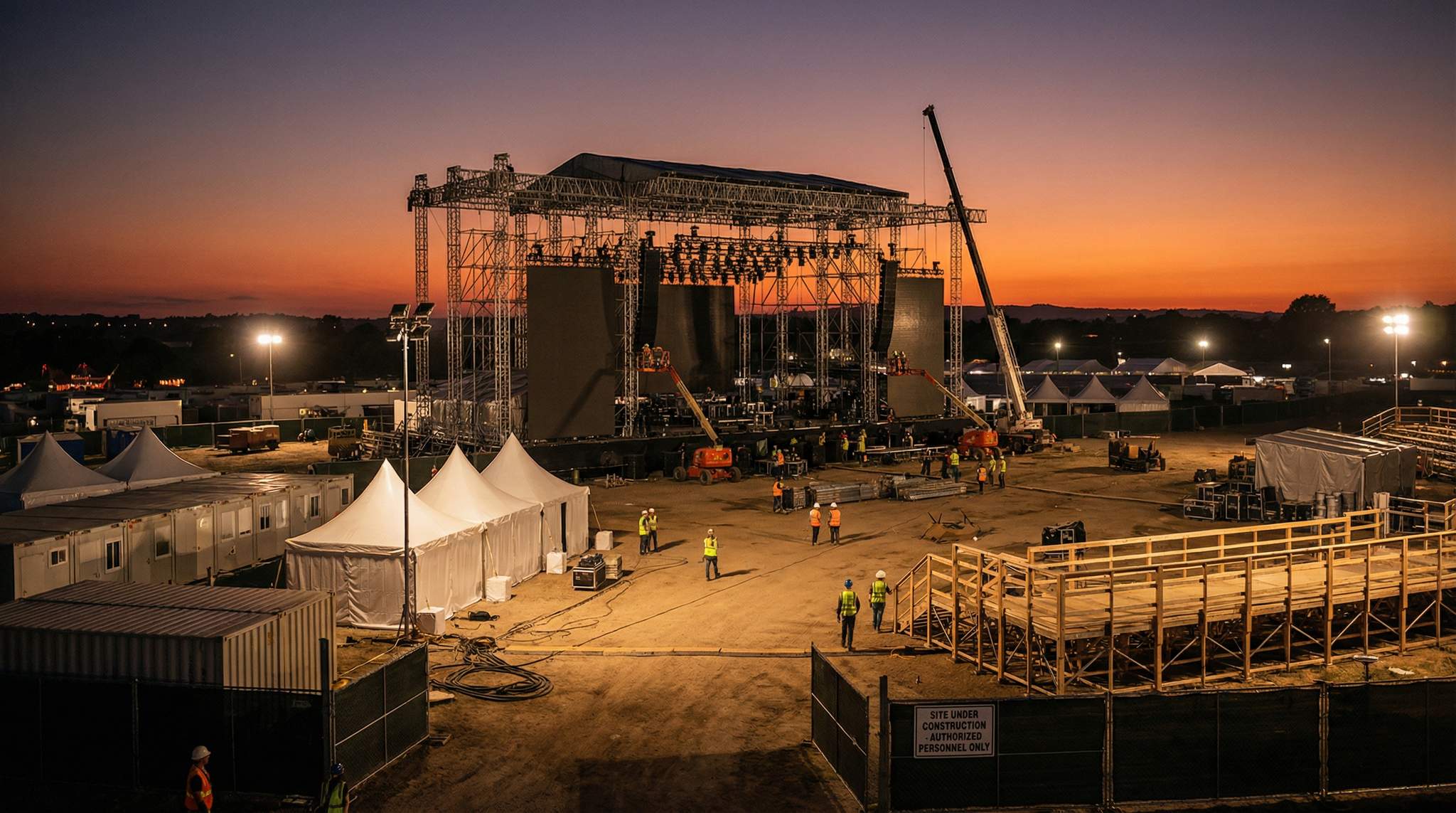
Turning a blank field or park into a festival venue is an immense undertaking. From intimate gatherings of a few hundred people to massive international festivals of 100,000+, organizers rely on temporary structures to create stages, shelters, seating, and entire back-of-house compounds from scratch. These structures are the skeletal framework of the event – stages where artists perform, tents that shelter attendees, platforms that provide views, and the many behind-the-scenes facilities that keep the festival running.
Beyond just the visible stages and tents, comprehensive temporary event infrastructure encompasses the foundational systems that make a greenfield site functional. This includes power distribution grids, temporary roadways, water supply lines, and high-capacity fencing. For festival producers, treating these pop-up facilities as a cohesive infrastructure project rather than isolated rentals is the key to operational efficiency and site safety.
Careful planning and safety oversight for temporary structures are absolutely critical. Unlike permanent venues, festivals face tight build timelines and variable site conditions (open fields, city streets, deserts) with structures that must assemble and disassemble quickly. Every stage platform, tent pole, and scaffold must be engineered to withstand crowds and weather. A single structural failure – whether a tent collapse in a storm or an overloaded viewing platform – can result in injuries and reputational disaster. By approaching temporary structures with the same rigor as permanent construction, top festival producers ensure a safe, memorable experience for all.
Key Stat: Festival site infrastructure and operations often consume 20–30% of an event’s total budget, according to Ticketfairy’s guide on budgeting for festival site operations. This significant cost underscores why strategic planning of temporary structures – balancing safety, comfort, and efficiency – is essential for a festival’s success.
Table of Contents
- Planning and Permitting Temporary Structures
- Designing Temporary Festival Stages for Safety
- Budget-Friendly DIY Festival Stage Solutions
- Selecting and Setting Up Festival Tents and Shelters
- Stretch Tents, Domes, and Inflatables: Creative Alternatives
- Brand Activations and Business Events: Customizing Temporary Structures
- Weather-Proofing Festival Structures for Extreme Conditions
- Audience Seating and Bleachers: Sightlines and Safety
- VIP Platforms and Elevated Viewing Decks
- Backstage Compounds and Green Rooms
- Shipping Containers and Modular Units
- Sanitation Facilities: Porta-Potties vs. Restroom Trailers
- Smart Tech: IoT Monitoring for Structural Safety
- Essential Reading
- FAQ
- Glossary
- Conclusion
Planning and Permitting Temporary Structures
Every successful festival structure starts with meticulous planning and compliance. Organizers must work closely with local authorities on permits, safety codes, and inspections long before the event. Many jurisdictions treat large temporary structures much like buildings – for example, Seattle requires a permit for any tent over 400 square feet, as detailed in Seattle Fire Department regulations for special events, and fire codes dictate features like exit signage and flame-retardant materials. Internationally, regulations can vary (the UK’s guidelines in the Purple Guide insist on structural engineer sign-offs for big tops and stages), but the core principle is universal: start the approval process early. Major festivals often begin permitting and structural design 6–12 months in advance to accommodate engineering reviews and any required revisions.
Planning also involves booking the right suppliers and budgeting ample time for on-site construction. Top producers create detailed timelines for when each structure will be built and taken down, accounting for everything from ground preparation to final safety checks. Temporary stages, grandstand seating, and large tents should be sourced well ahead of time – especially for peak festival seasons when rental inventory is limited. Engaging a professional structural engineer to review designs is considered best practice; according to industry safety experts, temporary festival stages and roofs should receive the same level of scrutiny as permanent buildings. All this preparation pays off when the site build goes smoothly and every structure is safe and fully certified when the festival opens.
Planning a Festival?
Ticket Fairy's festival ticketing platform handles multi-day passes, RFID wristbands, and complex festival operations.
Procuring reliable temporary event infrastructure requires vetting vendors who can scale their inventory to match your site plan. Venue managers and promoters must ensure that all short-term site infrastructure—from heavy-duty trackway panels that protect the grounds to the modular truss systems—integrates seamlessly. A unified approach to sourcing these foundational elements minimizes logistical friction during the high-pressure build week.
Pro Tip: Engage local officials and structural engineers at least a year before a major festival. Early input on structural plans and permit requirements helps avoid last-minute compliance issues and ensures stages, tents, and viewing platforms meet all safety codes.
To illustrate a high-level timeline, below is a planning schedule for key temporary structures:
| Task / Structure | Planning Lead Time | Notes |
|---|---|---|
| Permits & Approvals | Initiate 6–12 months before event; final permit 1 month prior | Early contact with authorities prevents permitting delays. Large events may need special engineering studies. |
| Major Stage Design & Engineering | Begin 8–12 months prior (for main stages) | Allow time for structural calculations, wind load analysis, and independent design checks. Iterations often needed. |
| Tents & Large Canopies | Book rentals 4–6 months out (earlier for peak season) | Popular tent sizes and suppliers book quickly. Ensure providers supply fire certificates and wind ratings. |
| Bleachers & Grandstands | Reserve 3–6 months out | Limited companies provide big bleacher systems. Plan for installation a few days pre-event including bracing and safety inspection. |
| On-Site Build & Inspection | Start major builds 1–2 weeks before opening; inspect 1 day prior | Stages and large structures often take over a week to assemble. Schedule final engineer or fire marshal inspection just before gates open. |
Designing Temporary Festival Stages for Safety
The main stage is often the centerpiece of a festival – and one of the most complex temporary structures to build safely. Unlike smaller setups, a large festival stage includes a deck supporting performers and equipment, a roof holding lights and sound systems, and often tall side structures for video screens. Ensuring this all-weather, load-bearing structure is secure starts with professional design. Leading festivals hire experienced staging companies that provide engineered stage systems with certified weight capacities and wind resistance. Every connection – from truss bolts to ground anchors – must be load-rated and correctly installed. As a best practice, a qualified structural engineer should review and sign off on critical stage designs. In addition, organizers develop formal safety plans: if winds exceed certain speeds (often ~30–40 mph), the stage lighting grid is lowered or the area evacuated as a precaution.
Producers also draw on hard lessons from past incidents to refine stage safety. Warning: A stage rigging collapse in a 59 mph wind gust at the Indiana State Fair (2011) killed seven people, and investigators found the structure didn’t meet safety standards while an emergency weather plan was lacking. Modern festivals respond by having strict wind action trigger policies and redundant safety measures (e.g. secondary guy wires, wind braces on roofs). Major festival stages today are built to withstand moderate storms, but they are also designed to be swiftly lowered or cleared if extreme weather hits. No show is worth risking lives, so if high winds or lightning approach, seasoned teams will delay performances and secure the stage rather than push on unsafely, as noted in safety alerts regarding temporary stage risks. By following established guidelines for building temporary festival stages safely – including proper ballast, wind bracing, and regular inspections – organizers greatly reduce the risk of a collapse and keep the focus on the music.
When sourcing temporary stages, organizers must evaluate the specific load-bearing needs of their production. A modular approach allows promoters to scale the footprint based on the acts booked, adding reinforced wings for heavy PA systems or extended thrusts for performer interaction. Procuring these temporary event structures from certified vendors ensures that the staging system arrives with up-to-date engineering documentation, which is critical for passing local municipal inspections.
Need Festival Funding?
Get the capital you need to book headliners, secure venues, and scale your festival production.
Building temporary festival stages with proper safety measures isn’t just about structure – it’s also about operational vigilance. Staff should monitor weather forecasts and watch for any signs of strain (like a swaying truss or loose connections). Many large events now station an experienced stage safety officer or rigger at main stages whose sole job is checking that all rigging and structural elements remain within safe parameters throughout the festival.
Beyond basic load-bearing capabilities, engineering temporary structures for music requires specialized attention to acoustic performance and audio rigging. Concert stages must safely support massive, suspended line-array PA systems, which introduce significant dynamic loads, especially when swaying in the wind. Furthermore, the materials and geometry of these temporary event structures can drastically impact sound quality. Professional production teams often utilize acoustic scrims and strategically angled roof canopies to project sound outward to the audience while minimizing noise bleed into neighboring communities. For outdoor concerts, integrating these audio-specific requirements into the initial structural design ensures both a safe environment and an optimal listening experience.
Budget-Friendly DIY Festival Stage Solutions
Not every festival can afford a massive engineered stage – especially smaller community events or start-ups working with limited funds. The good news is creative, low-cost stage solutions abound. Small festivals often rent a simple mobile stage (a fold-out stage trailer) or even repurpose local resources: for example, setting up on a flatbed truck trailer as a stage platform. With some plywood, carpeting, and a basic overhead cover, a truck bed or farm trailer can become a serviceable concert stage for a few hundred attendees. Community theaters or schools might loan portable risers that can be assembled into a stage. The key is to ensure stability and safety despite the DIY approach – bracing any makeshift stage, checking load limits on platforms, and being mindful not to overload with too much heavy equipment.
When working on a tight budget, prioritize the elements that deliver the most value. A basic covered stage to protect performers from sun or rain might be built from scaffolding and a sturdy tent canopy at a fraction of the cost of a professional stage roof. It won’t be as tall or impressive, but it can do the job for a local festival stage if properly secured. Organizers should still follow core safety practices from larger events: have an expert review the design, use proper hardware (no jury-rigged “home depot” solutions for structural connections), and always test the stage with some weight before showtime. Many first-time promoters have benefitted from small-scale DIY stage approaches used successfully at other festivals. Learning from those examples – whether it’s how to build a simple roof out of lighting truss or how todeploy local carpenters to assemble a stage – can spark ideas to keep costs down.
Boost Revenue With Smart Upsells
Sell merchandise, VIP upgrades, parking passes, and add-ons during checkout and via post-purchase emails. Increase average order value by up to 220%.
Pro Tip: Consider partnering with a local trucking or staging company. Renting a flatbed trailer as a ready-made stage platform can drastically cut costs compared to custom-building a stage deck. Just add railings and steps for safety, and you have a solid elevated platform that rolls on-site and sets up in hours.
Even for budget stages, plan for the worst-case scenarios. That means anchoring or weighting down a light stage cover so it doesn’t fly off in wind, using sandbags or concrete blocks as ballast if you can’t stake into ground. It also means setting clear rules about how many people (band members, crew, dancers) can be on the small stage at once so it’s never overloaded. The table below compares stage options by scale:
| Stage Option | Suitable Crowd Size | Approx. Cost (USD) |
|---|---|---|
| DIY basic stage (e.g. risers or flatbed trailer) | Up to ~500 attendees (small community events) | $500–$5,000 (materials or local rentals) |
| Mid-size mobile or scaffold stage | Up to ~5,000 attendees (regional festival) | $5,000–$25,000 (rental package) |
| Large professional concert stage | 10,000+ attendees (major festival main stage) | $50,000–$150,000 (engineered stage structure rental) |
Selecting and Setting Up Festival Tents and Shelters
Tents are the workhorses of festival infrastructure – providing stages with cover, shading audiences, housing food stalls, and sheltering operations like first aid or artist lounges. Choosing the right type and size of tent for each need is a fundamental planning task. Common festival tent styles include pole tents (traditional circus-style tents with center poles), frame tents (also known as clearspan structures, with an aluminum frame and no internal poles), and smaller pop-up canopies. Each has advantages: pole tents can cover very large areas and have an appealing classic look, while clearspan tents provide unobstructed space and can be erected on hard ground using ballast instead of stakes. Pop-up tents and canopies (10’x10’ or 20’x20’ easy-ups) are quick to deploy for vendor booths or small shelters, though they’re only suitable for fair weather and light winds.
Selecting tents starts with defining the purpose and capacity. Will it be an open-sided shade tent for 50 people or an enclosed shelter for a 500-person stage or workshop area? As a rule of thumb, allow roughly 10 square feet per person for standing-room shelter or 15 square feet per person for seating under a tent (accounting for aisles and a stage if applicable). So a 40’x40’ (1,600 sq ft) tent can comfortably host around 100–150 people seated or more if standing. Also factor in site conditions – a sloped or uneven field might complicate installing a large tent, and you may need flooring or platforms.
When setting up festival tents, safety and proper installation are paramount. Tents must be securely anchored either with long stakes driven into the ground or with heavy weights (water barrels, concrete blocks) as ballast on surfaces like asphalt. Each connection in the tent’s structure (clips, pins, ratchet straps) should be double-checked during build. It’s wise to follow a guide to selecting and safely installing festival tents provided by experienced crew or manufacturers – covering details like proper tensioning of tent fabric and lining up modular tent sections without gaps. Fire safety requirements also come into play: large tents typically need clearly marked exits and often emergency lighting, and the fabric must be certified flame-retardant. Don’t forget lighting and ventilation inside enclosed tents – for instance, using LED string lights (which produce little heat) and battery-operated fans for airflow on a hot day.
Here’s a quick comparison of festival tent types:
Smooth Entry With Mobile Check-In
Scan tickets and manage entry with our mobile check-in app. Supports photo ID verification, real-time capacity tracking, and multi-gate coordination.
| Tent Type | Features | Considerations |
|---|---|---|
| Pole Tent | Peaks with center poles; elegant look; can cover very large areas (e.g. 100’+ spans) | Requires staking into ground; center poles create interior obstructions; needs clearance around tent for guy lines. |
| Frame Tent (Clearspan) | No internal poles – open floor plan; can be installed on any surface using ballast; sturdy aluminum frame | Higher cost and heavier install (may require machinery for big frames); ideal for long-term or all-weather use. |
| Pop-up Canopy | Very quick setup (minutes); no poles except legs; great for small booths or shade | Not suitable for high winds or heavy rain; typically 10–20 foot sizes only; must be weighted down to avoid blowing away. |
Managing Vendor Villages and Small Activation Booths
While massive main stages draw the most attention, the financial lifeblood of many events relies on a different type of setup: the vendor village. When planning the layout for food and merchandise areas, organizers must carefully coordinate every small temporary structure at a fair or festival where goods or services are sold. These setups—ranging from 10×10 pop-up canopies to modular kiosks—require just as much logistical oversight as larger builds. A temporary tent at a fair used for selling crafts or food must still comply with local fire codes, including the use of flame-retardant fabrics and proper placement of fire extinguishers.
For operators managing these temporary structures for outdoor events, standardizing the vendor footprint is a proven best practice. By providing uniform temporary event structures (such as pre-installed frame tents with weighted ballasts) rather than allowing vendors to bring their own unpredictable pop-ups, producers can ensure a safer, more cohesive aesthetic. This approach minimizes the risk of a poorly secured vendor booth blowing away in high winds and simplifies the permitting process with local fire marshals, as the entire row of commercial booths can be inspected as a single engineered system.
Even a single temporary tent at a fair requires strict operational oversight. Venue managers must ensure that every small temporary structure at a fairground—whether housing a local craft vendor or a high-volume food and beverage operation—is properly anchored using approved ballast weights rather than relying solely on ground stakes, which may be prohibited on paved concourses. Establishing a standardized safety checklist for these smaller temporary festival structures prevents localized failures that could otherwise disrupt broader event operations.
Stretch Tents, Domes, and Inflatables: Creative Alternatives
Beyond standard tents, festivals increasingly experiment with alternative structures to create unique environments. Stretch tents – free-form canopies made of elasticated fabric – can be molded into organic shapes and anchored at variable heights. They are popular for VIP lounges, smaller stage covers, or experiential areas because of their stylish, flowing appearance. Stretch tents are extremely flexible in setup, able to fit irregular spaces, and can handle wind well when tensioned properly (the stretch fabric spills wind better than rigid tents). However, they are usually open-sided, so they provide shade and rain cover from above but less protection from sideways rain or cold.
Another eye-catching option is the geodesic dome, a hemispherical lattice structure made of interlocking metal or PVC struts. Domes are structurally very strong – the geometry distributes stress evenly – and they have been used as everything from dance music stages to immersive art galleries at festivals. A dome can be covered with fabric or panels to create an enclosed space or left partly open as a shade structure. Setup usually requires skilled crew and sometimes a crane for larger domes, but the result is a visually striking “mini-planetarium” for attendees. Festivals like Burning Man have long used geodesic domes for their durability in harsh desert winds.
Inflatable structures push creativity even further. Inflatables can form tunnels, igloo-like domes, even inflatable stage façades. They offer the advantage of ultra-fast deployment – essentially just add air. For example, a company might install a large inflatable dome that serves as a 360° projection theater at a festival, inflating it in a couple of hours. The interior can be climate-controlled and the walls used as projection surfaces. The trade-offs are that inflatables require continuous power for blowers (or they slowly deflate), and they have to be firmly secured so they don’t shift or roll if strong wind hits when they’re inflated. They are also vulnerable to sharp objects – a puncture in the wrong spot could be a big problem – though event-grade inflatables are made of tough material and often have multiple air chambers for redundancy.
Many boutique festivals use these alternative structures to set themselves apart. A stretch tent with colorful lighting can turn a generic seating area into a bohemian chill-out lounge. An inflatable arch or art installation at the entrance creates a “wow factor” landmark. Some European festivals have even stacked domes or combined stretch tents with trusses to create futuristic hybrid stages. When using exotic structures, it’s wise to have specialists on-site to manage them. The suppliers of stretch tents or inflatables should provide guidance on proper anchoring and wind limits. Warning: Never assume an alternative structure is foolproof – a giant inflatable can become a dangerous projectile if it’s not secured, and an improperly erected dome could buckle. Always follow the manufacturer’s guidelines and have a contingency plan (like deflating or evacuating an inflatable structure if winds exceed safe levels).
Brand Activations and Business Events: Customizing Temporary Structures
Beyond music and arts, festival organizers frequently collaborate with corporate sponsors to design immersive brand activations. These specialized temporary event structures must balance striking aesthetics with strict safety codes. Whether it is a multi-story VIP lounge for a tech sponsor or a climate-controlled pavilion for a B2B networking hub, adapting a temporary structure for events requires meticulous planning. For business events hosted within a larger festival footprint, operators often utilize modular glass-walled tents or custom-fabricated shipping containers. These high-end temporary festival structures provide a premium feel while maintaining the flexibility needed for rapid deployment and strike. Ensuring these corporate pop-ups integrate seamlessly into the overall site plan is a key revenue driver for modern event producers.
Weather-Proofing Festival Structures for Extreme Conditions
One of the biggest challenges for temporary structures is handling extreme weather. Festivals often take place outdoors during the riskier seasons – summer heat, thunderstorms, even early winter cold. Being prepared for wind, rain, heat, and cold is non-negotiable. Heavy rain demands waterproof tents (with rain flaps and sealed seams) and well-thought-out drainage – nothing kills the mood like water pooling in a tent or turning your audience area into mud. Savvy organizers use strategies like attaching gutter kits between adjacent tent tops to channel rain off, and grading the site or laying down mulch/ground cover so that pathways don’t flood. Wind is an even fiercer foe; sudden gusts can rip stakes out of the ground or topple an unsecured truss tower. Key tactics include over-spec’ing the anchor weights (better to have too many sandbags than too few), lowering stage roofs during high winds, and setting up wind breaks (like strategically placed trucks or barricades) to shield vulnerable structures. Many events will pause operation if winds exceed certain thresholds (e.g. sustained 30–35 mph winds might trigger an outdoor stage to temporarily close), a standard recommended by structural safety organizations.
Heat and cold bring their own structural considerations. In scorching heat, tents turn into ovens, so vented canopies or shade structures that allow airflow are vital – as are misting tents or cooling stations which themselves are temporary structures (often open-air tents with industrial misting fans). Key Stat: Outdoor concerts are facing more frequent extreme heat – a 2024 report highlighted a fatal heatwave at a festival in Rio de Janeiro, as reported by industry news sources, underscoring that providing shade, water, and cooling isn’t just comfort but life-safety. On the flip side, if an event runs in cold weather, structures need to accommodate heaters (ensuring fire safety with those heaters), and wind protection becomes critical for any tent expecting to hold people for long periods.
A comprehensive weather-proofing plan for festival tents and structures starts well before the event. Analyze historical weather data for your dates – if the area sees late-afternoon thunderstorms, have a evacuation and shelter plan ready for that time. If your festival is in a desert or plains known for high winds, invest in extra-durable tents and stage roofs with higher wind ratings, and consider hiring a weather monitoring service. Technology can help tremendously here: many large festivals now use IoT sensors that monitor wind speed on stage roofs or tent tension in real time (more on that in a later section). And when severe weather looms, nothing beats a clear chain of command and communication – someone on the team must have the authority to make the call to shut down stages or evacuate tents if conditions become unsafe.
Organizers also rely on industry resources to prepare. The American Rental Association’s ‘Safe Tenting Standard’ program offers tools and calculators to help crews ensure tents are properly ballasted and secured for expected winds via the Safe Tenting Standard program. Similarly, event safety guides often provide charts for how much weight a tent leg needs for given wind speeds. Warning: Ignoring weather risks can be catastrophic – there are cases where lack of a storm plan led to chaos as structures failed. It’s far better to spend an extra day reinforcing everything and to have a rain/wind delay protocol in place than to gamble on fair skies. In practice, weather-proofing is about both strengthening the structures and planning human responses (like evacuation routes from a tent, or emergency ponchos and shelter if a downpour hits). When done right, festivals can safely ride out even nasty surprises from Mother Nature with minimal disruption.
Audience Seating and Bleachers: Sightlines and Safety
Not all festival experiences involve dancing in a field – some events (film festivals, ceremonies, VIP zones at concerts) require audiences to sit. Temporary seating solutions range from simple rows of folding chairs to large bleacher grandstands that accommodate thousands. The goal is to keep attendees comfortable and safe while ensuring everyone gets a good view of the show. Achieving great sightlines is a design art: seating platforms or bleachers must be elevated enough so that each row sees over the row in front. This might mean calculating the rise per row (e.g. each row 8–12 inches higher than the one before) and the distance from stage. In flat chair setups, subtle staggering of seats and generous spacing can help people see between those in front of them. For very small “bring your own chair” events, it may be enough to mark a gentle slope or have ground-level risers for the back rows.
Safety is paramount when it comes to bleachers and grandstands. These are essentially temporary mini-structures themselves, often made of aluminum or steel scaffolding and planks. Every bolt and plank must be secure because if one piece gives way, it can cause a collapse like dominos. Rental bleachers from reputable vendors come with built-in safety features: guardrails at the back and sides to prevent falls, non-slip surfaces, and cross-bracing to keep the structure rigid. Still, the event crew should always inspect bleachers after installation – walk the rows, tighten any loose hardware, and ensure the unit sits level (shim if needed on uneven ground). Don’t forget ground conditions: a fully occupied grandstand concentrates a lot of weight in a small area, which can sink into soft soil, a risk highlighted in guides on temporary seating and bleachers for festivals. If placing on grass or dirt, use wood blocks or steel plates under the footings if necessary to distribute the load.
Providing comfortable seating also involves meeting local fire and building codes. This can dictate things like maximum seats per row before an aisle is required (e.g. many codes say 14–20 seats then you need an aisle), and minimum aisle widths for safe egress. For instance, an audience of 500 in rows of chairs might need at least 3 or 4 well-marked aisles to ensure everyone can exit quickly in an emergency. It’s crucial to follow these rules – they’re designed to prevent bottlenecks in a panic situation. As an organizer, you should map out seating sections with clear access and exit routes. Also plan for accessibility: include some wheelchair spaces at viewing areas, and if using bleachers, provide an alternative viewing area for those unable to climb the steps.
Attendees will absolutely notice if seating is uncomfortable or poorly arranged – and that feedback can hurt a festival’s reputation. Simple touches make a big difference: spacing chairs so people aren’t elbow-to-elbow, ensuring bleachers have guardrails and maybe even handrails for steep aisles, and keeping seating areas clean (no debris or spilled drinks that could be slip hazards). When laying out a seating plan, it helps to simulate the audience experience. Pro Tip: During setup, climb to the top row of your bleachers or sit in the back row of chairs and look toward the stage. This on-site sightline test lets you catch any view obstructions or layout issues and adjust the seating arrangement before gates open.
Despite best efforts, temporary seating can pose risks if mishandled. Warning: Never cut corners on bleacher assembly. Using mismatched parts, failing to install all required bracing, or skipping the guardrails can turn a grandstand into an accident waiting to happen. There have been instances at local events where poorly set-up bleachers collapsed or audience members fell off the back – exactly the kind of incident a professional producer works hard to prevent. By using quality equipment and rigorously following safety checklists, even a temporary seating setup can be as secure as a permanent venue. For a deeper dive into specifics, such as sightline geometry and anchoring strategies, refer to a detailed guide on planning festival bleachers and seating safely.
VIP Platforms and Elevated Viewing Decks
Most large festivals now offer VIP or premium viewing areas – and these often require elevated platforms so that high-paying guests have a clear, unobstructed view above the general crowd. Building a VIP deck is somewhat like a mini stage build: typically a scaffolding or truss-supported platform, topped with plywood or tech-stage panels, with railings, stairs, and sometimes even a roof. Safety for these structures is just as critical as for the main stage, especially since guests will be walking, dancing, and sometimes consuming alcohol on them. A well-built VIP platform will include toe boards and railings to prevent anyone slipping off the edges, and it will be rated for a certain capacity (e.g. no more than 50 people on a 20’x20’ deck). Security staff or signage must enforce those limits.
When planning a VIP viewing platform, think about accessibility and comfort as well. If it’s more than a few feet high, you may need to incorporate a wheelchair-accessible ramp or even an elevator lift to comply with disability access laws. In fact, one festival that pioneered a container-based VIP deck found by the next year they needed to install an elevator for accessibility, as noted in case studies on shipping containers and modular structures on festival sites. Internally, consider how the platform will be furnished – many VIP decks have lounges or bar areas on them, which means additional weight (furniture, people congregating) that the structure must support. Always communicate with the structure provider about these use cases. For example, if you plan to put a DJ booth or heavy décor on a VIP deck, those loads should be accounted for in the design.
Ensuring an elevated VIP viewing platform is both safe and premium involves some creative choices too. Organizers often dress these platforms with branded scrim, carpeting, and shade sails or tents to give a luxury feel. But none of those touches should compromise the underlying safety – e.g., do not drill holes in the stage deck to secure décor if it’s not allowed, and don’t overload one side of the platform with too many people at once. Guardrails should be never removed for a “better view”; instead, design the platform height and distance such that even with rails, VIPs have a fantastic line of sight. It’s worth noting that VIP structures can attract influencers and media attention, so their failure would be extra damaging. Therefore, festivals typically over-engineer these decks for peace of mind. The same companies that build concert stages often build the VIP platforms, using similar materials and calculations, just on a smaller scale.
Finally, consider the environment and vibe. VIP decks are usually adjacent to the main stage or front-of-house, but make sure they don’t block sightlines for everyone else or feel like an eyesore. A thoughtful design might integrate the platform with the stage aesthetics or lighting, so it feels like a natural part of the venue. At some music festivals, multi-level VIP risers flank the stage and are incorporated into the stage design itself. At others, stand-alone viewing platforms are erected at a sweet spot in the field. In all cases, the structure must be solid – no wobble when people dance on it – and the experience should feel exclusive yet safe. After all, VIPs are paying for an elevated experience in every sense of the word.
Backstage Compounds and Green Rooms
Behind the scenes, festivals are supported by a hidden village of backstage structures. These include artist green rooms, production offices, catering tents, crew break areas, storage units for equipment, and more. Since most outdoor festival sites don’t have permanent buildings, temporary structures must fulfill all these functions. A typical backstage compound might be a fenced-off zone with a cluster of small frame tents or modular cabins serving as dressing rooms for artists, a hospitality lounge, and office space for managers and communications. Ensuring these spaces are comfortable and functional is key to smooth operations and happy performers.
For artist areas, privacy and comfort are top priorities. Festivals often erect 10’x10’ or 10’x20’ green room tents for each act – outfitting them with rugs, couches, mirrors, and AC units – or bring in specialized portable dressing room cabins. In fact, some events use mobile dressing room vans as on-site green rooms, which are literally vehicles converted into luxe dressing spaces that can be driven in and parked backstage. These green room on wheels solutions come fully equipped (with power, lighting, even showers in some cases), saving the organizer from having to build out a lounge tent from scratch. Whether it’s a tent or a trailer, each green room should be clearly labeled and ideally climate-controlled (artists coming off a hot stage really appreciate blasting AC). Don’t forget practicalities like secure storage (lockboxes or guard presence) and nearby restroom access – many festivals position a couple of VIP-grade portable restrooms or a small restroom trailer in the backstage area for artists and crew.
Backstage compounds also include structures for production teams. The main production office is often a larger tent or modular unit where festival directors, stage managers, and communications staff coordinate. This space needs tables, chairs, Wi-Fi – essentially a temporary HQ – so the structure must be robust enough to support that equipment (like lighting for nighttime, or generators outside powering laptops and radios). Other common structures are the catering tent (where crew and artists grab meals – usually a big tent with tables and buffet setup) and storage tents or containers for equipment and instruments. Having dedicated covered space for all these functions keeps the festival running on schedule – e.g., if a storm hits, the show can continue once it passes because the gear was safely stowed under cover, and artists had a dry place to wait.
When laying out backstage structures, safety and workflow are important. There should be clear routes (often gravel paths or temporary flooring) connecting the stage to the dressing rooms, so artists don’t trip or wade through mud. Generators and power distribution for backstage are usually kept outside tents for ventilation and noise reasons – often housed under a small canopy or within a three-sided barricade for safety. Security fencing is critical: the entire compound is typically encircled by an opaque fence or barrier with controlled access points, so unauthorized people can’t wander in. That fence itself is a temporary structure that must be installed firmly (driven posts or water-filled barriers) to stand up to wind and keep prying eyes out.
The comfort of artists and crew directly affects the festival’s success. Top festivals put considerable effort into designing backstage compounds and green room facilities that feel secure and inviting. That can mean adding nice touches like flooring in the tents (to avoid a muddy ground), climate control, and even décor or branding that matches the festival theme so artists feel the event’s vibe even backstage. Pro Tip: If using modular containers or trailers for backstage rooms, label or color-code each unit by its function on the site map (e.g., “Band A – Green Room”, “Production Office”, “Catering”) and on the unit itself. This way, crew and artists can navigate easily, and there’s no confusion about which tent or cabin is which.
One more backstage structure not to overlook: the crew HQ or wellness tent. Festivals are long, hard days for staff, so providing a small crew-only tent with some seating, first aid supplies, and maybe a coffee station goes a long way. It’s usually a simple 10’x10’ pop-up tucked near the production office, but it becomes a critical recharge spot for the teams working behind the scenes.
Shipping Containers and Modular Units
In recent years, shipping containers and other modular structures have become a game-changer on festival sites. A standard 20-foot or 40-foot shipping container, originally built to withstand ocean voyages, can be quickly turned into a secure festival office, a pop-up bar, a merchandise shop, or even part of a stage design. The appeal lies in their strength and convenience: containers are essentially giant LEGO blocks. They arrive on a truck, a crane can drop them exactly where needed, and they’re immediately a solid building – wind-proof, rain-proof, and lockable. Many festival producers are using shipping containers as modular structures on site to add everything from ticket booths to artist green rooms in a matter of hours.
One popular use is stacking containers to create multi-level spaces. For example, two or three containers can be arranged in a U-shape and topped with a platform to form a raised VIP lounge or viewing deck (with the containers below serving as bars or storage). This approach was used at a European festival where a “wine garden” bar was made from two stacked containers, an example of creative modular structure usage. However, the moment you start stacking, you’ve effectively created a building – structural safety and access become big factors. Warning: If you plan to stack containers or significantly modify them (cutting windows, etc.), involve a structural engineer. Removing too much of a container’s wall for a door or stage opening can weaken its rigidity if not reinforced. And stacking containers requires proper alignment and possibly bolting them together so they don’t shift. Additionally, any second-story container or deck on containers must have railings and safe stairs (one festival found they needed to add an elevator to a container VIP deck for accessibility, as discussed in guides on modular unit accessibility, as mentioned earlier in VIP section).
Even at ground level, containers and modular units need careful placement. They are extremely heavy (a 40’ steel container can weigh 8,000+ lbs empty), so ensure the ground can support that weight – avoid soft, muddy areas unless you first lay down gravel or pads. You also need the right equipment on-site (usually a crane or telescopic forklift) to unload and position them. That means planning access routes for that machinery during build and break.
The beauty of modular units is how they can be customized. Many companies rent out prefab cabins or converted containers for events, complete with features like built-in air conditioning, lighting, and counters. For instance, a container can arrive already fitted with serving windows and be deployed as a self-contained bar. From a sustainability perspective, using containers can be eco-friendly too – they are reusable year after year, reducing construction waste. In fact, some festivals store their modified containers and simply bring them back each edition, rather than constructing new temporary wooden structures each time.
Pro Tip: Leverage color and signage on modular structures. Paint or wrap shipping containers in different colors to denote their function (e.g., blue for medical, green for info kiosk, red for staff only) and mark them on your site map. This not only helps attendees and crew find facilities quickly, but the containers become part of the festival aesthetics rather than looking like random steel boxes.
One consideration with containers is ventilation and temperature – metal boxes can get very hot inside in the sun. Always account for AC units or fans if people will occupy them. Also plan for power distribution: a container office will need generator hook-ups just like a tented office would. Lastly, think about the flow and facade: sometimes containers lined up in a row can create a tunnel effect or feel industrial. Break up container clusters with some open tents or decor so that the festival ambiance remains inviting. Some events let artists paint murals on containers, turning them into art pieces that double as walls – an efficient dual use of structure and art.
Sanitation Facilities: Porta-Potties vs. Restroom Trailers
No glamour here, but sanitation structures are absolutely essential to attendee experience. Festivals typically have two main options for restrooms: the classic portable chemical toilet (porta-potty) and the upscale portable restroom trailer. Each serves a purpose, and often festivals will use both – banks of porta-potties for general admission and a few restroom trailers for VIP or backstage. How do you decide what mix you need? It comes down to scale, budget, and attendee expectations.
For large crowds on a limited budget, you can’t beat porta-potties. They are inexpensive, and you can deploy dozens or hundreds of them relatively easily across a big site. Modern units are actually quite serviceable if maintained – vented, with hand sanitizer pumps, etc. The key is to have enough of them and service them regularly (pumping out waste and restocking supplies). A common guideline is about 1 toilet per 50–75 attendees for events that last several hours, according to festival sanitation planning guidelines, adjusted upward if the event is longer or if alcohol is being served (since that increases usage). For multi-day festivals, planners schedule vacuum truck servicing during overnight hours to keep units clean. Placing them strategically (clusters near stages, campgrounds, etc., plus some ADA-accessible units on level ground) is part of the logistics plan.
Restroom trailers, on the other hand, offer a luxury bathroom experience: real flushing toilets, running water sinks, mirrors, lighting, and climate control. These are fantastic for VIP areas, artist compounds, or boutique festivals where a higher-end experience is expected. Attendees definitely appreciate the comfort – especially at multi-day events, having a place with air conditioning and a clean interior can be a selling point. The downside is cost and complexity: trailers can cost many times more than porta-potties, require water fill and wastewater removal, and need power to run the pumps and A/C. They also take longer to set up (you have to truck them in and maneuver into place) and each trailer only contains a few stalls, so they don’t scale as efficiently for huge crowds.
So which to use? In practice, most festivals provide a base of porta-potties to cover the masses, and then layer trailers for VIPs or special zones. For example, an upscale wine tasting festival might primarily use restroom trailers for all attendees to maintain a certain image, whereas a giant outdoor concert will have fields of porta-potties with perhaps one trailer tucked in VIP. Critically, whichever mix you choose, maintenance is crucial: even the nicest trailer will become unpleasant if not cleaned, and a well-serviced porta-potty area (frequent pumping, deodorizing, with portable hand-wash stations added) can be perfectly adequate.
Key Stat: Industry planners recommend roughly 1 portable toilet per 50–75 people, a standard cited in comparisons of portable restroom trailers vs. porta-potties for events of a few hours, and at least 1 per 20–50 people for all-day or multi-day festivals (since usage accumulates). These ratios ensure short lines and a better experience – skimping on toilets is a surefire way to upset attendees.
Besides toilets, don’t forget other sanitation structures: hand-washing stations (often foot-pump sink units) are important for food areas, and some festivals bring in shower trailers for campers or multi-day events. These too need placement planning (flat ground, easy pump-truck access for greywater, etc.). Greywater from sinks and showers often has to be collected in bladders or tanks if not plumbed out.
To summarize the comparison between porta-potties and restroom trailers, here’s a quick look:
| Factor | Standard Porta-Potties | Restroom Trailers |
|---|---|---|
| Capacity & Quantity | Typically 1 unit per ~50-75 people (per several hours). Large events deploy dozens to hundreds of units. | Each trailer contains multiple stalls (e.g. 2–10); fewer units needed, but each serves more people at once (a 6-stall trailer might serve 300+ people). |
| Comfort & Amenities | Basic toilet with chemical tank; no running water (hand sanitizer only); very utilitarian. | Flushing toilets, running water sinks, lights, mirrors, sometimes A/C and music; essentially a real bathroom. |
| Utilities Required | No external water or power needed; standalone units. | Requires water supply (tank or hookup), power (generator or grid) and periodic waste pumping; needs level ground for setup. |
| Cost (Rental) | Roughly $50–$100 per unit for a weekend (plus servicing fees); cheapest option per capita. | Much higher – often $1,000+ per day for a large luxury trailer; high-end experience comes at a premium cost. |
Whether you opt for rows of plastic loos or fancy trailers, placement and maintenance are key. Always place restrooms slightly away from food areas and upwind of attendee zones if possible (trailers are less smelly than porta-potties, but still). Provide lighting for nighttime – some portable units now have built-in lights, otherwise use tower lights to illuminate the areas. And have a cleaning crew on schedule: there’s nothing more off-putting than an overflowing or filthy festival toilet. A little bit of attentive sanitation management will keep the inevitable necessity from becoming a talking point (for the wrong reasons).
(Also, pro-tip: always budget for a few more toilet units than you think you need. It’s better to have a couple unused porta-potties than lines of uncomfortable attendees.)
Smart Tech: IoT Monitoring for Structural Safety
In the digital age, festival producers are turning to smart technology to enhance the safety of their temporary structures. IoT (Internet of Things) sensors can now be attached to stages, tents, and other setups to provide real-time monitoring of structural conditions. For example, wireless anemometers (wind meters) mounted on a stage roof will continuously send wind speed data to a mobile app, alerting organizers if gusts approach predefined action levels. Similarly, load sensors can be placed on truss systems or scaffolding joints to detect any unusual strain or movement – essentially acting as an early warning if a connection starts to loosen or if weight distribution shifts unexpectedly.
One emerging application is smart tent monitoring. High-end festival tent systems can include tension sensors at key anchor points that measure how taut the tent fabric is and how much force wind is exerting on it. If one corner of the tent loses tension (maybe a stake came partially out or a strap snapped), the system can notify the site manager to check it before it becomes a bigger problem. There are even sensors that monitor the incline or tilt of lighting towers and speaker stands – if a tower begins to lean beyond safe limits, an alert is sent out so crew can address it or clear the area. By deploying IoT monitoring on festival tents and stages, organizers add an extra layer of safety on top of human inspections.
The benefit of these systems is continuous oversight. Human crews can’t be everywhere at once or might not notice a subtle wobble in a structure, but a sensor will. Many sensor systems feed into a central dashboard in the event control room. During a festival, the operations team can glance at a screen and see green/yellow/red status for various structures on-site. For instance, “Stage A wind load: Green (15 mph), Stage B: Yellow (28 mph gusts detected)” and so on. This helps in making informed decisions like “let’s pause the show at Stage B until this gusty period passes.” Some festivals have also implemented lightning detection systems (with sensors and software that track strikes in the area) to know when to shut down stages and send people to shelter. While not physically attached to structures, it’s another tech tool to protect structures and attendees from weather threats.
It’s worth noting that IoT safety tech is still a supplement, not a replacement, for good engineering and on-site crew diligence. Batteries can die, signals can drop – so organizers use these tools in tandem with regular physical checks. For instance, if a tent sensor pings that tension is low on one side, the response is for crew to immediately inspect that tent’s stakes and ratchets. In many ways, the technology just makes the safety process more proactive. Instead of discovering an issue by seeing it (or worse, after a failure), you get data that nudges you to “go check that now.” It shifts some of the safety checks from schedule-based (e.g. inspect each morning) to condition-based (inspect when a sensor detects an anomaly, even if that’s mid-event).
There’s also a future-forward aspect: as festivals adopt more sustainability measures, IoT can help with power management of structures (like tracking power consumption in a container office to optimize generator use) or with attendee flow (sensors on structures to estimate crowd density, etc.). But at the core, sensors on temporary structures are about catching the subtle signs of stress or risk that humans might miss amid the festival frenzy. It’s another example of how even age-old aspects of festivals – tents and stages – are evolving with innovation.
Essential Reading
- Temporary Seating and Bleachers for Festivals: Planning for Sightlines, Safety, and Comfort
- Weather-Proofing Festival Tents and Structures
- Green Room on the Go: Mobile Dressing Room Vans for Festivals
- Festival VIP Decks and Viewing Platforms: Safety and Premium Experience Elevated
- Festival Backstage Compounds and Green Rooms: Ensuring Comfort and Smooth Operations
- Shipping Containers and Modular Structures on Festival Sites
- Festival Tents and Temporary Shelters: Selection and Setup
- Stages on a Budget: DIY and Small-Scale Structures for Festivals
- Festival Sanitation: Portable Restroom Trailers vs. Porta-Potties
- Smart Festival Structures: IoT Monitoring for Tent and Stage Safety
- Stretch Tents, Domes, and Inflatables: Alternative Temporary Structures for Festivals
- Building Temporary Festival Stages Safely
FAQ
How early should we start planning temporary structures and permits?
For a major festival, planning for stages, tents, and other structures should begin 6–12 months in advance. This lead time allows you to consult structural engineers, secure permits (which many cities require at least 30–60 days before the event), and book reputable vendors. Smaller events might compress this timeline, but as a rule, earlier is better – last-minute structural changes or rushed permits can derail an event. Starting early ensures you can meet all safety codes and have the right infrastructure reserved for your dates.
Do festival tents and stages need special permits or approval?
Often, yes. Many local authorities treat large tents, stages, and structures as temporary buildings that require permits or licenses. For example, big tents usually need a fire department permit (to ensure the fabric is flame-retardant, exits are adequate, etc.). Stages and elevated platforms may require an inspection or engineer’s certification that they’re safely built. Every jurisdiction is different: some have specific “temporary structure” permits, others fold it into the general event permit. It’s crucial to check with the city or county early on and comply with all regulations – this can include submitting site plans, structural drawings, and scheduling on-site inspections before the festival opens.
How can we ensure a temporary stage is safe and won’t collapse?
To ensure stage safety, start with a professional stage system designed for your crowd size and environment. Use certified staging equipment (platforms, trusses, roof structures) and have a qualified rigger or structural engineer oversee the build. Key steps include: anchoring or ballasting the stage and roof per specifications (to resist wind uplift), not exceeding the stage’s weight limits (consider the combined weight of lights, speakers, and people), and conducting a thorough inspection before each show day. Also implement a wind action plan – for instance, agree that if winds exceed a set speed, the stage roof will be lowered or the performance paused. Continuous monitoring during the event (by on-site safety personnel or sensor systems) adds another layer of assurance. In short, proper design, proper build, and proactive monitoring are the trifecta for a safe stage.
What factors should we consider when choosing tents and shelters for a festival?
First, consider the purpose: Is it for audience shade, a beer hall, VIP lounge, or an artist green room? The use case will dictate size and style – e.g., a public beer tent might be a huge high-peak pole tent, whereas a backstage area might use smaller frame tents. Next, capacity and size: estimate how many people need to fit and ensure the tent’s rated size covers that with some buffer (remember to include space for any stages, tables, or equipment inside). Other factors include surface and anchoring – if the tent is on asphalt you’ll need ballast weights, not stakes. Weather is also key: in a windy or rainy locale, a robust clearspan (frame) tent with walls might be safer than an open pole tent. Don’t forget practical details like fire codes (tents should be certified flame-retardant and may need exit signs if enclosed) and access (do you need flooring for mud, ramps for accessibility?). Lastly, availability and setup time: large tents should be booked well ahead and can take a full day or more to install, so plan accordingly.
How do we weather-proof festival structures against storms?
Weather-proofing starts with using the right equipment and techniques. For rain, ensure all tents are waterproof (get rain flys or gutters between tents) and elevate sensitive equipment off the ground on pallets or staging in case of minor flooding. For wind, double-check all stakes, add extra tie-down straps or weights to tents and inflatables, and secure loose items (banners, decor) that could become airborne. It’s wise to lower any lightweight structures like inflatable art or speaker towers if high winds are forecast. Create a weather action plan: designate at what wind speed you’ll pause performances or evacuate large tents, and have staff ready to guide attendees to safe areas (for instance, to open ground away from structures if a severe storm hits). Lightning is another consideration – identify a safe shelter (even if it’s people sheltering in their cars or buses) and have a detection system or weather service to alert you to strikes. Essentially, design your site to shed water and withstand wind, and have an emergency protocol to temporarily evacuate or shut down parts of the event if needed. Rehearse that plan with your team so everyone knows their role if bad weather rolls in.
Are shipping containers and modular units safe to use as festival structures?
Yes – in fact they’re often extremely safe and durable when used correctly, but there are a few caveats. Shipping containers are built to be strong, so they handle weather and heavy use well (they won’t blow over or collapse under normal conditions). The main points to watch: placement and modification. When you place containers, make sure you have a stable, level surface that can bear the weight, and use a crane or lift with experienced operators so it’s set down safely. If you’re stacking containers or using them as elevated platforms, engage a structural engineer – stacked containers need to be secured to each other, and any deck or railing added on top must be properly designed. For modified containers (with windows, doors, etc.), ensure the structural integrity is maintained; cutting a big hole in a container can weaken it unless you reinforce the opening. Modular cabins (like portable offices) similarly should be put on stable ground and anchored if needed (some have tie-down points). One often overlooked aspect is exits and ventilation – if you use a container as a room for people, it should have adequate exits (at least one per container, often two if it’s a larger gathering space) and airflow or AC to prevent heat buildup. Within those guidelines, containers and modular units can be fantastic – they’re secure, weatherproof, and can even be locked up at night to protect gear.
Should we use porta-potties or restroom trailers at our festival?
It depends on your crowd size, budget, and the experience you want to provide – in many cases, a mix of both is ideal. Porta-potties are cost-effective and easy to deploy in large numbers, making them suitable for general admission areas and very large crowds. You’ll need enough units (typically 1 per 50-75 people for day events) and a plan to service them (cleaning and pumping) if your event is long. Restroom trailers offer a much nicer experience (flush toilets, AC, sinks) and can elevate the atmosphere for VIP zones, backstage, or upscale events. However, they are far more expensive per user and require water/power hookups. A common strategy: use mostly porta-potties for the main audience but add a few trailers in VIP areas or as family restrooms. If your event is high-end or small enough to afford it, providing trailers to everyone is a nice touch – just be sure to also supply things like ADA-compliant units and perhaps some porta-potties as backup (in case a trailer has an issue or for locations a big trailer can’t reach). Ultimately, for a typical festival expecting thousands, you handle the bulk with porta-potties and then use trailers as a premium option where justified. And whichever you choose, stay on top of maintenance – a well-maintained porta-potty unit is better than a filthy luxury trailer, in terms of attendee satisfaction.
What are the requirements for a small temporary structure at a fair or festival where goods or services are sold?
Even the smallest vendor booths and merchandise tents must adhere to strict safety and permitting guidelines. Organizers managing these temporary festival structures must ensure that every commercial canopy or kiosk uses flame-retardant materials, possesses the appropriate fire safety certificates, and is adequately weighted or staked to withstand wind loads. Additionally, local health and safety inspectors often require clear egress routes, proper electrical distribution for point-of-sale systems, and accessible sanitation stations nearby. Standardizing these vendor setups by renting commercial-grade temporary event structures in bulk is highly recommended to maintain site safety and compliance.
How do temporary structures for business events differ from standard festival tents?
When deploying temporary structures for business events or high-end brand activations, organizers typically prioritize premium aesthetics, climate control, and advanced AV integration. Unlike standard general admission shade canopies, a temporary structure for events catering to corporate clients often features hard glass walls, leveled cassette flooring, and custom branding facades. Despite the upgraded appearance, these short-term buildings must still adhere to the same rigorous permitting, wind-load engineering, and fire safety standards as any other temporary festival structure on the site.
How do organizers determine the correct load capacity for temporary stages?
Determining the load capacity for temporary stages requires calculating both the static weight of the production equipment (lighting rigs, LED video walls, and audio arrays) and the dynamic load of the performers and crew. Festival producers must work closely with staging vendors and structural engineers to ensure the chosen temporary event structures are rated for these specific loads, factoring in additional environmental stresses like wind resistance and potential water accumulation on the roof canopy.
What are the most important considerations when building temporary structures for music events?
When designing temporary structures for music, such as main concert stages or DJ pavilions, organizers must account for the heavy dynamic loads of audio equipment. Line-array PA systems and extensive lighting rigs require specialized rigging points and reinforced trusses. Additionally, the materials used in these temporary event structures can impact sound quality, making it essential to use acoustic scrims and proper roof angles to direct audio toward the audience while minimizing noise bleed into surrounding areas.
What is included in temporary event infrastructure?
Temporary event infrastructure goes beyond basic tents and stages to include all the foundational systems required to operate a pop-up venue safely. For festival organizers, this encompasses power generation and distribution (generators, cabling), site access materials (temporary roadways, ground protection mats, pedestrian walkways), perimeter security fencing, water and sanitation grids, and modular lighting towers. Essentially, it is the complete physical framework deployed to transform an empty field or parking lot into a fully functioning, compliant event site.
Glossary
- Ballast: Heavy weight used to secure temporary structures in lieu of stakes. Examples include water barrels or concrete blocks placed on tent legs or stage bases to prevent movement or uplift from wind.
- Bleachers: Tiered bench-style seating stands for audiences. Often made of aluminum or steel, bleachers provide elevation for spectators. Temporary bleachers must be assembled with secure bracing and usually include guardrails to prevent falls.
- Clearspan Tent: A type of frame tent that has no interior support poles (clear span) – it uses an aluminum or steel frame to support the fabric. Provides unobstructed interior space; ideal for large festival tents where poles would interfere with sightlines or layouts.
- Geodesic Dome: A spherical or hemispherical structure composed of interconnected triangles (struts). Geodesic domes are extremely strong for their weight and often used as temporary event structures (e.g. immersive domes, sound stages) that can handle wind well once covered.
- Green Room: Slang for the backstage room where artists or speakers relax before and after their performance. At festivals, green rooms are often temporary structures (tents, trailers, etc.) outfitted with seating, mirrors, and amenities for performer comfort.
- Guy Line: A tensioned rope, cable, or strap used to stabilize structures like tents, stages, or towers. One end attaches high on the structure, the other is anchored to the ground (with a stake or weight). Guy lines prevent swaying and add support, especially against wind forces.
- Inflatable Structure: A structure made of flexible material that maintains its shape when filled with air or gas. Common inflatables at festivals include domes, arches, and art pieces. They require continuous inflation (blowers) or an air-sealed design, and must be secured to the ground to stay in place.
- Modular Unit: A pre-fabricated portable building or structure, such as a shipping container, portable office cabin, or sectional booth. These units can be quickly deployed on site to serve as offices, ticket counters, etc., and often come with built-in amenities (lighting, AC). “Modular” indicates they can be combined or stacked as needed.
- Rigging: In festival terms, rigging refers to the system of ropes, cables, hoists, and hardware used to hang equipment (lights, speakers, banners) or to support elements of a structure. Rigging is also the process of securing these elements. Safe rigging is critical – it ensures heavy objects overhead stay properly attached to trusses or roof structures.
- Scaffolding: A temporary framework of metal poles and platforms used to support structures or workers during construction. In festivals, scaffolding is used to build stage platforms, viewing decks, camera towers, etc. It’s like an erector set that can be assembled in many configurations. Properly erected scaffold structures are very sturdy; they must be braced and often weighted or anchored.
- Truss: A structural element composed of triangular units, typically made from aluminum in event use. Truss is used to build frameworks like stage roofs, LED screen supports, and lighting hangs. It’s lightweight relative to its strength and can span long distances. Trusses must be connected and loaded according to specifications to remain rigid and safe.
- Temporary Demountable Structure (TDS): A formal term (often used in regulations) for any structure intended to be assembled and disassembled repeatedly. This includes stages, grandstands, tents, etc. The term emphasizes that, unlike permanent constructions, these structures are temporary but still require proper design and safety considerations as a building would.
Conclusion
Temporary structures truly enable the magic of festivals – they transform empty fields into electrifying concert arenas, gourmet villages, and vibrant cultural spaces for a few days. From the tallest stage down to the smallest tent stake, every piece must work in harmony to ensure a safe and seamless event. As we’ve seen, achieving this is equal parts engineering and art: it requires the calculation and caution of structural experts, the logistical choreography of production crews, and the creative vision to choose structures that fit a festival’s personality.
The best festival producers plan for all conditions and think holistically. They know a festival is like building a temporary city, and they approach it accordingly – with building codes, “public works” for power and sanitation, emergency services, and more, all set up on a blink-and-you’ll-miss-it schedule. Yet they also infuse these structures with character, making sure that even utilitarian elements contribute to the attendee experience (a brightly painted shipping container can become a beloved info booth, a stretch tent can define the style of an area). Looking ahead, temporary festival structures are evolving to be more sustainable and innovative – we’re seeing solar-powered lighting towers, stages built from sustainable materials, and increased reuse of components year after year to reduce waste.
In the end, when the lights come up on day one of a festival, attendees might not realize the immense effort and expertise that went into every stage and shelter around them – and that’s okay. If temporary structures are doing their job, they fade into the background of an unforgettable event, supporting the music, art, and community safely and effectively. But for those of us behind the scenes, it’s rewarding to know that through smart planning, hard work, and a bit of ingenuity, we can build whole worlds from nothing – and pack them up leaving no trace – all in the service of creating something truly special for a moment in time.