What Most Festivals Get Wrong About Crowd Safety (and How to Avoid a Disaster)
Crowd safety can make or break a festival. Yet time and again, well-intentioned organizers overlook critical details – and the results can be disastrous. From tragic crowd crushes at major events to near-miss stampedes at smaller festivals, most crowd incidents stem from the same preventable mistakes. When overlooked factors like flawed barrier layouts, poor communication, or untrained staff converge, a joyous celebration can turn dangerous in minutes. This article exposes the most common crowd safety errors festival producers make, with real-world examples of what happens when things go wrong. More importantly, it provides clear, practical steps to correct these mistakes so you can keep your event exhilarating and secure.
Organizing festivals for 35+ years across the globe has taught veteran producers one simple truth: safety is not automatic. It’s engineered through meticulous planning, continuous monitoring, and empowered teams ready to act at the first hint of trouble. Read on to learn what many festivals get wrong about crowd safety – and how you can avoid these pitfalls to protect your fans and your festival’s reputation.
Underestimating Crowd Dynamics and Behavior
Understanding how crowds move and behave is the foundation of festival safety – but it’s an area many organizers get wrong. One common mistake is assuming a crowd is just a bigger group of individuals, rather than a complex force with its own physics and psychology. Festivals often plan based on ideal conditions (“everyone will calmly exit here”) instead of preparing for the reality of human behavior under pressure.
Mastering crowd management at festivals means recognizing that these dynamic forces require proactive engineering, not just reactive policing. Successful event producers treat attendee flow as a core component of their site’s operational design, ensuring that every pathway, stage viewing area, and vendor zone is optimized for safe, continuous movement.
Data-Driven Event Marketing
Track ticket sales, demographics, marketing ROI, and social reach in real time. Exportable reports give you the insights to make smarter decisions.
At high densities, crowds behave less like people and more like a powerful fluid. Research shows that when crowd density exceeds roughly 4 people per square meter, even small nudges can escalate into shockwaves of force leading to crowd collapse. At 6–7 people per square meter, individuals can barely control their movement, and a phenomenon known as a “crowd quake” or crowd turbulence can occur – where one shove ripples through the mass, causing bodies to sway or fall in a chain reaction. Contrary to the myth of “mass panic,” many crowd disasters are caused by physics and density, not people suddenly behaving badly. In other words, good people in an overpacked space can still be at enormous risk. Organizers who underestimate this dynamic may not recognize danger until it’s too late.
Real-world tragedies underscore the cost of misjudging crowd behavior. At the 2010 Love Parade festival in Germany, planners expected attendees to flow normally through a tunnel entrance; instead, an overwhelming surge built up. Over 21 people died and more than 500 were injured when the tightly packed crowd in the tunnel ran out of space and a deadly crush ensued based on density dynamics. Investigators found no evidence of “stampede” or fan aggression – the crowd simply became so dense that people stumbled and a domino effect of compressive force occurred. It’s a stark reminder that any large crowd can turn dangerous if its movement isn’t managed.
Planning a Festival?
Ticket Fairy's festival ticketing platform handles multi-day passes, RFID wristbands, and complex festival operations.
Festival-goers’ mindset and demographics also play a role. Different audiences have different behaviors – for example, a crowd of excited teenagers at an EDM festival might rush the stage when the bass drops, whereas an older jazz festival audience is more likely to remain seated. Ignoring these distinctions is a mistake. If an artist is known for high-energy shows or even encourages “raging” (as was the case with Travis Scott at the Astroworld Festival), producers need to anticipate more extreme crowd surges. At the Astroworld Festival in 2021, 50,000 fans gathered for a notoriously rowdy headliner. Organizers failed to account for crowd surges in their safety plan and were slow to respond when distress signs emerged in the crowd. By the time the show was finally halted, a crowd crush had already claimed lives. (Notably, the festival’s detailed 56-page event plan covered scenarios like severe weather and bomb threats, but never mentioned specific crowd surge risk protocols).) The lesson is painfully clear: never assume “it won’t happen with our crowd.” Plan as if it could happen, no matter the genre or audience.
When evaluating music festival crowd safety, organizers must account for genre-specific triggers that alter physical density in seconds. A sudden tempo change, a surprise guest appearance, or a coordinated “wall of death” in heavy metal and punk shows can instantly compress the audience. Proactive live music crowd management requires operators to map these high-energy moments alongside the artist’s setlist, ensuring that security teams are braced for sudden shifts in audience pressure before the first note is even played.
How to Plan for Crowd Behavior
- Perform a Crowd Risk Assessment: Analyze your audience profile, expected peak crowd sizes, and movement patterns in advance. Identify high-risk moments (e.g. gate opening, headliner sets, end-of-night exits). As industry safety guides emphasize, you should calculate occupant load (maximum people in each area) and ensure the egress capacity examines the exit throughput can handle everyone quickly if needed. Furthermore, local building code often regulates these occupant load numbers. If 30,000 people are at the main stage, you need exits and pathways designed to let all 30,000 out safely.
- Know Critical Density Limits: Educate your team on warning signs of dangerous density. A moderately crowded festival still allows personal space and controlled movement. But if you start seeing 4–5 people per square meter packed together, that’s a red flag. At this point, individuals may be unable to freely turn or lift their arms – any stumble could escalate. If parts of your crowd begin swaying as a unit or people are shouting that they can’t breathe, treat it as an emergency immediately (more on responding swiftly in later sections).
- Leverage Crowd Science Expertise: Don’t rely on guesswork for large events. Consult experienced crowd managers or use simulation tools to model crowd flow in your venue. Veteran festival producers sometimes partner with crowd dynamics experts (such as professors of crowd science or firms specializing in event safety) to review site plans. Their insights can reveal subtle risks – like two pedestrian streams crossing that could cause “turbulence” – that you might otherwise miss. When planning one UK festival, organizers discovered via simulation that a food court placement would cause intersecting traffic with people leaving the main stage, creating a crush hazard. They redesigned that area before tickets ever went on sale, potentially averting a serious problem.
- Anticipate Audience Reactions: Include crowd behavior scenarios in your planning. For example, ask “What will our crowd likely do if there’s a sudden downpour? Or if the headliner is 30 minutes late?” If your attendees are younger and more impulsive, plan for how you’ll manage surges of excitement or frustration. If they’re older or include families, consider different needs (like more seating areas and calmer zones). The key is to avoid surprises – by mentally walking through how your specific crowd might behave at each phase of the event, you can prepare appropriate measures (like extra water stations during peak heat or additional security near high-energy mosh pit areas).
By respecting crowd dynamics from the outset, you lay the groundwork for all other safety measures. The next step is designing the festival environment itself to keep those dynamics in check.
Flawed Site Layouts Create Dangerous Choke Points
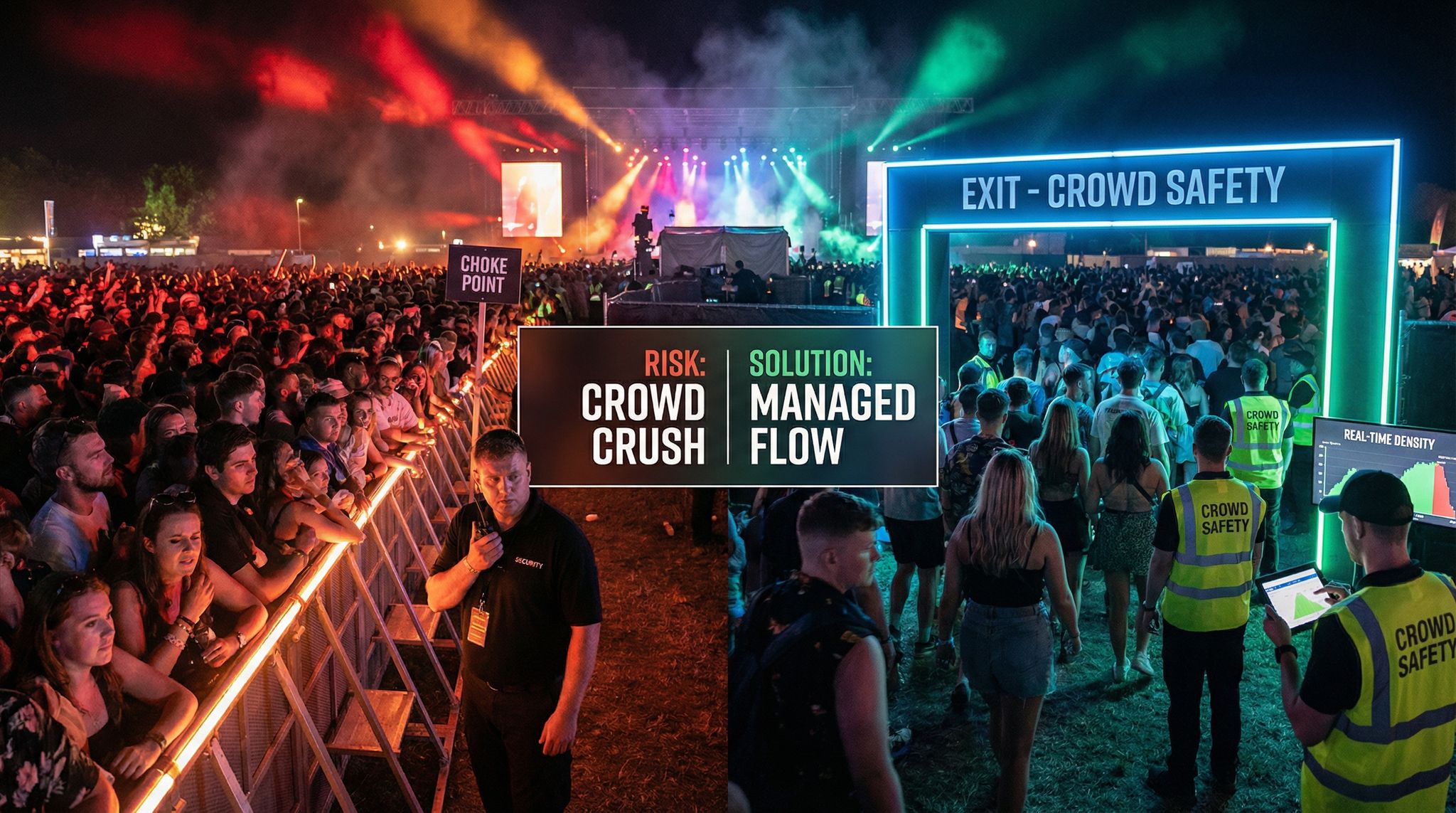
Where and how you arrange festival spaces – stages, exits, vendors, pathways – has a huge impact on crowd safety. Unfortunately, poor layout planning is a mistake that keeps repeating. Festival disasters often have one thing in common: a critical bottleneck or “trap” in the venue design. If thousands of people are funneled through too-small an area, or forced to stop in their tracks, dangerous pressure can build in the crowd.
Smooth Entry With Mobile Check-In
Scan tickets and manage entry with our mobile check-in app. Supports photo ID verification, real-time capacity tracking, and multi-gate coordination.
A tragic example was the Love Parade 2010 disaster mentioned earlier. The festival site was a former freight yard enclosed by fencing, with only one main entry/exit route through a tunnel ramp. When crowd density rose and movement stalled, people in the tunnel had nowhere to escape – a classic death trap scenario analyzed in safety studies. Similarly, smaller-scale incidents have occurred when venues fail to provide enough exits or create unintended dead-ends. Any layout that causes crowd flows to collide or suddenly stop can lead to a crush. Even in non-emergencies, poor design can cause distress – overheating, anxiety, minor trampling – that can snowball if a scare ripples through the crowd.
Many festivals mistakenly prioritize maximizing space usage or vendor visibility at the cost of safe flow. For instance, packing too many attractions in one zone or placing a popular stage at the end of a narrow pathway can be a recipe for congestion. Another common error is neglecting to separate ingress and egress. When incoming and outgoing streams of people intersect, it creates turbulence and gridlock. In worst cases, two opposing streams can squeeze those in the middle, raising the risk of compressive forces on people during surges. A well-known tactic to avoid this is designing clearly one-way routes in pinch-point areas. Sadly, many events overlook this simple fix, and attendees end up pushing against each other from opposite sides.
Need Festival Funding?
Get the capital you need to book headliners, secure venues, and scale your festival production.
Designing a Safer Festival Site
Experienced producers know that effective crowd management starts at the drawing board. Here are key layout principles to prevent choke points and keep crowds moving safely:
– Multiple Wide Entrance & Exit Points: Don’t rely on a single gate or narrow doorway for tens of thousands of people. Plan for multiple entry and exit portals around the perimeter, and make them wide. Distributing the crowd across several gates prevents dangerous buildup at any one point. Each exit should be clearly marked, illuminated, and sized for a quick full-venue evacuation. (Fire codes worldwide generally require that egress capacity examines the exit width – meaning your exits, in aggregate, must handle the maximum crowd with capacity to spare.) For example, Glastonbury Festival’s huge site has numerous exit routes and gates that can be opened in an emergency, so no area traps a crowd.
– Eliminate Blind Corners & Dead-Ends: Walk through your site map and identify any spot where a crowd could get bottlenecked. Look for sharp turns, fences ending abruptly, or cul-de-sacs formed by stage structures or vendor booths. These are hazard zones. Redesign them by widening the turn, adding an alternate route, or removing obstructions. A famous case: A U.S. music festival once had a narrow bridge between stages that caused massive bottlenecks; after attendee complaints and some falls, organizers replaced it with a temporary pedestrian causeway triple the width and added directional signage, resolving the issue.
– One-Way Flow in Key Areas: In high-traffic corridors, designate one-way lanes for foot traffic. For instance, if one path leads to the main stage and an adjacent path leads away, clearly signpost and staff those routes so people aren’t colliding head-on. Many festivals implement one-way systems after shows end – e.g., all foot traffic moves outward in loops toward camping or parking areas, and incoming routes are closed or redirected. This was effectively used at the 2012 Olympics concerts in Hyde Park, London: after the show, staff converted some entrance gates to exit-only and used barriers to guide thousands safely out in one direction.
– Avoid Tight Corridors & Pinch Points: Widen your walkways. A common mistake is underestimating how much space a mass of people actually needs. Even if a path is fine for 100 people per minute, what about 1,000 per minute after a headliner? As a rule of thumb, main arteries (between stages, or from stages to exits) should be extremely wide and never obstructed. If your venue has physical constraints (like a bridge or tunnel), limit how many people can access that area at once. You may need to station staff as flow controllers, temporarily halting people entering a narrow zone until others have passed through (similar to how subways regulate crowd entry during rush hour).
– Strategic Placement of Amenities: An underrated way to spread a crowd is via where you put attractions. If all the popular features (main stage, best food vendors, restrooms) cluster in one section, everyone will gravitate there. Instead, disperse these draws. Place some food, merch, medical tents, and other amenities in each major area of the grounds. This way, people have reasons to occupy different zones rather than all cramming into one spot. For example, Coachella traditionally spreads its stages across a large polo field with art installations, vendors, and shade tents distributed throughout, encouraging attendees to roam rather than constantly mob one area.
– Zoning and Section Barriers: For very large festivals, consider dividing the crowd into zones with internal barriers. This concept – often used in mega-concerts – creates “pens” or sections so that you don’t have 100,000 people as one homogeneous mass. Each zone might hold a limited number of people with access to its own exits and facilities. If done thoughtfully, zoning prevents a single surge from propagating through an entire crowd. For instance, Belgium’s Tomorrowland uses sectioned areas and pathways between stages, along with real-time monitoring, to ensure no zone exceeds safe capacity. Barriers should be used not to block people arbitrarily, but to guide and diffuse crowd pressure. Curved barriers, for example, can redistribute the force of a crowd pushing forward, reducing the risk of collapse or injury at the front.
Even as you optimize layout, maintain flexibility. Have backup plans to reroute crowds on the fly if a particular area gets overly congested. (This might mean training staff to remove a barricade creating a bottleneck or open an extra emergency gate when needed.) Remember that a festival site isn’t static – how it feels at 2 PM with half the crowd wandering and dancing is very different from the end of the night when everyone heads for the exits simultaneously. Design with those peak pressure moments in mind. As one festival operations director put it, “We always plan for the moment of maximum crowd stress. If your layout can handle that safely, it will handle anything.”
Neglecting Stage Pit Safety and Barrier Configuration
When attendees rush to see their favorite artist up close, the area directly in front of the stage (often called the “pit” or “front-of-house”) becomes the most volatile spot in the venue. Unfortunately, many festivals get the setup wrong in this critical zone. Mistakes in barrier design or pit operations have led to some of the worst crowd accidents in history. If the front barrier fails, or if there’s no relief for crowd pressure at the stage, people can be crushed against each other or the barricade.
A tragic illustration occurred at Denmark’s Roskilde Festival in 2000. During a Pearl Jam performance, fans surged toward the stage; the combination of a slippery muddy ground and an inadequate front-of-stage setup led to a pileup. Nine people suffocated in the crush. Pearl Jam’s lead singer begged the crowd to step back once he realized what was happening, but by then it was too late. In the aftermath, Roskilde and many other festivals revamped their stage barrier systems – a landmark shift in festival safety. The lesson learned: a single straight barricade at the stage isn’t enough for large crowds. You need a robust, engineered solution to manage front-of-stage pressure.
Common pitfalls at the stage front include: lack of secondary barriers or “pens” in a huge general admission crowd, poorly anchored barricades (which can topple), and no escape route for people in distress. Festivals sometimes also underestimate how much trained staff is needed right at the stage. If a fan collapses or crowd surfers start coming over the top, you need alert security teams ready to pull people to safety. Inadequate pit staffing is a frequent mistake at smaller festivals that suddenly book a big act – they don’t realize 50,000 passionate fans could surge and compress those at the front.
Getting Stage and Barrier Safety Right
- Use Professional-Grade Barriers: The front-of-stage barricade must be heavy-duty and preferably a modular system designed for concerts (usually steel barriers that interlock and have a wide base). Rental fencing or flimsy bike racks won’t withstand a real surge. Invest in quality barricades that can handle thousands of pounds of force. Also, consider a curved or V-shaped barrier layout for big crowds – many large festivals employ a semi-circular front barrier that wraps the stage, which helps distribute pressure outward instead of straight back into people, preventing surges and keeping attendees safe. For extremely large shows, a “D-barrier” system is common: one barrier at the stage, then another semi-circular barrier further back creating a pit within a pit. This divides the crowd into smaller sections, so the force of tens of thousands isn’t all directed at the main stage barrier.
- Align Barrier Placement with Acoustic Design: When configuring the front barrier, mastering room design principles often apply to the live outdoor environment. Audio engineers treat the space between the stage and the front-of-house (FOH) mix position as a critical acoustic zone. If you ignore front barrier mastering room acoustic design, extreme low-frequency sound pressure (bass buildup) can physically impact the crowd packed against the rails, causing discomfort, nausea, or panic. Coordinate with your audio production team to ensure the barrier layout accommodates safe sound dispersion and doesn’t create acoustic traps.
- Provide Front Pit Escape Routes: One lifesaving feature is having openings in the barrier or platforms that allow attendees to be lifted out. Make sure there are breaks or gates in the front barrier where security or medics can evacuate someone to the safe side (stage side) quickly. Some events design dedicated “escape chutes” at intervals. Train your security staff to watch for crowd members in distress – anyone signaling for help, unconscious, or pressed hard against the barrier – and to extract them swiftly. An example of this in action: at a 2019 rock festival in Australia, guards pulled over 30 overheating fans out of the front row over the course of the day, handing each water and medical attention as needed, all without stopping the music. Those fans went home safe because a system was in place.
- Staff the Pit Heavily: The area between the stage and front barrier (the “moat”) should have a dedicated team of safety personnel. For major festivals, it’s common to see dozens of security lining the stage front. Their sole job is crowd observation and intervention. They relay information by radio to a central control if they see dangerous conditions (like crowd crush waves or multiple people passing out). They also physically act – handing out water, helping fans climb out, and if necessary, signaling to stop the performance. Don’t skimp on these staff. A mistake some events make is putting all their security at gates and forgetting the stage pit because “the fans will just be enjoying the show.” In reality, that’s where energy is highest and things can go wrong fastest.
- Implement Artist & MC Awareness: Performers and their teams should be briefed on crowd safety, too. Many artists will stop a show if they see someone hurt in the crowd – as they should. Encourage this. It’s far better to have a brief pause than to push through a set during an unfolding crisis. There have been notable positive examples: Linkin Park famously halted a show in 2001 until a fallen fan was helped up, and more recently artists like Adele and Billie Eilish paused concerts to keep their audience safe. These actions potentially prevented serious harm. As an organizer, work with artists’ production teams to establish hand signals or cue words they can use if they need the venue to raise house lights or cut sound for an emergency. Similarly, artists can implore the crowd to move back and relax, as seen when Billie Eilish voiced concern for fan safety.
- Plan for Crowd Psychology at the Stage: Festival producers sometimes say the most dangerous time is the 10 minutes before a headliner comes on, when anticipation is peaking and crowd density at the front is maxed out. Use that interval wisely – for example, have the MC or a safety announcement remind people to take a step back and watch out for neighbors before the show starts. Some festivals play short safety videos or messaging on the big screens (e.g., “If you drop something, do not stop to pick it up. Move to the side and notify staff.” or “Feeling uncomfortable? Wave your arms and our team will assist you.”). Setting expectations can influence behavior. When attendees know the festival cares about their well-being and has protocols, they’re more likely to look out for each other and less likely to panic if something goes awry.
- Monitor and Cap Front-Area Capacity: If possible, control how many people enter the immediate stage-front area. This is easier when zones or barriers are in place – you can estimate when a section is getting full and temporarily divert additional people. Some events issue wristbands for front-of-stage access (first come, first served) to cap it. Others simply have staff meter the flow (“hold up, it’s crowded up there, wait a minute”). This can be tricky in practice – fans will always push toward their favorite artist – but even a rough form of metering can prevent the worst overcrowding.
When evaluating your front barrier design, remember that the physical barricade is only one part of the equation. The space immediately behind it must be engineered to give security and medical teams unobstructed access, ensuring that the structural integrity of the barrier works in tandem with your rapid-response protocols.
Ultimately, the goal is a stage environment where fans can go wild dancing and jumping without injury or asphyxiation. That means absorbing and channeling their energy safely. Strong, intelligently placed barricades and a vigilant pit crew act as that safety buffer. If you neglect these, you’re relying on luck – and in crowd safety, luck is a poor strategy.
Poor Communication and Slow Emergency Response
In any crisis, seconds count. This is especially true with crowds, where conditions can deteriorate quickly. One of the most fatal mistakes festival organizers make is not having clear, immediate communication methods when something goes wrong. If staff and attendees aren’t rapidly alerted and guided during an emergency, the situation can spiral into chaos. Poor communication was a major factor in multiple festival incidents: delays in decision-making, messages not reaching the right people, or contradictory information causing confusion.
A notorious recent example is the Astroworld 2021 tragedy. As the crowd surge unfolded, there were reportedly calls from some security and attendees to stop the show. Yet the music continued for 30-40 minutes after the first reports of people being trampled, raising questions about how the crowd surge could have been prevented. There was a breakdown in the chain of command – either the warning messages never got to the festival control center and artist, or the decision-makers hesitated despite pleas. This communication lapse meant the crowd kept pushing toward a live stage, worsening the crush. In another scenario, the 2010 Love Parade disaster, communication was almost non-existent: cell phone networks jammed under the load of thousands of attendees, and there were no loudspeakers in the tunnel to issue warnings or instructions, as phones did not work due to network overload. Police and organizers on opposite sides of the venue couldn’t coordinate in time, meaning police and organizers were not communicating effectively.
These cases show how important it is to have robust, redundant communication channels and an emergency action plan that staff can execute without delay. Every festival should be prepared to deliver a clear message to tens of thousands of people within seconds – and to do so with authority and calm. Unfortunately, many are not. Common mistakes include: unclear hierarchy on who can call a show stop or evacuation, no pre-written emergency announcements (leading to ad-libbed, possibly confusing messages), and relying on a single system (e.g., just the stage PA or just text alerts) to reach the crowd.
Rapid Communication: Your First Line of Defense
- Establish a Clear Chain of Command: Before the festival, decide exactly who has the authority to make safety calls – such as pausing a performance, triggering an evacuation, or sending emergency alerts. This might be the festival director, head of security, or on-site emergency manager (often it’s a small group). Make sure all staff know who this person or team is. Equally important, define escalation protocols: how frontline staff report incidents up the chain and how instructions flow back down. For example, if a security guard sees a dangerous crowd crush forming, they radio the security chief with a specific code word, and the security chief immediately informs the festival control (where the show producer or safety officer can decide to stop the music). There should be no confusion about who pulls the trigger when time is ticking. As one guide puts it, “One voice, one message” in a crisis – meaning a single authoritative source should coordinate all communications to ensure one voice when things get real.
- Pre-Script Your Emergency Announcements: In an emergency, you won’t have time to craft the perfect message. Do it in advance. Compose clear, brief announcements for foreseeable scenarios: severe weather approaching (storm, lightning), fire, security threat, or an unsafe crowd condition. Use simple language and firm directives (e.g., “Attention: We have a weather delay. Please calmly proceed to the exit and take shelter in your vehicles. The show is paused and will resume when safe.”). By writing these scripts ahead of time and getting them approved by legal/authorities, you avoid hesitation and wordiness under pressure. When seconds count, clarity and confidence in crisis communication prevent panic. Many top festivals keep a binder or digital folder of ready-to-go announcements for emergencies. When a real situation hit – like sudden high winds at a 2019 country music festival in Ontario – organizers just pulled the pre-written alert, filled in a couple details, and blasted it out on all channels within one minute of deciding to evacuate, keeping attendees calm and informed.
- Use Multiple Communication Channels: Don’t rely on only one way to reach the crowd. Ideally, deploy audio and visual messages for maximum coverage. Options include: the main stage PA system, video screens/scoreboards with text, push notifications via your festival mobile app, SMS text blasts, social media updates, and even staff with bullhorns in the campgrounds. For example, when a lightning storm threatened a multi-stage festival in Florida, organizers sent app push notifications and texts to every ticket holder and made announcements from each stage and roaming safety vehicles. The consistent message across these channels was “Severe weather – seek shelter now, event paused – stay tuned for updates.” Attendees later reported that hearing and seeing the same alert everywhere instilled confidence and minimized chaos. The key is consistency: keep the content of the message the same on all platforms, ensuring you update every channel and communicate regularly. That way, no matter how people get the info, they’re instructed to do the same thing. Conflicting messages (e.g., an MC says one thing while a screen says another) can breed panic or disbelief.
- Train for a Calm, Confident Delivery: Even the perfect message can fail if delivered poorly. Panic is contagious, but so is calm. Select a spokesperson (often the stage MC or festival director) who will address the crowd if needed, and train them to use a steady, assertive tone. Never scream or use overly emotional language. A model to emulate is how airline pilots speak during turbulence – calm and authoritative. During emergency drills or pre-show prep, have the MC practice reading the emergency script in a measured tone. Likewise, instruct all staff: no matter what they witness, they should convey reassurance. Attendees will take cues from staff demeanor, relying on clarity and confidence in the message. If staff are running or look frightened, the crowd will amplify that. If staff are directing people firmly but calmly, it reassures attendees that there is an orderly plan.
- Leverage Technology for Instant Alerts: Modern mass notification systems can greatly speed up crowd communication. Many festivals now integrate emergency alert functions into their event apps or ticketing systems. For instance, the Ticket Fairy platform can capture attendee contact information, allowing organizers to send mass emails or texts to ticket-holders during the event if urgent information needs to go out. Some events also use geofenced SMS alerts (via a service that pushes a text to all cell phones in a certain location – often used by public authorities). While not every attendee will see a phone alert immediately, it’s an excellent supplement to PA announcements, especially for those in parking lots, campsites, or other areas out of earshot. Dynamic signage is another tech tool: digital signs around the venue that you can override with emergency messages. Set up an “emergency mode” for all video screens and LED boards that switches them to a bold message like “ATTENTION – PROCEED TO EXIT” or similar.
- Coordinate with Local Authorities: Ensure your communication plan meshes with police, fire, and medical responders. Often, festivals have a unified command post where festival officials and emergency services sit together. This is ideal for communication – decisions are made jointly and messages go out without delay. If police or fire decide something (e.g., “we must evacuate now due to a bomb threat”), you should be able to disseminate that info immediately through your channels, and vice versa. Local authorities might also bring their mass notification systems (for instance, some cities have sirens or wireless emergency alerts). Know in advance how those will be activated to avoid surprises (you wouldn’t want a county emergency text to go out that you didn’t also communicate on-site). Having a pre-agreed plan for who says what and when will make your response lightning-fast when seconds matter.
- Practice the Plan (and Have Backups): A communication plan is only as good as its execution. Conduct tabletop exercises with your team: simulate a scenario (say, a partial grandstand collapse or a lost child turning into a rumored security threat) and rehearse who communicates to whom, and what announcements are made. This flushes out weaknesses. Also, have backup methods: if the power goes out and your PA fails, do you have battery-powered bullhorns? If the cell network is down, can you dispatch security runners with messages to stage managers? At the Love Parade, one issue was that police radios and mobile phones were overloaded, meaning phones did not function for coordination. Modern solutions could include dedicated radio frequencies or satellite phones for key personnel in case typical comms fail. Think of communication like a safety net – you want multiple layers. If one channel rips, another catches the info.
Fast, clear communication can prevent a manageable incident from escalating into a full-blown disaster. By keeping your team and attendees informed with one authoritative voice and consistent messaging, you guide the crowd’s behavior. People are far less likely to panic or make dangerous choices if they know what’s happening and what to do. In crowd safety, information is control – don’t let confusion compound the crisis.
Insufficient Training and Unempowered Staff
Even the best-laid safety plans are useless if your people on the ground can’t execute them. A frequent festival oversight is treating crowd management as just an item for the security firm, rather than a skill every staff member and volunteer needs to some degree. In many crowd emergencies, the warning signs were visible to staff minutes or even hours in advance – but those staff either didn’t recognize the danger or didn’t feel authorized to act. Proper training and an empowered culture could change that outcome.
One issue is staffing levels. Festival budgets are always tight, and security is often a huge line item. It can be tempting to cut corners by hiring fewer crowd management personnel. This can backfire badly. If there aren’t enough eyes watching the crowd, you will miss early cues of trouble. Industry veterans recommend at least 1 trained crowd safety staff per 250 attendees in many scenarios, as most states require crowd managers. For high-energy, dense crowds, festivals often deploy even more – one security or steward per 50–100 patrons near stages or mosh pits, having a plan and authority structure ready. These figures aren’t arbitrary: it’s about span of control and field of vision. A single guard cannot effectively monitor a throng of 5,000 by themselves; important details will be missed.
Another problem is training quality. Too often, festival “security” consists of temp staff with minimal briefing beyond checking IDs or tickets. They might not know how to spot the signs of crowd distress or how to respond if they do see them. And it’s not just security guards – all staff and even volunteers play a role. The person selling merch or scanning wristbands might be the first to notice a crush forming by an overpass or a fence being breached by eager fans. If they’re trained to flag that immediately and have a clear way to report it, the incident can be addressed before it grows. If not, it might go unreported until someone gets hurt.
Equally critical is the empowerment of staff to act decisively. In hierarchical festival operations, junior staff might hesitate to “make a scene” or interrupt the show, even if they sense something is wrong. This was highlighted in post-Astroworld discussions – some personnel noticed the dangerous crowd conditions but weren’t sure if they could stop the music or thought someone else would handle it. A culture of deference (“don’t disturb the headliner”) can literally cost lives. Experienced festival organizers instead foster a culture of “if you see something, do something.”
Building a Trained, Empowered Safety Team
- Invest in Crowd Management Training: Ensure that key team members – especially security supervisors, front-of-stage crews, and area managers – have formal crowd management training. There are certified courses and workshops (for example, those recommended by the Event Safety Alliance or Crowd Safety organizations) that cover crowd psychology, spotting hazards, and emergency procedures. Even a few hours of training or a seminar can give staff the knowledge to identify, say, the signs of crowd crush versus a rowdy but safe mosh pit. One useful concept from training is the “density scan”: teaching guards to routinely gauge crowd density in their area (looking at how tightly people are packed, how much free movement they have) as an early warning metric.
- Brief All Staff and Volunteers: Before gates open, conduct a comprehensive safety briefing for everyone – not just security. Spell out the crowd management plan: show them the site map with emergency exits, explain the communication codes for incidents, and describe scenarios and responses. For example, tell them, “If you see a section getting overcrowded or any attendee looking distressed due to crowding, immediately radio Channel 1 and say ‘code blue at Stage B’” (or whatever your procedure is). Empower even non-security staff to trigger an alert if they see something. It’s better to have a false alarm than a missed real alarm.
- Standardize Manual Coordination Tasks for 2026: While AI and automated monitoring are rising trends, the core of event security relies on well-executed physical duties. Top organizers are revamping their standard operating procedures to prioritize festival crowd safety and staff coordination manual tasks. As we look toward 2026, ensure every manual duty—from physical clicker counts at secondary gates to hand-delivering water in the pit—is explicitly assigned and tracked. Documenting these responsibilities ensures that if digital communication networks fail, your team still knows exactly how to manage crowd flow autonomously.
- Use Emerging Training Tools: Consider modern methods like simulations and drills. Some festivals now use VR (virtual reality) simulation training to put staff in hyper-realistic emergency scenarios, embracing VR and AR simulations. In VR, a security team can “experience” a virtual crowd surge or evacuation scenario and practice their response, all in a safe environment. While high-tech, this kind of training can be incredibly effective for muscle memory and decision-making under pressure. Tabletop exercises (where leaders walk through a mock crisis on paper) are also valuable to test your team’s understanding of roles and procedures. If local authorities are open to it, involve police/fire in a drill – for instance, a month before the festival, run a practice where an evacuation is simulated so everyone sees how it should unfold.
- Set Empowerment from the Top: Leadership should explicitly tell staff that safety comes first – even above the show. Make it clear that anyone on the team has the authority to shout for a show stop if they truly believe lives are at risk. In practice, there may be a protocol (e.g., a security guard alerts the control center who then kills the music), but psychologically every staffer should know that management has their back if they raise a red flag. In attorneys’ terms, give them “duty and authority” to act. One festival in Europe implemented an “Emergency Pause” hand signal taught to all crew and artists: if any staff member crossed arms overhead (universal signal for stop), the nearest stage manager would immediately pause the show and address the issue. They rarely needed it, but having that power known to all created a proactive safety culture. You can also empower attendees in this mindset – encourage them to lookout for each other and notify staff if someone nearby is in trouble.
- Adequate Staffing Ratios and Positioning: Use realistic numbers of security and stewards based on crowd size and risk areas. As mentioned, one crowd manager (a trained person responsible for safety in a crowd) per 250 people is a common requirement as most states require crowd managers trained under NFPA. For active crowd control, you may deploy one guard per 100 or even 50 in the densest areas, ensuring a plan and authority structure is ready. Spread staff to all key spots: stage fronts, thoroughfares, gate entrances, mosh pits, viewing platforms, etc. Also consider having relief staff to rotate – fatigue can cause people to miss things, so swap out your spotters intermittently on long days. Be strategic: for instance, assign more personnel to the main stage area 30 minutes before and during the headliner set (peak risk time), then reassign some to exit gates as the show ends. A dynamic staffing plan that follows the crowd’s movement is ideal.
- Communication Tools for Staff: Equip your team with the right tools to do their job. Two-way radios are a must for security and key operations staff – make sure there are enough units and spare batteries. Use separate channels for routine ops and emergency calls if possible, so urgent warnings aren’t lost in chatter about lost & found or artist transport. Implement a clear coding system for crowd issues (like code words or alert levels). Some festivals use a color system (e.g., “Condition Yellow at Stage 2” might mean moderately increasing crowd density; “Condition Red” means stop the show now). Teach these codes in training so everyone has a shared language. Additionally, consider providing all staff (even volunteers) with a phone number or SMS system to reach the control room as backup if they don’t have radios. During the 2019 Pilton festival, for example, volunteer stewards had a special WhatsApp hotline to report any safety concerns in real time to the command center, supplementing the radio network.
- Reward and Reinforce Vigilance: Cultivate an environment where staff are praised for attentiveness. If a team member makes the call to delay a set because they observed an overcrowding problem, acknowledge that decision as the right one, even if some fans were upset about a pause. After each event day or in post-mortems, discuss any close calls or great catches (e.g., “Section C got really tight during DJ X’s set, but thanks to Sarah’s quick reporting, we eased it up”). This reinforces that management values safety actions and helps staff learn collectively from each event. It also combats the bystander effect, where people assume someone else will handle it – instead, they know it’s on each of them to speak up.
An empowered, well-prepared team is your festival’s safety net. Think of staff as the sensors and nerve endings of your event – with training, they can detect problems at the smallest scale and trigger a response before it grows. And when the big decisions need to be made, they won’t hesitate because they know exactly what to do and that leadership supports them. In contrast, if you neglect this area, you’re effectively flying blind and mute when a crisis hits. As the saying goes, hope is not a strategy – but training and empowerment are.
Lack of Contingency Plans and Ignoring Warning Signs
The final – and perhaps most encompassing – mistake is failing to plan for the worst-case scenario. Festivals are complex, live ecosystems where things can and will go wrong. Those that thrive have robust contingency plans and are hyper-attuned to early warning signs of trouble. Those that fail often do so by assuming everything will be fine and reacting late. In crowd safety, procrastination or denial can be deadly.
We’ve touched on specific scenarios (crowd surges, weather, etc.), but here we’re talking about the overall readiness to handle emergencies. Many festival organizers complete a basic risk assessment for permits and then shelve it. Or they might have an emergency plan on paper that no one has really practiced. Others get lulled by years of incident-free events into complacency (“we’ve never had a serious issue, so why would this year be different?”). These attitudes can leave you flat-footed when a real crisis strikes.
Early warning signs – both physical and procedural – are often present before a disaster. It could be something like a section of barrier starting to sag (indicating excessive pressure), a swell of people pushing back from the front (signaling distress up front), or a spike in attendees visiting the medical tent for heat exhaustion (maybe the crowd in one area is too packed and overheating). It could also be behavioral cues: frantic waves, people shouting for help, or a murmur of panic spreading. A classic warning sign is attendees climbing fences or stage rigs to escape the crowd, as seen moments before the fatal surge at a 1979 The Who concert in Cincinnati or in the 2021 Seoul Halloween crowd crush. Whenever people start trying to escape upwards or out of the crowd cluster, conditions have reached a dangerous level. If staff ignore or don’t recognize these signals, the event can tip into catastrophe.
On the planning side, not accounting for specific contingencies is a huge gap. We saw this at Astroworld: the official event plan didn’t include procedures for a crowd crush, despite ticketless fans and previous breaches. By contrast, well-prepared festivals have playbooks for different emergencies, complete with decision trees like “If X happens, we will Y.” Without pre-planning, decisions in the moment are slower and more prone to error. Imagine trying to coordinate an impromptu evacuation of 40,000 people because of a bomb threat without having ever discussed how – it would be chaos.
Preparing for the Worst – and Avoiding It
- Have a Detailed Emergency Action Plan (EAP): Develop a comprehensive plan that covers all plausible emergencies – not just the obvious fire/medical, but also crowd-specific dangers like surges and crushes. This plan should define roles, communication flows, evacuation routes, muster points, and contingencies if one exit is blocked. Include triggers for decision-making (e.g., “If crowd density exceeds X in Zone Y, or if more than Z people are in distress, initiate Protocol ABC”). The plan must be written down, approved by local authorities, and distributed to all senior staff. A good EAP might incorporate input from police, fire, and medical services so that it meshes with their responses too. For instance, decide in advance where ambulances would stage if there’s a mass casualty scenario, or how you’d get extra medics into a dense crowd if multiple people collapse. Thinking through these details under calm conditions allows for a swift, organized response under chaotic conditions.
- Identify and Monitor Key Risk Indicators: Determine what warning signs would precede a crowd disaster at your event and actively watch for them. As mentioned, these can be physical (crowd density, heat, structural stress) or behavioral (panic signs, etc.). Some festivals deploy real-time tech to aid this: AI-powered CCTV that estimates crowd density and alerts when it passes a threshold, or IoT sensors that measure crowd flow and pressure, helping identify where festival site design prevents bottlenecks. In fact, nearly 80% of major event organizers in 2026 use real-time crowd monitoring tools to catch early signs of dangerous conditions and leverage modern technology like real-time monitoring. For example, AI cameras might detect an abnormal compression in front of a stage and send an instant alert to control, prompting them to lower sound levels and instruct the crowd to step back. Even without fancy tech, appoint human spotters on elevated platforms (with binoculars) to scan for trouble spots. Many longstanding festivals have a “Crowd Control HQ” – a team in the operations center whose sole job is to watch CCTV feeds, listen to on-ground reports, and track metrics like ingress rates or the count of people treated for crushing symptoms.
- Practice Decisive Intervention: Plan and rehearse what you will do when a warning sign appears. It’s not enough to see it; you need to act fast. This could mean pausing the music, activating lights, and communicating (as discussed earlier) before the situation escalates. Some events formalize this in a show-stop procedure: e.g., if staff call “Code Red” and the manager agrees, they immediately cue the audio engineer to cut the sound and the MC to address the crowd. The quicker you can reduce crowd excitation (turning off music often helps) and communicate instructions, the more likely you can relieve the pressure safely through clarity and confidence in crisis communication. In essence, you’re hitting the brakes on the crowd momentum. Festivals that have avoided full-blown disasters often credit early intervention. For example, at a 2018 EDM festival in Asia, security noticed a section near the stage barrier getting overly tight and several fans signaling distress. Within two minutes, the DJ was instructed to stop the music and turn up house lights; organizers announced a 5-minute safety hold, during which medics entered, water was passed out, and the crowd was politely asked to take three steps back. The surge dissipated and the show resumed uneventfully – a complete contrast to scenarios where the show went on and people got trampled.
- Plan Escape Routes & Extractions: In worst-case crowd crush scenarios, you may need to rapidly thin out a packed area or rescue large numbers of people. Think now about how you’d do that. Are there emergency gates in the fencing you can swing open to release pressure? Do you have a system of lane ropes or barriers that can instantly create extra exits? At some festivals, emergency “escape lanes” are built into the design – like pathways that can be cleared of attendees and used by EMS or as channels for people to disperse. Ensure your crew knows these and keeps them clear. Also, plan for crowd extraction: how will you pull people out of a dense crowd if many are collapsing? One tactic is a “crowd surf” extraction line – staff form a chain to physically lift and pass back unconscious victims to the periphery. It sounds extreme, but having a trained team for this can save lives if ambulances can’t get in. The key is to visualize these worst-case operations in advance, so if you ever need them, you’re not inventing on the spot.
- Engage in Continuous Learning: Safety planning is not one-and-done. Adopt a practice of learning from every festival (your own and others’). After each event, convene your team for an honest debrief. Identify any crowd issues or near-misses and ask: Why did this happen? How can we prevent it next time? Maybe you realize that the entrance layout led to an overcrowding at gates when they first opened – next year, you might implement timed entry waves or open earlier to stagger arrivals. Or you note that a particular artist’s set caused an unusually intense surge – next time, you’ll allocate double the water and medics to that set. Likewise, stay informed from industry incidents. When another festival has a scare or an incident, study it. If a reputable source like Pollstar or IQ Magazine publishes an analysis of a crowd issue, discuss it internally. The best producers treat these not as distant stories but as lessons applicable to their own events. As a mantra: update your plans annually (at least). Threats evolve, audience demographics shift, and new technologies emerge – your emergency plans and training should evolve too, ensuring a safety net around the attendees.
- Consult Stakeholders, Including the Community: Sometimes the warning signs of a potential disaster come from outside your immediate team. Involve local community and frontline personnel in planning. For example, local police might know that historically, crowding at a certain train station after your fest could be an issue – so you arrange extra shuttles or staff there. Or nearby residents might point out that fans have been jumping a back fence to shortcut to parking (a possible crowd crush hazard if many try it) – so you bolster that perimeter or provide a safer path. By engaging widely (through Safety Advisory Groups or planning meetings), you gather intel that can shape better contingencies. Additionally, share your emergency plans with these stakeholders so everyone knows their part. A well-integrated plan with community, medical, and law enforcement input is far stronger than one made in a vacuum.
Planning for disaster is not pessimism; it’s professionalism. Ironically, the festivals that prepare the most are often the ones that never have a major incident – precisely because they anticipate and neutralize risks in advance. By contrast, festivals that “wing it” and ignore the telltale signs often find themselves in the headlines for all the wrong reasons. As the old emergency response saying goes, “If we do our job right, nothing happens and no one notices. And that’s exactly the point.”
Before we conclude, let’s summarize the biggest crowd safety mistakes and their solutions in one quick reference. Every festival organizer should double-check that they aren’t falling into these common traps:
| Common Crowd Safety Mistake | Potential Consequences | How to Avoid It |
|---|---|---|
| Underestimating crowd dynamics – assuming a crowd will “self-manage” or not monitoring density and flow. | Overcrowding goes unnoticed until people collapse or a crush occurs. Attendees may begin to panic without clear cause. | Analyze crowd behavior in advance. Use spotters or tech to track crowd density in real time. Recognize early warning signs (turbulence, difficulty breathing) and intervene early (pause show, relieve pressure). |
| Flawed site layout and choke points – single entry/exit, narrow passages, dead-ends, or crossing crowd streams. | Bottlenecks form; people can get trapped or trampled in tight areas. In an evacuation, slow exits could lead to deadly jams. | Design multiple wide exits and routes. Eliminate choke points with better layout or barriers. Implement one-way flow in busy areas to prevent head-on pushing. Conduct a thorough site walk-through for hazard spots. |
| Inadequate stage/front barrier setup – weak barricades, no secondary barriers for big crowds, no escape lanes or pit staff. | Crowd surges toward stage cause fans to be crushed against the barrier or trampled. Barrier failures lead to sudden crowd collapses. | Use strong professional barricades (curved or sectioned for large crowds). Include secondary barriers for huge audiences. Staff the pit with trained security and medics. Provide gap openings to pull out distressed attendees and distribute water. |
| Poor communication during emergencies – no clear authority to stop the show, delayed or confusing public instructions. | Dangerous situations aren’t addressed quickly, making injuries worse. Panic can spread if attendees are uninformed or hear rumors. | Establish a chain of command and empower officials to halt performances. Pre-script emergency announcements. Use PAs, screens, and texts in unison to give clear, calm instructions. Practice the protocol so responses are immediate and coordinated. |
| Untrained or underprepared staff – staff/volunteers unaware of crowd management or hesitant to act on issues. | Early warning signs (like people fainting or structural strain) go unreported. Slow reaction allows a preventable issue to escalate to an emergency. | Train your team in crowd safety basics and emergency roles. Assign plenty of security (approx. 1 per 50–100 in dense crowds). Encourage all staff to report concerns without delay. Conduct drills or briefings so everyone knows how to respond and feels responsible for safety. |
| No contingency plans for worst-case scenarios – failing to plan and rehearse for crowd disasters or evacuations. | Disorganized or improvised response when a crisis hits, leading to chaos, delays in medical aid, and higher casualties. | Develop a detailed emergency action plan covering crowd surges, severe weather, attacks, etc. Coordinate with authorities on this plan. Rehearse scenarios (tabletop or live drills). Monitor the crowd actively for red flags and respond decisively at the first sign of danger. |
By avoiding these mistakes and implementing the solutions, you drastically reduce the chance of a crowd disaster at your festival. Safety planning isn’t just bureaucracy – it’s what keeps the magic of a festival from turning into a nightmare.
Frequently Asked Questions
At what crowd density does a festival become dangerous?
Dangerous crowd conditions begin when density exceeds four people per square meter, limiting individual movement. At six to seven people per square meter, “crowd quakes” occur where shockwaves cause individuals to fall helplessly. Organizers must treat densities above four people per square meter as an immediate red flag requiring intervention to prevent crowd collapse.
How can festival organizers prevent crowd bottlenecks?
Organizers prevent bottlenecks by designing multiple wide entrance and exit points and implementing one-way flow systems in high-traffic areas. Eliminating dead-ends and separating incoming and outgoing crowd streams prevents turbulence. Strategic placement of amenities like food and restrooms in dispersed zones also helps spread the crowd to avoid congestion in single areas.
What is the safest barrier configuration for large concerts?
The safest configuration involves heavy-duty, interlocking modular steel barriers arranged in a curved or V-shape to distribute pressure outward. For massive crowds, using secondary “D-barriers” creates zones that break up the audience mass. This setup prevents direct compression against the stage and allows security teams to extract distressed fans safely via escape lanes.
How should festivals communicate during an emergency?
Emergency communication requires a unified message delivered across multiple channels, including PA systems, video screens, and mobile app notifications. Organizers should use pre-scripted, clear announcements delivered in a calm, authoritative tone. A defined chain of command ensures a single source coordinates all messaging to prevent confusion and panic among attendees when seconds count.
What is the recommended ratio of security staff to attendees at festivals?
Industry standards typically recommend at least one trained crowd manager for every 250 attendees. In high-risk zones like stage pits or mosh areas, ratios should increase to one staff member per 50 to 100 patrons. Effective safety relies on positioning these trained personnel at key vantage points to monitor density and intervene early.
What causes crowd surges and crushes at music festivals?
Crowd crushes primarily stem from physical density and poor venue design rather than mass panic. When density exceeds safe limits, the crowd behaves like a fluid, and small stumbles cause domino-effect collapses. Common triggers include bottlenecks at exits, intersecting pedestrian flows, and lack of escape routes in high-pressure areas like stage fronts.
What should be included in a festival emergency action plan?
A comprehensive Emergency Action Plan (EAP) includes clear chains of command, pre-written communication scripts, and specific protocols for scenarios like weather, crowd surges, or evacuation. It defines decision triggers, such as when to stop a show, and coordinates response strategies with local police, fire, and medical authorities to ensure rapid execution.
How can organizers monitor crowd density in real-time?
Real-time monitoring utilizes AI-powered CCTV cameras and IoT sensors to track crowd density and flow rates automatically. Supplementing technology, human spotters positioned on elevated platforms perform visual “density scans” to identify turbulence or distress. These tools allow organizers to detect dangerous overcrowding early and divert flows or pause performances before incidents escalate.
How do you manage safety in a festival front-of-stage pit?
Managing the front-of-stage pit requires a dedicated security team stationed in the “moat” to observe the crowd and extract distressed fans via escape chutes. Safety protocols include distributing water, using barrier breaks for quick evacuations, and empowering staff to stop the show if crushing occurs. Artist cooperation in calming crowds is also vital.
What are the core principles of crowd management at festivals?
Effective crowd management at festivals relies on proactive planning, real-time density monitoring, and strategic site design. Core principles include engineering wide ingress and egress routes, deploying robust front-of-stage barrier systems, empowering trained personnel to intervene early, and maintaining clear, unified emergency communication channels to safely direct attendee flow.
How do manual staff coordination tasks impact festival crowd safety in 2026?
Even with advanced technology, festival crowd safety and staff coordination heavily depend on manual tasks. For 2026, best practices dictate that organizers explicitly document manual duties—such as physical headcounts, visual density checks, and manual barrier inspections—so that staff can maintain safe crowd management at festivals even if digital systems fail.
Why is acoustic design important when setting up a front barrier?
The space between the stage and the front barrier acts similarly to a live mastering room. Proper acoustic design ensures that low-frequency sound waves do not become trapped against the barricade. If ignored, extreme sound pressure can cause physical discomfort or panic among attendees pinned at the front, making audio coordination a vital part of barrier safety.
What are the unique challenges of music festival crowd safety?
Music festival crowd safety involves managing rapid, music-driven behavioral shifts, such as sudden surges during a headliner’s entrance or mosh pits forming during high-energy sets. Unlike static events, live music environments require operators to anticipate genre-specific crowd dynamics, coordinate closely with artists to pause shows if necessary, and deploy specialized front-of-stage barrier systems to absorb rhythmic pushing and jumping.