When tens of thousands of fans flood a festival site, they’re not just there for the music – many are itching to grab a tangible piece of the experience. Band merchandise has evolved from a few t-shirt tables to a major operation that can delight fans and generate significant revenue for artists and festivals alike. Veteran festival producers treat artist merch with the same care as staging or security, knowing that a poorly run merch operation can mean missed sales and frustrated fans, while a smooth one boosts the bottom line and artist satisfaction. This comprehensive guide draws on decades of festival production know-how to show how to seamlessly integrate performers’ merchandise booths into your event’s operations. From negotiating fair revenue splits and setting up inviting sales areas to staffing, inventory tracking, and beyond – we’ll cover how to streamline artist merch sales so everyone benefits.
Pre-Festival Coordination and Agreements
Mastering concert merch management at scale is the foundation of any profitable festival merchandise program. Whether you are a venue operator transitioning from single-night shows or a seasoned promoter organizing a multi-day mega-event, establishing clear logistical frameworks before the artists even arrive is critical. Effective oversight of live event retail requires aligning touring teams with your site’s infrastructure, ensuring that every t-shirt sold translates into seamless revenue rather than an operational bottleneck.
Align Merch Plans Early with Artists
Effective merch integration starts long before gates open. Early communication with artists and their management is key. Seasoned festival organizers initiate merch discussions during the booking and advance stages – often 3-6 months before the event. This is when you’ll gather each artist’s merchandise needs and plans. Will the artist bring their own merch stock and seller, or do they expect the festival to handle sales? Do they have special items (like limited-edition vinyl or signed posters) requiring extra care? Getting these details early ensures you can allocate booth space, prepare equipment, and avoid last-minute surprises. For example, at international festivals like Lollapalooza Chile, overseas bands may not ship large inventories due to customs and cost; in such cases, festivals that coordinate early can help artists produce merchandise locally or adjust plans so fans still have goodies to buy. By aligning on merch plans well in advance, you demonstrate professionalism and prevent headaches down the line.
Integrating Tour Merchandise Management
When dealing with touring acts, festival producers must seamlessly integrate the artist’s existing tour merchandise management protocols into the festival’s infrastructure. A veteran artist often travels with a dedicated merchandise company or a specialized tour manager who handles their inventory across multiple dates. To avoid friction, establish how their touring POS systems will sync with your festival’s reporting requirements. Discussing these logistics early helps prevent pre-order fulfillment issues that can arise when a merchandise company or a veteran artist tries to balance festival allocations with their ongoing tour demands. By aligning your festival’s intake process with their established road operations, you ensure a frictionless handover that keeps both the artist’s team and your accounting department happy.
Go Cashless With RFID Technology
Enable contactless payments, faster entry, and real-time spending analytics with cashless RFID wristbands for your events.
Include Merch Terms in Artist Contracts
Don’t leave merchandise as an afterthought in contracts. Explicit merchandise clauses in artist agreements set clear expectations for everyone. Industry veterans ensure the artist contract (or rider) covers who has rights to sell merch on-site, any revenue split, booth provisions, and staffing responsibilities. For instance, some festivals stipulate that all merch sales go through the official festival merch booths, whereas others allow artists to operate their own tables. If the festival will take a percentage of sales (more on that in the next section), spell it out in writing to avoid conflict on show day. Also include details like permissible merchandise types (e.g. no unlicensed or bootleg items), whether the festival will provide utilities like power and lighting, and any rules about pricing (some events ban price gouging on certain items like water or earplugs). Clear contracts ensure everyone is on the same page. Experienced festival producers know that when terms aren’t defined up front, it can lead to disputes or even artists refusing to sell merch on-site – a lose-lose for both parties.
Planning Space and Logistics in Advance
Once artists are booked, plan out the merchandise footprint in your site layout. Identify high-traffic spots suitable for merch booths and include these in your site design from the beginning. Early on, coordinate with your venue team to allocate enough square footage for merch areas, considering factors like crowd flow, queuing space, and security. If you’re running a boutique 5,000-person festival, that might be one centralized merch tent; a 50,000-person mega-festival might need a sprawling merch village with multiple points of sale. Start any necessary permit applications or venue approvals for these vendor areas well ahead (especially for temporary structures or additional tents). Logistically, also plan how artist merch stock will get on-site: decide on a load-in schedule for merch vehicles or packages so that boxes of t-shirts don’t arrive unannounced during peak attendee ingress. By building merch logistics into your pre-production timeline, you avoid treating it as an “extra” and instead make it a core part of festival operations.
Planning a Festival?
Ticket Fairy's festival ticketing platform handles multi-day passes, RFID wristbands, and complex festival operations.
International and Special Considerations
For festivals hosting international performers or unique acts, take into account special circumstances. Artists flying in from abroad may have limited luggage, so their ability to bring merchandise could be constrained. Proactively ask if they plan to ship inventory and if they need assistance with customs or local printing. Some veteran organizers forge partnerships with local print shops or merchandise suppliers – for example, a large Australian festival might connect a U.S. band with a Sydney-based vendor to print shirts locally, saving on shipping and import fees. Similarly, if an artist’s brand involves unusual merch (like custom art pieces, food items, or tech gadgets), coordinate on any permits or infrastructure needed (refrigeration, extra display cases, etc.). The goal is to anticipate these needs so that when the festival weekend arrives, even artists with non-standard merch requirements have a smooth experience. This level of preparedness not only pleases artists but also impresses fans who find the merch they expected, no matter where the artist came from.
Negotiating Revenue Splits and Merch Rights
Industry Benchmarks for Merch Splits
One of the trickiest conversations is how to split merchandise revenue between the artist and the festival. Industry-standard merch splits can vary widely, but most commonly you’ll see something in the range of 80/20 up to 70/30 (artist/festival) for artist-branded merch, as detailed in clauses for merch sales splits and effective allocation of merch revenue. In other words, the artist keeps the majority, while the festival takes a smaller cut in exchange for providing the sales opportunity (space, utilities, staff, etc.). At some artist-friendly events, especially indie or community festivals, organizers forgo any merch commission and let artists keep 100% as a goodwill gesture, a trend where venues support touring band members. On the other end, a few venues and corporate festivals have historically asked for 25-30%, though this often sparks pushback from artists. The key is to research the norms for your festival’s size and genre. For example, a headlining pop star may be accustomed to paying a standard venue merch fee (often around 15-20%), whereas a small local band at a grassroots festival might expect to keep everything. Knowing these benchmarks informs a fair starting offer. Seasoned promoters recommend being transparent and explaining what the festival’s cut covers (like credit card fees or staff wages). Aim for a split that feels fair given both parties’ contributions – remember that artists rely on merch sales for income, but festivals also incur costs to enable those sales.
Fixed, Tiered, or Flat-Fee Models
Revenue sharing doesn’t have to be one-size-fits-all. There are a few common models for merch deals, each with pros and cons. The fixed percentage split (like 80/20 or 70/30) is straightforward – both sides share every dollar of sales at a set ratio. This is simple and incentivizes both parties to maximize sales. Another approach is a tiered split: for example, the first $5,000 in sales might be split 80/20 favoring the artist, but beyond that threshold, the festival’s share might increase to 30%. Tiered models can reward higher volume and help the festival cover scaling costs (more sales means more staffing or security needed). A different strategy entirely is charging a flat merch fee or booth rent – say the artist pays $500 for the space and keeps all sales revenue. This is common at some smaller festivals and comic-con style events; it gives the festival a guaranteed income but puts all sales risk on the artist. Finally, some large festivals use a consignment or buy-out model where the festival’s own merch team sells all merchandise and then pays the artist either a wholesale price or a percentage after the fact. This lets the festival control operations tightly but means more responsibility on their end. Here’s a quick comparison of these models:
Common Merchandise Deal Models
Boost Revenue With Smart Upsells
Sell merchandise, VIP upgrades, parking passes, and add-ons during checkout and via post-purchase emails. Increase average order value by up to 220%.
| Revenue Split Model | How It Works | Suitable For |
|---|---|---|
| Fixed Percentage (e.g. 80/20) | Artist keeps a set percentage of gross sales, festival keeps the rest. Simple split of every sale. | Most mid-to-large festivals; straightforward and widely accepted. |
| Tiered Percentage | Percentage shifts after certain sales milestones (e.g. festival % increases at higher sales volumes). | Big festivals or high-revenue artists; aligns with performance – both benefit from big sales. |
| Flat-Fee Booth Rental | Artist pays a fixed fee (or the festival pays artist a flat advance) for the right to sell merch, no ongoing percentage. | Small festivals, fairs, multi-genre events with varied vendors; simple but risk shifts to artist. |
| Festival-Run Sales (Consignment) | Festival staff handles all sales and inventory, then pays artist a pre-agreed amount or split after event. | Very large festivals or ones with official merch stores; ensures uniform process, but requires more festival staffing. |
No matter the model, get the agreement in writing. Outline not just the percentage or fee, but also how sales will be calculated (gross vs. net of tax or credit fees), when the payment will be settled, and who provides the point-of-sale system. Clarity here prevents conflict later.
Balancing Costs and Fair Profits
Why do festivals even take a cut of artist merch? In many cases, the festival’s percentage helps cover costs the organizer bears to facilitate merch sales. This might include providing the physical booth or tent, tables and racks, electricity, lighting, point-of-sale systems, transaction fees, and sometimes even sales staff or volunteers. These resources cost money, and a reasonable commission can offset the expense. When negotiating, it helps to be transparent about these costs – for example, if the festival hires dedicated merch cashiers for $15/hour and rents extra tents, that portion of merch revenue isn’t pure profit to the festival, it’s covering those outlays. On the flip side, be mindful that artists invest in their merch (they pay to produce those t-shirts and hoodies) and rely on the income, especially as touring costs rise. Some independent venues and festivals have done away with merch fees entirely to support artists, as seen when venues forgo merch cuts to maximize the income received by the artists. While not every event can afford that, the principle is to strike a balance that respects the artist’s earnings while recouping legitimate festival expenses. If you do take a percentage, consider offering extra value: perhaps the festival’s cut includes staff to run the booth, or access to premium space and marketing like announcements from the stage (“Visit the merch tent!”) that drive sales. A fair deal will leave both sides feeling like they benefit.
Need Festival Funding?
Get the capital you need to book headliners, secure venues, and scale your festival production.
Merchandise Rights and Exclusivity
Another area to iron out is merchandise rights and exclusivity. Festivals often want to ensure that official sales happen within the event grounds under controlled conditions. This could mean including a clause that prohibits artists from selling merch out of their tour bus in the parking lot or via pop-up stands not approved by the festival. It’s also wise to address bootleggers – unauthorized vendors who might hover outside selling unlicensed band shirts. Many major festivals work with local authorities and have security sweep the perimeter for bootleg merch sellers, confiscating goods if necessary, to protect both the festival’s and artists’ merchandise rights. From the artist’s perspective, they might request assurance that the festival won’t sell any artist-branded item without permission. If your festival plans to do any co-branded merchandise (like a limited tee with the festival logo plus the headliner’s name), you’ll need the artist’s sign-off and a separate agreement on those profits. Some artists, especially at high-profile events, also negotiate exclusivity windows – for example, the artist might agree not to sell their merch anywhere else in town during the festival weekend, to drive all fans on-site. These nuances should be discussed openly. The last thing you want is an artist discovering an unapproved festival shirt with their name on it, or the festival discovering the artist secretly set up a merch table at their hotel. Clear mutual respect of merch rights builds trust.
Clear Settlement and Reporting Terms
Finally, lock in the settlement process and reporting procedures for merch sales. Both the artist and festival should know when and how the money will be counted and distributed. A best practice is to conduct a settlement meeting on-site at the end of the artist’s performance day (or end of festival) where sales are tallied. Will there be a joint count of cash and a printout of credit card sales? Will the festival provide a sales report from its point-of-sale system? Specify that the artist (or their tour manager) has the right to observe or audit the count for transparency. Also define the timeline for payment – some festivals pay out the artist’s share on the spot in cash or check, while others finalize post-event (especially if multiple days of sales or if payment is via bank transfer). It’s wise to agree that the festival will provide a written sales report breaking down the number of units sold per item and the total gross, minus any agreed deductions (like sales tax or fees) to arrive at net revenue. Experienced producers also include a clause about handling unsold merchandise: the artist is responsible for removing or shipping out any leftover stock by a certain time, or if the festival is helping with post-event sales (perhaps selling leftover items on the festival’s online store), how that will be managed. By detailing the settlement and cleanup process, you ensure the merch side of the festival ends as smoothly as it began, with no lingering disputes.
Designing and Setting Up Merch Booths On-Site
Strategic Booth Placement for Maximum Sales
In real estate and festivals alike, it’s location, location, location. Placing merch booths in the right spots can dramatically impact sales. Seasoned festival organizers analyze the attendee traffic flow to choose prime locations for merchandise sales, ensuring fans can gather without blocking flow. High-traffic areas – like near the main entrance/exit, along main walking paths, or adjacent to popular stages and food courts – tend to generate the most impulse buys. For example, Glastonbury Festival situates its main merch tent near a central thoroughfare so nearly every attendee passes by it during the day. One clever strategy: place an official merch booth by the exit so that as fans leave on a high, they can grab a souvenir on the way out (this often scoops up sales from those who didn’t want to carry items around all day). However, be mindful of crowd control. Avoid placing major merch tents in spots that cause bottlenecks or block emergency egress routes. In 2024, Coachella actually relocated its most popular artist-specific merch tents away from the main entrance to reduce crowding, moving them deeper into the grounds for better flow, meaning some areas may not have a merch tent. The lesson is to integrate merch into the event’s footprint such that shopping feels like a natural part of the journey, not a chaotic add-on. If you have multiple stages far apart, consider satellite merch booths near each to capture fans who stay in one area. At the same time, avoid over-saturating – too many spread-out booths can complicate inventory management. It’s a balance, tuned by studying how your attendees move and congregate.
Centralized Tent vs. Individual Artist Booths
Decide on the layout style for your merch area: a centralized megastore or individual artist-run booths (or a hybrid of both). Each approach has pros and cons. A single large merch tent operated by the festival (essentially a “merch marketplace” for all artists) allows tight control – you can put all sales under one system, manage queues more efficiently with multiple cashier stations, and give fans a one-stop shop. Major festivals like Reading & Leeds often use a big merch tent where shirts for dozens of bands are on display in one place. This setup ensures consistent pricing and presentation and can be staffed by a trained festival team for speed. The downside is it can create one massive line and may feel less personal; fans might have to wade through a crowded tent to find their favorite artist’s gear.
Free Tool: Size Your Festival Site
Zoned capacity planning for arena, campsite, parking and entry lanes — against UK Purple Guide and NFPA density standards. Finds your bottleneck zone.
On the other hand, individual artist booths (each band has its own small tent or table, often run by their own crew) offer a personal touch. Artists can decorate their booth, interact with fans, and tailor the experience. This model was famously used on the Vans Warped Tour, where each band’s merch tent was part of the attraction – a whole alley of colorful booths where band members sometimes hung out with fans. The individual approach can disperse crowds (fans go to the specific booth of the artist they love) and allows simultaneous transactions across many points. However, it requires more space and can be chaotic if not well-organized – dozens of stands need clear signage and arrangement so fans can find them. Hybrid models are common too: for example, a festival might run one big store for all the small-font artists while giving the headliners their own dedicated tents to handle the peak demand for their merch. Consider your event’s scale, staffing, and the preferences of your artists. Smaller festivals might not have the bandwidth for a giant centralized store and might lean toward letting artists handle their own sales with some festival oversight. Whichever model you choose, communicate it early to artists so they know what to expect and prepare accordingly.
Booth Infrastructure, Design, and Branding
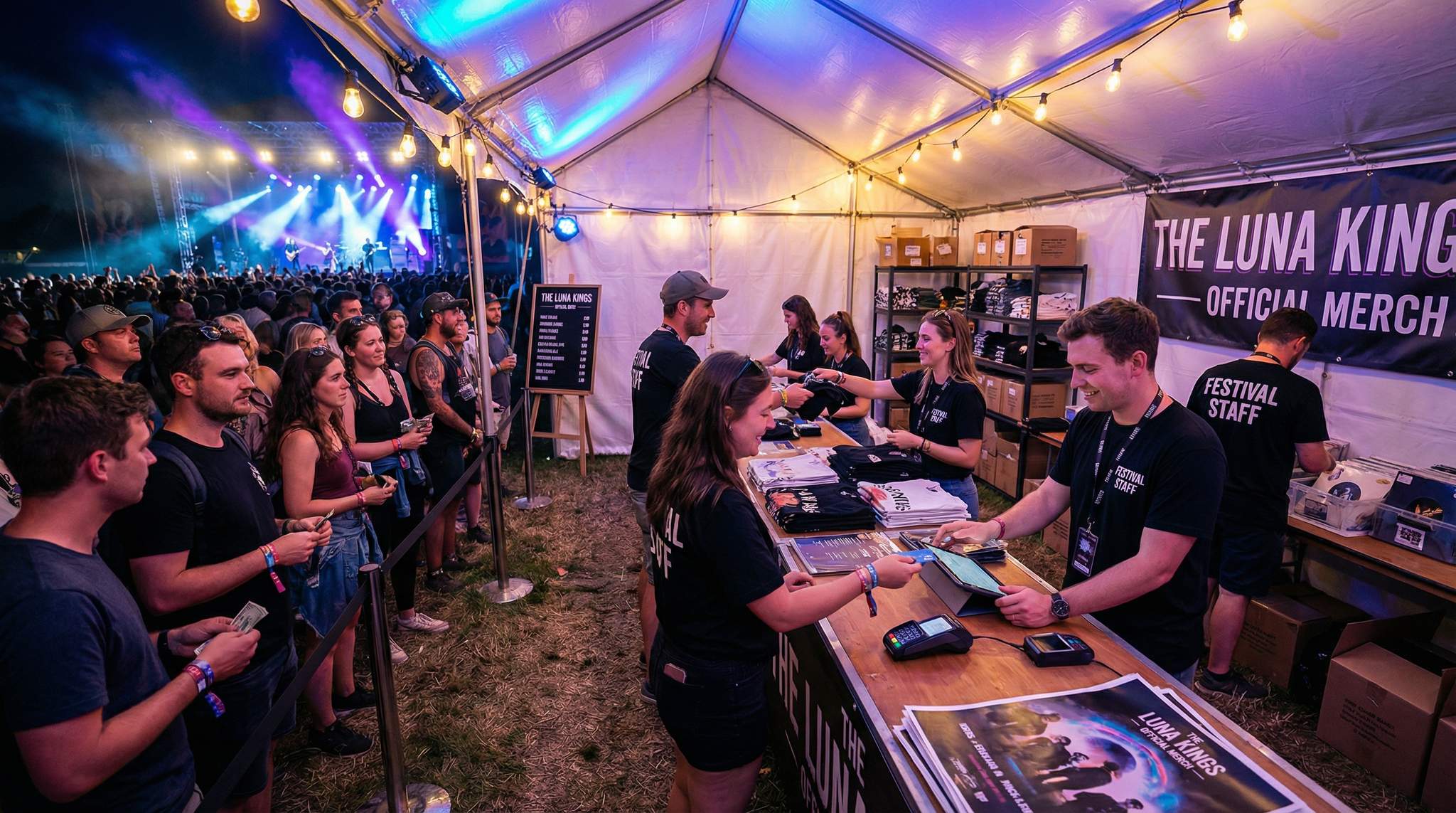
An appealing merch booth can draw in customers the same way a well-decorated storefront increases foot traffic. Make sure the physical setup of your merch areas is both functional and inviting. Start with the basics: sturdy tents or canopy covers (to protect from sun and rain), enough tables or gridwall racks to display items, and secure hangers or shelving so you can showcase shirts, hats, and other products prominently. Visibility is crucial – fans should be able to spot the merch booth from afar. Use tall banners or feather flags with “Merch” or the festival’s logo, and encourage artists to have a banner with their name/logo at their booth if they’re separate. Visually, a neat and attractive display will encourage browsing: arrange apparel by size, use mannequins or creative hanging displays for best-selling designs, and don’t clutter the tables too much. According to retail design experts, even simple improvements like organised product sections and good lighting can significantly boost sales, while maintaining professional presentation standards. Many festivals now use LED lights and even neon signage to give the merch tent a cool vibe at night – it is part of the show, after all.
It’s also smart to integrate the festival’s branding into the merch area’s look. This reinforces the connection between the merchandise and the overall event experience. For example, if your festival has a specific colour scheme or art theme, reflect that in the decor of the merch tent (backdrops, staff t-shirts, signboards). Some events play live video feeds or music at the merch area to keep the energy up for folks standing in line. However, maintain professional presentation standards – keep the area tidy, boxes out of sight, and ensure prices are clearly posted (either on each item or a central price board). Fans will likely decide whether to buy in a matter of seconds while looking at the display; a chaotic or dimly lit booth can turn them off. On the flip side, a colourful, well-branded merch zone can become a memorable part of the festival – think of it as another attraction where fans enjoy spending time (and money).
Lighting, Power and Weather Proofing
Merch operations can run from daytime into late night, so plan accordingly for lighting and weather. Good lighting is non-negotiable if you have any evening program – you want fans to actually see those shirt designs and read sizes once the sun sets. Use ample LED flood lights or string lights inside each booth to illuminate products (and make it welcoming). Externally, light up the area with towers or clamp lights so the merch zone is safe to navigate; a dark merch corner not only hurts sales but could become a security risk. Speaking of security, ensure you have reliable power supply with backups. Use generators or dedicated circuits so that your merch lights and POS systems aren’t tripping when the main stage lighting kicks in. Many veteran producers put merch and vendor power on separate generators from audio/lighting rigs to isolate any overload issues. If your festival uses green energy solutions (solar, etc.), test them for nighttime reliability or have a generator as backup.
Weather-proofing is also essential – after all, merchandise is inventory that can be ruined by rain or wind. Tents should be water-resistant and have sidewalls that can drop in case of a sudden storm so you can quickly protect the goods. Sandbags or stakes are a must to anchor tents; merch tents loaded with shirts can surprisingly act like sails in high wind if not secured (no one wants to see the merch tent tumble across the field in a gust!). If you’re in a hot climate, consider fans or misting for the comfort of staff and shoppers; in cooler climates, portable heaters might be needed. Also think about ground covering if the booth is on grass or dirt – a simple tarp or flooring can keep things cleaner when crowds tromp through, and prevent boxes from sitting in mud. Experienced organizers recall horror stories of merch boxes soaked because the ground flooded during a downpour, teaching them to always palletize or raise stock off the ground. In short, make the merch environment as resilient as any other part of your festival. This protects revenue (dry shirts sell better than soggy ones) and signals professionalism to artists and fans alike.
Accessibility and Crowd Flow
When setting up merch booths, account for accessibility and crowd management so that everyone gets a chance to buy without chaos. Ensure there’s enough space in front of the booth for a line that doesn’t obstruct key walkways or become a safety hazard. Use barriers or line markers (like posts and ropes or simple tape on the ground) to organize queues if you expect large crowds. Some festivals create a queue maze to pack more people in without a gigantic snake line spilling into pathways. If a headline artist’s merch is ultra-popular, consider a dedicated queue just for that act’s items (or even a separate booth as mentioned) to isolate crowds. It can also be effective to station a staff member as a “line manager” during peak times – they can answer common questions (like pricing, cash only, etc.), hand out menus of merch to those waiting, or even distribute water on a hot day. This role keeps things orderly and improves the fan experience (no one likes queue uncertainty).
Data-Driven Event Marketing
Track ticket sales, demographics, marketing ROI, and social reach in real time. Exportable reports give you the insights to make smarter decisions.
Accessibility for disabled fans is another important aspect. Design your merch layout so that counters or tables are at a reasonable height (or have a lower section) to accommodate wheelchair users. Ensure pathways to and around the merch tent are wide and free of obstacles for those with mobility aids. Train staff to assist hearing-impaired or visually impaired customers patiently – simple things like having a written price list to show, or being ready to speak clearly or repeat information can go a long way. An inclusive merch environment reflects well on your festival (shows you care about all fans). Also, think about payment accessibility – if the festival is cashless, make sure there’s a clear way for someone who might not have a credit card or who has accessibility needs in payment. Some events set up an accessibility line or specific service hours for those who might need more time or help at the merch booth. In summary, plan your merch space and procedures to handle crowds efficiently while welcoming all attendees. A thoughtfully arranged merch operation keeps the focus on excitement (“Which cool shirt should I get?”) rather than frustration (“Why is this line so slow/blocked/unfair?”).
Staffing and Training for Merch Sales
Festival Staff vs. Artist Crew: Who Sells?
Determining who will staff the merch booths is a crucial decision. There are generally two approaches: having the festival provide dedicated merch staff, or having each artist bring their own seller (or some mix of the two). Each has advantages. Festival-provided merch staff means you hire a team of sellers (or assign volunteers) to handle transactions for all artists. This often goes hand-in-hand with a centralized merch operation. The benefit is you can train them uniformly, they know the festival’s sales systems, and you maintain control over cash handling and customer service quality. Festivals that take a percentage usually lean this way – essentially, the festival acts like a retailer, and artists just supply the goods. On the other hand, many artists – especially those accustomed to touring – have their own merch person or tour manager who is very experienced at selling that artist’s merch. Allowing artist crews to run their own booth can bring expertise (they know their products and fans) and saves you from needing a large staff. It can also make settlement simpler if each artist is responsible for their own cash till (they just pay you your cut later, if applicable).
In practice, a hybrid approach is common: the festival might staff the main merch tent, but if certain artists insist on using their own sellers, you accommodate that in a controlled way. Communication is key here – if artists are bringing sellers, make sure those individuals connect with your merch manager on arrival, get any necessary credentials or training (like how to use the festival’s POS if they must), and understand the festival’s rules (such as no discounting without approval, or when to close each night). Conversely, if your staff are selling artist merch, you need to collect the inventory from artists, understand their pricing, and maybe even a bit of their “sales pitch” (fans sometimes ask about shirt designs or tour dates on the shirt – the seller should have basic knowledge). Clearly assign roles and ownership: some festivals designate a Merchandise Coordinator on their team to liaise with all artist merch reps. This person ensures everyone knows who is running each booth. No approach is one-size-fits-all; just avoid a scenario where no one is sure who is manning a particular artist’s table – that’s a recipe for confusion and lost sales.
Hiring and Training Merch Vendors
If the festival is providing merch staff, hire early and train them well. Because handling money and inventory is high-responsibility, look for staff or volunteers who are trustworthy, calm under pressure, and ideally have retail or event merchandise experience. Many festivals tap into their volunteer pool or local event staff lists for people who have done merch at concerts before. Others work with professional staffing agencies to get temporary retail clerks. Either way, plan a training session before the festival (if possible, even a day before on-site) to run through the point-of-sale (POS) system, credit card readers, cash handling procedures, and customer service expectations. Make sure every merch seller knows how to operate the sales software or cash register – fumbling with the device in front of a long line of fans is not a good look.
It’s also important to train on festival-specific policies: for example, how to handle staff meal breaks (merch booths should never be left unmanned – schedule rotations), what to do if there’s a refund or exchange request, and who to contact if a problem arises (like the iPad freezes or a customer is irate). Emphasize accuracy in counting – sellers should double-check sizes and prices, and not be afraid to slow down a bit to avoid mischarging someone. A good trick is to have a cheat sheet at each register with item codes, prices, and taxes if needed. Additionally, instruct staff on security measures: keeping cash drops low (store excess cash in a lockbox or with security regularly), watching for shoplifting or tag-switching, and never leaving the booth unattended. Since festivals can be hectic, empower them to call over a supervisor or the Merch Coordinator if anything is off. An investment in thorough training can save thousands of dollars in avoided errors – and it speeds up transactions, resulting in happier fans. As one festival merch manager put it, “Every extra second per transaction adds up to hours of lost selling time over a weekend, so we train our cashiers like it’s a sprint and an art form.”
Volunteers, Interns, and Incentives
What about using volunteers or interns for merch? Many festivals do enlist volunteers to assist with merchandise sales, especially at non-profit or community events. This can work well if managed properly: volunteers are often enthusiastic and will work hard if they know it’s important. However, because handling money is sensitive, consider using volunteers in support roles rather than as solo cashiers, unless they have proven experience. For example, volunteers can help with restocking items, bagging merchandise for customers, running errands (like fetching more change or inventory from storage), or managing the line. If you do need volunteers behind the counter, mix them with a few experienced paid staff as leads. That way, there’s oversight and immediate help if something goes wrong. Be sure to screen volunteers – ideally they apply with references or through a reputable program – since they’ll be dealing with cash and valuable goods.
Smart Promo Codes & Presale Access
Create percentage or flat-rate discount codes with usage limits, date ranges, and ticket type restrictions. Plus unlock codes for private presales.
In terms of incentives: paid staff obviously get wages, but volunteers need perks to stay motivated. Common incentives include free festival tickets (often a volunteer will work one shift in exchange for a day pass), free merchandise (give them a t-shirt – it also serves as a uniform during their shift), food vouchers, or community service credit for students. Some festivals hold a quick thank-you event or provide a certificate/letter after. For interns (if you have an internship program for event management students, etc.), working merch can be a great learning experience – they see a revenue side of the festival up close. Treat them professionally and they might become future staff. Additionally, let artists know if volunteers are helping; artists often appreciate it and will be patient or even help train the volunteers at their booth. One pro tip: if you expect heavy sales for a particular artist, assign your best staff or most reliable volunteers to that booth, and let them know it’s a critical role. You can even turn it fun by making it a competition (“The record for most merch sales in a shift is X – let’s see if you can beat it!”). By leveraging volunteers smartly and keeping them motivated, you augment your workforce and create engagement, all while keeping costs down, whether selling a vintage Warped Tour shirt or running a profitable festival merch operation.
Managing Staff Schedules and Breaks
Running merch booths is a marathon, not a sprint – and you need your team fresh and alert. Plan out staff schedules so that everyone gets breaks and no booth is ever left unattended. Depending on the festival hours, you might have multiple shifts per day. For example, if gates open at noon and music goes until midnight, you could have an early shift (e.g. 11am – 6pm) and a late shift (6pm – close) with some overlap during the peak afternoon rush. Stagger shift changes to avoid a situation where an entire crew swaps out exactly at the headliner set (which might be peak sales time). Instead, do rolling breaks or changes. Use a rotation system for breaks: one person at a time steps away for lunch or a restroom break while others cover. It’s helpful to have at least one floater or extra staff who isn’t tied to a specific booth – they can plug in when someone needs a break or if one booth suddenly gets slammed with a line.
Ensure that every staffer knows their assigned times and locations, and designate a check-in at start of shift (e.g. everyone meets at the merch office or coordinator tent to get daily briefings, maybe pick up a cash bag or device, then goes to position). Build in overlap time for shift transitions so the incoming person can be briefed by the outgoing (on any special issues or stock levels). As for breaks, labor laws may dictate minimum break times if they are paid staff – always comply with those. Even if volunteers, basic decency says give them time to rest and eat. A pro tactic is to supply snacks and water at the merch area for your team – they often can’t leave their post easily when it’s busy, so bringing them sustenance keeps them happy and functional. One festival merch lead we know creates a “merch survival kit” for her crew: water, energy bars, a fan or hand warmers (depending on weather), and even some pain relievers for those long hours on their feet.
Finally, encourage a positive team atmosphere. Merch can be stressful with long lines and demanding fans, so check in on your staff’s morale. Rotate people out of extremely busy booths if you sense fatigue (for instance, swap a cashier from the less busy merch booth to the crazy one for an hour to give the other a breather). Happy, alert sellers not only handle money more accurately but also sell more effectively, engaging cheerfully with fans instead of rushing them. Supporting your merch team with sensible schedules and care is an investment that directly pays off in smoother operations and stronger sales.
Artist Meet-and-Greets and Signings
Sometimes, the merch booth becomes a hotspot not just for merchandise but for artist interactions. Smaller bands or even big artists with a personal touch may do impromptu meet-and-greets or autograph signings at their merch table. This can be a fantastic fan experience and drive sales – fans often buy an item specifically to get it signed. However, it requires additional planning from the festival side. If an artist is planning a signing session, try to schedule it during a window that won’t clog up the entire merch area (for example, right after their set when fans are already nearby and excited, but perhaps on a side of the booth). Announce it via the MC or festival app so fans know. Crucially, manage the queue: a signing line should be separate from the normal sales line if possible. Use barriers to snake a distinct queue and have an extra staffer or volunteer act as the line manager/security, ensuring things stay orderly and that not too many people crowd the artist at once.
If the artist is very popular, consider a ticket or wristband system for autographs (e.g. first 50 people get a pass to the signing) to control demand, else you might have hundreds lining up and leaving disappointed when time runs out. Communicate clearly – signs at the booth like “Signing at 4:00 PM – first 50 people” help set expectations. Also coordinate with the artist’s team on any ground rules: are they signing only merchandise purchased, or anything? Will they take photos with fans? Knowing this helps the line flow (“folks, have your item ready, one item per person, please”). From a logistics standpoint, having the artist at the booth means you may need extra security presence to protect them and the cash. And don’t forget to have water or a chair for the artist if they’re signing for an hour – those small hospitable touches matter.
Smooth Entry With Mobile Check-In
Scan tickets and manage entry with our mobile check-in app. Supports photo ID verification, real-time capacity tracking, and multi-gate coordination.
Finally, alert your merch cashiers if a meet-and-greet is about to happen so they can prepare (maybe pre-count popular item stock or have pens ready). A planned artist appearance can quickly create a surge of people wanting to buy merch to get signed. That’s a good surge – just be ready with sufficient inventory and maybe even a separate “cash only for signed item” line to speed things up. Many veteran festival producers have seen how an artist signing can elevate the merch tent from a simple shop into a buzzing fan hub – capitalise on it, but control it. When done right, these sessions leave fans ecstatic (and wearing freshly signed merch around the grounds), artists happy with the personal connection, and festivals pleased with the sales spike and goodwill generated.
Payment Systems and Sales Technology
Embracing Cashless and Contactless Payments
Gone are the days of “cash only” merch stands – today’s festival audiences expect fast, flexible payment options. Embracing modern payment tech not only speeds up transactions but can also increase sales. Start with the basics: equip each merch point with a robust point-of-sale (POS) system that accepts credit and debit cards. There are many tablet-based POS systems that are user-friendly and can handle inventory tracking (e.g. Square, Toast, or specialized event POS). If your festival has gone cashless across the board, integrate merch into that system. Many large events use RFID wristbands or mobile wallet apps for attendees to pay for food, drink and merch with a tap, utilizing modern cashless payment methods that streamline operations. From the organizer’s perspective, cashless payment systems can dramatically cut down queue times – no fumbling with bills or making change, just scan and go. A case in point: when a Swiss music festival switched entirely to RFID cashless payments, they saw the average attendee spending jump significantly (over CHF 126 per visitor), proving that frictionless transactions encourage purchasing, especially when a festival uses a cashless payment model. Faster throughput also means more sales per hour, which is crucial during those short set-change windows when merch booths get swarmed.
Contactless payments (tap-and-go cards, Apple Pay, Google Pay, etc.) are also a must – especially post-2020 when people got used to touch-free transactions. Ensure your devices have NFC capabilities. And don’t forget international payment systems if you draw a global crowd – for example, many Asian visitors prefer Alipay or WeChat Pay, so consider enabling those modern cashless payment methods to capture every sale. Festivals that embrace a borderless payment mindset stand to gain extra revenue by driving hype and revenue with exclusive collectibles and welcoming all digital wallets.
Of course, not everyone will be cashless, so ideally support multiple payment methods. A hybrid approach covers all bases: cash, cards, and digital. If you are going mostly cashless, clearly advertise that beforehand so attendees load their wristbands or bring cards. Some festivals provide an exchange booth where people can load cash onto a festival card or wristband – if so, situate one near the merch area for convenience. The bottom line is to remove any friction in the buying process: if a fan has money to spend, make it effortless for them to give it to you in whatever form. The technology to do this is readily available, and festival producers in 2026 are leveraging it to overcome labor shortages and long lines, effectively running a profitable festival merch operation while ensuring cashless payment methods can spur higher spending. It’s a high-tech move that doesn’t sacrifice the human touch (fans still interact with friendly staff), but it does eliminate the age-old “sorry, cash only” barrier that might have made a fan walk away empty-handed.
Reliable Connectivity for Transactions
All the fancy payment tech in the world won’t help if your card readers can’t connect. Reliable internet connectivity on festival grounds is absolutely vital for modern merch sales, as issues processing payments can halt operations. Many festivals deploy a dedicated Wi-Fi network for vendors and merch, separate from public Wi-Fi, to ensure stable service. If your venue has spotty cell signals (common in remote fields or concrete arenas), plan ahead by working with a tech provider to set up boosted networks to improve guest experience or even satellite internet solutions. Some events now use mesh network nodes around the site to create a robust local network linking all POS devices, ensuring every vendor has reliable internet connectivity. Always test the connectivity in each merch location before the festival begins – do a simulated transaction at every register to confirm it goes through. It’s wise to have a backup plan too: for instance, POS devices that can work in offline mode (storing transactions to process later when signal returns) or a good old manual credit card imprint machine as last resort.
Power is related here – a blip in power can drop your internet. So along with solid networking, ensure your critical devices have battery backups or UPS (uninterruptible power supplies) if possible. Even a 5-minute power loss during a headliner changeover could equal hundreds in lost sales from impatient fans who give up. Some festivals provide each merch cashier with a wireless mobile hotspot as a backup to the main Wi-Fi, just in case one goes down. Also, train staff what to do if the system is slow or unresponsive: sometimes simply moving a few feet to get a better signal or resetting a router can fix things, but they should know who to call (e.g., an on-site IT support person) immediately. When it comes to connectivity, redundancy is your friend. Think of it like a safety net – you hope you don’t need it, but if a network issue arises, you can switch to Plan B (or C) without panicking. Fans will forgive a slightly slower line; they won’t forgive not being able to buy something because “the card machine is down.” By investing in strong tech infrastructure and backup connectivity, you keep the cash flowing no matter what.
Choosing the Right POS and Tracking System
Selecting a point-of-sale system for festival merch involves more than just taking payments – it’s the backbone of your sales tracking and inventory management. Look for a system that can handle the multi-vendor, multi-item nature of a festival. Ideally, it should allow you to program each artist’s merchandise items (with names, sizes, prices) into one system so sellers can easily find them from a menu. Modern event POS solutions, like atVenu or other festival-focused platforms, even support features like assigning sales to different artists and producing end-of-day reports by artist – which makes settlement a breeze. For example, if Fan buys a Band X shirt and a festival-branded hat in one transaction, the system can attribute the correct amounts to each “account”. This level of detail can save hours of manual reconciliation. Also consider inventory needs: a good system will let you input starting stock and then decrement as sales occur, with alerts or at least the ability to check stock levels in real time. This helps prevent a scenario where you keep selling a size that’s actually run out (leading to unhappy customers later). Some festivals use barcode scanning on merch tags to speed up item selection and reduce errors – the infrastructure for that (tagging items, having scanners at each register) is more work upfront but can pay off with high volume.
Another crucial factor is the user interface: festival merch sales often rely on temp staff or volunteers, so the POS app needs to be super intuitive. Big buttons, logical categories (e.g., by artist or by item type), and quick modifiers (like tapping S, M, L for size) make training easier and transactions faster. Speed is king when that crowd rushes in at 9pm to buy headliner merch. Consider doing a test run with your system at a smaller event or even a simulated environment to iron out kinks. Also, confirm the system’s capability to handle offline transactions if connectivity blips (as discussed earlier) – many will queue transactions and sync later. Ensure data security too: whatever system you use should be PCI-compliant for payment security and ideally not store card data on the device. Print (or email) receipts? Nice, but often not necessary at festivals; still, have the option if someone insists.
Finally, think about integration. Does your ticketing or festival management platform integrate with any POS for unified data? For example, if you’re using Ticket Fairy’s platform, see if it can tie in with your merch sales data or cashless system to analyze attendee spend patterns. Some advanced festivals even link merch purchases to loyalty programs or RFID wristbands (e.g., attendees earn points or get personalized offers). That might be beyond “101”, but it’s something to keep on the radar as your event grows. In summary: choose tech that makes selling and tracking easier, not harder. A well-chosen system will provide you with end-of-festival reports showing total sales per artist, per item, peak sales times, etc. – goldmine data to refine your strategy next time.
Real-Time Inventory Tracking and Restocking
In the heat of a festival, inventory can disappear fast. Keeping on top of stock levels in real time is critical to avoid both sell-outs and oversupply. As mentioned, your POS system can help by decrementing inventory with each sale. Assign someone (often the merch coordinator or a dedicated inventory manager) to monitor these numbers periodically through each day. For instance, if you see that the commemorative festival poster is 90% sold by Saturday afternoon, you might decide to hold a few for Sunday or at least inform staff to push alternative items to fans who miss out. Alternatively, if an item isn’t moving at all, this real-time insight lets you strategize – maybe drop the price on Day 2, or bundle it with another purchase (“buy a hoodie, get that tote bag half off”) to shift it.
Restocking procedures should be worked out in advance. If you have a warehouse or storage container on-site with back-stock, set designated times to replenish the booths. Many festivals do restocks during less busy times like early afternoon or late night after close. To facilitate this, prepare “restock kits”: pre-counted batches of popular SKUs that can just be grabbed and delivered (for example, a box with 20 small, 20 medium, 20 large of the best-selling t-shirt ready to go). This reduces counting time on the field. Staff should keep a running list of items that get low at their booth and communicate it by radio or a messaging app to the inventory team. That way the runners can bring what’s needed. Some festivals empower sellers to swap inventory between booths if needed – e.g., if Stage A’s booth ran out of Artist X medium tees but Stage B booth has extra, a quick shuttle of stock can fill the gap (just be sure to note it so accounting stays straight).
Avoiding stockouts is ideal because every time a fan asks “Do you have this in Medium?” and the answer is no, you likely lost a sale. Yet, running out of a few extremely hot items isn’t the worst problem – it indicates strong demand. The balance is tricky: you don’t want huge leftovers (we’ll address that in Post-Festival), but during the event, better to err on having a bit more of each size than you think you’ll need. Historical data helps here: if previous years or similar events sold 500 units of something, plan maybe 600 to be safe if you have that flexibility. For artists, their tour manager often knows roughly how much they sell per show and will bring stock accordingly, but a festival can be a wildcard with more potential buyers. Encourage them to bring a little extra if possible.
Lastly, have a plan if something sells much slower or faster than expected. Can you relocate merchandise? For example, if one artist’s merch isn’t moving, you might consolidate their stock into the main store on Day 2 and free up a booth for another purpose, rather than keep staff idle. Or if an artist has multiple designs, adjust the display to feature the one that is selling (maybe the design just wasn’t appealing for the crowd, and another design could do better). Dynamic response is the hallmark of great on-site management: treat your merch operation like a living retail pop-up – monitor, respond, and optimize in real time. This ensures you maximize sales and minimize frustration for fans who want something only to find it’s gone because no one realized inventory was low.
Proactive tracking also allows organizers to increase merch reorders on the fly. If a specific design is flying off the shelves by Friday afternoon, having a rapid-response local print partner can allow you to restock by Saturday morning. Knowing exactly when to trigger these mid-festival reorders is a hallmark of top-tier operations, ensuring you never leave money on the table during peak demand windows.
Data and Analytics During the Festival
One of the perks of modern merch systems is the wealth of data they generate – even in the middle of the event. Savvy festival producers don’t wait until after the festival to look at numbers; they keep an eye on sales data during the event to make informed tweaks. For example, if by mid-Day 1 you see that only 5% of attendees have bought anything so far, an attach rate insight that aligns with festival insights on spending, you might decide to boost your on-site marketing: announce from the stage about the exclusive merch available, or send a push notification on the festival app highlighting a hot item. Conversely, if merch sales are blowing past expectations, you might organize an emergency reorder or on-site printing (some festivals have the capability to print more shirts overnight if needed, especially for festival-branded merch). Watching sales per hour can also tell you when the rushes are – maybe you expected an early evening peak but data shows a huge spike at 3pm; you can then reallocate staff to that time or open an extra till to accommodate.
Analytics can extend beyond just sales numbers. Observe basket size (do people buy more than one item at once?), popular price points, and even the effect of performances. It’s common to see a surge in an artist’s merch sales immediately after their set, especially if they gave a shout-out on stage like “meet me at the merch tent!” or if they played a breakout hit that gets everyone hyped to grab a souvenir. If you notice that pattern, you could coordinate with stage managers to allow artists a quick shout-out about merch (some do it unprompted, but not all think to). Also, identify if any demographic trends appear – e.g., your data might show VIP ticket holders (if they have separate merch perks) are buying more expensive items. Or mobile wallet users spend 20% more on average than cash payers, which is often the case when transactions are frictionless and the festival uses a cashless payment system. These insights can help you adjust on the fly (like perhaps promoting a high-end item more to VIPs or encouraging digital pay through a small discount or faster line).
All this said, don’t get lost in the numbers at the expense of operations. Assign someone, perhaps the merch coordinator or an analyst on the team, to periodically crunch the live data and feed applicable info to the merch and production teams. A quick daily merch briefing (“Item A is our bestseller, Item B isn’t moving, total sales so far are $X, attach rate Y%”) can be very motivating and sharpening. It turns merch into a more strategic part of the festival’s success rather than a sideline souvenir shop. At the extreme end, some festivals even display a live sales leaderboard in the production office (just like they track ticket sales). That might not be necessary for everyone, but it shows how data-driven the approach has become. Use those stats – they’re like real-time feedback from your audience’s wallets on what they love.
Inventory Management and Merch Security
Check-In and Inventory Counts on Arrival
The moment artists (or their shipments) arrive on site with merchandise, it’s time to get organized. Implement a check-in process for all merch inventory coming into the festival. This typically means that upon arrival, each artist’s merch is counted and recorded jointly by the artist’s rep and a festival merch manager or security. Use an inventory sheet listing each item (e.g., “Band T-Shirt Black Logo, Size M, 50 units”) to document how much stock is brought in. Both parties should sign off on this initial count. This step establishes a baseline so that at the end of the event, everyone agrees on how much was sold versus what remains – a critical detail for settlements and for preventing disputes like “some of our boxes went missing”. For smaller festivals or if time is short, you might not count every single item but at least count boxes and have the artist confirm quantities later. However, the more detailed the check-in, the more confidence on settlement day.
Also consider logistic details at check-in: assign each artist’s merch a storage space or ID if you have a shared storage area. For example, give them a labeled shelf in a secure container or a tag so you know which boxes belong to whom. If artists are keeping surplus stock at their booth, make sure they have weather protection and security for it (maybe you provide some lockable bins). As part of the check-in, it’s worth reviewing any special handling instructions – is any item perishable, fragile, or high-value requiring locked storage (like a $200 luxury box set or limited art prints)? If so, plan accordingly. This check-in is also a chance to enforce any prohibited items: if an artist accidentally brought merch that violates a sponsor exclusivity (say a soft drink logo on their shirt when you have a competing soft drink as sponsor), catch it now and resolve it, rather than on the floor.
Organized check-in sets the tone: artists see that you run a tight ship, and you show that you’ll take care of their goods. Some festivals even issue merch tags or credentials to identify who is authorized to handle merch boxes – e.g., a special “Vendor” wristband or badges for artist merch crew, so security will allow them in and out of storage areas. It’s all about accountability and tracking. Remember, those t-shirt boxes are essentially cash waiting to be converted – you need to treat them as such from the moment they come through the gate.
Secure Storage and Overnight Safety
Festivals often span multiple days (and even if one-day, overnight storage might be needed before or after). Having secure storage for merchandise is paramount. Ideally, you have a lockable merch storage tent or container on-site. This is where extra inventory is kept, as well as the place to lock away cash boxes or high-value items when the festival is closed. Make sure only authorized personnel (merch managers, inventory staff, perhaps artist tour managers) have access. For multi-day events, it’s wise to hire overnight security specifically to monitor lighting and overnight security and ensure solid security protects inventory. Many experienced producers will arrange for a couple of security guards to do nothing but keep an eye on merchant booths after hours – it’s cheaper than risking a burglary. Some festivals require vendors to remove cash and, if possible, small high-value merch each night, but larger stock can stay under guard.
Weather also ties into security: ensure the storage area is protected from rain leaks, etc. Palletize boxes or put them on shelving so nothing is on the ground (in case of minor flooding). If extreme weather is forecast (heavy rain, wind, cold), consider giving vendors a heads up to add extra tarps or relocate stock. In one case, an overnight storm at a U.K. festival blew water under the tent flaps and soaked several boxes of band tees – since then, that festival uses waterproof containers with lids for all stored merch. It’s those hard lessons that lead to better practices.
Another aspect is loss prevention during the event: busy merch areas can unfortunately attract thieves or scammers. Train staff to be alert – e.g., watch that no one is reaching behind the table to grab a shirt when staff are distracted. Use cable locks for hanging display items if you have valuable jerseys or jackets on display (so they can’t be snatched easily). Keep back-stock out of public reach. Adopting a “two-person rule” for cash handling (like two people present when cash boxes are opened or moved) adds security and transparency. Encourage artists with their own booths to follow similar precautions. It’s also smart to number your cash tills and perhaps do random cash skims during the day (have a roaming supervisor take excess cash to a safe location) – not because you distrust staff, but because it’s safer than letting too much cash accumulate in a busy tent.
In summary, secure storage and vigilant loss prevention may not be the most glamorous part of festival merch management, but they are absolutely vital. A single theft incident can sour an artist’s entire festival experience (and relationship with you), and an inventory loss hits your revenue. By investing in proper security measures, lighting and overnight security, and protocols like asking vendors to raise tent flaps, you protect the merch and everyone’s profits.
Preventing Theft and Counterfeiting
Merchandise at big events can attract not only petty thieves but also professional bootleggers and counterfeiters. To safeguard legitimate sales, festival organizers need a plan to tackle these risks on two fronts: internal (within the festival grounds) and external (outside the venue). Internally, as discussed, controlling access to stock and monitoring the merch area are key. Have a discreet eye on cash handling – maybe a security camera in the main merch tent trained on the register area (if acceptable) or a security staff positioned near but not inside the booth to watch for suspicious activity. Many festivals do daily reconciliations for each seller’s cash versus reported sales to catch any major discrepancies quickly. If you spot a shortfall, investigate promptly – sometimes it’s simple miscounting, other times it could be skimming. A well-trained team that knows management is on top of it is usually deterrence enough.
Externally, bootleg merch vendors notoriously pop up around big concerts and festivals, selling knock-off t-shirts in parking lots or roadside. While you can’t police the whole world, you can work with local authorities and your own security to discourage unauthorized sales on or near festival property. Some festivals hire off-duty police or pursue city permits that allow them to enforce an exclusion zone around the venue, confiscating counterfeit merch. For example, major tours often get court orders allowing seizure of unlicensed merch within a certain radius. As a festival promoter, communicate with artists ahead if you plan to do this, as often it’s done on behalf of protecting their trademarks too. During the event, instruct gate and security staff to keep an eye out at entrances – someone bringing in a huge bag of shirts might be planning to sell inside (which shouldn’t be allowed unless they’re an approved vendor).
Another angle: counterfeit tickets and wristbands aren’t our focus here, but mention because sometimes scammers also try to sell fake “merch vouchers” or run cons like claiming to be official merch staff to collect cash. Ensure your official merch areas are clearly branded and staff identifiable (bright STAFF shirts or badges). If you use merch tokens or coupons (some festivals do for VIP packages), make them secure (unique codes or holograms) so they can’t be easily faked.
In the digital age, also be aware of counterfeit online merch – some unscrupulous sellers might start listing “Festival X 2026” shirts online even during your event. While you can’t stop all internet fraud, what you can do is push your official online merch store (if you have one) via your channels, and consider language on your website about how official merch is only sold on-site or through certain channels. After the festival, if you have an online store for leftover merch, that presence helps dilute the market for bootlegs. Ultimately, deterring theft and fakes is about vigilance and asserting your (and the artists’) rights. Thankfully, many festival fans want the authentic item from the event – you just need to make sure they can get it easily from you, and that the shady operators think twice before meddling.
Managing Unsold Merch and Settlement
When the final encore has played and the crowds drift away, there’s still important work at the merch stand: handling unsold inventory and settling finances. Start by conducting a final inventory count for each artist. Ideally, you’ll do this jointly with the artist’s merch rep: count how many of each item are left and compare it to the starting count minus sales. This confirms that sales numbers are accurate. It also accounts for any “comp” items (occasionally an artist might give away a shirt or you might have used a few for promotions – those should be accounted for too). Once the count is done, unsold merch is typically packed up for the artist to take back. Some festivals, however, may offer to purchase certain unsold items at cost, especially festival-branded merch or co-branded items, to sell online post-event or keep for promotions. It depends on your arrangements – most of the time for artist-owned merch, they take it with them or ship it home.
Next comes financial settlement. If the artist handled their own sales entirely, then it’s more about reconciling the festival’s percentage. For example, if an artist sold $10,000 gross and the deal was 80/20, the festival should receive $2,000. Often the festival will invoice the artist or deduct from the performance fee payout if done same day. Some festivals require artists to pay the commission on-site in cash or check before leaving (especially if it’s a one-day event). Ensure you have a clear record of the agreed split and any deductions (like sales tax or fees) to arrive at net revenue. Transparency is vital: show the artist the sales report, and have both parties sign a simple settlement sheet that states gross sales and final amounts due to each. If the festival collected all the money (like in a centralized system), then you’ll be paying the artist their share. That might be done via bank transfer after the event (within a specified timeframe in the contract) or occasionally in cash on-site for smaller totals. Again, documentation and mutual sign-off protect everyone.
A comprehensive artist settlement sheet is the cornerstone of this financial handover. This document should clearly itemize starting inventory, total units sold per SKU, gross revenue, and the agreed-upon percentage splits. Furthermore, a professional settlement form will detail any deductions—such as credit card processing fees, local sales taxes, or booth rental charges—so the touring manager can easily reconcile the net payout. Providing a standardized, easy-to-read financial summary not only speeds up the nightly close-out process but also protects the festival from post-event accounting disputes.
What about leftover festival-branded merch? This is a common scenario: despite best forecasting, you may have some festival t-shirts, posters, or other swag remaining. Smart festival producers plan for this by creating a post-event merch strategy. Options include selling leftovers on the festival’s website or Shopify store (turn it into a “limited remaining stock” online sale to recoup some money), using them for marketing (giveaways for contests, gifts for partners), or in some cases donating certain items to charities (e.g., donate unsold shirts to local shelters – though note, if they have specific festival dates on them, that might be odd). If you had an official festival cookbook or compilation CD that didn’t sell out, maybe local record stores or boutiques could retail them year-round . The key is to inventory and store leftovers properly if you intend to use them later. Count them, box them, label them, and keep them in a dry, safe place. This ties into settlement too: those items are now fully owned by you (since you presumably paid production cost already), so your profit/loss on them is on the festival books.
After everything, do a post-mortem on merchandise performance. Calculate the attach rate: what percentage of attendees bought merch? Was your revenue in line with expectations? Maybe you’ll find that 15% of attendees made a purchase, spending an average of $50 each – if you aimed for 20% attach rate, brainstorm why it fell short (or celebrate if it exceeded). Break down which artists had the strongest sales and which didn’t – it can inform future bookings or how you support certain genres of artists. Perhaps you learned that the metal bands’ merch flew off the shelves while EDM DJ merch languished (which aligns with industry trends that rock/metal fans buy more band merch, putting the festival’s brand front and centre for those demographics, while data also gives us insight into branded items sales). Such insights can inform everything from which genres you might book more, to whether you allocate more booth space or better location to certain artists next time.
Finally, wrap up by thanking your merchandise team and the artists’ teams. A smooth merch operation is a partnership, and maintaining positive relationships will pay off. Artists talk to each other – if they had a great experience selling a ton of merch at your festival and found the process fair and easy, word will spread and more acts will be eager to play your event (and bring great merch). Likewise, a burnt bridge over a botched merch deal can harm your reputation. So celebrate the wins, learn from any misses, and keep evolving your merch management playbook for next year.
Maximizing Merch Sales and Fan Engagement
Promoting Merch to Attendees
“Merch doesn’t sell itself” is a mantra for sharp festival marketers. You need to promote the merchandise just as you promote the lineup or food vendors. Start building hype even before the festival gates open: use your social media and email newsletters to preview some hot merch items – for instance, reveal the design of the official festival poster or a limited-run t-shirt collab with a headliner. Emphasize if anything is exclusive to the festival (“only available on-site, limited quantities!”) to drive FOMO-driven pre-demand by boosting on-site sales and creating buzz around exclusive collectibles. Some festivals allow attendees to pre-order merch online when they buy tickets (either for pickup on-site or delivered after) – this can gauge interest and guarantee sales. If you do this, make the pickup point obvious and efficient so pre-order folks aren’t frustrated.
During the festival, treat merch like a featured attraction. Have MCs or artists occasionally plug the merch booths: e.g., “Don’t forget to stop by the merch tent by the main stage – tons of cool gear from all the artists and the festival itself!” Many fans simply need a reminder; they get caught up in music and may forget, so a timely nudge helps. Use your festival app and screens too: push notifications about “New merch drop at 5 PM – [Band] limited edition hat now available!” or show rotating ads on video screens between acts highlighting a few items. One effective technique is to incorporate merchandise into the festival experience: for example, create a scavenger hunt or QR code hunt where one of the prizes or stops involves the merch booth, thus driving foot traffic there (perhaps they get a discount code if they complete a challenge). Some festivals partner with sponsors for merch promotions – like a photo booth that prints a coupon for $5 off merch if you use it.
Also, don’t underestimate old-school signage around the grounds. Directional signs pointing to “Merch ?” help, as do banners that list some items and prices to entice people. A large banner that says “Official Merchandise – T-Shirts, Hoodies, Posters, and more” at the entrance can plant the seed the moment fans walk in. If there are unique items, such as a vinyl record or a local craft item, mention that too (“Limited vinyl & local artisan goods here!”). People may not expect beyond the usual shirts, so highlight variety. By promoting merch proactively, you turn it from a passive opportunity into an integrated part of the festival hype. The result? Fans head to the merch tent with intention, not just by happenstance – boosting sales and giving them souvenirs they’ll cherish (and free advertising for you when they wear them). Remember, every time someone wears your festival’s shirt in public, it’s a walking billboard, proving that festival merchandise is more than just clothing and that giving fans what they want pays off, so it’s worth nudging more folks to pick one up.
Limited Editions and Exclusive Drops
Nothing creates a buying frenzy quite like the phrase “limited edition.” Festivals around the world have learned that offering exclusive merch – items available only at the event, or only in very small quantities – can dramatically spike interest through FOMO and collectible culture and by boosting on-site sales. If it fits your festival’s strategy, plan one or two special merch drops. This could be a collaboration with an artist (e.g., a headliner designs a shirt or a piece of jewelry that’s sold only at your fest), a commemorative item like a pin or badge numbered and limited to a few hundred units, or even on-demand custom merchandise (like a live screen-print booth where fans create a unique shirt). Announce these exclusives in advance to build anticipation, and be clear about how and when to get them (e.g., “limited edition poster – only 200 available at merch tent opening 1pm Friday”). Expect that die-hard fans might line up early for these; it’s wise to enforce one-per-person limits on ultra-rare stuff to curb scalpers.
Case in point: Coachella 2022 saw massive lines at the main merch tent largely due to exclusive drops by artists aimed at boosting on-site sales. One headliner’s limited-run hoodie at $100 sold out in 15 minutes, leaving latecomers disappointed but also fueling the legend of that item and the buzz around exclusive collectibles. By intentionally creating scarcity, festivals tap into the collector mindset of fans. If you go this route, though, manage it thoughtfully: nothing angers attendees more than poorly handled limited releases. So, ensure the process is fair (no cutting lines, clear info on when/where, maybe a ticket system for those in line early). If possible, spread out exclusives so not everything is on Day 1 – for instance, drop one special item each day to keep excitement up and avoid Day 1 being too chaotic.
Exclusives aren’t only about hype; they also can be aligned with festival themes or values. Maybe your festival is eco-conscious, so you release a sustainable eco-friendly line of merch (made from recycled fabric or one tree planted per item sold). Market that as a special initiative to entice those who care about the cause, possibly even at a premium price point if it’s for charity. Or if your festival is known for art, commission a local artist for a limited screenprint poster. These sorts of items can become traditions – like Montreux Jazz Festival’s famous annual posters, which fans collect year after year, triggering a sense of festival history.
One more angle: consider exclusive experiences tied to merch. For example, a golden ticket concept – the first X people who buy a particular item get a meet-and-greet pass, or hide a secret design on the inside of a shirt and if a fan finds it they get an upgrade. These creative gimmicks engage the community and drive merch interest beyond the product itself. All in all, exclusivity done right drives urgency: fans fear missing out and thus act fast, driven by FOMO and collectible culture. And even those who miss out talk about it, which feeds the festival’s mythos and might make them come back next year earlier or more prepared to spend. Exclusive merch not only boosts revenue on-site but also builds cultural cachet – owning that rare festival item is a badge of honor among the fan community.
Engaging Fans at the Merch Booth
The merch booth doesn’t have to be a static retail counter – it can be an interactive extension of the festival experience. By engaging fans at the merch area, you make shopping fun and memorable rather than a chore. One way is to incorporate live elements: for instance, have a demo or display where fans can customize something. Some festivals set up heat-press stations for putting your name on the back of a jersey or patches on a jacket you buy. Others might have a small stage for surprise artist drop-bys (beyond formal signings, maybe a brief acoustic song or a DJ spinning while people shop). These create buzz and draw more people to the area just to see what’s happening.
Another idea: turn merch into a game or photo op. Maybe there’s a life-size cutout or an art installation near the merch zone where fans can take selfies – and of course, it’s branded with your festival, indirectly promoting merch in the background. Some events do raffles or prize wheels at the merch tent (“spin to win a free upgrade on your merch purchase” or minor prizes). These might require a purchase or might be open to all to lure them in. Even simple things like a Polaroid wall of fans wearing the merch they just bought can foster a sense of community – take their pic and pin it up, now they’re part of the festival’s story. At family-friendly festivals, consider adding a kids’ corner near merch where children can color a picture of the festival logo or design their “dream band t-shirt” – while the parents are shopping, the kids are entertained, and everyone’s happy (potential future customers in those kids too!).
You can also use the merch area to solicit fan feedback or content. For example, have a short survey kiosk or a big board asking “What band would you love to see next year?” or “Drop your ideas for new merch items” with sticky notes. This engages attendees in conversation, shows you value their input, and it’s literally drawing them near the merch. People who might not have intended to buy could end up browsing while they’re there. Additionally, ensure your merch staff are friendly and knowledgeable conversationalists when time permits. A fan might be on the fence about buying something; a clerk who chats about how cool the last set was or points out a neat detail on the shirt design can tip the scales. It’s the festival version of good customer service – building a connection rather than just a transaction.
In essence, the more you can integrate the merch experience with the festival’s overall vibe, the better. Don’t isolate it as a “shop” – make it a place to hang out, meet, and enjoy. Fans will remember that. They’ll recall how they hung out at the merch tent and maybe met another fan in line or got a drumstick signed along with a t-shirt. Those positive memories become attached to the merchandise they take home, making it more likely they’ll want that ritual again next time (and that they’ll proudly show off the merch, telling the story to friends). Engaged fans are loyal fans, and loyal fans come back – often with last year’s festival tee on and ready to buy the new one.
Tailoring Merch to Your Audience
Just as you curate your lineup to suit your audience’s taste, your merch strategy should consider who your attendees are. Different demographics and music communities have distinct preferences when it comes to merchandise. Start with genre: as industry studies show, at rock and metal festivals a large chunk of merch revenue comes from artist-specific merch (because those fans love band shirts), whereas at EDM or pop festivals, attendees often gravitate more toward festival-branded items and fashion-forward pieces, putting the festival’s brand front and centre and focusing on branded items sales. If you’re running a metal festival like Download or Wacken, you’ll want to ensure every significant band has a t-shirt or patch available, and maybe stock extra black hoodies – those fans can’t have enough black in their wardrobe! Conversely, an EDM fest might move more funky accessories, like branded LED bracelets, caps, or even collaborative streetwear, with the festival name taking center stage.
Consider age and lifestyle too. If your event draws an older crowd (say a jazz or heritage rock festival), offering higher-quality, practical items can win them over – think classy embroidered polo shirts, tote bags, or even home goods (an example: New Orleans Jazz Fest sells things like festival-themed posters that become serious collectibles). At family-friendly festivals, have something for the kids: child-size tees, ear-protection headphones with the festival logo, maybe plush toys of a festival mascot if you have one. Families appreciate when they see “merch for all ages,” and it can increase the total basket if mom, dad, and the little one each get something.
International or culturally diverse audiences are another factor. If you know a lot of attendees are coming from abroad (for example, a destination festival in Bali or Ibiza), consider merch that travels well – lightweight items, and maybe designs that playfully reference the local culture as well as the festival. Be mindful of language on merch; having an item with local language slogans could be a hit or miss depending on if it resonates. Also, sizes: know your audience’s average builds to stock appropriately (US audiences might buy more XLs, whereas an event in Japan might sell more S/M – generalizing, but data can inform these choices). It’s better to adjust the size ratio of your order to match likely demand than end up with a heap of 2XL that don’t sell or run out of smalls in an hour.
Price sensitivity is another audience trait. A college-town indie fest might need plenty of low-cost options (stickers, buttons, $20 tees) because young fans are on a budget. Meanwhile, a luxury festival or one with an upscale crowd (like foodie/music crossover events or VIP-heavy festivals) can push premium items – think limited edition high-end jackets, autographed memorabilia, or designer collaboration apparel at higher price points. Some festivals even successfully sell merch bundles or packages (e.g., a bundle with a tee, poster, and program book for one set price) – if your crowd includes a lot of hardcore festival-goers or tourists, they might appreciate a one-stop “merch kit.”
In short, use every bit of insight about who attends your festival. Survey data, ticket purchase demographics, prior years’ merch sales breakdowns – all can guide what mix of products to offer. The goal is to provide something for everyone: the die-hard music nerd wants the deep-cut band tee or limited vinyl, the casual attendee wants a cool festival-branded cap that goes with any outfit, the kid wants a fun colourful shirt, the big spender wants the deluxe poster framed set. By tailoring the merch range to match your audience’s profile, you not only increase sales (because you’re giving people what they actually want), but you also make fans feel understood and valued. It’s a subtle but powerful reinforcement of the community feeling: “this festival gets me, even in the merch they sell.”
To truly boost your artist merch sales, it pays to analyze the typical music artist merch sales breakdown between apparel and accessories. While t-shirts and hoodies (apparel) traditionally drive the highest gross revenue, smaller accessories like tote bags, enamel pins, and bucket hats often yield higher profit margins and encourage impulse add-on purchases. By advising artists to bring a balanced mix of high-ticket apparel and accessible accessories, promoters can maximize the average transaction value at the booth.
Pricing Strategies that Work
Pricing festival merchandise is a balancing act between accessibility and profitability. Charge too much and you’ll scare away buyers (or worse, anger fans); charge too little and you leave money on the table or undermine perceived value. Experienced festival producers analyze their audience’s willingness-to-pay and reference industry norms when setting prices. For standard items like t-shirts or caps, look at comparable events and what they charge – most fans have a mental range (e.g., $25-40 for a tee). If you position yourself on the higher end, make sure the quality justifies it (thicker fabric, better print, or an especially cool design). Often fans are willing to pay a bit more if the merch feels premium or unique. On the flip side, having a few entry-level priced items (like a cheap wristband, sticker pack, or bandana under $10) is smart to cater to those who want a souvenir but can’t spend much.
One strategy is tiered pricing within your lineup. For example, offer basic tees at $25, more elaborate all-over print or long-sleeve shirts at $35-40, hoodies at $60, etc. This way, fans self-select into price tiers. Limited editions or artist collaborations can command higher prices – don’t be shy to price those according to scarcity. If only 100 hoodies exist and they’re high quality, $80 or $100 each might actually be acceptable (as was seen at Coachella’s high-end merch drops). However, be transparent about why it’s premium (special materials, handmade, signed, etc.). Another approach is bundle deals – e.g., “Buy any two shirts for $5 off” or “Bundle: festival poster + t-shirt for $50”. Bundles can increase the average spend by incentivizing volume. They also help move less popular items by pairing them with hot sellers (if you cleverly allow mix-and-match). Just be cautious: unlimited bundle discounts can complicate accounting with artists if splits differ, so structure it cleanly (like if it’s a festival item + artist item combo, decide how the discount is absorbed).
Dynamic pricing (changing prices during the event) is generally not advised for festivals because it can feel unfair – imagine Day 1 you paid $40 for a shirt and Day 3 it’s marked at $30. That said, some events will do an end-of-festival flash sale in the final hours for remaining stock. If you do this, do it subtly and at the very end when most transactions are over – it can help clear unsold stock and fans kind of expect clearance sales at the end. You can phrase it as a “final-hour special” rather than “we dropped the price”. Another tip: set prices in round numbers that are easy for cash handling (if still using cash) – like multiples of $5. If in an international setting, consider rounding to avoid needing small coin change. And remember taxes: decide whether your prices are tax-included or plus tax, and stick to it. Many festivals bake sales tax into a nice round price to keep lines moving and avoid messing with coins.
Also, think psychologically – $39 feels significantly cheaper than $40 to a consumer, even though it’s $1. That can be used if needed. However, in a festival environment, even numbers might speed things up more (e.g. $40 flat vs $39 requiring change) – so weigh efficiency vs. optics. Watch sales; if something’s not selling by midway, you can consider quietly dropping the price or offering a promo (like a time-limited sale: “Happy Hour at merch: 5pm-6pm get 10% off hoodies”). But use sparingly, so you don’t train fans to wait for discounts, but rather focus on running a profitable festival merch operation. In essence, set a fair price that reflects value, offer a range to suit different budgets, and be consistent. Fans will generally pay a premium at events if they feel it’s worth it – your job is to ensure they feel it is worth it, through quality, exclusivity, or experience tied to that purchase.
Understanding the standard band merch markup at concerts is essential for promoters helping artists set competitive yet profitable price points. Typically, apparel like t-shirts carries a markup of 150% to 300% over the wholesale manufacturing cost. For example, a high-quality blank tee that costs $8 to print might retail for $35 to $45 on the festival grounds. This margin must absorb not only the production expenses but also the venue or festival commission, staffing, and transport logistics. By advising touring acts on these standard concert markups, organizers ensure that both the talent and the event remain financially viable without alienating fans through price gouging.
Post-Festival: Leveraging Merch Success
Settling Up and Financial Debrief
Once the festival is over, and you’ve caught a breath (and maybe some sleep), it’s time for a thorough debrief on merchandise finances. This starts with finalizing any outstanding settlements with artists. If you didn’t pay out on-site, ensure payments to artists for their share of sales go out promptly as per your agreement – this is crucial for trust. Nobody wants to chase a promoter for months over a merch check. Send along a detailed sales report with the payment, itemizing units sold and money owed; artists and their managers will appreciate the professionalism. If any discrepancies or disputes arose (say an artist claims some merch “went missing” or sales seem off), address them diplomatically. Double-check against your inventory logs and if needed, hop on a call to walk through the numbers. Sometimes minor miscounts happen; offering to split the difference or find a solution can maintain goodwill. But if you did your homework with solid tracking, you should have backup for the figures.
Next, review the festival’s merch revenue and costs in total. Calculate the profit margin: subtract the cost of goods (for festival-produced merch) and any direct expenses like merch staff wages, tent rental, and credit card fees from the gross sales. See how merch contributed to the festival’s bottom line. At many festivals, merch can be 5-10% (or more) of overall revenue – nothing to sniff at. If you had sponsors, note if any merch tie-ins happened (did a sponsor cover cost for their logo on shirts, etc.) as that offsets costs. Compare the outcome to your budget projections. If you made more than expected, great – identify why (higher attach rate? a particular item blew up? more attendees?). If you fell short, pinpoint the causes (perhaps weather affected sales, or maybe a big act canceled and their merch would have sold a lot, or maybe pricing was misjudged). This analysis is gold for making adjustments in future editions.
It’s wise to compile a brief merch report internally. Cover the sales by category (festival vs artist merch, top sellers, total units sold, average spend per attendee, attach rate percentage). Highlight successes like “Limited edition poster sold out in 2 hours” or “Improved card payment system cut line wait times by 30%”. Also note challenges: “ran out of small sizes for three popular shirts – order more next time” or “volunteer staffing was thin on Sunday, consider more paid staff or shorter shifts to avoid fatigue”. Including qualitative feedback is useful too – gather any notes from merch staff or even fan feedback (did anyone complain or praise something about the merch?). If you used a post-event attendee survey, check if any merch-related questions or comments came through (sometimes people mention if merch was too expensive or if they loved a design). All of this goes into continuous improvement.
Finally, share some kudos. Thank your merch team in your wrap-up communications. If certain items did particularly well due to great design (maybe your graphic designer hit a home run), give them a shout-out. Share a stat with the whole festival staff like “We sold 3,500 t-shirts – that’s 1 in 5 attendees who went home with our logo on their chest!” to reinforce what a joint success it was. These positive notes reinforce the importance of merch and encourage everyone to contribute ideas to grow it further. And they set the stage for you to possibly allocate more resources to merch next year (like a bigger tent or more staff) because you’ve demonstrated its value. The post-festival financial debrief isn’t just number-crunching; it’s storytelling with data – telling the story of how merch enhanced both fan experience and festival finances, which is a pretty happy story to tell.
During this debrief, it is crucial to evaluate the live events and entertainment company facts on merchandise performance. This means looking beyond gross sales to understand the true net profitability, attach rates, and per-head spending metrics. By treating merchandise data as a core operational fact rather than an afterthought, entertainment companies and festival promoters can secure better vendor deals, optimize future site layouts, and accurately forecast revenue for subsequent editions.
Year-Round Merchandise Opportunities
Just because the festival weekend is over doesn’t mean the merch magic has to stop. Many successful festivals keep the revenue (and fan engagement) flowing by leveraging year-round merchandise sales. This can take several forms. The simplest is setting up an online merch store on your website (or via platforms like Shopify, Bandcamp, etc.) to sell remaining stock and even new items between events. For example, after the festival, you can market a “Missed out on merch? Get it online!” campaign to attendees and even those who didn’t attend. Limited sizes of leftover shirts can still find buyers around the world. It’s common to see a small spike in online sales right after the festival as people have nostalgia or regret not buying on-site – capitalize on that by emailing ticket buyers with a link to the store.
Another avenue is creating festival-branded products that stand on their own. Some iconic festivals have turned their brand into a lifestyle product line – selling everything from coffee table books of festival photography to seasonal apparel capsules (e.g., a special winter hoodie drop). If your event has a strong identity or artwork, there might be demand for collectibles like vinyl records of live highlights, photo prints, or even a festival cookbook featuring recipes from food vendors, even if some areas may not have a merch tent. These not only bring in revenue but keep your community engaged in the off-season. Collaborating with artists doesn’t have to be limited to the event either – you could release a signed poster series or digital merch like NFTs and virtual collectibles to help sell out their merchandise, sharing profits and keeping fans excited.
Also consider tapping into holiday seasons: sell gift bundles or holiday-themed merch (“Give the gift of [Festival Name] – holiday merch sale now on!”). Some festivals do limited merch drops on Black Friday or around the dates when early-bird tickets go on sale, to boost those campaigns. If your event is annual, think about releasing next year’s dated merch early for superfans – for instance, a 2027 festival t-shirt as soon as the lineup is announced, to ride that hype. This can pair with ticket sales (“buy tickets and add an official tee at a discount”). Keep in mind logistics for year-round: you’ll need a plan for fulfilling orders (either in-house or via a print-on-demand or fulfillment partner). If demand is modest, you can handle storing and shipping in-house; if it’s large, outsource to professionals to maintain quality service.
A caution: don’t overproduce out of season and end up sitting on heaps of unsold product. Use data from the festival to guide what might sell online (usually your top sellers continue to be in demand). Online sales typically won’t match on-site impulse sales volume, but they can be steady. Even a few thousand dollars a month is valuable, and more importantly, it keeps your brand alive. Every time someone wears your festival’s hoodie in December, they’re a walking reminder that sparks conversations – essentially free marketing that also paid for itself in the sale. Ultimately, treating merchandise as a year-round extension of your festival brand can strengthen loyalty (fans feel part of an ongoing community, not just a once-a-year event). It’s also a hedge for revenue: if, knock on wood, you have to skip a year or go virtual, that merch brand you built might sustain some income and connection in the interim. As an experienced producer would say, the festival may end on Sunday night, but the merch keeps the spirit alive until the next one – so keep feeding that flame.
Using Sales Data to Refine Lineups and Offerings
It might not be obvious at first, but your merch sales data can provide insightful feedback that influences broader festival decisions, even lineup curation and partnerships. Look at which artists’ merch sold the most – this is a strong indicator of which acts truly connected with your audience (not just whose set was packed, but who translates to fan investment). If a mid-tier band’s merch sold out instantly, it reveals a passionate fanbase; you might consider booking them again or giving them a higher slot next time because they clearly draw not just bodies but spend – a sign of deep engagement. Conversely, if you expected a big headliner to have massive merch sales and it was lukewarm, maybe their crowd was more casual or they didn’t resonate as hoped. That can inform future talent booking or at least how you support certain acts (e.g., maybe ensure that artist does a fan signing or more promotion if you bring them back, to boost engagement).
Sales patterns can also validate whether your festival brand is growing. If festival-branded merch outsold artist merch by a large margin (aside from genre reasons mentioned earlier), it suggests people strongly identify with your event itself, putting the festival’s brand front and centre and giving fans what they want. This is a dream scenario for building a long-term brand – fans become loyal to the festival, not just the artists on the bill. You can double down on that by investing in design and variety of festival-branded goods next time, perhaps even year-specific collectibles because attendees want to commemorate their presence each year. On the flip side, if mostly artist merch sold and hardly any festival logo stuff moved, maybe your branding needs work or the lineup overshadowed the festival identity. That’s a sign to up your game in cultivating a unique brand that people want to wear.
Data might reveal interesting trends too, like certain genres of music correlate with higher spends on certain merch. For instance, if you have multi-genre stages, you might notice the hip-hop stage attendees bought more headwear and the rock stage attendees bought more shirts and patches. Use that to tailor offerings in those areas next time (literally bring more snapbacks to the hip-hop merch booth). Demographics within your crowd could be inferred: did women’s cut apparel sell strongly or poorly relative to crowd ratio? If you expected 50/50 gender split but sold 90% unisex/men’s tees, maybe your designs didn’t appeal broadly or sizing was off. Adjust for inclusivity in styles and sizing (more ladies’ tanks, plus sizes, etc., if there’s demand). Similarly, if you offer eco-friendly merch (recycled, etc.) and it sold out, that’s feedback that your crowd values sustainability – keep that going, maybe even charge a little premium with a charity tie-in, since they’ll support NFTs and virtual collectibles or the allure of exclusivity in festival merchandise.
Also consider sponsor and vendor implications. If you partnered with a sponsor on a merch item (say a co-branded lanyard or water bottle) and it underperformed, analyze why – wrong item? Price? Or maybe just fans didn’t care for a big logo of a sponsor on their souvenir. That’s valuable feedback for sponsor discussions. Conversely, if a particular item like a festival beer stein (branded cup) sold crazily, maybe next year you get a beverage sponsor to underwrite a portion of it, or increase price slightly and include a free drink coupon, etc. Use knowledge of what fans want to negotiate smarter deals.
In essence, treat merch data as a survey with dollars – every purchase was an attendee “voting” for something they liked. Aggregating those votes can yield surprising and actionable insight. Many top festival organizers are now quite data-driven, even as indie venues forgo merch cuts; merch is one more dataset to integrate alongside ticket sales patterns, social media engagement, and so on. When planning the next edition, reviewing this data might lead you to shift site layouts (more merch space if wildly successful, or relocating if one area saw low traction), adjust lineup balance (genres that draw big-spending fans can help your revenue mix), and refine what new cool stuff you introduce. As a veteran, you know gut feeling is important, but backing it with data is how you keep improving year over year in delivering what fans truly want.
Driving consistent artist merch sales growth year over year requires promoters to treat retail data as a core booking metric. When organizers actively share historical purchasing trends with returning acts—such as which apparel styles or price points performed best in previous editions—touring teams can optimize their inventory before they even arrive on site. This collaborative approach to retail strategy not only maximizes the per-head spend but also cements the festival’s reputation as a highly profitable stop on any tour routing.
Strengthening Artist Relationships Through Merch
Successfully managing artist merchandise isn’t just a one-off transactional win – it can become a selling point that strengthens your relationship with artists and their teams long-term. Picture this: an artist’s tour manager goes back on Monday and tells industry colleagues, “Our merch sales at [Your Festival] were fantastic, and the organizers were super fair and helpful.” That kind of endorsement spreads, and suddenly agents and managers are noting your event as artist-friendly. One tangible way to build this rapport is through transparency and honesty. If an issue arose (say a miscount or a theft incident), owning up and perhaps even compensating the artist to make them whole (assuming it was on the festival’s watch) can turn a negative into a net positive impression – it shows integrity. On the flip side, if sales blew past expectations, share that success enthusiastically: “You sold all 500 units you brought – next year feel free to bring more because fans loved you!” This signals that your festival is fertile ground for their business, not just their art.
Consider also giving artists merch perks when possible. For example, some festivals waive merch fees for emerging artists or local bands as a goodwill gesture (and PR move – you can frame it as supporting new talent). This can engender loyalty; those acts will want to come back as they grow, remembering you treated them well. For bigger artists where you do take a cut, emphasize what you provided in exchange (like “we had three staff dedicated to selling your merch which is why you could just relax and meet fans without worry”). Many experienced producers also provide feedback to artists post-event: e.g., “your merch sales per head were 20% above the festival average, you might consider expanding your merch line with us next time; our crowd loved your designs.” This kind of data sharing isn’t common, and it will impress them – you become a partner helping them succeed, not just a promoter taking a slice.
Another relationship-building tactic is merchandising partnerships. For instance, approach a popular returning artist with an idea to do a co-branded item next year (maybe a limited hoodie that pairs your festival name and their logo in a slick design). Offer them a favorable split or arrangement on that item since it cross-promotes you both. If executed well, it can be a win-win: you both profit, fans get something special, and it tightens your bond with that artist’s camp. Similarly, if an artist had a merch logistics problem (like their card reader failed or they underestimated stock), step in to assist – lend them a spare POS or connect them with a local printer mid-fest if feasible. Going above and beyond in a crisis will be remembered.
Finally, loop back to artists for feedback. Ask the tour managers or artists: “How was your merch experience with us? Anything we can improve for you next time?” This might reveal simple fixes or just earn respect for asking. They might mention that load-in was confusing, or that they’d prefer if the settlement was done earlier in the evening so they can leave sooner – whatever it is, if you can accommodate it in the future, you become their favorite festival stop. In an industry where tales of promoters gouging on merch or providing zero support are all too common, being the festival that “gets it” and treats artists as partners can set you apart, especially when indie venues face financial pressure and forgo merch cuts. And that could lead to better lineups, smoother bookings, and an overall virtuous cycle: artists are happy, they give great performances and fan interaction (maybe even drop by the merch tent unprompted), fans are happier and spend more, and the festival thrives. It all connects.
Frequently Asked Questions
How does concert merch management differ from festival merchandise operations?
While standard concert merch management typically involves a single touring act and a dedicated venue team for one night, festival operations require coordinating dozens of artists, multiple points of sale, and complex revenue splits over several days. Promoters scaling up from standalone concerts to festivals must invest in robust inventory tracking systems and centralized settlement processes to handle the increased volume and multi-vendor complexity.
What are the standard revenue splits for live event merchandise?
Industry benchmarks for artist-branded merchandise typically range from an 80/20 to a 70/30 split in favor of the artist. However, many independent venues and boutique festivals are increasingly adopting zero-fee models to support touring acts, while larger corporate events may utilize tiered percentage models based on total sales volume.