In the digital age, a festival doesn’t end when the last beat drops or the final curtain falls. Festival producers worldwide – from massive electronic music extravaganzas in Belgium and the US to boutique cultural gatherings in New Zealand – are harnessing aftermovies, live streams, and video archives to keep the magic alive year-round. These media tools can transform a one-weekend event into a continuous experience for fans across the globe. For example, Tomorrowland’s YouTube channel boasts 10 million subscribers and nearly 2 billion views of its festival videos, a milestone where Tomorrowland reached 10 million YouTube subscribers, illustrating how powerful online festival content can be. But there’s a fine line to tread: share too much (or in the wrong way) and you risk dulling that precious fear of missing out (FOMO) which drives fans to attend in person. Done right, though, film and streaming content can amplify the allure of your event – giving audiences worldwide a taste of the experience without ever replacing the irreplaceable on-site atmosphere.
This guide offers practical advice drawn from veteran festival producers with decades of experience across multiple countries. It dives into how to capture the true spirit of an event on film, how to broadcast festival moments to the world without diminishing on-site exclusivity, and how to drip-feed content in a cadence that sustains your community’s excitement throughout the year. Whether you’re producing an underground rave in Berlin, a multi-stage EDM festival in India, or a food-and-art festival in Australia, the goal is the same: use media to expand your reach and engagement without killing the FOMO that makes live festivals so special. By updating your approach with the latest 2025–2026 trends and expert insights, you can ensure your festival’s digital presence elevates your brand’s authority while still making fans ache to be there in person.
Capture the Feeling, Not Just the Faces
A great aftermovie is not just a highlight reel of performers and crowd shots – it’s a storytelling vehicle that rekindles the festival’s atmosphere. When planning festival filming, emphasize emotion and energy over rote documentation. Instead of endless footage of DJs twisting knobs or bands on stage, focus on moments that encapsulate how it felt to be there. Show the delirious joy of the crowd when the bass drops, the awe on fans’ faces during a fireworks finale, or the quiet, happy exhaustion of attendees watching a sunrise after a night of dancing. Wide-angle shots showing a sea of fans united in song, or close-ups of genuine emotion (tears of happiness, broad grins, warm hugs), convey the vibe far better than simply panning over a crowd of anonymous faces.
Real-world example: The Belgian mega-festival Tomorrowland is famous for aftermovies that feel like cinematic journeys. One year, their official aftermovie included a touching scene of a wheelchair-bound fan being lifted above the crowd, tears in her eyes as she soaked in the moment. That clip spoke volumes about the festival’s spirit of unity and euphoria – far more impactful than any generic crowd panorama. The lesson is to film with intent: capture those unique interactions, the scenery, the culture, and the euphoria that make your festival unique. If your festival is on a beach in Mexico, get that beautiful sunset dance shot. If it’s a nighttime city rave in Singapore, capture the neon skyline and laser-lit crowd energy. Show viewers the soul of the event.
Grow Your Social Following With Every Sale
Require social media follows, shares, or playlist adds to unlock presale access or special pricing. Turn every ticket purchase into audience growth.
To achieve this, brief your videography team to hunt for emotional beats and iconic scenes. It helps to outline a loose narrative or theme for the aftermovie beforehand (for example, “a day in the life of the festival” or “the journey of a first-time attendee”). Some festivals even plan a mini storyline, following a group of friends or an artist’s perspective through the event, to give the video a beginning, middle, and end. Encourage your camera operators to film crowd reactions from multiple angles, artist-fan interactions backstage, candid moments in the camping grounds, and little details like art installations or local food stalls – whatever makes the festival experience rich and immersive. Don’t be afraid to include ambient audio in your footage as well; the roar of the crowd or a spontaneous sing-along can transport viewers in ways a music overlay alone can’t. Remember, an effective aftermovie should make someone who missed the festival ache to be there next time, and someone who attended feel proud that they did. In short: capture the feeling, not just a roster of faces or acts.
Pro Tip: During the event, designate some camera crew to roam for candid gems while others cover big stage moments. This two-pronged approach ensures you film both the epic and the intimate. Key emotional moments – the sunset drop, the fireworks climax, the 3AM campfire jam – only happen once, so have your team prepared at those peak times.
Plan for Permissions and Releases
While cameras are rolling to grab all those amazing moments, savvy festival organizers must also cover the legal and ethical bases. Whenever you’re filming people up close – whether it’s an attendee, a performing artist, or even staff – make sure you have the right permissions to use that footage in your promotions or archives. No one wants a brilliant shot in the aftermovie to be derailed by a last-minute complaint or legal claim.
Start with your attendees: It’s impractical to get every person’s written consent in a festival crowd of thousands, but you can ensure they’re informed about filming. Include a notice of filming and photography in your music festival ticketing platform’s terms and on prominent signage at venue entrances. For example, a simple posted message like: “By entering this event, you consent to being photographed and filmed, with images/footage possibly used for promotional purposes.” This covers your bases by obtaining broad consent. Make sure the signage is highly visible (entry gates, info boards, even on the festival app) so people see it as they arrive. This way, festival-goers know that if they dance in front of the camera, they might appear in the recap video or on social media. If anyone is uncomfortable with that, they can avoid the cameras or alert staff. And if your event is family-friendly, take extra care with minors: for any close-up footage of children, get a parent or guardian’s consent on camera or via a quick form, since privacy laws often require parental permission for minors.
For more focused footage – say you grab a heartfelt on-site interview with a fan about their experience, or you plan to feature a particular individual’s face clearly in the aftermovie – it’s wise to get a release form signed. A quick video release or photo release form grants you permission to use that person’s likeness. Many festivals in the US, UK, and Australia keep digital release forms on hand for this reason, and it’s a good practice globally. This is especially important if your content will be monetized or widely distributed (for example, used in a commercial, documentary, or film, not just a casual YouTube post). Having a signed release means that months down the line, you won’t hit a roadblock using that incredible attendee soundbite or reaction shot because someone changed their mind about being filmed.
Artists and performers require special attention too. Most artists’ performance contracts should explicitly state whether the festival is allowed to record, live stream, or later publish their set (in full or as part of an aftermovie). Big-name DJs or bands may have restrictions – for instance, some DJs might not want unreleased music in their set to be broadcast without clearance, and some bands have agreements to release official live recordings themselves. Always negotiate recording and streaming rights upfront while booking talent. If an artist’s team insists on approvals or has a streaming embargo, build that into your plan. It’s not uncommon: even legendary performers sometimes decline broadcast to maintain control of their image; notably, Neil Young requested that the BBC not live-stream his Glastonbury set. Knowing such preferences in advance lets you adjust – whether that means not filming a certain artist, or agreeing that their set will be streamed live but not available as VOD later. In fact, sometimes an artist will permit a live transmission but restrict recorded replays on-demand, so clarify those details in advance to avoid any post-festival headaches.
Free Tool: Size Your Festival Site
Zoned capacity planning for arena, campsite, parking and entry lanes — against UK Purple Guide and NFPA density standards. Finds your bottleneck zone.
Another area to keep firmly in mind is music licensing for your videos. An aftermovie often features an uplifting soundtrack – but if you overlay the video with a popular track, be absolutely sure you have the rights to use it. Otherwise, your video could get muted or taken down by platforms due to copyright strikes. There are a few approaches here:
- Use the festival performances themselves as the soundtrack (with the artist’s permission). This can be great for authenticity – for example, using audio from the headliner’s actual live set gives viewers the true live feel. Just ensure you’ve cleared it with the artist and that any song covers or third-party compositions in their performance won’t trigger copyright issues.
- License a known track – which might involve reaching out to record labels/publishers or using a licensing service to get a sync license for the song. This can be pricey and time-consuming (some big hits are nearly impossible to license for independent producers), but if there’s a song that perfectly captures the vibe, it might be worth it for marketing impact.
- Commission an original track or use music from artists on your lineup. Some festivals solve the issue by having an official “festival anthem” made or by selecting a song from a headliner’s new album (with their label’s blessing) for the aftermovie. For instance, Tomorrowland often features exclusive tracks from its affiliated artists as aftermovie soundtracks, ensuring both a unique vibe and a clean rights situation. In a similar vein, if you run a folk festival, you might ask a local band to create a bespoke instrumental for your video – it adds authenticity and avoids the licensing quagmire.
Also, remember that publishing a recorded performance may involve additional rights beyond the artist’s consent – you might need to clear songwriting and publishing rights via performing rights organizations (PROs) if the content will live online. A DJ may give you permission to stream their set, but if they dropped a remix of a famous track, the songwriters might have a say in recorded usage. Research local requirements: for example, a festival in Germany or France might coordinate with rights agencies like GEMA or SACEM to properly license recorded performances for online use. It’s a lot of homework, but it’s better than finding your aftermovie muted on YouTube because an algorithm flagged the background song.
Planning a Festival?
Ticket Fairy's festival ticketing platform handles multi-day passes, RFID wristbands, and complex festival operations.
Warning: Skipping proper releases or music licenses can result in footage you can’t use. Don’t let an amazing shot or recording go to waste due to legal snags. Always handle permissions and copyrights upfront so a great clip doesn’t end up on the cutting-room floor (or worse, in court).
Livestreams: Engage the World, Preserve the Magic
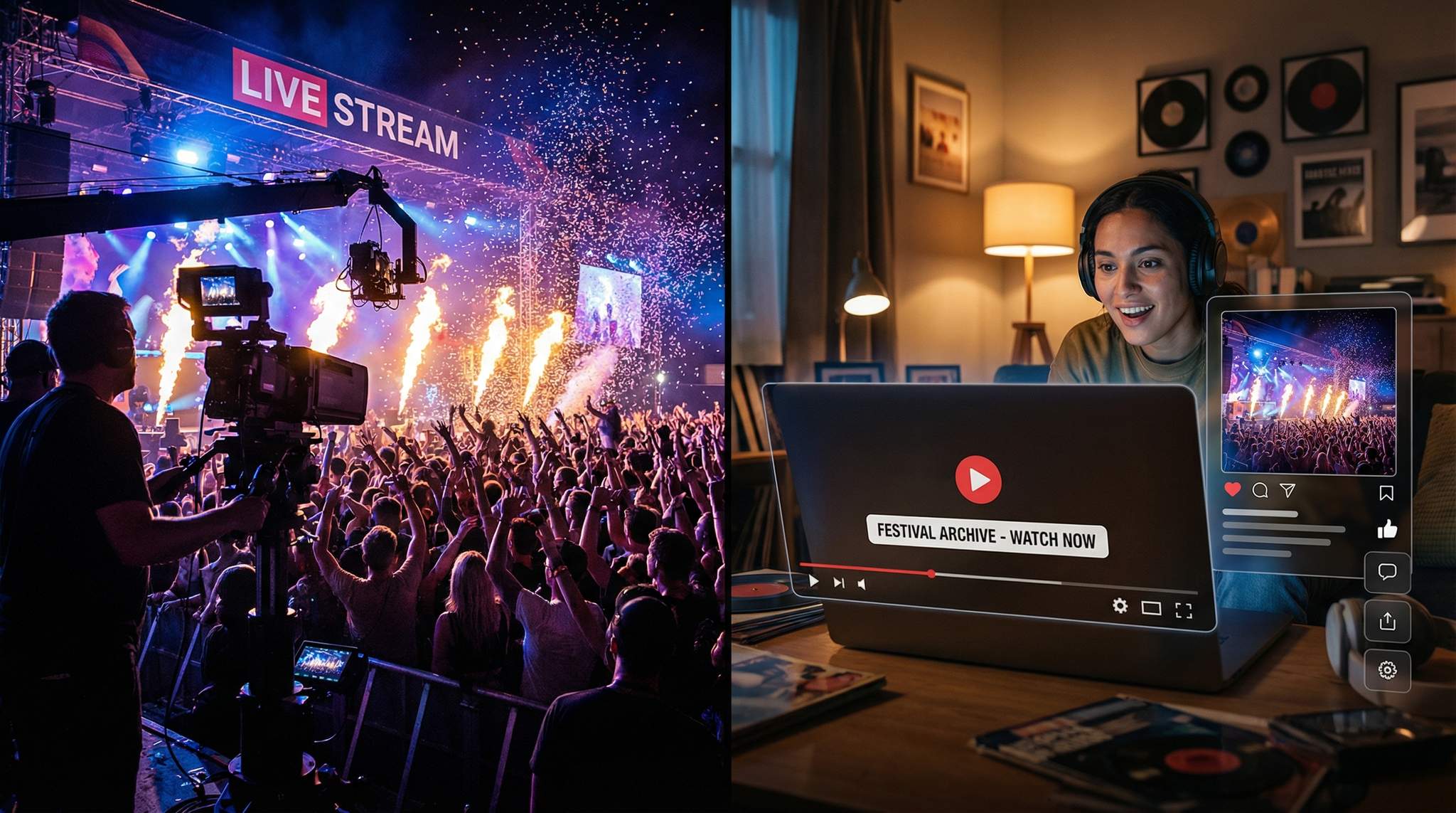
Live-streaming your festival can be a double-edged sword. On one side, livestreams let fans from all over the world join in real time, dramatically extending your reach beyond the physical venue. A fan in Argentina or India can vibe to a UK festival’s headline set via YouTube, Twitch, or a dedicated platform – building a global community around your event. In fact, many electronic music festivals have embraced this. Ultra Music Festival in Miami streams selected sets worldwide each year, and Australia’s Splendour in the Grass has at times broadcast performances to engage those who couldn’t attend. The appetite is huge: Coachella’s 2019 YouTube livestream racked up 82 million live views across its first weekend (far eclipsing the ~250,000 on-site attendees), and in 2023 Elton John’s Glastonbury set drew a peak of 7.6 million TV viewers in the UK alone. Major festivals are reporting massive online audiences – Montreux Jazz Festival saw a 324% year-on-year increase in livestream viewership in 2025, totaling over 2.5 million YouTube views and 7.5 million across social platforms. These numbers prove livestreams can generate huge buzz, social media chatter, and even new revenue streams via sponsorships or pay-per-view models. They also cater to those who missed out on tickets (perhaps your event sold out in minutes) – keeping those fans engaged rather than alienated.
However, if you do stream, make sure to do it well. A laggy video feed or distorted audio can turn off viewers and reflect poorly on your event’s brand. Invest in a professional streaming crew or experienced broadcast partner for a smooth, high-quality broadcast. Many top festivals partner with media professionals or tech platforms to ensure a TV-quality experience – for example, Tomorrowland works with expert crews (and even featured a custom content hub on TikTok in 2023) to deliver flawless multi-camera streams via global partnerships. A crisp, well-mixed stream with dynamic camera work can impress potential future attendees, while a glitch-filled, shaky broadcast might do more harm than good. (In fact, if a top-notch stream isn’t feasible, it may be wiser to skip it or limit it, and stick to polished post-event videos instead.) Also consider adding live captions for accessibility and a dedicated audio mix for the stream; professional stream mixers target around –16 LUFS for consistent volume, and honoring geo-blocking agreements ensures viewers don’t constantly adjust sound. These technical details reflect well on your festival’s professionalism and make the remote experience more enjoyable.
On the other side of the sword, there’s the fear: Will some fans skip buying a ticket because they can watch from their couch? This is where strategy comes in. The key is to balance live broadcasts with on-site exclusives. You want the stream to be a tantalizing sample, not a full substitute for being there. One tactic is to stream select stages or time slots – not every moment of the festival. For example, you might broadcast the main stage after 6 PM, or only certain superstar acts, while keeping smaller stages, surprise guest sets, or special late-night shows exclusive to those on the grounds. This way, remote viewers get a taste of the action, but they understand they’re not seeing everything. It creates a highlight reel effect rather than a comprehensive experience.
Free Tool: Project Your Bar Revenue
Per-head spend benchmarks by event type turned into projected bar and food revenue, with a stock-mix estimate and gross-margin line. Free calculator.
Another strategy is to maintain elements that simply cannot be streamed. The on-site experience isn’t just the music – it’s the visceral feeling of the subwoofers in your chest, the camaraderie of the crowd, the fireworks exploding overhead, the smell of the food trucks, the art installations you wander through, even the energy of dancing together in a field. Emphasize those unique physical perks to your audience. Some festivals lean into this by orchestrating exclusive in-person moments: for example, a secret set only announced via an on-site message board, or interactive spectacles (a costumed parade through the grounds, a flash mob, a holographic surprise) that aren’t fully captured on the broadcast. On-site attendees will feel they got something special that the at-home audience didn’t, and those who only watched from home will know they definitely missed out on more than what the camera showed. By designing a few “you had to be there” moments, you keep the FOMO high for next time.
Geo-blocking is another consideration. If your festival largely draws a local or regional crowd, you could geo-fence the livestream so that people within, say, the same country or state can’t access the stream (or can only access delayed highlights). This is akin to how some sports events do local TV blackouts to ensure stadium attendance. For instance, a festival in New York might choose to block the live stream in the Eastern U.S. but make it freely available internationally – so local fans still have incentive to buy tickets, while overseas fans can partake remotely. Similarly, major events like Glastonbury partner with national broadcasters for extensive coverage in their home country, but only release select highlight sets on global platforms. In 2023, over 21.6 million people – about a third of the U.K.’s population – tuned in to BBC’s Glastonbury TV broadcasts over the festival weekend. Yet if you were outside the U.K., you mostly caught curated highlights on YouTube. This approach preserves a bit of exclusivity for the home audience while still engaging a worldwide fanbase. Just be transparent if you implement geo-blocking; fans will understand a regional restriction if it’s communicated as supporting the live experience (or due to rights agreements) rather than them discovering it last-minute and feeling left out.
Need Festival Funding?
Get the capital you need to book headliners, secure venues, and scale your festival production.
Despite your best efforts, know that in today’s world, completely controlling content is nearly impossible – and that’s not necessarily a bad thing. Even if you don’t officially stream a particularly epic moment, attendees with smartphones will. And their organic sharing can actually boost your festival’s profile. Case in point: at Coachella 2023, one headliner’s set wasn’t part of the official livestream, yet it still appeared online via countless fan-shot videos within hours. Those grainy clips went viral on social media, sparking both envy and excitement, and arguably increased the mystique of that set. Rather than fearing fan streams, you can even encourage on-site attendees to share snippets on their own social channels (using your event hashtag) to create a flood of FOMO-inducing mini clips. When remote fans see tantalizing 30-second videos of a surprise guest or an unbelievable crowd moment – and realize the only way to truly experience it is to be there next time – it only amplifies the desire to attend.
In short, embrace livestreaming as a powerful tool, but be strategic. Stream what showcases your festival best to the world, hold back what you want to keep special, and always remind viewers that nothing beats the real thing. Many industry leaders now believe that streaming and live attendance can thrive hand-in-hand. As Amazon Music’s global content head Kirdis Postelle put it, fandom knows no borders – fans worldwide will tune in if given the chance – but your job is to ensure the online experience complements the live show, rather than cannibalizing it. Done correctly, the live stream becomes an appetizer for the main course of attending in person. You get to have the global engagement cake without losing the in-person attendance icing.
Pro Tip: If you plan to livestream, invest in redundancy. Use multiple internet uplinks (fiber, satellite, 5G) and backup power for your streaming equipment. Nothing kills the magic for remote viewers like a stream that crashes during the headliner’s set. A robust technical setup and on-site IT team will protect the stream quality – and your festival’s reputation.
Drop Content in a Year-Round Cadence
After the stages go dark and attendees head home, your festival’s story shouldn’t go silent. One of the smartest things a festival producer can do is treat content release as an ongoing drumbeat that keeps the community engaged between editions. Rather than dumping all your photos and videos in one go, plan a content cadence – a timeline for releasing material over weeks and months that sustains excitement and nostalgia.
Free Tool: How Many Tickets to Break Even?
Enter your venue, artist, production and marketing costs with your ticket price. See how many tickets cover your costs and how many you still need to sell.
Right after the festival, while the energy is high, drop some quick gratification for fans. For example, within a day or two post-event you can share a snappy 30- to 60-second highlight reel on Instagram or TikTok, and publish an album of the best photos on Facebook or your website. Attendees will be eager to tag themselves and relive peak moments, and those who missed it will get an immediate taste of what just went down (and what they missed). This immediate content also softens the post-festival blues and keeps the positive buzz circulating in news feeds. As seasoned organizers often say, when the last notes fade, the real post-festival marketing work begins – keeping the momentum after the event is crucial to retain your tribe of fans.
In the ensuing weeks, roll out the more polished pieces. The official aftermovie – typically anywhere from 3 minutes up to 15–20 minutes long, depending on your style – should premiere once it’s finely edited and storytelling-driven. Often releasing it 1–3 weeks post-event is ideal: the memory is still fresh, but enough anticipation has built since the teaser clips. Promote the aftermovie’s release like an event in itself. Some festivals even do a countdown or a YouTube premiere for it, turning the video drop into a communal online celebration of the festival everyone attended. For instance, a festival in Indonesia or India might synchronize their aftermovie premiere time so both local fans and international viewers can watch together and share the moment. When you announce “Official Aftermovie coming Friday at 8PM!”, you give everyone – attendees and curious prospects alike – something to look forward to that week.
Don’t stop at the aftermovie. If you recorded full DJ sets or band performances (and have permission to use them), consider releasing a few of them over time. Many festivals do this: one week it’s the epic closing set everyone is talking about, the next week it’s a montage of the wildest moments from the underground stage, and later a fan-favorite band’s full 45-minute set in HD. By spacing these out – perhaps one video release every week or two – you give fans a reason to keep checking back and reliving the excitement. For example, one summer Montreux Jazz Festival launched a series of archived concert videos weekly, extending their online engagement for months. Some festivals even package select live recordings as official live albums or streaming releases (in 2024, the singer Raye released an album of her Montreux performance just six weeks after the show, bringing additional publicity and revenue to the festival). Each piece of content rekindles interest and conversation. It also shows potential future attendees the caliber of performances and the vibe they can expect.
Between those major content drops, keep your community alive with smaller bites and interactive posts. Social media is your best friend here. Share attendee-generated content (repost great fan Instagram clips or TikToks from the festival, with credit). Do “throwback” posts on Thursdays like “Remember this moment? ?” with a photo of a standout memory. Share fun stats (“Fun fact: our crowd munched 5,000 tacos and danced for a total of 36 hours across three days!”) or behind-the-scenes anecdotes (“Did you know our crew built the main stage in just 48 hours on-site?”). Some festivals even start podcasts or blog series between events – interviewing artists, spotlighting the festival team, or exploring the local culture and community around the event. All of this keeps people feeling like the festival isn’t just a once-a-year blip, but an ongoing community and culture they are part of.
Be creative and tailor content to your festival’s personality. If your festival has a strong cultural element, consider producing mini documentary snippets – e.g., “Meet the team behind our stage designs” or “How our food vendors brought global cuisine to our festival city.” If your event is very music-focused, you might do a series where artists briefly explain the inspiration behind the sets they played, or a Q&A with the festival founder about how this year’s edition came together. Engage fans with polls (“Which moment gave you goosebumps? A, B, or C – tell us!”) and contests (“Share your best festival outfit photo to win early-bird tickets”). The idea is to turn attendees into an ongoing community rather than one-time customers. A festival that feels like a year-round home to its fans will enjoy loyalty that money can’t buy.
Timing your content cadence to lead naturally into the next year’s promotion cycle is also wise. As you approach the announcement of next year’s dates or lineup, you want your audience already buzzing with fond memories and ready for more. Use the past to tease the future: for instance, when you’re about to announce early-bird tickets for next year’s festival, post a short video mash-up of this year’s best moments as a hype springboard. If you’re marketing to new audiences in other regions, showcase how international your crowd was this year (shots of flags, diverse attendees dancing together) – this can persuade someone abroad that your festival is worth the trip. The goal is a continuous loop: content from the last festival fuels excitement for the next, and the promise of the next festival makes the content from the last feel even more poignant. By the time you drop the actual lineup or open music festival ticket sales, you’re not starting from zero – you’ve kept people emotionally invested all year, so they’re primed to purchase and promote on your behalf.
Free Tool: Will the Money Be There in Time?
Map your deposits and balances against when ticket money reaches you. See your lowest balance and how much you need to find before it arrives.
Warning: Avoid dumping all your content at once or spamming feeds with repetitive posts. It’s tempting to share everything immediately, but pacing yourself will yield better engagement. Each piece of content should have its moment to shine. A steady drumbeat of updates prevents burnout and keeps fans hungry for more, rather than overwhelming them in the first week after the festival.
By drip-feeding content thoughtfully throughout the year, you transform post-festival marketing from a one-off push into a sustained conversation. Attendees will keep the festival spirit alive on forums, group chats, and fan pages, all sparked by the content you provide. They’ll watch videos together, swap memories, and hype each other up for the next edition. A year-round engagement strategy means that when you finally announce “Festival XYZ is back!” or launch ticket sales, you’re activating an audience that’s already fired up and full of FOMO from last time. In this way, your festival isn’t a one-weekend event – it’s an ongoing story that fans love to follow and be part of.
Frequently Asked Questions
How do festival aftermovies capture the event’s atmosphere?
Effective aftermovies prioritize emotion and storytelling over rote documentation. By focusing on crowd reactions, specific interactions, and scenic details rather than just stage footage, producers rekindle the festival’s spirit. Techniques include wide-angle shots of united fans and close-ups of genuine joy to convey the unique vibe and soul of the event.
How can festivals livestream without reducing ticket sales?
Festivals balance live broadcasts with on-site exclusives to maintain the fear of missing out (FOMO). Strategies include streaming only select stages or time slots while keeping surprise guests and special late-night shows exclusive to physical attendees. This approach treats the stream as a highlight reel rather than a replacement for the in-person experience.
What permissions are needed for filming festival attendees?
Organizers should post visible notices at entrances stating that entering the event constitutes consent to be filmed. For close-up shots, interviews, or featuring specific individuals prominently, obtaining a signed video or photo release form is essential. Special care and parental consent are required when filming minors to comply with privacy laws.
How do festivals handle music licensing for aftermovies?
Producers must secure rights to use copyrighted tracks to avoid takedowns. Options include using the artist’s actual live performance audio (with permission), licensing specific tracks via labels, or commissioning original music. Some festivals create an official anthem or use a headliner’s track to ensure the video has a unique vibe and clean rights situation.
Why is a year-round content cadence important for festivals?
Drip-feeding content keeps the community engaged and sustains excitement between events. Instead of releasing everything at once, festivals release immediate highlights, followed by polished aftermovies and full sets over weeks or months. This continuous engagement transforms the festival from a one-weekend event into an ongoing story, priming fans for future ticket sales.
What is the purpose of geo-blocking festival livestreams?
Geo-blocking restricts livestream access based on location to protect local ticket sales or honor broadcast rights. Festivals may block streams in the host country or region to encourage physical attendance while allowing international fans to watch freely. This ensures local fans have an incentive to buy tickets without alienating the global audience.