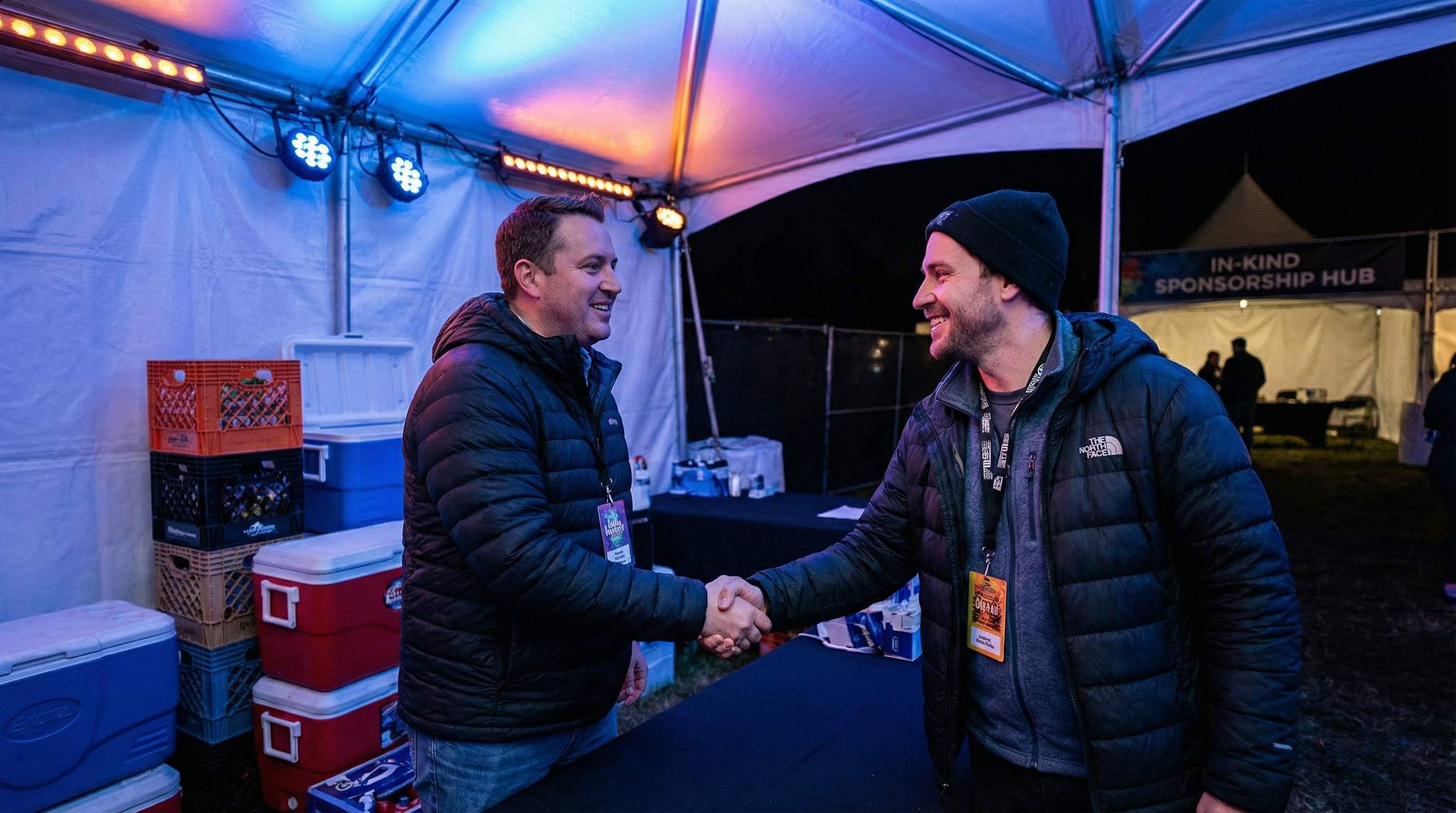
For festival producers facing tight budgets and rising costs, in-kind sponsorship trades can be a game-changer where a sponsor provides goods or services instead of cash. This bartering approach allows events to secure needed resources while offering partners meaningful benefits in return. From huge music festivals to local community events, smart in-kind deals have helped organisers slash expenses, enhance guest experiences, and build lasting sponsor relationships across the globe.
If you are scaling up your event production and wondering exactly what is an in kind sponsor, the concept is straightforward but highly strategic. An in-kind sponsor is a brand or corporate partner that provides essential goods, services, or technology to an event in lieu of a direct financial fee. In the global events industry, this is frequently referred to as value-in-kind sponsorship (or VIK). Whether it is a staging company providing the main stage rig or a beverage brand stocking the artist compound, VIK partnerships are foundational to scaling festival operations without over-leveraging your cash reserves.
Structuring a Sponsorship in Barter
When transitioning from traditional cash deals to a sponsorship in barter, festival organizers must adopt a strict procurement mindset. A barter sponsorship isn’t just about accepting free goods; it is a strategic exchange of your event’s marketing assets for budget-relieving inventory. Whether you are trading VIP hospitality access for site lighting or exchanging main stage branding for artist transportation, every barter agreement must be weighed against your actual hard costs. By treating these non-cash transactions with the same financial rigor as your ticketing revenue, you ensure that every trade directly improves your festival’s bottom line.
Core Categories of Value-In-Kind Sponsorship
When explaining what an in-kind sponsor is to stakeholders or new promoters, I always break these partnerships down into core operational buckets. Infrastructure and site ops partners supply heavy machinery, temporary fencing, or staging equipment that directly offset massive rental costs. Media and promotional trades offer out-of-home billboard space, radio airtime, or digital ad inventory, expanding your marketing reach without draining your ad spend. Finally, consumable and hospitality brands provide crew catering, artist rider fulfillment, or VIP hydration. By segmenting these non-cash targets, your procurement team can systematically approach brands to cover specific line items in your production budget.
Go Cashless With RFID Technology
Enable contactless payments, faster entry, and real-time spending analytics with RFID wristbands and NFC-enabled ticketing for your events.
Securing Food Sponsors for Events and Festivals
One of the most impactful ways to reduce your overhead is by securing dedicated food sponsors for events. Feeding a massive production crew, fulfilling complex artist riders, and catering VIP hospitality areas can quickly drain your cash reserves. When pitching potential F&B partners—whether they are national FMCG brands, regional restaurant groups, or emerging snack companies—focus on the captive audience and sampling opportunities your festival provides. A strategic culinary trade might involve a local restaurant group taking over your artist catering in exchange for a prime, rent-free vendor pitch in the main arena. Alternatively, a consumer packaged goods (CPG) brand could supply thousands of units of snacks for your volunteer break rooms, directly offsetting your internal catering budget while getting their new product into the hands of influential event staff.
Partnering with Payment Companies That Sponsor Music Festivals
Beyond physical infrastructure and catering, financial technology represents a massive opportunity for budget relief. When evaluating payment companies that sponsor music festivals, organizers should look beyond traditional cash fees and explore hybrid or value-in-kind agreements. Major fintech brands, cashless RFID providers, and point-of-sale (POS) platforms are highly motivated to showcase their technology in high-volume, live environments. In exchange for exclusive “Official Payment Partner” status or naming rights to a VIP lounge, these tech firms will often waive hardware rental fees, subsidize the cost of RFID wristbands, or even reduce transaction processing rates. This type of strategic trade not only slashes your ticketing and on-site operational overhead but also provides attendees with a frictionless purchasing experience at the bar and merchandise tents.
Planning a Festival?
Ticket Fairy's festival ticketing platform handles multi-day passes, RFID wristbands, and complex festival operations.
Furthermore, when evaluating payment companies sponsoring music festivals, consider the broader data ecosystem. A top-tier fintech partner won’t just supply card readers; they will integrate seamlessly with your primary ticketing platform to provide real-time analytics on attendee spending habits. This data-sharing aspect of the barter agreement is invaluable for future financial forecasting and proving ROI to other prospective sponsors.
Value In-Kind Trades Realistically (Retail Value Minus Costs & Risk)
Not all “free” contributions are created equal. A crucial first step is to evaluate an in-kind offer at its true net value. Consider the product’s retail value, minus any costs you’ll incur to deliver or utilise it, and any risks if things go wrong. For example, if a beverage sponsor offers “$10,000 worth” of drinks, calculate what it saves you in wholesale cost and account for expenses like refrigeration, staff to serve, and leftover waste. Never overvalue goods just because they’re free – especially if they are not essential or come with strings attached. In fact, sponsorship experts often value non-essential in-kind items at roughly 50% of their cash value, since these may not offset a budget line directly.
Before saying “yes” to an in-kind deal, ask practical questions:
– Do we truly need this? If the item or service isn’t something you’d otherwise purchase or rent, it might hold little real value for the festival.
– What will it cost us to use? Estimate any delivery, storage, staffing, or implementation costs required on your side. For instance, free T-shirts might require hiring extra staff to distribute.
– What are the risks? Consider the impact if the sponsor’s promise falls through or the quality is subpar. If a lighting sponsor fails to deliver, do you have a backup plan, or will you be scrambling to rent gear last-minute?
It’s perfectly acceptable to decline an in-kind offer that doesn’t make financial or logistical sense. Seasoned festival organisers have learned that saying “no” can be wiser than accepting a donation that comes with hidden costs. Always remember: an in-kind deal should work for you and fill a genuine need for your event, just as a paid service would.
Data-Driven Event Marketing
Track ticket sales, demographics, marketing ROI, and social reach in real time. Exportable reports give you the insights to make smarter decisions.
On the other hand, when the fit is right, in-kind trades can substantially reduce core expenses. For example, waste management is a necessity for any large event – you need dumpsters and trash removal. Some festivals have saved thousands by trading sponsor benefits for these essential services (e.g. offering the waste company logo placement and VIP tickets instead of paying cash). Similarly, a beverage brand might supply drinks for volunteer and artist hospitality areas, eliminating that cost from your budget. The key is to focus on in-kind sponsors that cover essential line items – security, fencing, staging, power, sanitation, transport, accommodations, and so on – because those directly replace expenses you would otherwise pay in cash.
Cap the Volume to Prevent Sponsor Clutter
It can be tempting to say yes to every in-kind contribution offered – free snacks from a local bakery, water bottles from a gym, lanyards from a print shop, you name it. But if you stack up too many small sponsors, your festival branding and operations can suffer. Too many logos and promotions create clutter, diluting the visibility of each sponsor and overwhelming your audience. Attendees can only absorb so many brand messages in a festival environment, and if fifteen sponsors all demand banner placement, shout-outs, or their own booths, no one wins – not the sponsors (who get lost in the crowd) and not the festival (which starts to feel like a marketing expo).
Need Festival Funding?
Get the capital you need to book headliners, secure venues, and scale your festival production.
Successful festival producers strike a balance. They cap the number of in-kind deals to keep partnerships impactful and manageable. It’s often better to have a handful of high-value in-kind sponsors than dozens of minor trades that explode into signage everywhere. One major Australian music festival learned this when early years saw a proliferation of sponsor banners from every local business that donated something. By consolidating and limiting sponsorship slots, they later ensured each partner got quality exposure and attendees weren’t bombarded by logos at every turn. Fewer, stronger sponsors also mean you can give each one more attention with tailored activations, rather than a generic “logo soup” on a banner wall.
To avoid clutter while still benefiting from barter deals:
– Limit the total number of sponsor logos on-site. Consider setting a cap (e.g. “no more than X sponsor banners on the main stage”) and bundling smaller contributors under a collective banner (like a “Community Partners” board) instead of individual prime placements.
– Ensure category exclusivity or differentiation. Try not to accept five different in-kind sponsors all providing similar products, which can confuse attendees and upset the sponsors. If one beverage brand is giving you stock, don’t also take competing beverage logos just for a few cases of product.
– Align with the festival identity. Only partner with brands that make sense for your audience and vibe. This way any branding feels more organic and less like clutter. A curated approach (choosing sponsors that align culturally) naturally limits random logos.
Sponsors themselves prefer an uncluttered environment – they know a lone logo on a stage or a unique activation is far more memorable than being the 20th logo on a fence. By keeping your in-kind roster selective, you preserve the premium feel of the event and actually increase the value for those partners you do bring on board.
How to Negotiate Music Festival Sponsorship Deals for Value-In-Kind
Mastering how to negotiate music festival sponsorship deals requires a shift in mindset when dealing with non-cash assets. When you sit down with a prospective brand partner, you must approach the table knowing your exact operational deficits. Start by presenting a “wish list” of hard costs—such as site fencing, heavy machinery rentals, or VIP hospitality catering—that you would otherwise pay for out of pocket. Pitch the value-in-kind sponsorship as a direct offset to these line items. During negotiations, emphasize the unique experiential marketing the brand will achieve by integrating their product directly into the festival’s infrastructure, rather than just slapping a logo on a banner. Always negotiate based on the wholesale cost of the goods provided versus the actual market value of the sponsorship assets you are trading away, ensuring the exchange remains equitable for your production budget.
Free Tool: Size Your Festival Site
Zoned capacity planning for arena, campsite, parking and entry lanes — against UK Purple Guide and NFPA density standards. Finds your bottleneck zone.
Another advanced tactic for how to negotiate music festival sponsorship deals involves timing your outreach to align with a brand’s product launch cycle. Corporations often possess surplus promotional inventory or dedicated experiential budgets that are separate from their cash sponsorship funds. By positioning your event as a high-visibility testing ground for their new releases, you can unlock substantial in-kind value that wouldn’t be available through traditional cash requests.
Leveraging Value-In-Kind Sponsorship for Festival Teams
In my decades of producing mega-events, I’ve found that one of the most overlooked negotiation levers is staff integration. When corporate partners ask how to sponsor a team—whether that means outfitting your volunteer crew, street team, or site ops staff—you have a prime barter opportunity. Pitching a value-in-kind sponsorship where an apparel, footwear, or radio communications brand provides high-quality gear in exchange for visibility is a highly effective tactic. It solves a massive logistical expense for the organizer while giving the brand walking billboards across the entire festival footprint.
Treat In-Kind Agreements Like Cash Deals (Contracts & Service Levels)
When you strike an in-kind deal, formalise it just as you would a cash sponsorship. Put all terms in writing, including detailed deliverables from both sides. Too often, novice organisers handle in-kind trades casually (“Sure, you’ll bring some generators and we’ll thank you on social media”), which can lead to big problems if expectations misalign. Instead, draft a sponsorship agreement or addendum that covers:
– Description of the goods/services provided: Quantities, brand/specifications, and delivery dates. For instance, “Sponsor will provide 10 golf carts for staff transport, delivered to site by June 1 at 9 AM.”
– Service levels or quality standards: If it’s a service (e.g. medical staff, Wi-Fi, shuttle buses), outline performance expectations. Example: a telecom sponsor providing Wi-Fi should guarantee a certain coverage and uptime, with on-site support technicians available.
– Remedies or backup plans: Agree on what happens if the sponsor fails to deliver or the product is not as promised. Will the sponsor cover the cost for you to rent a replacement? Will their fee benefits be reduced if service is below par? Spell it out.
– Sponsor benefits and recognition: List what the sponsor receives in return, as you would for a cash sponsor – logo placements, mentions, booths, VIP access, etc. This keeps the exchange clear and keeps you accountable to deliver value back to the sponsor.
By documenting these points, you protect your festival and set the sponsor up for success. In-kind sponsorships are not charitable donations; they are business deals where the sponsor expects a return on investment (marketing value, goodwill, access to attendees) just as if they paid cash. Thus, both parties should understand their obligations. Having a lawyer or experienced sponsorship manager review your in-kind agreements is wise – a contract ensures everyone is on the same page and that your festival isn’t left in the lurch.
Real-world lesson: A North American food festival once arranged an in-kind trade with a local power generator company for a series of generators. However, they only had a handshake deal. When one generator broke down mid-festival and the company didn’t have a technician on standby (and felt no urgency since no cash was on the line), it caused a major power outage. The festival had to scramble to rent a replacement. This fiasco could have been avoided if service expectations and contingency plans were formally agreed upon. The takeaway? Hold in-kind sponsors to the same standards as paid vendors. If it’s important enough to your event to rely on, it’s important enough to contract and enforce.
Financial Tracking for Non-Cash Partnerships
Beyond the operational logistics, accurately recording an in-kind sponsorship on your festival’s profit and loss (P&L) statement is critical for long-term financial health. Event producers should log the fair market value of the bartered goods as both an expense and a corresponding sponsorship revenue line item. This dual-entry approach ensures your overall event valuation remains accurate, which is vital when seeking future investment or scaling your operations. Proper documentation of these non-cash transactions also simplifies tax reporting and provides a transparent financial picture for your stakeholders.
Free Tool: Project Your Bar Revenue
Per-head spend benchmarks by event type turned into projected bar and food revenue, with a stock-mix estimate and gross-margin line. Free calculator.
Track Utility and Guest Feedback
After the festival, don’t just thank your in-kind sponsors and move on – analyze how those contributions actually performed. Treat each in-kind trade as an investment and evaluate its return in both financial and experiential terms:
– Operational impact: Quantify how much budget you saved. For example, if your beer sponsor provided $5,000 worth of kegs that you would have otherwise purchased, that’s a direct $5,000 saved. If a tech sponsor gave you an app or cashless payment system, how much did it save in development costs?
– Usage and utility: Measure how widely the sponsored goods/services were used. If you got free water refill stations, how many refills were dispensed? If a rideshare partner offered discounted rides, how many attendees used the code? This data shows if the sponsorship truly filled a need.
– Attendee satisfaction: Gather guest feedback on these perks. Many festivals include questions in post-event surveys like “How was the free water service?” or “Did you use the phone charging stations?” Positive feedback or high usage is a sign the in-kind sponsorship hit the mark. For instance, Austin City Limits Festival in Texas partnered with CamelBak to provide free filtered water stations, which festival-goers consistently praise as a huge convenience. Comments like “Filtered water stations from CamelBak – fill up for free!” underscore how an in-kind amenity can boost the attendee experience and reflect well on both the event and sponsor.
– Sponsor goals: Check in with the sponsors about their objectives and satisfaction. Did the trade deliver the brand exposure or goodwill they hoped for? If you can show them data — say, 10,000 water refills provided or hundreds of social media mentions of the free Wi-Fi — you help prove the ROI of their contribution.
By tracking these factors, you gain valuable insights. You might discover that some in-kind benefits were underutilised (telling you to adjust or communicate them better next time), while others were a smash hit. This information guides future sponsorship negotiations: you’ll know which types of in-kind trades are truly “worth it” and can share success metrics with potential new sponsors. Additionally, demonstrating to a sponsor that their contribution made a positive impact (and guests loved it) lays groundwork for renewing or even upgrading that partnership in the future.
Leveraging Barter for Audience Engagement and Data Capture
When new promoters ask exactly what are in kind sponsors, they often limit their thinking to back-of-house infrastructure or crew catering. However, these non-cash partnerships are also incredibly powerful tools for front-of-house audience engagement. A strategic value in kind sponsorship can supply high-end prizes that drive your festival’s marketing campaigns or charity initiatives. For instance, partnering with a luxury travel brand, an automotive company, or a consumer electronics manufacturer can secure big ticket items for raffle draws, VIP upgrade sweepstakes, or pre-event data capture contests. Instead of paying out of pocket for promotional giveaways, you trade digital real estate or on-site activation space for premium goods. This not only incentivizes fans to opt into your mailing list or download your festival app but also provides the sponsor with highly qualified leads, making the sponsorship in barter a massive win for your marketing department.
Managing the Logistics of B2B Trading at Festivals
When executing these non-cash agreements, the physical reality of B2B trading at festivals requires meticulous site planning. Whether a sponsor is dropping off heavy plant machinery or setting up a branded VIP activation, organizers must integrate these barter partners into the master production schedule. Treat your in-kind vendors with the same logistical rigor as paying exhibitors. Assign dedicated liaison staff to ensure that the goods or services promised during the negotiation phase actually materialize on-site without disrupting the broader event build.
Examples of Smart In-Kind Trades Worldwide
Every festival, from boutique to blockbuster, can leverage in-kind sponsorships creatively. Here are a few real-world examples of trades that paid off:
- Glastonbury Festival (UK) & Vodafone – Connectivity: In a multi-year partnership, Vodafone became Glastonbury’s Official Connectivity Partner, providing critical infrastructure and freebies to festival-goers. In 2023, Vodafone built a new festival app and offered free phone charging for all attendees, while bolstering the event’s network coverage. This in-kind support meant Glastonbury didn’t have to invest heavily in technology and guest services, and attendees enjoyed better connectivity. The sponsor gained high-profile presence and goodwill by solving a real pain point (phone battery and network access) for thousands of fans.
- Bacardi NH7 Weekender (India) & Red Bull – Stage Production: At India’s popular NH7 Weekender festivals, energy drink brand Red Bull provided a fully equipped “Red Bull Tour Bus” stage – a mobile stage on wheels complete with sound and lights. This unique in-kind contribution added an extra performance venue to the festivals. The organisers saved on staging costs for that stage, while Red Bull showcased its brand through a memorable attraction. Fans got to enjoy surprise performances on a tricked-out bus stage, creating buzz and added value without the festival spending a rupee on that infrastructure.
- Local Food & Wine Festival (USA) & Media/City Partners – Services: A regional food and wine festival in California partnered with its city government and a local radio station in lieu of cash sponsorship. The city’s public works department provided in-kind support with street closures, trash cleanup, and even some police overtime, significantly reducing the festival’s municipal fees. Meanwhile, the radio station gave the festival tens of thousands of dollars’ worth of advertising airtime in exchange for on-site branding and being named the official media partner. These trades stretched the festival’s budget far beyond its cash-on-hand, while the city gained positive community exposure and the radio station built its reputation with listeners through association with a beloved local event.
The common thread in these examples is that the trades were strategic. Each sponsor’s contribution aligned with a key festival need (technology, staging, city services, publicity), and the benefits to the sponsor were tangible and well-defined. Crucially, none of these deals overwhelmed the festival with disjointed branding – instead, they enhanced the event experience in ways attendees noticed and appreciated.
Smooth Entry With Mobile Check-In
Scan tickets and manage entry with our mobile check-in app. Supports photo ID verification, real-time capacity tracking, and multi-gate coordination.
Smart Barter Stretches Budgets and Builds Relationships
When executed thoughtfully, in-kind sponsorships can significantly extend your festival’s capabilities beyond what the cash budget allows. It’s about stretching every dollar by trading for value where it makes sense. A smart barter can fund a new stage, a better attendee amenity, or a higher quality production element that you otherwise couldn’t afford.
However, the wisdom of an industry veteran is to approach in-kind deals with both enthusiasm and caution. Always align trades with genuine needs, keep your sponsor roster curated, lock down agreements in writing, and measure the outcome. By doing so, you ensure these partnerships remain win-win and regret-free.
In-kind trades are not a silver bullet for all budget woes – you can’t pay your security staff with cases of soda, after all. But used in conjunction with cash sponsorship and ticket revenue, they are powerful tools. Many seasoned festival producers can recount a barter that saved their event, whether it was a last-minute stage equipment loan or a long-term deal for free venue space. These stories underscore a final point: in-kind sponsorships often forge deeper relationships. A company that has invested its products or expertise in your festival has a stake in your success. If you deliver value back and treat them as true partners, that in-kind deal can evolve into a recurring sponsorship, or even future cash support as budgets grow.
In summary, think of in-kind trades as budget multipliers. They require creativity, due diligence, and clear communication – but the payoff is budget relief, enriched festival experiences, and stronger bonds with sponsors and the community. That’s a trade any festival organiser can appreciate.
Frequently Asked Questions About Festival Sponsorships
What is an in-kind sponsor in the events industry?
An in-kind sponsor is a brand or corporate partner that provides essential goods, services, or technology to an event instead of a direct cash payment. For festival producers, this value-in-kind sponsorship helps offset hard operational costs like staging, fencing, or catering, preserving vital cash reserves.
How do you negotiate music festival sponsorship deals effectively?
Successful negotiation starts with a clear understanding of your event’s operational deficits. Present potential partners with a wish list of hard costs you need covered. Focus the conversation on how their product integration offers unique experiential marketing, and always weigh the wholesale cost of their goods against the market value of the assets you are trading.
Can a brand sponsor a festival’s staff or volunteer team?
Absolutely. When companies explore how to sponsor a team at a large-scale event, organizers can offer value-in-kind trades for staff outfitting. A brand might provide uniforms, two-way radios, or catering for the production crew in exchange for official partner status, reducing the festival’s overhead while delivering authentic, on-the-ground brand integration.
How do you calculate the true value of a value-in-kind sponsorship?
Festival organizers should calculate VIK based on the actual budget relief it provides, not the retail price of the goods. If a brand offers products you wouldn’t normally purchase, the operational value is zero. Always assess the wholesale cost of the essential items provided minus any activation, storage, or staffing expenses required to deploy them on-site.
How do you pitch food sponsors for events and festivals?
To successfully pitch culinary and beverage partners, focus on how their products can integrate into your operational ecosystem. Offer them exclusive sampling rights in VIP areas or rent-free vendor pitches in exchange for covering your internal crew catering or artist rider fulfillment. This offsets your hard F&B costs while giving the sponsor direct access to your attendees.
How do payment companies sponsor music festivals?
Payment companies that sponsor music festivals typically engage in hybrid or value-in-kind partnerships by providing point-of-sale hardware, cashless RFID technology, or reduced transaction fees. In return, these fintech brands receive exclusive on-site branding, experiential activation spaces, and direct exposure to thousands of transacting attendees, allowing organizers to significantly lower their event’s financial infrastructure costs.
What are the best practices for managing a sponsorship in barter?
Managing a sponsorship in barter requires strict documentation and clear valuation. Festival producers should always draft a formal barter agreement that outlines the exact retail and wholesale value of the goods or services provided, alongside the specific marketing assets given in return. This ensures both the event organizer and the brand partner have aligned expectations and protects the festival from unexpected operational shortfalls if the traded services underdeliver.
Can in-kind sponsors provide items for festival giveaways or charity raffles?
Yes. Beyond operational relief, many organizers secure big ticket items for raffle campaigns, VIP sweepstakes, or charity auctions through barter agreements. By trading promotional visibility for premium goods—like travel packages or high-end electronics—festivals can drive massive audience engagement and data capture without spending cash on prizes.
What are the best big ticket items for raffle campaigns at festivals?
When securing big ticket items for raffle draws or VIP sweepstakes, focus on high-perceived-value goods that align with your audience’s lifestyle. Luxury travel packages, exclusive backstage experiences, and premium consumer electronics are highly effective. These high-end barter items incentivize attendees to participate in data capture campaigns, providing valuable leads for both the festival and the sponsoring brand.
How should organizers record an in-kind sponsorship on their event budget?
For accurate financial tracking, an in-kind sponsorship should be recorded on your festival budget as both a revenue line item and an offsetting expense. By logging the fair market value of the bartered goods or services, organizers maintain an accurate picture of the event’s true operational cost and total sponsorship revenue, which is essential for future financial forecasting and stakeholder reporting.