In festival production, a single overlooked risk can turn a dream event into a nightmare. Whether it’s a sudden thunderstorm, an unruly crowd surge, or a medical emergency, producers must anticipate and plan for countless scenarios. The safety of attendees, staff, and artists – and the festival’s very survival – depends on rigorous risk management. This authoritative guide provides festival organizers with proven strategies to identify threats, prevent incidents, and protect everyone involved.
Mastering live event risk management requires a holistic approach that extends beyond the festival grounds. Whether you are producing a multi-day outdoor gathering or a high-capacity indoor concert, the foundational principles of risk management for events remain the same: proactive hazard identification, rigorous operational planning, and seamless inter-departmental communication.
From small community festivals to massive international events, the principles of risk management and safety planning apply universally. It’s not about paranoia – it’s about preparation. A well-run festival operates like a safety-first machine behind the scenes, so that attendees only experience the magic. The sections below break down how top producers plan for every contingency to ensure their festivals run smoothly and safely.
Table of Contents
- Understanding Festival Risk Management
- Regulatory Compliance and Safety Standards
- Security Planning & Law Enforcement Coordination
- Crowd Management & Venue Design
- Weather Contingency Planning & Climate Resilience
- Insurance & Liability Coverage
- Safety Personnel, Training & External Experts
- Emergency Action Planning & Response
- Learning from Past Festival Failures
- Essential Reading
- FAQ
- Glossary
- Conclusion
Understanding Festival Risk Management
Festival risk management is the art and science of anticipating what could go wrong – and ensuring it doesn’t. At its core is the conduct of a comprehensive risk assessment to identify festival-specific threats. Organizers systematically list potential hazards (from severe weather to crowd crushes to technical failures), then analyze how likely each is to happen and how severe the consequences would be. This process shines a spotlight on the most critical risks so producers can prioritize their safety measures.
A dedicated music festival risk assessment goes beyond generic event templates. It must account for high-decibel environments, multi-day camping logistics, and dynamic crowd behaviors that are unique to live music settings.
When developing a strategy for live event risk management, producers must look at the entire production lifecycle. Effective risk management for events encompasses everything from the initial site survey and contractor vetting to the final load-out. By treating safety as an integrated operational function rather than a standalone checklist, organizers can build resilient production frameworks capable of handling unexpected disruptions.
Planning a Festival?
Ticket Fairy's festival ticketing platform handles multi-day passes, RFID wristbands, and complex festival operations.
To visualize this, consider a practical music festival risk assessment example: evaluating the threat of a sudden stage power failure during a headline set. The hazard is the loss of lighting and sound, which could trigger crowd panic or dangerous surges in the dark. The likelihood might be rated as ‘medium’ (depending on generator reliability), but the severity is ‘high.’ The resulting mitigation strategy would require installing secondary backup generators with automatic transfer switches, deploying battery-operated emergency egress lighting, and briefing the security team on manual crowd-calming protocols using megaphones. Documenting these specific scenarios transforms a theoretical safety document into an actionable operational guide.
Key Stat: In 2019, 26% of adults in the UK visited a music festival – a huge audience that underscores the responsibility organisers have to keep crowds safe. Every festival, regardless of size, should treat risk assessment as an ongoing process. As the event approaches, conditions evolve – ticket sales surge, weather forecasts change, new intelligence on security threats emerges. Top producers update their risk assessments continually, ensuring no new hazard slips through the cracks.
Risk management is proactive, not reactive. It’s far better to spend months planning for a crisis that never occurs than to be caught unprepared. Organizers create detailed mitigation plans for each high-priority threat. For example, if analysis shows a main stage crowd could become overcrowded, the plan might include additional barriers, one-way pedestrian routes, and live crowd density monitoring. If lightning is a risk, the mitigation plan will specify clear evacuation criteria and shelter locations. These prepared responses mean that when an issue arises, staff can act decisively according to a well-rehearsed script – not scramble in chaos.
Another key tool is maintaining a “risk register” – a documented list of all identified risks, their owners, and the status of actions to mitigate them. This living document is shared with the festival team and reviewed regularly. It ensures accountability (every major risk has someone responsible for managing it) and visibility (nothing is forgotten amid the hundreds of planning tasks). By making risk management a structured part of festival planning, successful producers build events that are prepared for even the most unexpected challenges.
Free Tool: Size Your Festival Site
Zoned capacity planning for arena, campsite, parking and entry lanes — against UK Purple Guide and NFPA density standards. Finds your bottleneck zone.
When evaluating which are the risk management factor considerations that apply to all CFT events (cross-functional team operations) within a festival’s production cycle, organizers must prioritize inter-departmental communication, shared operational timelines, and unified emergency protocols. Whether coordinating between staging, hospitality, or medical teams, these universal factors ensure that no single department’s oversight compromises the broader event safety.
Ultimately, a dynamic music festival risk assessment must evolve alongside the event’s logistical footprint. As site maps change, new stages are designed, or additional vendors are contracted, the overarching safety documentation should be updated to reflect these shifting operational realities.
Need Festival Funding?
Get the capital you need to book headliners, secure venues, and scale your festival production.
Similarly, when scaling down from a massive multi-day footprint to a single-evening arena or stadium show, conducting a targeted music concert risk assessment is equally vital. This specialized evaluation zeroes in on short-duration, high-intensity hazards—such as rapid crowd ingress, concentrated audience surges during a single headliner’s set, and the specific acoustic or structural limits of an enclosed venue.
When drafting a foundational risk assessment for a music event, producers must account for variables rarely seen in corporate or sporting environments. High sound pressure levels (SPL), dynamic crowd surges toward barricades during headline performances, and complex artist production riders all introduce unique hazards. A thorough evaluation maps these specific live entertainment risks against the venue’s physical constraints, ensuring that every technical and audience-facing element is scrutinized before load-in begins.
Pro Tip: Integrate risk discussions into every planning meeting. When you decide on a new element – like adding a fireworks show or a camping area – immediately ask, “What are the risks?” This mindset ensures safety is baked into your event design rather than an afterthought.
Risk management also spans the entire lifecycle of the event, from early planning through post-event debrief. The table below illustrates an example timeline of how top festivals weave safety planning into each stage:
| Timeline | Risk Management Activities |
|---|---|
| 12+ months before event | Initial risk assessment; engage local officials early; outline required permits and budget for safety measures and insurance. |
| 6–12 months before | Hire key safety personnel (e.g. security director, medical coordinator); develop or update the Emergency Action Plan; apply for major permits (health, fire, building, etc.). |
| 3–6 months before | Confirm insurance coverages (liability, cancellation, weather); schedule site inspections with authorities; begin staff and volunteer safety training programs. |
| 1–3 months before | Conduct a full site safety walkthrough; run emergency drills or tabletop exercises; finalize all permit approvals; hold pre-event coordination meetings with police/fire/EMS. |
| During event | Continuously monitor weather and crowd conditions; hold daily all-staff safety briefings; keep emergency response team and equipment on standby; document any incidents in real time. |
| Post-event | Debrief with the team and local officials; document any incidents or near-misses; gather attendee and staff feedback on safety; update risk management plans based on lessons learned for next year. |
Regulatory Compliance and Safety Standards
No matter how cutting-edge a festival’s stages or how stellar the lineup, the event won’t even open its gates without meeting health and safety regulations. Every jurisdiction (city, state, country) has its own labyrinth of permits, codes, and licenses for festivals. Organizers must navigate requirements for fire safety, building structures, electrical systems, food handling, noise, and more. Using a health and safety compliance checklist for festivals is an effective way to track these obligations and ensure nothing slips through the cracks.
Beyond simply checking boxes for local authorities, establishing a comprehensive festival health and safety program protects your most valuable assets: your crew and your attendees. A robust health and safety framework integrates occupational hazard controls during the site build with public welfare measures during the live event. This means proactively managing everything from sanitary food vendor conditions and adequate hand-washing stations to crew fatigue and proper personal protective equipment (PPE) usage on the festival grounds.
Early and frequent communication with authorities is key. Savvy producers don’t view regulators as adversaries – they’re partners in safety. Meet with fire marshals, building inspectors, police, and health department officials as soon as your festival dates and location are set. They can clarify which permits you need and the specific local rules (for example, some fire departments might require a certain number of extinguishers per tent, or the building department may need structural plans for stages). Starting this process 8–12 months ahead for large events is not too early. Complex festivals often take a year or more to secure all approvals.
Warning: If you fail to secure required permits or comply with safety codes, authorities can shut your festival down even as attendees arrive. Regulators have zero tolerance for events that ignore public safety laws – there are documented cases of festivals being halted on opening day because a critical permit was missing or an inspection was failed.
Key areas of compliance include fire and life safety (ensuring clear emergency exits, proper fire extinguisher placement, flame-retardant stage materials), structural safety (stage and tent permits to withstand wind and crowds), and health regulations (adequate sanitation facilities, safe food and water for attendees). Noise ordinances and curfews also come into play, though they’re more about community relations than safety. Major festivals in the US juggle federal OSHA rules, state laws, and local ordinances simultaneously, while countries like the UK have national guides (e.g. the “Purple Guide”) that centralize event safety best practices. Regardless of locale, it’s imperative to know the rules thoroughly or hire a consultant who does.
The following table highlights a few common permits/approvals needed and why they matter:
Free Tool: Project Your Bar Revenue
Per-head spend benchmarks by event type turned into projected bar and food revenue, with a stock-mix estimate and gross-margin line. Free calculator.
| Permit/Approval | Issued By | Purpose |
|---|---|---|
| Fire Safety Permit | Fire Department / Fire Marshal | Ensures the festival site meets fire codes (e.g. placement of extinguishers, clear exit routes, capacity limits in tents). |
| Building/Structure Permit | City Building Department | Certifies that stages, scaffolding, grandstands, and large tents are structurally sound and can withstand expected loads and weather. |
| Mass Gathering License | Local Government Authority | Official permission to hold a large event; confirms that emergency services, medical plans, and traffic controls are in place for public safety. |
Pro Tip: Begin the permit process early and document every step. Create a calendar specifically for compliance deadlines – for example, when to submit your fire safety plan or schedule the electrical inspection. Early submission not only cushions against delays but also shows authorities that you’re committed to a safe, well-organized event, which can make them more willing to work through any issues with you.
Security Planning & Law Enforcement Coordination
A robust security operation is the festival’s first line of defense against many risks. This starts with hiring trained security personnel who understand event environments. Many top festivals partner with professional event security firms, and assign a security director to lead the effort. That director will work closely with local police and emergency services, essentially forming a unified safety team. Hiring professional security staff and coordinating with law enforcement ensures that both private security and public agencies know their roles and communication channels long before gates open.
A comprehensive festival security plan serves as the operational blueprint for safeguarding your venue, staff, and attendees. This document should detail perimeter control strategies, access management for credentialed zones, and specific deployment maps for static guards and roaming patrols. By formalizing these protocols into a written security strategy, organizers ensure that every stakeholder—from private contractors to local police—operates from a single source of truth.
Security planning covers both preventative and responsive measures. On the preventative side, festivals implement bag checks, magnetometers (metal detectors), and perimeter fencing to keep weapons, drugs, and other threats off-site. They develop credential systems to control who can access back-stage or sensitive areas. These steps deter most problems from ever entering the venue. On the responsive side, there must be clear protocols for handling incidents – from minor scuffles to major emergencies. Security teams should have rapid response plans for fights, unruly patrons, missing persons, or suspicious packages. If an incident exceeds the capacity of the on-site team (for instance, a violent altercation or a threat of terrorism), police liaisons embedded at the event can quickly step in or summon additional officers.
One often overlooked aspect is communication. All key security personnel and festival management should be on a dedicated radio network. Additionally, a direct line to local law enforcement dispatch is crucial. In fast-moving emergencies, seconds count – a direct radio line between the festival’s security control center and the city police/fire dispatch can shave minutes off response times. Likewise, festival security and medical teams should have a way to communicate instantly. For example, if a medical issue in the crowd looks like it could spark panic, security can assist with crowd control while medics work, but only if they know about it immediately.
Warning: A common mistake is understaffing security to save money. If there are too few trained guards to cover entrances, stages, and roaming patrols, dangerous situations can escalate before anyone even notices. Always err on the side of having more security staffing (and clearly identifiable security uniforms) than you think you need – it’s far cheaper than dealing with the fallout of an unchecked incident.
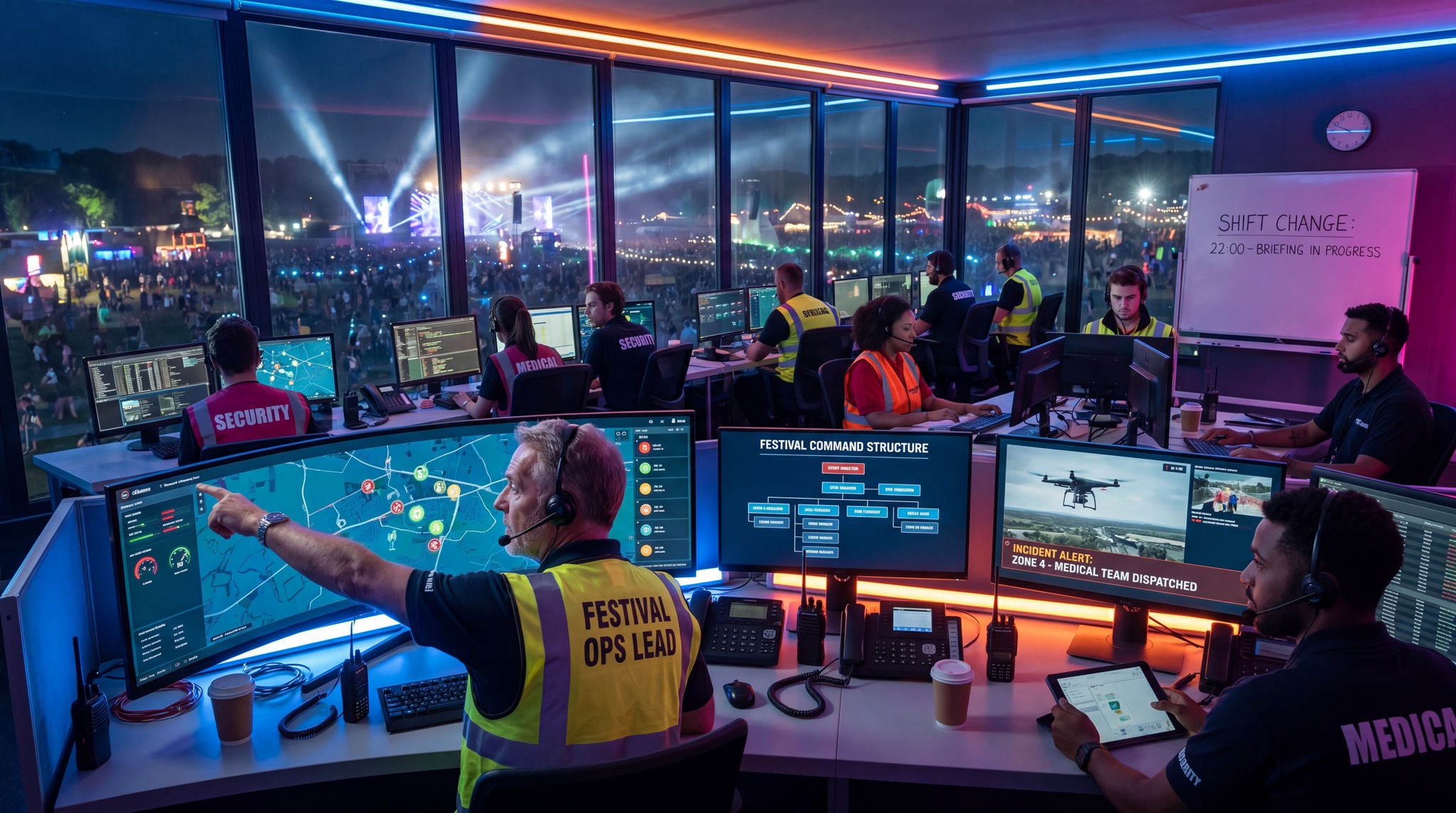
Effective festival security also involves the local police proactively. Many large events set up a joint command post where festival security, police, and other emergency services sit side by side monitoring live CCTV feeds and crowd reports. This real-time collaboration means that if, say, a segment of the crowd becomes unruly or an evacuation is needed, decisions can be made in unison and communicated uniformly. Police presence (whether uniformed or plainclothes) can also deter bad behavior and enable quicker law enforcement action (for example, handling a drug dealing issue or an assault) without waiting for calls from the public. The best festivals foster a friendly working relationship between private security and law enforcement – including pre-event briefings and post-event debriefs to continuously improve coordination.
Crowd Management & Venue Design
Crowd management is both an art and a science, and it starts long before any ticket-holder sets foot on the grounds. It begins in the festival layout design. Producers must ensure that stages, food courts, restrooms, and exits are placed in a way that prevents choke points. Plenty of space and multiple egress routes are critical. For example, wide pathways and dedicated entry/exit lanes help avoid congestion. Physical infrastructure like barriers and fencing are used strategically – not just to delineate VIP areas or keep people out of backstage, but to channel crowd flows in safe directions. An experienced team will simulate crowd movements on a map during planning to spot any potential pressure points.
Integrating these elements into a comprehensive venue safety plan ensures that every stakeholder—from stage managers to local fire marshals—understands the physical limits and flow dynamics of the site. Effective event safety planning & logistics require mapping out not just the attendee experience, but the operational pathways for emergency vehicles and vendor load-ins.
A robust approach to venue safety planning requires organizers to conduct a spatial risk analysis before finalizing the site map. This involves evaluating topographical hazards, identifying natural choke points, and establishing secure perimeters. By treating the physical space as a dynamic environment, producers can implement proactive facility safety measures—such as reinforced fencing lines, dedicated medical triage zones, and strategically placed high-visibility signage—that adapt to shifting crowd densities throughout the event.
When drafting this spatial blueprint, organizers should collaborate closely with local authorities to ensure all physical layouts meet municipal codes. Key elements to document include:
- Egress Capacity: Calculating the exact number of people who can safely exit through available gates within a specified time frame.
- Emergency Access Lanes: Maintaining sterile routes that are strictly off-limits to pedestrian traffic and vendor parking.
- Zone Density Limits: Establishing maximum occupancies for individual areas, such as VIP tents or enclosed dance floors, rather than just a blanket site capacity.
A critical component of this logistical oversight involves the load-in and load-out phases, which are statistically the most dangerous periods of festival production. Coordinating heavy machinery, forklift traffic, and hundreds of temporary crew members requires strict traffic management protocols. By separating pedestrian walkways from vehicle routes, enforcing high-visibility PPE for all site crew, and scheduling staggered arrival times for suppliers, producers can drastically reduce the likelihood of workplace accidents before the gates even open.
Accept Payments Across 13 Countries
Local currency processing via Stripe, Razorpay, Xendit, Paystack, and OXXO across 13 countries with region-specific payment methods.
Even with great design, large crowds can behave unpredictably when excitement peaks. That’s why every festival needs on-the-ground strategies for managing crowd behavior. This includes trained crowd spotters (staff positioned with clear vantage points over the audience) who monitor density and mood. If one area of a field starts getting too packed, these spotters can alert control to stop entry into that zone or pause performances to ease pressure. Many festivals also deploy video analytics or people counters to get real-time crowd density data. Implementing proven crowd management strategies to keep attendees safe – such as one-way pedestrian routes in tight areas, scheduled breaks between big acts to allow dispersal, and robust barricade systems – is essential to prevent dangerous situations.
Key Stat: The 2021 Astroworld Festival crowd crush in Houston tragically killed eight attendees and injured many more, as reported by NPR. This disaster underscored that high crowd density itself can be deadly even if nobody in the crowd intends harm. Effective crowd management isn’t optional – it’s literally a matter of life and death in avoiding such worst-case outcomes.
One fundamental pillar of crowd safety is respecting venue capacity limits. Every area – from the main stage pit to tents or warehouses – has a safe occupant capacity set by fire codes or engineers. Producers must not only adhere to these limits but build in buffers. Overselling tickets or allowing a popular stage to overflow beyond its design can lead to crushing, as people simply have no space to escape pressure. It’s far better to spread audiences out by programming simultaneous attractions or using large screens and sound relays to create secondary viewing areas. That way, if one stage has a superstar act, not every attendee feels compelled to pack into a single field.
Warning: Resist the temptation to oversell your venue beyond safe capacity. Packing even a few hundred extra people into an area without enough room or exits can create the conditions for a lethal crowd surge or stampede. It’s always better to have a comfortable crowd than to risk a dangerous overcrowding situation.
Crowd management extends to how information is communicated to attendees. Clear signage for exits, one-way routes, and less crowded areas (like “More food vendors this way ->” to disperse a food queue) can subtly influence crowd distribution. During the event, timely announcements can also help – for instance, if one area is becoming too full, a polite public address message might direct people to another stage that’s about to have a show, thereby thinning the gathering. In urgent cases, security may temporarily stop entry to an overfilled area (metaphorically “metering” the crowd) until the density drops to safe levels.
Pro Tip: Equip your team with real-time tools. Use clicker counters at entry gates and popular tents to monitor attendance against capacity. If you have the budget, consider a crowd monitoring AI system using CCTV feeds to alert you when crowd density in a zone exceeds a safe threshold (for example, more than 4 persons per square meter). Early detection of crowding allows you to act (like opening an additional exit or sending volunteers to guide people) before the situation becomes critical.
Free Tool: When Should You Announce?
Pick your event date and genre — the free planner outputs a recommended announce, presale, on-sale and reminder schedule anchored to how your audience actually buys.
Weather Contingency Planning & Climate Resilience
Outdoor festivals are at the mercy of Mother Nature, so a comprehensive weather plan is non-negotiable. A prudent organizer starts by developing rain plans and backup venues for weather emergencies. This means identifying in advance what you’ll do if there’s heavy rain, lightning, high winds, extreme heat, or even cold snaps. For example, many events arrange a backup indoor location (or sturdy structures like hangars) where key performances can be moved if an outdoor stage becomes unsafe. Even if a full relocation isn’t possible, having designated storm shelters (like robust buildings or even buses) for attendees can save lives during events like lightning storms.
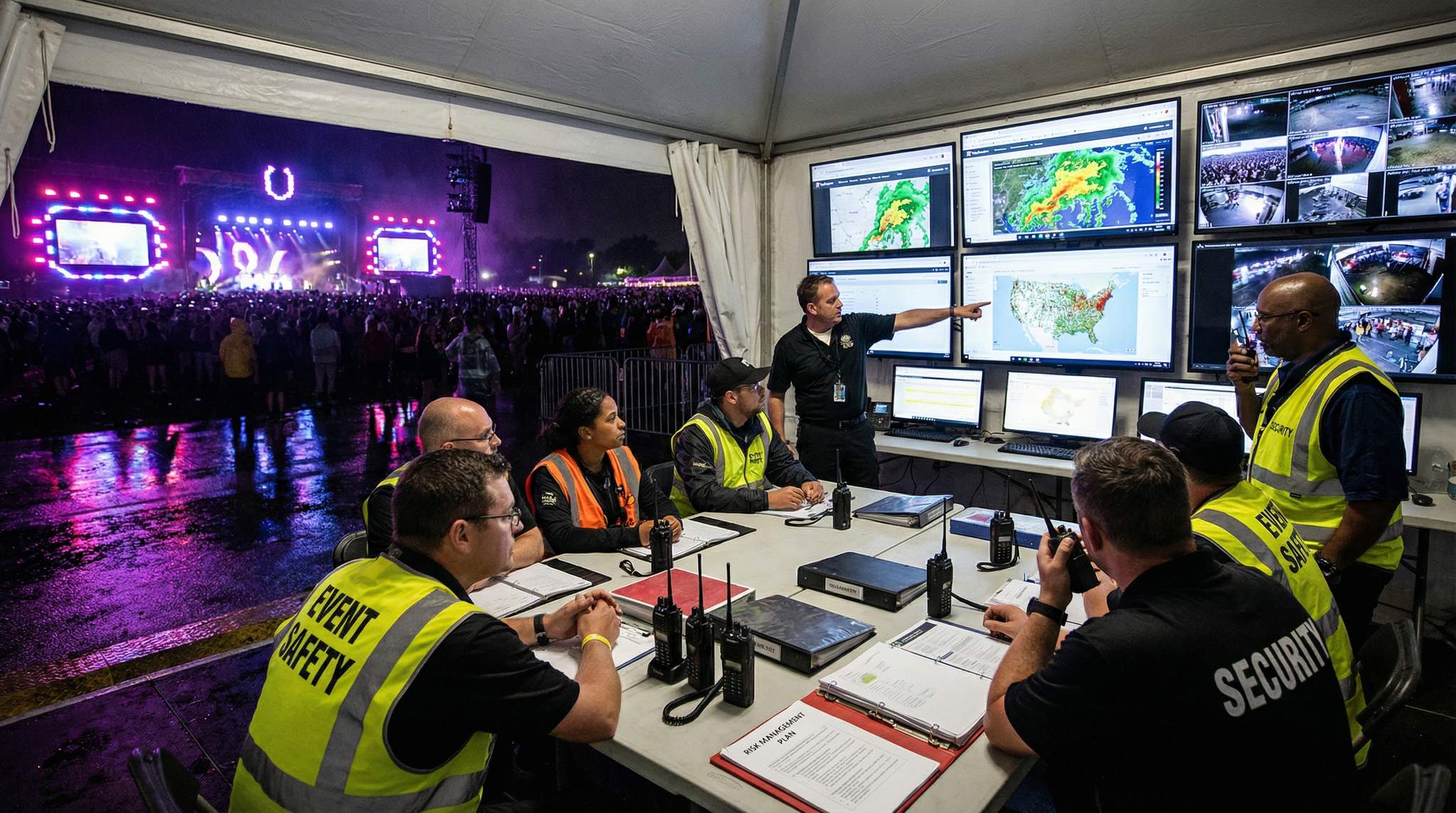
Weather monitoring is critical. Assign someone on the team – or hire a meteorologist – to track forecasts in the days leading up to and during the festival. Modern forecasts can often give hours or even a day or two of warning for major weather events. But equally important is real-time monitoring: using lightning detection apps, radar, and on-site weather instruments. Many festivals invest in handheld weather meters and subscribe to alert services that will ping the team if, say, lightning is detected within a 10-mile radius or if wind gusts above a certain speed are imminent. If severe weather strikes, you may need to pause the show or evacuate the site entirely according to plan.
Key Stat: The year 2023 was the warmest year on record according to data from the Australian Institute for Disaster Resilience, and festivals worldwide felt the impact – from heatwaves causing medical emergencies to sudden storms forcing evacuations. Climate change is making extreme weather more frequent and unpredictable, which means robust weather contingency plans are more important than ever.
Heat is a slower, quieter threat than a storm, but it can be just as deadly. High temperatures and sun can cause dehydration, heat exhaustion, and heat stroke among attendees. Festivals in hot climates or summer seasons must implement heat mitigation: free water refill stations, shaded rest areas, misting tents, and scheduled programming breaks during the hottest part of the day. Likewise, plan for cold at night if your event is in the desert or a temperamental climate – have heaters or warming stations, and communicate to attendees to bring layers.
Building weather resilience into festival planning is now a best practice for major events. This involves designing stages and structures that can handle wind and rain better (e.g. high wind rated stages, drainage for fields to prevent mud), and even choosing festival dates or locations with climate in mind. Some festivals are shifting season or month to avoid the most volatile weather periods. Others invest in site improvements like permanent drainage systems or windbreaks (like rows of trees or walls) to make their venues more resilient to storms.
Of course, even with the best preparation, some weather events will force hard decisions like delaying performances or evacuating the site. Make these calls based on predetermined triggers that you’ve set in your Emergency Action Plan (for example, “if lightning is within 8 miles, we suspend the show and instruct attendees to shelter”). The table below shows sample weather trigger actions:
| Weather Condition | Action Trigger | Response Plan |
|---|---|---|
| Lightning within 8 miles | Immediate | Stop all performances; instruct attendees to seek shelter (indoors or in vehicles) until 30 minutes after the last lightning strike. |
| Heat index above 100°F (38°C) | Sustained for 1+ hours | Activate cooling measures: open misting tents, distribute water, and make stage announcements urging attendees to hydrate and rest in shade. |
| Wind gusts over 40 mph (64 km/h) | As forecasted or detected | Pause performances on exposed stages; lower any overhead rigging to ground level; clear large tents that could collapse; prepare for a possible site evacuation if winds persist. |
Warning: Never try to “push through” dangerous weather in order to keep the show on schedule. History has shown that hoping for the best can lead to disaster – stages have collapsed and lives have been lost because organizers waited too long to evacuate or cancel. If severe weather is on the way, err on the side of caution and implement your emergency plans early.
One more layer of protection is financial. Weather can cause huge losses – from refunds for canceled days to damage of equipment. Traditional event cancellation insurance typically covers some weather scenarios, but recently many organizers are also turning to parametric weather insurance to weather-proof their event finances. Unlike traditional insurance that pays out only if very specific conditions are met (and after a lengthy claims process), parametric insurance will pay a set amount automatically when a defined weather threshold is reached (for example, 2 inches of rain in 24 hours). It can be a lifesaver for your budget if extreme weather strikes. The bottom line: plan for the weather as rigorously as you plan the lineup – your festival’s fate can literally depend on it.
Pro Tip: Hire a professional meteorologist service or designate a qualified “weather officer” on your team. Having an expert who can interpret forecasts and radar, and advise when to take action, will remove the guesswork. This person can liaise directly with production managers on whether to pause a show due to an approaching storm, ensuring you act at just the right time – not too late and not too early.
Insurance & Liability Coverage
Insurance is the safety net that keeps a festival’s worst day from becoming its last day. Simply put, without the right insurance, one major incident can bankrupt your event and potentially your whole company. The cornerstone is general liability insurance, which covers injuries or property damage claims – for example, if an attendee is hurt and sues the festival. Beyond that, organizers usually need a suite of policies: event cancellation insurance (to cover losses if you have to cancel due to weather or other covered causes), equipment insurance (for staging, sound, and lighting gear), and worker’s compensation (for employees). A good starting point is covering all your insurance bases to reduce liability – understand the major types of coverage available and what risks they address.
For organizers producing one-off gatherings rather than annual series, securing single event insurance coverage is a highly effective way to protect against specific dates without committing to a year-round policy. This short-term liability protection shields the production company from catastrophic financial loss tied to a solitary weekend.
When selecting policies, it’s important to review in detail what is and isn’t covered. Many first-time festival producers assume “we have insurance, so we’re fine,” only to discover exclusions buried in the policy. For example, some liability policies might exclude pyrotechnics or injuries that occur in mosh pits. If your festival has any unique elements (fireworks, extreme sports, water activities), be sure to get riders or special coverage for those. Also, check the coverage limits – major festivals often carry $1 million or more in general liability per occurrence, because medical bills and legal claims add up fast in worst-case scenarios.
An often overlooked aspect is requiring insurance from others involved in your event. All your vendors, contractors, and partners on site should carry their own insurance and name your festival as an additional insured on their policies. This means if a food vendor’s negligence causes food poisoning, their insurance would help pay claims, not just yours. Many venues also require the festival organizer to add the venue owner as an additional insured on the organizer’s policy. It’s a web of shared responsibility that ultimately makes sure that the party responsible for an incident bears the financial burden.
Warning: Cutting corners on insurance or other safety expenses is a false economy. The money saved on skipping a policy or hiring fewer medics can be obliterated by a single lawsuit or settlement. Financially and ethically, you never want to be in a position where a preventable incident occurs and you lack the insurance or resources to make it right. It’s not just about protecting your balance sheet – it’s about doing right by the people who trust your event with their safety.
One innovative tool in festival insurance is the rise of parametric policies (mentioned earlier in weather planning). As climate risks grow, traditional insurers have been raising premiums and narrowing coverage – some festivals have struggled to even obtain affordable cancellation insurance for weather. Parametric insurance offers a complement: it pays out fast based on measurable events (like rainfall or wind speed thresholds) without the hurdles of proving losses. Some forward-thinking producers use a mix of traditional insurance policies to protect the festival from liability and parametric covers to ensure cash flow if weather hits. The key is to consult with an insurance broker who specializes in events. They can tailor a package specific to your festival’s size, location, and activities.
Remember that insurance doesn’t reduce the chance of an incident – it only helps with the aftermath. So while it’s crucial to have, it should go hand in hand with all the proactive safety measures discussed in this guide. Ideally, you never need to use your insurance. But if you do, it can mean the difference between a scary but manageable situation versus a total catastrophe for your festival’s future.
Safety Personnel, Training & External Experts
One of the smartest moves a festival organizer can make is acknowledging where outside expertise is needed. You might have the best stage managers and artistic directors, but festival safety often requires specialists. For example, engaging a certified crowd safety manager or a structural engineer to review stage plans can dramatically reduce risk. Knowing when to hire external safety and technical experts for your festival – such as electrical engineers, weather consultants, or professional medics – can fill critical gaps that your core team may not cover.
A well-rounded safety team might include roles like: a Safety Officer (overseeing all safety programs), a Head of Security, a Chief Medical Officer or EMS Coordinator, and a Fire Safety Manager. These individuals lead their respective teams (security guards, medical staff, fire marshals if on site) and report into the festival director or an operations chief. All staff and volunteers should know who these safety leaders are and how to reach them during the event.
To maintain these standards, many top-tier productions appoint a dedicated festival health and safety coordinator. This specialist focuses exclusively on site-wide welfare, bridging the gap between medical responders and site operations. They monitor occupational risks during the grueling load-in days, ensure compliance with sanitation guidelines, and verify that all contractors adhere to the event’s overarching safety policies before the public ever arrives.
Training is a huge part of effective safety planning. It’s not enough to have plans on paper – every staff member and volunteer needs to understand their role when something goes wrong. In the weeks leading up to the festival, conduct training sessions for different groups: security personnel get crowd management and de-escalation training, volunteers are taught basics like how to spot someone in distress or how to use a radio to call for help, and all department heads walk through the emergency action plan together. Many major festivals do a “full staff briefing” the day before opening, essentially a crash course on who’s in charge of what, how to evacuate the site, and where key resources (like fire extinguishers, first aid, etc.) are located.
Daily briefings should also cover specific environmental hazards. For outdoor events, landscape safety meeting topics might include navigating uneven terrain, identifying trip hazards near temporary staging, managing mud or flooding in high-traffic pathways, and safely operating heavy machinery around the festival grounds.
Key Stat: Over a seven-year period at a major European music festival, only 5% of on-site medical cases were due to drug intoxication – the vast majority were due to injuries, illness, and other issues, based on mass gathering health studies. This busts the myth that festival medical teams are there just for overdoses. In reality, most festival medical emergencies are from dehydration, heat, trips and falls, allergic reactions, and so on. When staffing your medical team, ensure you have paramedics, nurses or doctors who can handle trauma and common ailments – not just substance issues.
Volunteers often make up a large portion of festival staff, especially for smaller events. While volunteers are enthusiastic, remember that they are not professionals – clear instructions and supervision are needed. Pair less experienced volunteers with veteran staff in important areas like crowd entry or stage pit duties, so they can learn on the job with guidance. Emphasize to every team member: if they see something unsafe, they should speak up immediately (empower a culture where any crew member can radio in a concern if they spot a hazard or a brewing issue).
When it comes to technical safety (like stage rigging, pyrotechnics, or large temporary structures), bring in licensed professionals. For instance, a structural engineer or qualified rigging supervisor should inspect and sign off on staging installations, especially after high-profile stage collapses in past years. Similarly, if your festival uses lasers, flames, or special effects, a safety technician in those specific areas should be on site. It might feel like an added expense, but these experts are insurance in human form – their approval means you’ve significantly reduced the chance of a catastrophic failure.
Another best practice is to run an emergency drill or tabletop exercise shortly before the festival. Gather the key personnel from security, medical, production, etc., and walk through a hypothetical crisis (for example, “a severe storm is arriving in 30 minutes,” or “there’s a report of an active threat on site”). Talk through each person’s actions and decisions. This practice session can reveal gaps (“Wait, who has the keys to the emergency gates?”) and build muscle memory. By the time the real festival happens, your team will have mentally rehearsed the worst cases, making them far more prepared and calm if something actually happens.
Emergency Action Planning & Response
Even with all the prevention in the world, emergencies can still happen – and this is where an Emergency Action Plan (EAP) becomes a festival’s playbook for crisis response. An EAP is a formal document (often mandated by authorities) that outlines exactly what to do in various worst-case scenarios. Developing and preparing an emergency action plan for worst-case scenarios means thinking through situations like severe weather, fire, bomb threats, active shooters, medical mass-casualty incidents, and more.
Beyond active threats and weather, organizers must prepare for public health crises. Implementing FSA-standard emergency response planning for food incident scenarios at festivals is critical. If a mass foodborne illness or severe allergic reaction occurs due to vendor cross-contamination, your EAP must dictate immediate steps: isolating the suspected food source, coordinating with local health departments, and deploying rapid medical triage to prevent the situation from overwhelming on-site clinics.
A strong EAP specifies the chain of command during an emergency – who is in charge of making decisions (often called the Incident Commander) and how information will flow. It includes communication plans: for example, a pre-written public announcement to instruct attendees to evacuate calmly, and designated methods (like SMS alerts, loudspeaker systems, or screen messages) to deliver those instructions. The plan also details evacuation routes and assembly points: if the order is given to clear the festival, where should people go? Are there different evacuation plans for different threats (e.g., seek shelter on site for tornado warning vs. evacuate to parking lots for a bomb threat)? All of this needs to be mapped out and agreed upon with local emergency services in advance.
One of the most critical parts of emergency planning is coordination with local responders. Festivals should provide copies of their EAP to police, fire, and EMS agencies and ideally incorporate their feedback. Often, local authorities will station resources on site (like an EMS tent or a fire engine) during the event – these should be factored into the plan. Many large events actually integrate into the local Incident Command System, with a unified command post as mentioned earlier. This way, if a 911 call goes out from the festival, the responders already at the event are seamlessly looped in.
Pro Tip: Conduct a tabletop exercise with your core team a few weeks before the festival. Pose a scenario (for instance, “Lightning strike hits near the grounds, power is out, several injuries reported – what do we do?”) and walk through it step by step. This low-cost drill will surface any confusion or missing resources and make everyone much more confident in their roles. It’s far better to practice on an imaginary emergency than for the first time in a real one.
An often underestimated element is how to handle communication during a crisis beyond just the attendees on site. Have a plan for who will interface with the media if something happens – you don’t want staff giving inconsistent or speculative information. Designate a spokesperson (and a backup) and prepare holding statements in advance (“We have temporarily paused the festival due to an ongoing emergency. We are working with authorities and will provide an update soon.”). In the era of social media, also assign someone to monitor and post updates on the festival’s official channels, since attendees (and their families at home) will seek information there. Prompt and transparent communication can prevent panic and rumors.
After the immediate crisis is handled, the EAP should also cover reunification and incident follow-up. For example, if people were evacuated, how will you account for staff/volunteers or assist attendees who may have been separated from their group? Establish a missing persons area or hotline. Document everything that happens – these reports will be invaluable for debriefs and for insurance claims or investigations. Many disaster investigations (such as the Indiana State Fair stage collapse in 2011) have noted the lack of an adequate emergency plan as a major failing – don’t let your festival be an example of that. Having a solid EAP, and executing it well, can turn a potentially tragic situation into a safely managed one.
Learning from Past Festival Failures
While the goal is to never experience a serious incident, the festival industry has seen its share of high-profile failures that offer valuable lessons. Studying these events is a sobering but essential part of risk management education. Organizers should avoid repeating the mistakes of past festival disasters by understanding exactly what went wrong and how it could have been prevented.
For example, the Love Parade tragedy in 2010 (Duisburg, Germany) taught harsh lessons about crowd flow and venue selection – 21 people died in a crowd crush in a tunnel that was a fatal bottleneck. After that incident, festivals worldwide re-evaluated how their entrance and exit routes are designed. The 2011 Indiana State Fair stage collapse (in the USA) came from severe winds hitting an outdoor stage, killing 7 people; it underscored the importance of strict weather monitoring and sturdier stage design (and led to new regulations on temporary stage structures and evacuation protocols for weather warnings). More recently, events like Astroworld 2021 highlighted how an overwhelmed crowd without proper control measures can lead to multiple fatalities, and organizers are being held accountable for not stopping the show in time.
Many festivals now have formal “lessons learned” sessions post-event. After the festival concludes – and once the dust settles – organizers gather key staff and sometimes local officials to debrief. What went well? What could have gone better? Were there any near-misses (situations that almost became serious)? Document these and incorporate the findings into next year’s planning. It’s important to foster a culture where staff can speak openly: if a security volunteer felt unprepared for a task, that’s critical feedback to improve training. If a vendor reports that a generator almost failed, maybe next year you’ll invest in backups.
The industry also shares knowledge through organizations and conferences (for instance, the Event Safety Alliance, or country-specific bodies like the UK’s Health and Safety Executive guidance on events). Tapping into these resources can keep you updated on evolving best practices. Safety standards are not static – they evolve with each incident and new technology. By keeping an eye on reports of why certain festivals failed or had close calls, you can continuously update your risk strategies.
In essence, every mistake that has happened at another festival is a chance for you to learn without having to suffer the consequences firsthand. Incorporate those lessons, and you vastly increase the chances that your event will never make the wrong kind of headlines.
Essential Reading
- Risk Assessment: Identifying Potential Threats to Your Festival
- Festival Crowd Management: Strategies to Ensure Attendee Safety
- Festival Weather Emergencies: Developing Rain Plans and Backup Venues
- Health and Safety Regulations: Compliance Checklist for Festivals
- Festival Insurance 101: Covering Your Bases and Reducing Liability
- Emergency Action Plan: Preparing Your Festival for Worst-Case Scenarios
FAQ
What does a festival Emergency Action Plan include?
A festival’s Emergency Action Plan (EAP) details the response procedures for various emergencies like severe weather, fires, medical incidents, security threats, and evacuations. It outlines who is in charge (chain of command), how to communicate emergency instructions to staff and attendees, evacuation routes and assembly points, and coordination steps with local police, fire, and medical services. Essentially, it’s a playbook that tells festival staff exactly what to do and who does it when a worst-case scenario hits.
When should I start risk management planning for a festival?
Risk management planning should begin as soon as you start organizing the festival – often 12 to 18 months before the event for large festivals. Early on, you should conduct a preliminary risk assessment and start discussions with local authorities about permits and safety requirements. Key safety hires (like your security director or safety consultant) should be onboarded many months in advance. In short, the earlier the better – comprehensive safety planning is not something to leave until the last minute.
How do festivals handle extreme weather conditions?
Festivals prepare detailed weather plans. This includes monitoring forecasts and real-time weather data, having predetermined triggers for action (like “lightning within 8 miles = pause the show”), and providing infrastructure for attendee safety (shelter areas for storms, misting tents and water for heat, etc.). If extreme weather hits, organizers may delay performances, instruct attendees to shelter on-site or evacuate to safe locations, and only resume when conditions are safe. Many festivals also have weather insurance to mitigate financial losses if a cancellation is necessary.
What insurance do I need for a music festival?
At minimum, a music festival needs general liability insurance to cover accidents and injuries. Most will also carry event cancellation insurance (which can cover weather-related cancellations or other disruptions), property insurance for equipment, and workers’ compensation for employees. Depending on the event, you might need additional coverage (for example, liquor liability if alcohol is sold, or special coverage for pyrotechnics or structures). It’s wise to work with an insurance broker familiar with events to identify all the necessary policies.
How much security staff is required at a festival?
The amount of security needed depends on the festival’s size, layout, and risk profile. A common guideline is at least 1 security staff per 250 attendees for general crowds, but additional personnel are required for sensitive areas (stage pit, VIP, backstage, parking). Large festivals often have hundreds of security guards on duty. It’s important to assess key points: entrances, stages, perimeter, and roaming patrols. Local authorities or licensing may also specify a minimum ratio. Ultimately, you should err on the side of more security – it helps with both safety and attendee comfort.
Who is liable if someone is injured at a festival?
Liability can depend on the circumstances, but typically the festival organizer (and their insurance) may be held responsible if an injury was due to negligence in planning or operations (for example, unsafe structures or inadequate crowd control). Vendors and contractors can be liable if the injury was due to their actions (for instance, a food vendor’s equipment causing a fire). This is why contracts and insurance are critical – organizers require vendors to have their own insurance and include the festival as an insured party. In any case of injury, it’s important to document the incident and involve medical and security personnel immediately.
How do you handle a major food safety incident at a festival?
Handling a foodborne illness outbreak or severe allergen exposure requires immediate, coordinated action. Organizers should incorporate FSA-standard emergency response planning for food incident scenarios into their broader EAP. This involves immediately shutting down the suspected vendor, securing food samples for health inspectors, dispatching additional medical personnel to triage affected attendees, and communicating transparently with local health authorities to contain the outbreak.
What does a music festival risk assessment example look like in practice?
A practical example involves breaking down a specific threat, such as severe weather or a crowd surge, into actionable data points. For instance, if the hazard is “high winds causing stage instability,” the assessment will rate the probability and potential impact. The mitigation column would then list concrete steps: hiring a structural engineer for sign-off, establishing a wind-speed threshold (e.g., 40 mph) for lowering suspended PA systems, and designating a clear chain of command for halting the performance. This structured approach ensures every identified hazard has a corresponding, pre-planned operational response.
How do event safety planning and logistics intersect during festival production?
Safety and logistics are deeply intertwined, particularly during the site build and breakdown phases. Effective logistical safety planning involves scheduling vendor load-ins to prevent vehicle congestion, establishing dedicated emergency access lanes that remain clear at all times, and managing heavy machinery traffic around pedestrian zones. A comprehensive approach ensures that the physical movement of equipment, artists, and personnel never compromises the secure environment of the venue.
What are the core components of a venue safety plan?
A comprehensive venue safety plan outlines the physical and operational safeguards of your event space. Core components include detailed site maps highlighting emergency exits and triage locations, zone-specific capacity limits, ingress and egress flow models, and designated access routes for first responders. It serves as the foundational blueprint that aligns your security, medical, and production teams on how to safely utilize the physical environment.
How does a music concert risk assessment differ from a multi-day festival plan?
While both share foundational safety principles, a music concert risk assessment typically focuses on the intense, short-duration dynamics of a single-evening event. It prioritizes rapid crowd ingress and egress, concentrated audience energy during a single headlining performance, and the specific structural or acoustic hazards of a standalone venue, rather than the sprawling logistics of multi-day camping and continuous site operations.
What are the first steps in creating a risk assessment for a music event?
The initial phase of building a risk assessment for a music event involves a comprehensive site walkthrough and a hazard identification workshop with your core production team. Organizers must catalog potential threats—ranging from stage structural integrity and high-decibel noise exposure to crowd flow bottlenecks and severe weather vulnerabilities. Once identified, each hazard is scored by likelihood and severity, allowing the safety team to prioritize resources and draft specific mitigation protocols for the most critical risks.
What are the core elements of festival health and safety?
A comprehensive festival health and safety strategy encompasses both occupational welfare for the production crew and public protection for attendees. Core elements include rigorous site design to prevent physical hazards, strict sanitation and food hygiene protocols, adequate medical and first aid provisioning, and proactive management of environmental risks like extreme weather or noise exposure. It requires a unified approach where every contractor, vendor, and staff member adheres to documented safety standards.
How does venue safety planning differ for greenfield sites versus permanent facilities?
When organizing a festival, venue safety planning must adapt to the location’s existing infrastructure. For permanent facilities (like stadiums or arenas), the focus is on integrating your event’s specific crowd flow and production needs with the building’s established fire codes and emergency systems. In contrast, greenfield sites (open parks or farmland) require building a safety infrastructure from scratch. This means your site safety blueprint must account for temporary power grids, portable water supplies, uneven terrain, and the creation of temporary emergency access roads that can support heavy responder vehicles.
Who should be involved in a music festival risk assessment?
A thorough music festival risk assessment requires input from multiple stakeholders. The core team should include the festival director, head of security, site operations manager, and the chief medical officer. Additionally, consulting with external experts—such as structural engineers for stage builds, local law enforcement, and fire marshals—ensures that the evaluation covers both internal operational hazards and external regulatory compliance.
What are the limitations of single event insurance coverage?
While single event insurance coverage is ideal for standalone festivals, organizers must carefully review policy exclusions. Short-term liability policies often exclude high-risk activities like pyrotechnics, extreme sports activations, or incidents occurring in mosh pits unless specifically added via a rider. Additionally, this type of coverage typically applies only to the specified dates of the event, meaning any pre-build or post-event teardown phases might require extended coverage terms to fully protect the production company.
What should a comprehensive festival security plan include?
A robust festival security plan must outline perimeter control measures, credential-based access zones, and detailed deployment maps for both static guards and roaming patrols. It should also establish clear communication protocols between private security contractors and local law enforcement, ensuring a unified response to any potential threats or crowd management issues.
Which risk management factor considerations apply to all CFT events?
For cross-functional team (CFT) events within festival production, universal risk management considerations include establishing clear inter-departmental communication channels, aligning shared operational timelines, and creating unified emergency response protocols. These factors ensure that staging, hospitality, security, and medical teams operate cohesively without creating isolated vulnerabilities.
What are the core principles of live event risk management?
The core principles of live event risk management revolve around proactive hazard identification, comprehensive contingency planning, and continuous monitoring. Effective risk management for events requires organizers to evaluate physical site vulnerabilities, establish clear chains of command, and implement robust emergency response protocols. By integrating these safety measures into every phase of production—from initial site design to post-event load-out—producers can mitigate threats and ensure a secure environment for attendees, staff, and artists.
Glossary
Risk Assessment: A systematic process to identify potential hazards at an event, evaluate how likely they are to occur and how severe their impact would be, and determine measures to prevent or mitigate those risks.
Mitigation: Actions taken to reduce the likelihood of a risk occurring or lessen its impact if it does. In festival planning, mitigation measures might include things like adding more exits (to mitigate crowd congestion risk) or securing structures with extra ballast (to mitigate high wind risk).
Emergency Action Plan (EAP): A detailed protocol outlining the response procedures for emergencies during the festival. It covers various scenarios (e.g. evacuation, severe weather, medical crisis) and assigns specific roles and actions to staff and coordinators for each scenario.
Crowd Management: The strategies and practices used to guide and control large groups of people to ensure their safety. This includes venue design (layout, barriers), entry/exit control, monitoring crowd density, and methods for preventing surges or panic.
Crowd Surge (Crowd Crush): A sudden movement or press of a crowd in which individuals are pushed against one another or against barriers, potentially causing injury or asphyxiation. Crowd surges often occur when a large group all moves toward something (like a stage) or tries to flee from something, creating dangerous pressure.
Permitting: The process of obtaining official permission and permits from local authorities to hold a festival. Permitting ensures the event meets legal requirements for safety, noise, sanitation, capacity, and more. Common permits include fire safety permits, building permits for temporary structures, and mass gathering licenses.
General Liability Insurance: An insurance policy that provides coverage for accidents, injuries, and negligence claims that occur during the event. If an attendee is injured or property is damaged and the festival is held responsible, general liability insurance helps cover legal fees and payouts.
Additional Insured: A status on an insurance policy that extends the policy’s coverage to another individual or organization. In festivals, vendors or partners often add the festival organizer as an additional insured on their policies (and vice versa) so that all parties are protected by each other’s insurance in case of a claim.
Duty of Care: The legal and moral obligation of festival organizers to take reasonable measures to protect the health and safety of attendees, staff, and participants. Breaching the duty of care (through negligence) can make organizers liable for injuries or damages.
Risk Transfer: A risk management strategy where liability for a risk is shifted to another party, typically through insurance or contracts. For example, buying insurance transfers some financial risk to the insurer, or hiring a licensed third-party pyrotechnics company transfers the operational risk of fireworks to that contractor.
Parametric Insurance: A type of event insurance that pays out a predefined amount based on the occurrence of a trigger event (usually measurable weather conditions) rather than the actual loss incurred. For instance, a policy might pay a set sum if rainfall exceeds a certain threshold on festival day, regardless of the specific damage or loss.
Incident Command System (ICS): A standardized emergency management framework used by responders (police, fire, EMS) that organizes personnel into roles (Incident Commander, Operations, Planning, Logistics, etc.) for effective coordination. Large festivals often integrate with ICS by establishing a unified command post so that festival staff and emergency services work under a common structure during an incident.
Conclusion
Risk management and safety planning might not be the most glamorous part of festival production, but they are undeniably the most important. A festival’s success isn’t measured only by tickets sold or social media buzz – it’s ultimately judged by whether everyone went home safe and happy. By investing time and resources into robust safety strategies, producers not only protect their attendees and staff, but also the reputation and longevity of their event.
The world’s most respected festival organizers all share a common trait: an almost obsessive attention to “what could go wrong” and how to prevent it. They know that when a festival feels safe, attendees can fully immerse themselves in the music, art, and community without worry. And in those moments, the magic of the festival truly shines.
In the end, great risk management is largely invisible – if you do it right, most people will never realize how much work went into making the event safe. They’ll just remember having the time of their lives. That’s the goal: an incident-free festival where the only lasting impressions are amazing performances and joyous memories. With the knowledge, tactics, and insider tips outlined in this guide, festival producers can turn safety planning into their strongest ally, ensuring every event is as secure as it is sensational.