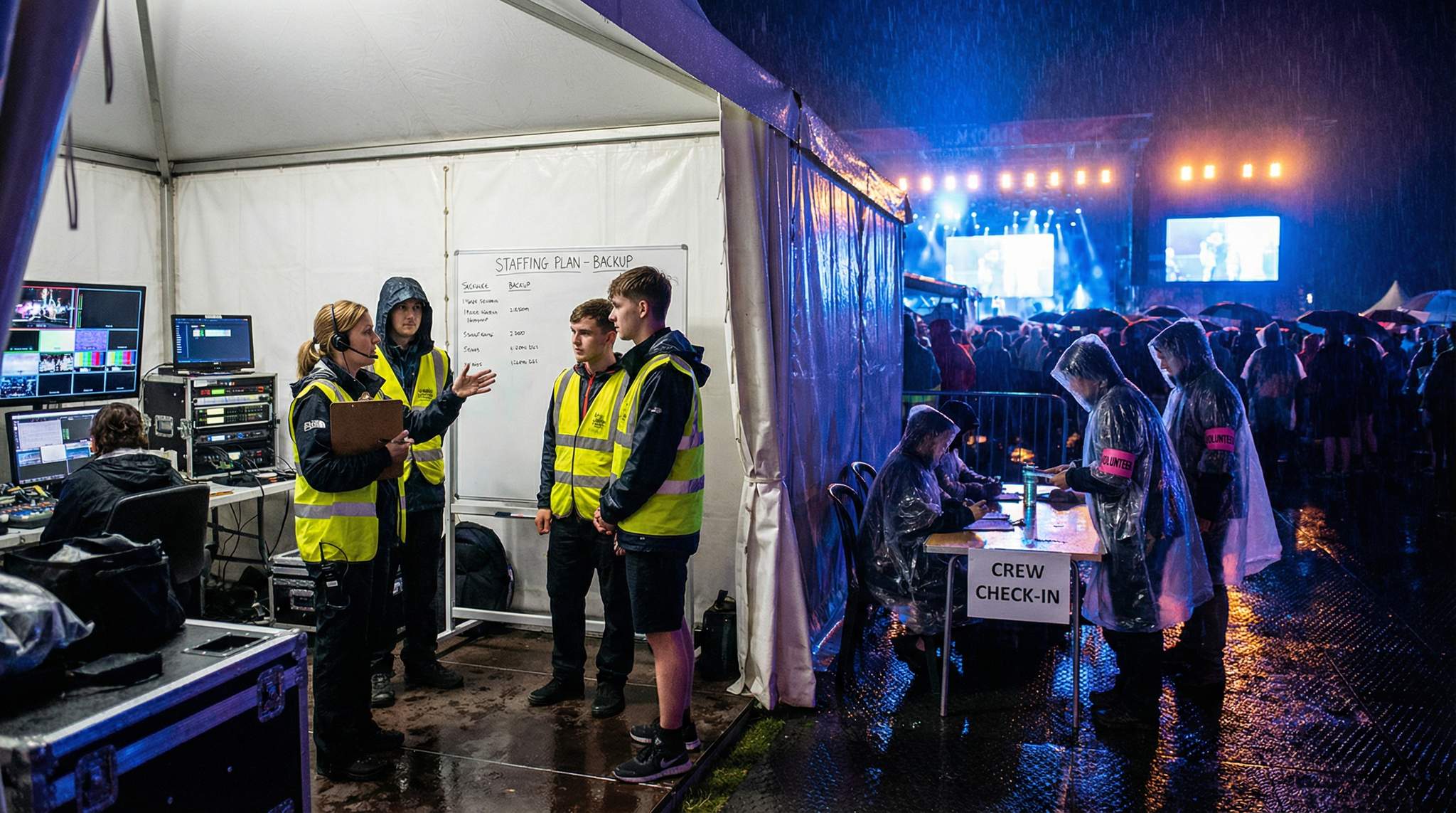
The Importance of Staffing Contingencies
In festival production, unexpected staff shortages can happen at any time. Crew members might fall ill, critical team leads could be unavailable, or volunteers may simply not show up. Robust staffing contingency plans ensure the show goes on even if key people drop out unexpectedly. By anticipating these challenges as part of risk management, festival organizers can avoid operational disruptions and keep the event running smoothly despite surprises.
Cross-Training Team Members for Flexibility
Cross-training is a cornerstone of effective contingency planning. Team members who are trained to cover multiple roles can step in when someone is unavailable. For example, a stage crew member who also knows lighting can fill in if the lighting technician falls sick. This multi-role training means fewer single points of failure. Festival staff should routinely shadow other departments or attend workshops to broaden their skills. The result is a versatile crew that can adapt on the fly, minimizing downtime when faced with staff absences.
Tips for Cross-Training:
– Identify critical roles (e.g., sound, lighting, security) and train at least one other team member in those duties.
– Rotate responsibilities during smaller events or rehearsals so staff gain hands-on experience in different positions.
– Encourage knowledge sharing and create simple guides or checklists for essential tasks in case someone new needs to take over on short notice.
Floating Staff and On-Call Backup Labor
Even with cross-training, having extra personnel on standby provides an added safety net. Many veteran festival producers keep a few “floating” staff members who aren’t assigned to a fixed post. These floaters roam the site, ready to jump in wherever help is needed most. Similarly, an on-call pool of pre-vetted crew can be notified to come in if someone unexpectedly can’t make it.
Free Tool: Size Your Festival Site
Zoned capacity planning for arena, campsite, parking and entry lanes — against UK Purple Guide and NFPA density standards. Finds your bottleneck zone.
Consider scheduling a 10–20% surplus of volunteers or part-time staff to account for no-shows and last-minute cancellations. At a large multi-day festival, for instance, a backup crew was essential when a wave of food poisoning sidelined several volunteers. Because the organizers had recruited more volunteers than the bare minimum, they could reassign people and avoid service delays. It’s wise to budget for these extra hands; the upfront cost is far less than the cost of a critical operation grinding to a halt due to understaffing.
How to Build a Backup Labor Pool:
1. Maintain a contact list of reliable freelancers, staff from past festivals, or staffing agency contacts who can step in quickly.
2. Offer training or orientation to backup personnel before the event so they are familiar with the festival layout and operations.
3. Use floaters strategically by placing them in roles where they can observe and move around (like site runners or assistant stagehands) until they’re needed elsewhere.
4. Communicate expectations clearly to on-call staff about response times and availability during the festival dates.
Planning a Festival?
Ticket Fairy's festival ticketing platform handles multi-day passes, RFID wristbands, and complex festival operations.
Establishing a Clear Chain of Command
A well-defined chain of command ensures that someone is always ready to make decisions if a leader is unavailable. In the high-pressure environment of a festival, delays in decision-making can cascade into bigger problems. Every key leadership position (such as Festival Director, Operations Manager, Stage Manager, Security Chief) should have a deputy or designated second-in-command. This way, if the primary leader is ill, unreachable, or overwhelmed, the deputy can seamlessly take charge.
Organizers should document who reports to whom and share this structure with the entire team. For example, if a stage manager has to leave due to an emergency, everyone on that stage crew should immediately know that the assistant stage manager is now in charge. This clarity prevents confusion and power vacuums. In one festival scenario, the Operations Director was stuck off-site due to a traffic delay, but because her team knew the production manager was next in command, site setup continued without a hitch.
Chain of Command Best Practices:
– Create an organizational chart showing primary and backup leaders for each area (operations, production, security, etc.).
– Ensure contact information for all decision-makers and their deputies is distributed and posted in staff areas for quick reference.
– Conduct brief drills or tabletop exercises where deputies make key calls (e.g., handling a stage power outage) to build confidence and test the chain of command before the live event.
Planning for No-Shows and Last-Minute Absences
No matter how well organizers vet and schedule staff, no-shows are an unfortunate reality in festival management. Volunteers might decide not to come, or contracted staff might face emergencies. The best defense is proactive planning:
– Overstaffing as Insurance: For instance, if a festival requires 50 volunteers, organizers should line up around 60. This buffer covers unexpected absences. Many experienced producers plan for a certain percentage of drop-off, such as recruiting 10–20% extra volunteers based on historical no-show rates.
– Confirmation and Communication: Reach out to staff and volunteers a day or two before they are scheduled to reconfirm their commitment. Friendly reminders about when and where to show up (and the importance of their role) can reduce no-shows.
– Rapid Reassignment: When someone doesn’t report for a shift, have a system to quickly reassign a floating staff member or call in a replacement from an on-call list. For example, if two parking attendants no-show, an on-call staffer or a volunteer from a less critical area can be moved to cover that gap immediately.
Free Tool: Project Your Bar Revenue
Per-head spend benchmarks by event type turned into projected bar and food revenue, with a stock-mix estimate and gross-margin line. Free calculator.
Additionally, build a culture where team members feel comfortable alerting their supervisors early if they’re at risk of missing a shift. It’s better to have early notice of a potential absence than to be surprised. By planning for no-shows as a normal part of operations, organizers can respond calmly and keep things running.
Managing Fatigue and Avoiding Burnout
Festivals are marathon events for staff and crew, not sprints. Fatigue can hit even the most seasoned crew members, especially during multi-day festivals or long setup hours. A key part of contingency planning is ensuring people can rest and that backups can step in to give breaks. Exhausted staff are more likely to make mistakes or even become ill, so preventing burnout is both a safety and a continuity measure.
Need Festival Funding?
Get the capital you need to book headliners, secure venues, and scale your festival production.
Strategies to manage fatigue include:
– Shift Scheduling: Plan shifts that allow for rest. Instead of having a few people work 16-hour days, break jobs into shorter shifts and rotate fresh crew in. If an event runs late into the night, have a day team and a night team rather than stretching one team across both.
– Buddy System: Pair up staff so they can monitor each other’s wellbeing. If one person notices their partner is flagging or looks unwell, they can flag it to supervisors and a floater can relieve them.
– Rest Areas and Amenities: Provide a staff-only area with snacks, hydration, and a place to sit or lie down. Sometimes a 30-minute power nap for an exhausted crew member can mean the difference between them finishing their shift or having to drop out.
– Health and Wellness Checks: Encourage a culture where taking a break is okay. Remind the team to stay hydrated, eat, and rest when possible. Assign team leads to periodically check that their crew members aren’t overextending themselves. Being proactive helps catch fatigue before it leads to mistakes or accidents.
By actively managing workload and fatigue, festival organizers can reduce the chance that staff will have to bow out mid-event due to exhaustion. In one case, a crew member who felt faint was immediately replaced by a floater and taken to the medical tent to recover, preventing a potential accident and ensuring the role was still filled.
Documentation and Knowledge Sharing
One often overlooked contingency is documenting critical information so that backups can quickly get up to speed. If the person in charge of power generators, for instance, has detailed checklists and manuals available on-site, a backup technician can step in more easily. All essential procedures, contact lists, and setup maps should be accessible to the team. Cloud-based folders or printed “run-of-show” binders can be literal lifesavers when someone new must take on a role unexpectedly.
Encourage team leads to brief their assistants or second-in-command on ongoing issues and plans throughout the festival. A nightly or morning briefing among key staff can ensure everyone knows the current status of operations. This way, even if someone has to step away or a new team member comes in, the knowledge transfer has already happened.
Free Tool: Will the Room Actually Be Full?
Forecasts expected attendance from ticket type, event type and day of week. Calculates safe over-book count for free-RSVP events. Free estimator.
Having information transparency and backup copies of schedules and plans means the festival’s brain isn’t solely in one person’s head. It’s a team asset, ready to be used if the situation calls for it.
Learning from Successes and Failures
Every festival provides lessons on what went right and what went wrong with staffing. Embrace both the success stories and the near-disasters as learning opportunities:
– Success Example: At a regional food and wine festival, the event manager fell ill on day two. Because she had cross-trained her assistant in all aspects of the operation and kept detailed notes, the assistant seamlessly took over. Attendees and vendors never noticed a difference, and the festival continued without a hitch. This success underscored the value of preparing deputies for leadership.
– Learning from a Failure: Conversely, a music festival once faced a major hiccup when the only certified pyrotechnician was a no-show on the day of the big finale. With no one else qualified to handle the fireworks, the team had to cancel that portion of the show, disappointing attendees. Afterwards, the organizers changed their policy to always have a second licensed expert on call for any critical specialty role. The failure was embarrassing, but it led to a stronger, fail-safe staffing plan in future years.
By analyzing incidents like these, future festival producers can avoid repeating mistakes. Regular post-event debriefings with the crew can capture insights on where staffing plans held strong or where they were stretched thin. Continuous improvement is key — each festival’s experience refines the next festival’s contingency strategy.
Frequently Asked Questions
Why is cross-training important for festival staffing?
Cross-training allows team members to cover multiple roles, ensuring the show goes on if key people drop out. By training staff to handle duties outside their primary assignment, such as a stagehand knowing lighting basics, organizers minimize single points of failure. This versatility reduces downtime during unexpected staff absences.
What is the role of floating staff in festival production?
Floating staff are unassigned personnel who roam the site to assist wherever help is needed most. Veteran producers often schedule a 10–20% surplus of these floaters and on-call backups to mitigate no-shows. This safety net allows for rapid reassignment of labor to critical areas without disrupting fixed posts.
How should festival organizers plan for volunteer no-shows?
Organizers should recruit 10–20% more volunteers than required to create a buffer against historical no-show rates. Strategies include confirming attendance 24 hours prior and maintaining a contact list of on-call freelancers. If gaps occur, floating staff or less critical volunteers can be immediately reassigned to cover essential positions.
Why is a chain of command essential for event management?
A clear chain of command ensures a designated deputy can immediately take charge if a primary leader, like a Festival Director or Stage Manager, becomes unavailable. Documenting this hierarchy and sharing it with the team prevents power vacuums and confusion, allowing decision-making and site operations to continue seamlessly.
How can festival managers prevent crew burnout and fatigue?
Managers can prevent burnout by scheduling shorter shifts that allow for rest and utilizing a buddy system to monitor crew well-being. Providing staff-only areas for hydration and power naps helps maintain performance. Rotating fresh staff in to relieve exhausted team members reduces the risk of safety incidents and errors.
What is the benefit of documenting festival procedures?
Documenting procedures ensures that backup staff can quickly take over critical roles without extensive briefing. Accessible resources like checklists, contact lists, and site maps allow deputies to step in effectively if a lead is absent. This knowledge sharing prevents operational details from being isolated with a single individual.