When tens of thousands of people gather for a festival, it’s the operations and on-site management that quietly ensure everything runs like a well-oiled machine. Attendees might not see the bustling activity behind the scenes, but every great festival is powered by a dedicated team coordinating logistics, safety, and support. Whether it’s a grassroots event for 500 people or a major international festival with 100,000+ attendees, success hinges on meticulous operational planning and real-time management. This authoritative guide breaks down the core components of festival operations—from building the site and managing crowds to responding to emergencies—so producers can deliver a seamless experience that attendees will remember for all the right reasons.
The bridge between months of theoretical planning and a live event is flawless on-site execution. For promoters and producers, this phase is where strategy meets reality. Effective execution on the ground means empowering your department heads to make split-second decisions, ensuring that every vendor, contractor, and staff member understands their role in the broader ecosystem. It is the active, real-time orchestration of your master plan, turning static schedules into a dynamic, living event.
Below, explore the key facets of on-site festival operations in detail. Use this table of contents to navigate to specific topics, and dive into each section for expert insights, practical tips, and real-world examples that illuminate what it takes to keep a festival running smoothly from start to finish.
Table of Contents
- Preparing the Festival Site: Load-In and Final Checks
- Opening Gates and Ingress Management
- Command Center and Communications
- Stage and Technical Operations
- Volunteer and Staff Coordination On-Site
- Safety and Medical Services
- Security, Crowd Control, and Incident Response
- Attendee Services and Experience Monitoring
- Sanitation, Waste Management, and Sustainability
- Weather Tracking and Operational Agility
- Night Operations and After-Dark Safety
Preparing the Festival Site: Load-In and Final Checks
Long before the first attendee scans their ticket, operational teams are on-site transforming an empty field or venue into a fully functioning festival. The load-in and setup phase of building the festival from the ground up is a massive undertaking that can span days or even weeks. It involves staging infrastructure (stages, tents, fencing), laying utilities (power generators, water lines, internet), and coordinating a parade of suppliers delivering everything from lights to toilets. Large festivals often operate on detailed production schedules dictating which crews arrive when – for example, electricians lay cables before sound systems are installed, and sanitation units are placed before fencing closes off certain areas. Smaller boutique festivals might compact this timeline into a day or two, but the principle is the same: careful sequencing and ample time buffers are critical to avoid last-minute scrambles.
Planning and executing the build and break phases of your event is no small task. A meticulously crafted production schedule acts as the blueprint for these critical windows. Effective festival operations management relies on this master timeline to coordinate heavy machinery, stage construction, and vendor arrivals, ensuring that the site transitions smoothly from an empty field to a fully operational venue, and back again during load-out.
An experienced operations manager will develop a master schedule and site plan that allocates space for each department. This includes backstage areas for artists and crew, vendor zones, medical tents, and more. Heavy machinery like forklifts and cranes may be used to erect stages or place heavy equipment, requiring strict safety protocols and trained operators. As structures go up, the team also considers practical details – for example, ensuring there are clear pathways (sometimes reinforced with temporary roads) for emergency vehicles and supply runs. Lighting must be installed not just on stages but across the grounds, anticipating that overnight load-in work and early arrivals need adequate illumination.
Planning a Festival?
Ticket Fairy's festival ticketing platform handles multi-day passes, RFID wristbands, and complex festival operations.
Warning: Underestimating the time required for load-in is a common rookie mistake. Rushing setup can lead to incomplete safety checks, untested sound systems, or missing equipment when gates open. Always build generous buffer time into your load-in schedule and plan for potential delays – it’s far better to have everything ready a day early than to be frantically driving stakes as doors are about to open.
As opening day draws near, operations teams conduct final checks. Many seasoned producers utilize a detailed festival eve checklist covering last-minute preparations. This might include walking the entire site the night before with key crew leads to spot any hazards or overlooked details (such as a fence section left unsecured or a missing directional sign). The final checks also involve verifying communications systems (radios charged and tested), confirming all permits and inspections (like electrical or structural inspections) are cleared, and running through safety briefings with staff. By the end of load-in, the festival site should essentially be a temporary city: stages set, water and power flowing, emergency exits marked, and every team member aware of their duties for the moment the gates open.
Pro Tip: On the night before opening, hold a full-site walk-through with your core operations team after dark. Seeing the venue under the same conditions attendees will (lighting, signage visibility, etc.) lets you catch issues that aren’t obvious in daylight, such as paths that need extra lighting or signage that isn’t visible. This pre-opening walk is an actionable way to catch last-minute fixes that ensure a smooth start the next day.
Scaling Up: Transitioning to Complex Event Operations
Many organizers eventually reach a tipping point where they realize they have outgrown how they used to run a complex exhibition or boutique festival. When an event scales up, it often triggers stricter municipal regulations, tighter fire codes, and more rigorous permitting processes. At this stage, you simply cannot afford any on-site issues, as compliance failures can lead to immediate shutdowns or hefty fines. So, how do professional teams usually handle this transition?
Free Tool: Size Your Festival Site
Zoned capacity planning for arena, campsite, parking and entry lanes — against UK Purple Guide and NFPA density standards. Finds your bottleneck zone.
The answer lies in formalizing your festival operations management. Transitioning from a scrappy, ad-hoc approach to a professionalized framework means hiring dedicated compliance officers, utilizing specialized event management software, and establishing strict standard operating procedures (SOPs). Teams handling highly regulated exhibitions or mega-festivals often conduct multi-agency tabletop exercises with local authorities months in advance. By proactively integrating regulatory compliance into the core of your festival operations, you ensure that scaling up doesn’t compromise safety or the attendee experience.
Opening Gates and Ingress Management
The first impression of the festival is shaped at the entry gates. A well-executed gate opening and ingress plan sets the tone for attendees and prevents safety risks from the get-go. In practice, this means having staff in position early, clear signage and instructions for arriving guests, and robust coordination between ticketing, security, and traffic management teams. Ensuring a safe and smooth start as gates open requires anticipating attendee behavior. For example, at large music festivals, crowds often queue up hours before opening, eager to rush in for prime spots. Operations managers mitigate potential crowd surges by setting up organized queue lanes (with barriers or rope lines), deploying plenty of staff or volunteers as line marshals, and sometimes using a staggered entry (opening different sections in phases or using multiple entrances).
Traffic and transport logistics are also integral to ingress. Many events coordinate with local authorities to manage road traffic flow, especially if thousands of cars are arriving at once. A solid festival transportation and traffic control plan during the event will designate parking areas, drop-off zones for rideshares or shuttles, and clear signage on approaching roads. For remote festivals, it might involve running shuttle buses from airports or city centers, scheduling them to avoid bottlenecks. Controlling the pace of vehicle entry (through checkpoints or metering on nearby highways) can prevent massive jams and keep emergency routes open.
At the gates themselves, technology and training combine to keep lines moving. Staff use scanning devices to validate tickets rapidly, and contingency plans are in place if tech fails (like a temporary switch to offline verification or manual wristbanding). Security screening (bag checks, pat-downs, magnetometers) is calibrated to the event’s risk profile – for example, a major city festival might have airport-style screening, while a small community event might simply have volunteers checking bags. In all cases, brief staff to be efficient but courteous, since a friendly welcome goes a long way in setting a positive vibe.
Communication is critical during ingress. Gate managers relay updates to the command center on queue lengths and entry rates. If an unexpected delay occurs (perhaps a power issue with ticket scanners or a road accident causing late arrivals), the schedule might adjust accordingly, such as delaying the first act until more attendees are inside. Flexibility is key: well-run festivals keep some programming elements adaptable on Day 1 in case the ingress takes longer than planned. By the time the initial rush subsides, the goal is to have everyone safely inside without incident, ready to enjoy the event.
Command Center and Communications
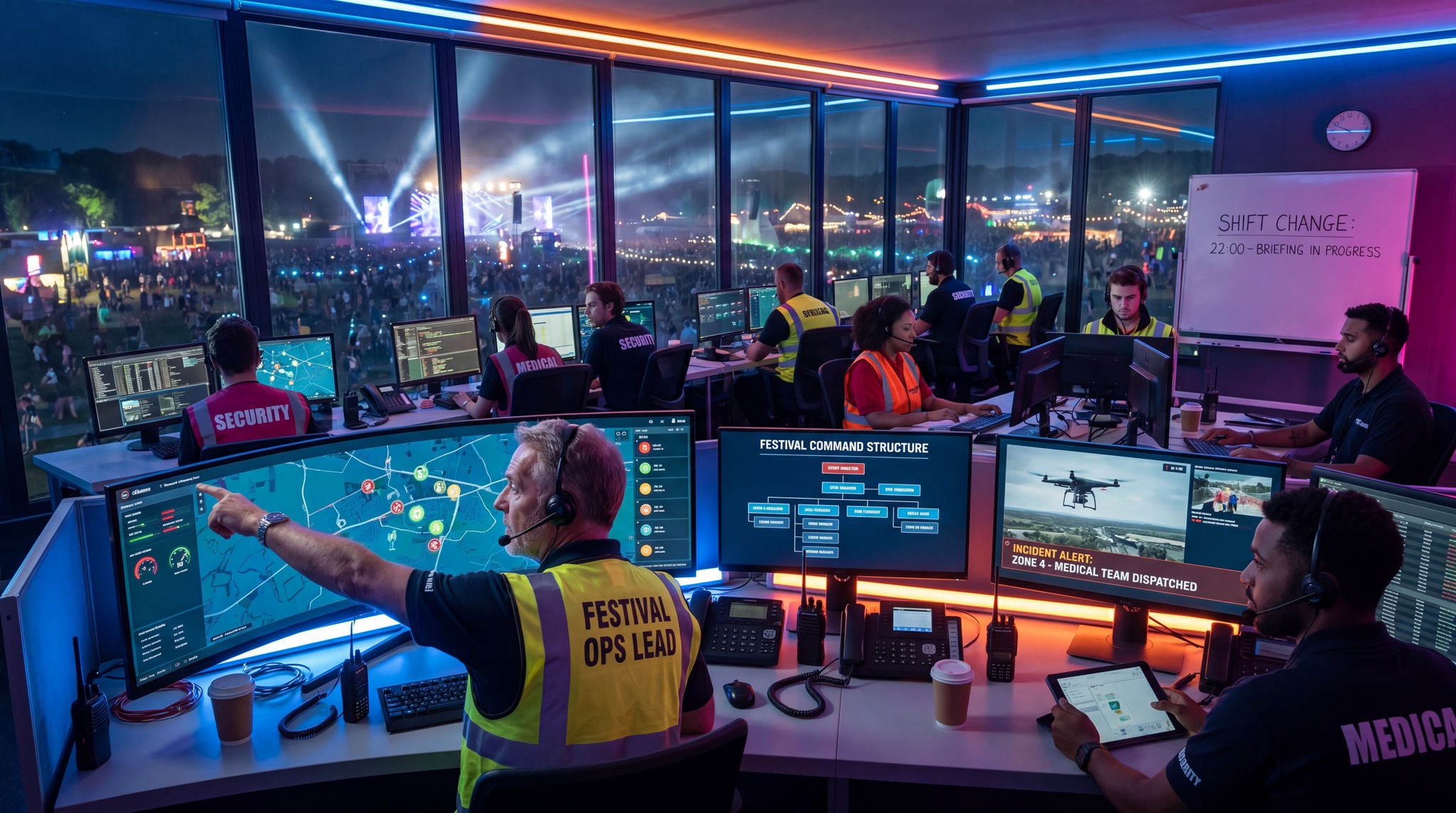
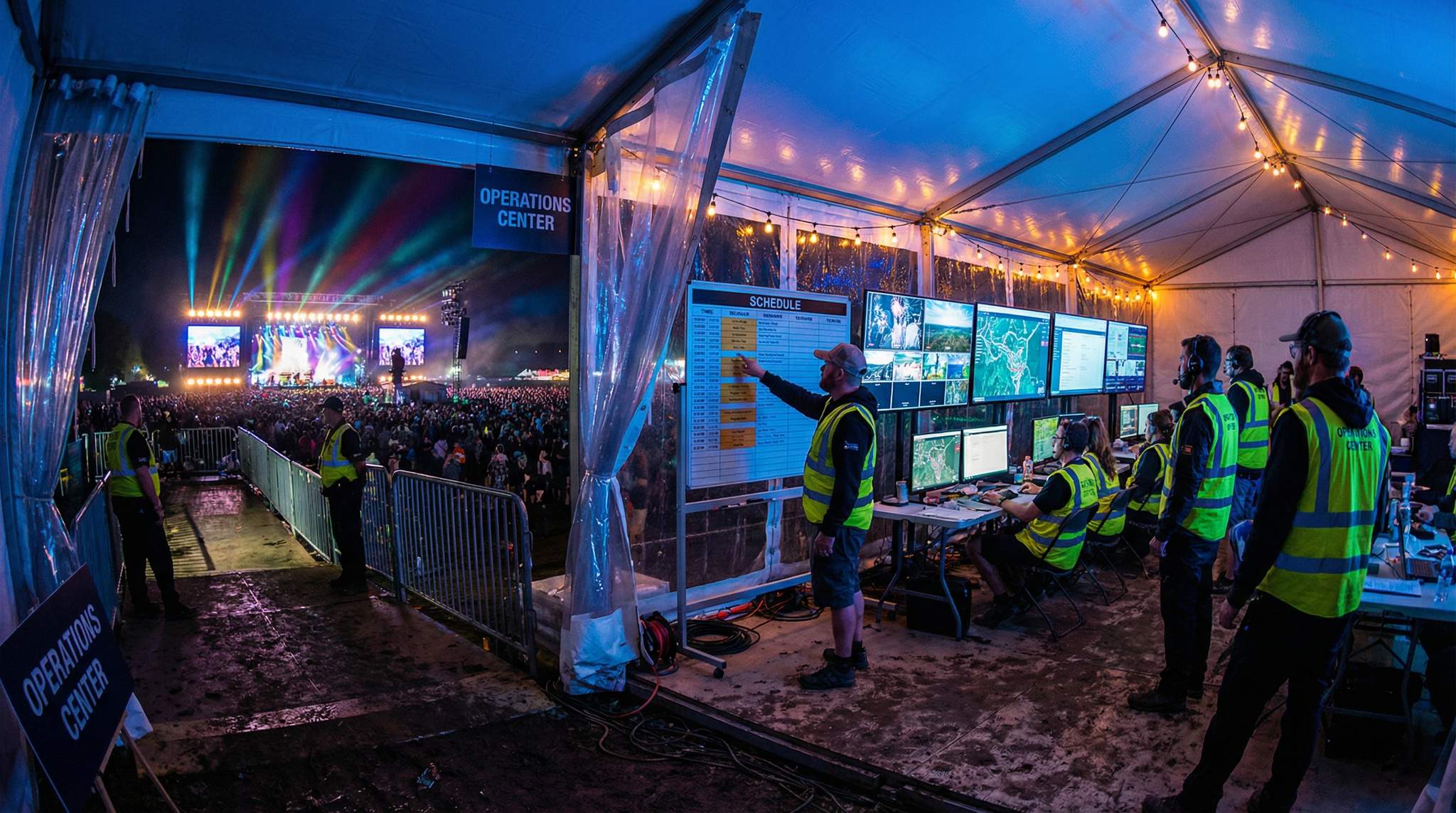
In the heart of every festival’s on-site management lies the operations command center. Often described as the event’s nerve center, this is where information converges and decisions are dispatched. The command center (sometimes just a trailer or tent packed with radios and monitors) hosts key personnel: operations managers, security chiefs, medical coordinators, and often representatives from local police or emergency services if it’s a large event. The setup is deliberate – by co-locating these leaders, they can coordinate quickly face-to-face while also maintaining constant radio contact with their respective field teams. Think of it as an air traffic control tower for the festival. The command center and communication hub monitors everything from crowd density and weather radar to stage schedules and even social media chatter about on-site issues.
Effective communications protocols are essential to avoid chaos. Festivals assign specific radio channels to different departments (e.g., security on one channel, medical on another, production/stage crew on another) and a designated channel or coordinator to link them. This prevents radio traffic jams where too many people are shouting over one another. All staff are trained in proper radio etiquette and device usage, learning to keep messages brief, use clear codes or plain language, and prioritize urgent calls (like an emergency) over routine chatter. For example, many events use a simple code system – a “Code Red” might denote a serious medical incident, while “Code Blue” could mean a lost child – so that detailed info isn’t broadcast publicly over open channels, but everyone trained understands the situation.
The command center relies on information coming in from all over the site. That’s why there are scheduled check-ins and also technology aids: CCTV camera feeds overlooking crowds, GPS tracking of key assets (like golf carts or response teams), and computer dashboards for things like ticket ingress counts or weather updates. A great way to understand the intensity of this environment is through real examples – for instance, a day-in-the-life case study of a festival operations manager in the command center reveals how they juggle dozens of decisions. They might be coordinating rerouting a delivery truck while simultaneously green-lighting a slight schedule shift due to a delay on one stage and alerting security to a developing issue at the gate.
Need Festival Funding?
Get the capital you need to book headliners, secure venues, and scale your festival production.
Pro Tip: Always have backup communication methods. Festivals often operate in remote areas or under conditions where radios can fail or signals jam. Establish a secondary plan – whether that’s a spare set of radios on a different frequency, a group messaging app for key staff as a redundancy, or even runners (staff who physically relay messages) – in case primary comms go down. Knowing there’s a fail-safe means the team can still coordinate if technology fails at a critical moment.
Ultimately, the command center’s role is to keep the big picture in focus. While individual teams handle their tasks on the ground, someone needs to synthesize all that information and direct resources where needed most. For example, if weather radar shows a storm incoming, the command center might trigger actions across departments: informing stage managers to pause performances, guiding security to prepare for a possible evacuation, and instructing the tech crew to secure equipment. This real-time orchestration is what prevents small issues from escalating and ensures the festival can adapt to changing conditions on the fly. A strong communications infrastructure and a empowered command center team are what allow large events to run safely and smoothly despite the countless moving parts.
Stage and Technical Operations
While the artists and performances are the focal point for attendees, there’s a complex web of stage management and technical operations working backstage to keep the show running on time. Each performance area (whether it’s a main stage for headline acts or a tiny workshop tent for speakers) requires a stage manager who serves as the air traffic controller for that stage. They coordinate with artists, audio engineers, lighting techs, and crew to ensure everything from sound checks to set changes happen according to the run-of-show. Backstage, you’ll see color-coded schedules, cue sheets, and lots of headsets – all tools to keep the entertainment on track. A well-trained stage manager will have contingency plans for when things don’t go perfectly: for instance, if a band is running late, they might shuffle a DJ to fill the gap or have pre-approved announcement content to engage the crowd.
One of the biggest challenges is handling tight changeovers between acts. Major music festivals might have as little as 15-30 minutes to tear down one artist’s equipment and set up the next. Keeping the show on track backstage through efficient stage management and cues requires a small army of technicians and crew rehearsing these changeovers in advance. Drum kits are often set on rolling risers that can be swapped in seconds, and entire backline setups are sometimes duplicated so one can be prepped while the other is on stage. Clear production cues are agreed upon – for example, a lighting cue might signal the end of an encore, upon which crew flood the stage to start the teardown.
Turn Fans Into Your Marketing Team
Ticket Fairy's built-in referral rewards system incentivizes attendees to share your event, delivering 15-25% sales boosts and 30x ROI vs paid ads.
Technical maintenance during the festival is another crucial aspect. With sound systems pumping at high volume and lighting rigs working long hours, equipment can and will fail if not vigilantly maintained. That’s why festivals keep audio, lighting, and tech teams on duty around the clock. Specialists in audio, lighting, and other technical maintenance during the festival roam between stages, carrying spare cables, replacement parts, and tools. If a speaker blows out or an LED wall panel glitches, they can often fix it in minutes to avoid show stoppages. Regular “checks” are scheduled – for example, some events do a brief audio test each morning before gates open to ensure overnight conditions (like dew or dust) haven’t compromised the equipment.
The reality is that no festival schedule is immune to change. Artists might run over their time, weather could cause pauses (more on that later), or technical delays might ripple through the day. To handle this, smart operations teams design flexibility into the schedule. They might have a longer dinner break for attendees that can double as a buffer if earlier acts ran late, or a standby performer (like a local DJ or emcee) ready to entertain if a gap emerges. In short, keeping the festival schedule flexible when dealing with delays or changes is a skill that separates seasoned producers from novices. Open communication between the stage managers of different stages is also vital – if the main stage is unexpectedly delayed, a side stage might adjust by holding their act for 10 extra minutes to avoid crushing crowd flow towards the delayed main stage.
Pro Tip: Always have a “surprise” or backup performance in your pocket. This could be a local band, a DJ, or even a planned extended set that isn’t advertised. If a headliner cancels last-minute or an act is severely delayed, a backup performer can keep the crowd engaged and buys precious time for your team to troubleshoot the issue. It’s an insurance policy for the show schedule – something experienced stage directors swear by to prevent dead air on stage.
Backstage coordination also involves up-to-the-minute problem solving. For example, if an artist’s special effects aren’t working (maybe the CO2 cannons failed), the production team will quickly decide whether to swap to a backup effect or adjust the performance plan. The best stage and tech crews practice these scenarios so that when something goes awry, it’s handled so smoothly the audience hardly notices. They are, in effect, the unseen performers making sure the spotlight stays on the talent – and not on any hiccups behind the scenes.
Volunteer and Staff Coordination On-Site
It takes a village to run a festival. From security guards and sanitation crews to stagehands and info booth attendants, a huge human workforce is orchestrated to keep the event moving. Many festivals rely on a mix of paid staff, contractors, and volunteers to fill these roles. Coordinating this diverse team on-site is an operation unto itself. It starts with a robust check-in process: when staff and volunteers arrive for their shifts, they report to a crew gate or operations center to receive credentials (wristbands, laminates, or badges) and any last-minute instructions. Efficient on-site volunteer coordination ensures that each person knows their assignment, whether it’s scanning tickets at the front gate, directing cars in the parking lot, or roaming the grounds picking up trash.
Training is crucial. Ideally, key volunteers and staff have been briefed or trained before the festival day, but a quick refresher or on-site training session can align everyone. For instance, volunteer ushers might be walked through the venue to learn stage locations and emergency exits, or camping area hosts might be briefed on the procedure for handling noise complaints. Clear documentation (like quick reference guides or contact lists) is often distributed so every team member knows how to escalate an issue. The better prepared your crew is, the more confidently they can handle situations without constant supervision.
Smooth Entry With Mobile Check-In
Scan tickets and manage entry with our mobile check-in app. Supports photo ID verification, real-time capacity tracking, and multi-gate coordination.
The operations team also focuses on staff wellbeing and morale. Festivals are long, exhausting days for workers. Providing regular breaks, meals, and even small perks (like a shaded rest area with snacks and water) helps maintain high energy and focus. Sustaining staff and crew through proper meals, breaks, and morale boosts is not just kind – it’s strategic. A fatigued crew member is more likely to make mistakes or have safety lapses. Many events partner with catering services to ensure there’s hot food and coffee for crew pulling 12+ hour shifts, and they schedule rotations so each person has downtime. For example, security personnel might operate on rotations where teams cycle every few hours from active duty to a short rest period.
Managing volunteers brings its own challenges and rewards. Volunteers often trade their labor for festival entry, so while they may be enthusiastic, they are not as experienced as professional crew. Assigning each group of volunteers a supervisor (a more experienced volunteer coordinator or staff member) can improve reliability. This supervisor checks that volunteers sign in for their shifts, understand their tasks, and stay on post. It’s also wise to place volunteers in roles that match their skills – for example, outgoing, comfortable people in attendee-facing roles like Info Booth or merch stand support, and more task-focused folks in roles like runner or credential checking. By playing to individuals’ strengths and keeping shifts reasonable (no one should be scheduled for an endless 10-hour volunteer shift without break), festivals create an environment where volunteer help is effective and committed.
Warning: Neglecting your staff and volunteers on-site can backfire badly. If volunteers are thrown into roles without training or if crew members miss meals and breaks, mistakes will happen – a ticket mis-scan here, a safety oversight there – and those add up fast. Always brief your teams thoroughly and ensure they are taken care of throughout the event. A well-rested, well-informed crew is your greatest asset; an exhausted, confused crew can turn small issues into big problems.
One of the beautiful things about festival operations is watching a multi-disciplinary team gel together. Crew and volunteers often develop a camaraderie – it’s not uncommon to see security staff helping move barricades with the stage crew when an urgent change is needed, or medical volunteers jumping in to assist with crowd control if an emergency unfurls. This willingness to collaborate across roles comes from good leadership setting the tone that everyone’s working toward the same goal: a successful, safe festival. Recognizing and thanking the team frequently (even a quick “great job on that quick stage turnaround!” over the radio) helps keep morale high. At the end of each day, some production teams even huddle for a quick debrief and cheer – then it’s back to work the next morning to do it all again.
As your event’s reputation grows, you will likely see a surge in fans asking how to volunteer at music festivals you produce. Managing this influx requires a streamlined B2B approach. Professional organizers deploy dedicated volunteer management portals to handle applications, background checks, and shift assignments long before anyone steps foot on the grounds. By automating the intake process, your festival operations team can efficiently filter candidates, ensuring you build a reliable, capable workforce rather than being overwhelmed by last-minute inquiries.
Safety and Medical Services
From minor scrapes to major incidents, festivals must be prepared to handle the full spectrum of medical and safety scenarios. A robust on-site medical presence typically includes first aid tents staffed with EMTs or nurses, roving medical teams in the crowd, and a plan for how to escalate care (like accessing local ambulances or hospitals for severe cases). The goal is to provide immediate care within the festival grounds, reducing the need to send attendees off-site unless absolutely necessary. Comprehensive festival medical and first aid operations often resemble a field hospital: expect to see treatment beds, IV fluids for dehydration, defibrillators, and plenty of bandages and ice packs. Major events may even have doctors on-site or on-call. For example, an electronic music festival known for hours of dancing might stock electrolyte solutions and have teams specifically watching for signs of overheating or substance-related issues.
One emerging innovation is the integration of telemedicine at festivals, linking on-site clinics with remote care. This means if a festival’s medics encounter something unusual – say a rare allergic reaction or a complex injury – they can consult a specialist doctor via a live video call or hotline. Such integration extends the reach of on-site medical teams without needing a doctor of every specialty physically present. It’s especially useful at multi-day or remote festivals where transporting someone to a hospital could take significant time. Having telemedicine support can turn a potentially event-ending medical crisis into a manageable situation on-site.
Prevention and preparedness are the pillars of festival safety. Operations teams conduct emergency drills and scenario planning well ahead of the event. They ask “what if”: What if there’s a fire in the campgrounds? What if a stage structure fails? What if a patron goes into cardiac arrest in the middle of the crowd? For each scenario, there should be a documented response procedure and a trained team ready to execute it. Regular safety briefings are held for staff so that everyone knows the basics — like where the fire extinguishers and first aid kits are, and how to initiate an evacuation if needed. Many festivals even perform a walkthrough rehearsal of their emergency procedures drills before gates open. For instance, they might simulate a staged “missing child” incident to practice the communication chain and ensure security and staff know how to respond.
Key Stat: Large music festivals typically see approximately 1–2 medical patient presentations per 1,000 attendees on-site per day, according to research on medical utilization rates at music festivals. The vast majority are minor issues (dehydration, blisters, fainting), but a small percentage require advanced care or hospital transport. This means for a 50,000-person event, the medical team might treat 50–100 people a day. Knowing these numbers helps in planning adequate medical staffing and supplies for the expected volume.
When something does go wrong, how the operations team reacts can literally save lives. Take for example a crisis like a stage evacuation or a structural collapse scenario: a well-prepared festival will have an Emergency Action Plan (EAP) that immediately activates. The EAP designates who is in charge of decision-making (often the festival Operations Manager or Safety Officer), how to communicate to the crowd (e.g., an emergency announcement script and audio system override), and where people should evacuate or shelter. Drills prepare staff to fulfill their roles without hesitation – security guides attendees to exits, medics stand by to assist the injured, and the command center coordinates with local emergency services. A real-world illustration is invaluable here: consider a case study of a festival crisis where the show still went on – perhaps a scenario where a sudden power outage threatened the night’s headline set, but the ops team managed to safely regroup, deploy backup generators, and communicate clearly to the crowd, turning a potential riot into merely a brief intermission.
At the heart of festival safety is the mantra “hope for the best, plan for the worst.” Attendees often won’t realize just how much planning is in place for emergencies because, in the best case, those plans never need to be seen. But if a real emergency strikes, those countless hours of preparation and the on-site vigilance of medical and safety staff make all the difference. In the end, the highest compliment to a festival’s safety operation is an event where attendees say “I felt safe the whole time” – because that typically means all the risks were managed so effectively that they never became incidents at all.
Security, Crowd Control, and Incident Response
A festival is a small city, and like any city, it needs a security force. The role of festival security is two-fold: protect the attendees from threats and enforce the event rules (while being as unobtrusive as possible to preserve the fun atmosphere). Planning security starts with a risk assessment – understanding the crowd profile, the venue, and any known concerns (for example, a history of fence-jumpers or a particular artist whose fans might surge forward). Organizers then determine the number of guards and their deployment. High-visibility areas include stage front barricades (to catch crowd surfers or help anyone in distress out of the front row), entry points, perimeters, and roaming teams inside the crowd. A solid security and incident response plan during the festival ensures that these guards and response teams can react swiftly to anything from a fight breaking out to an unauthorized drone flying over the site.
Free Tool: Project Your Bar Revenue
Per-head spend benchmarks by event type turned into projected bar and food revenue, with a stock-mix estimate and gross-margin line. Free calculator.
Crowd control is a science in itself. Festivals use barriers and layout design to naturally guide crowd flow and prevent dangerous overcrowding. For instance, larger festivals often create sections within the front-of-stage area using barriers (pens), so that one massive crowd is subdivided into more controllable groups. This prevents the kind of uncontrolled surges that can lead to crush injuries. Trained crowd spotters may be positioned on platforms or using CCTV, constantly monitoring crowd density and behavior while also being available for patron services. These spotters look for warning signs: waves in the crowd, individuals in distress, or bottlenecks forming. If they see something, they can radio for relief (like sending more security or pausing a performance to calm the crowd). A famous example of proactive crowd management is how certain festivals will momentarily stop the music and address the crowd if things get too tight up front, giving attendees time and instruction to step back for safety.
Another aspect of security is safeguarding the festival’s assets and brand. This includes everything from preventing equipment theft to stopping unauthorized vendors. A common issue is bootleg merchandise – outside sellers setting up near the venue hawking unofficial T-shirts and memorabilia. Security teams, sometimes in partnership with local law enforcement, will do perimeter sweeps to combat bootleg merchandise and protect the festival’s brand and revenue. They confiscate fake merch and move the sellers away. It’s not just about money; these unregulated products can be low quality or even unsafe, reflecting poorly on the event if attendees mistake them for official goods.
Incident response extends to all the unpredictable human issues that can occur. Trained teams handle lost children (often code-named to keep it discreet over radios), altercations, or intoxicated individuals who need help. Festivals typically establish a lost child protocol where any report of a missing child triggers an immediate all-staff alert (without panicking the public) – staff quietly fan out to search key areas while security may temporarily lock down exits until the child is found. Similarly, a standard operating procedure might exist for an aggressive guest: security will isolate and escort the individual to a safe area, involve police if needed, and document the incident.
Key Stat: With strong preventive measures, serious security incidents at festivals can be kept remarkably low. At Glastonbury Festival (over 200,000 attendees), only 30 arrests were recorded in 2024, as noted in reports on the festival’s security efficiency – a testament to effective crowd management and security presence. This low number shows that a well-managed security operation can maintain order in what amounts to a temporary city, largely through deterrence and rapid response that stops issues before they escalate.
Part of what makes festival security effective is coordination with local authorities. Many events now invite police or licenced security firms to have a presence or liaison in the command center. If an incident exceeds the festival’s internal capacity – for example, a major public safety threat or a criminal issue – having those external agencies looped in from the start speeds up their response. The best festivals foster a cooperative relationship: local police, fire, and medical services are briefed on the event schedule and layout, and even tour the site in advance. That way, if they’re called in for an emergency, they aren’t coming in cold.
Above all, festival security works best when it’s treated as part of the guest experience rather than separate from it. A friendly security guard who helps someone find the exit can leave as positive an impression as a performer on stage. By balancing firmness (enforcing rules and safety) with approachability, security personnel can actually enhance the overall vibe. They become not just enforcers, but helpers – whether that means giving a lost attendee directions or dancing along with the crowd while keeping a watchful eye. In doing so, they maintain the delicate equilibrium of keeping the environment safe without ever overshadowing the fun.
Boost Revenue With Smart Upsells
Sell merchandise, VIP upgrades, parking passes, and add-ons during checkout and via post-purchase emails. Increase average order value by up to 220%.
Attendee Services and Experience Monitoring
No matter how great your lineup is, a festival lives or dies by the attendee experience on the ground. Operations teams pay close attention to the little things that add up to overall happiness (or frustration) for festival-goers. This means ensuring essentials like water, food, rest areas, and information are readily available. Free water refill stations, for instance, have become standard at most multi-day festivals to prevent dehydration. Operational staff monitor these stations and coordinate refills so they don’t run dry, especially on hot days. They also keep an eye on restroom conditions (through sanitation teams) because nothing tanks attendee satisfaction faster than filthy or insufficient toilets. We’ve all heard the legend: attendees might not remember a slightly late set, but they’ll never forget the festival that had no toilet paper. By actively observing these elements and adapting – like dispatching cleaning crews when trash bins overflow or opening an extra water station if one gets too crowded – operations can fix pain points in real time.
A key practice is to literally walk in the attendees’ shoes. Festival operations staff often do sweeps of the grounds, blending into the crowd to feel and see things from the fan perspective. They’ll note if wayfinding signs are clear or if people look lost at key junctions. If confusion is observed, they might deploy additional signage or station a volunteer to direct traffic. Observing and adapting to the attendee experience in real time is an art – it requires attentiveness and a willingness to tweak the plan. For example, if one food court is swamped with long lines but another on the far side of the grounds is quiet, they could announce that less busy options are available elsewhere, or even temporarily cap entry to the crowded area until it thins out.
Lost and found is a surprisingly significant operation at any festival. Over multiple days, people will inevitably drop phones, wallets, bags – you name it. Setting up a clear, accessible lost and found management system is straightforward but vital. Typically, a tent or booth is designated as the official Lost & Found, staffed by volunteers or team members who log found items and help reunite them with owners. They might use forms or a database to record each item and where it was found. Attendees coming to claim something often need to provide a description to ensure it’s theirs. Efficient lost-and-found not only saves attendees from post-festival headaches but also reduces the load on security – fewer people roaming distressed looking for lost items means a calmer environment. Some festivals even integrate technology, like scannable tags or online portals, so attendees can check if their item was turned in.
Beyond physical needs, patron services include providing information and addressing concerns. Well-placed information booths (with big “Info” signs) allow attendees to ask questions about the schedule, find specific attractions, or get tips (like the nearest ATM or charging station). These booths are typically managed by knowledgeable staff who have a direct line to the command center in case they get an unusual question. For example, if multiple attendees start asking “Where do I get the shuttle back to town?”, and the info staff notice confusion, they can alert operations to perhaps put out an app notification or more signs for shuttle loading zones. It’s a great example of how front-line patron service teams feed intelligence back into operations adjustments.
Pro Tip: Deploy roaming “ambassadors” in the crowd whose job is both to help attendees and to be the eyes and ears of operations. These ambassadors (often volunteers or guest services staff in easily identifiable shirts) can answer common questions on the fly – like where the nearest bathrooms are – and also carry radios to report any issues they see (for instance, a spilled drink causing a slip hazard, or an overly congested area). This friendly mobile support team greatly enhances customer service and can spot problems before they escalate.
At the end of the day, happy attendees are the ultimate measure of festival operations success. Many festivals solicit real-time feedback via social media or festival apps (“How are the lines today?” polls, etc.), and have team members ready to respond. For instance, if tweets start trending that “Water station by Stage 2 is empty,” the operations center can dispatch a refill team immediately and maybe tweet back an update or post a sign: “Refill on the way – try station by Stage 3 in the meantime.” This responsiveness shows the audience that the festival cares and is on top of things. By actively managing the attendee experience – not just reacting to complaints after the fact – festivals build goodwill that pays off in returning guests and positive word-of-mouth.
Free Tool: When Should You Announce?
Pick your event date and genre — the free planner outputs a recommended announce, presale, on-sale and reminder schedule anchored to how your audience actually buys.
Sanitation, Waste Management, and Sustainability
A great festival isn’t just judged by the performances – attendees also notice how clean (or not) the event is. Sanitation and waste management may not be glamorous tasks, but they are fundamental to on-site operations. This starts with facilities: providing ample restrooms (portable toilets or a mix of porta-potties and any permanent venue facilities), showers if it’s a multi-day camping festival, and hand-wash or sanitizer stations. A dedicated team handles facility maintenance to keep the event clean and hygienic. That means routine cleaning cycles – for example, toilets might be cleaned and restocked every few hours, and garbage around them removed to an external dumpster. Festival organizers often hire professional cleaning services that operate overnight when attendees have left or are in their tents, swooping in to restore order for the next day.
Trash and recycling management is a continuous battle. Large events generate mountains of waste, from food vendor packaging to discarded ticket stubs and personal litter. An effective waste management plan during the festival involves placing plenty of trash and recycling bins throughout the venue, and having crews (“green teams”) constantly empty and replace them before they overflow. Many festivals separate waste streams (recyclables, compostables, landfill) and station volunteers at waste receptacles to help attendees sort their trash correctly – this improves recycling rates and prevents contamination of compost bins with plastics, for instance. Signage on bins should be bold and clear (often with pictures) since attendees disposing items quickly won’t spend long reading fine print.
Key Stat: Major events produce significant waste. A festival like Coachella can generate over 100 tons of solid waste per day, based on waste generation data for outdoor festivals during its run. Even a modest 10,000-person, three-day festival will create roughly 60–80 tons of waste that needs managing. Without a robust on-site waste operation – including continuous trash collection, sorting, and off-hauling – that volume could overwhelm the grounds and tarnish the attendee experience.
Pro Tip: Implement a “Green Team” initiative: dedicate a crew (often volunteers passionate about sustainability) to actively help with waste diversion. Equip them with distinct uniforms and station them at waste bins to guide attendees on recycling vs. compost vs. trash. These green team members not only keep the grounds cleaner in real time, but also educate the public. Many festivals report significantly higher recycling rates and cleaner venue grounds by using friendly volunteers to coach proper waste disposal on-site.
Sustainability efforts at festivals have ramped up in recent years, going beyond just keeping the venue tidy. Organizers are pushing eco-friendly practices on-site such as banning single-use plastics (no plastic straws, cups, or even water bottles – encouraging attendees to bring reusables or using biodegradable alternatives). Some events partner with vendors to use only compostable food service ware. Others provide incentives: for instance, a deposit system where attendees get a refund for returning their beer cup, which encourages reuse and cuts down litter. Powering the festival is another area of focus – many large festivals now incorporate renewable energy by installing solar panels for a portion of their power needs or using bio-diesel generators instead of purely diesel, reducing the carbon footprint.
Sustainability isn’t just an environmental concern, but a community one. Festivals that leave their host venue trashed face community backlash and difficulty securing permits for the future. Thus, operations often include a leave-no-trace ethic in messaging and practice. For multi-day camping festivals, organizers might distribute garbage bags to campers and run “cleanup competitions” to see which campground can stay the cleanest. Crew will do nightly sweeps of the grounds picking up litter after the crowds leave each stage, preventing a buildup of debris by the end of the event. It’s an ongoing effort – akin to painting the Golden Gate Bridge, by the time you finish one round of cleaning, it’s time to start over – but it keeps the festival safe (less risk of trips and falls or attraction of pests) and appealing.
Finally, a sustainability success story is when attendees themselves take up the cause. Many veteran festival-goers are now used to separating their trash or bringing refillable bottles. By weaving sustainability into the operations plan and attendee education, festivals transform cleaning from a purely operational chore into part of the culture of the event. It’s not unusual now to hear festival MCs on stage making announcements like “Remember to refill your water and use those recycling bins, let’s keep this place beautiful!” – further driving home that everyone, not just the crew, has a role in maintaining the festival environment.
Weather Tracking and Operational Agility
Outdoor festivals are at the mercy of Mother Nature. A sunny day can turn into a thunderstorm or a heat wave, and operations teams must constantly monitor and respond to weather conditions to keep everyone safe and the event on track. Weather tracking at festivals often involves subscribing to real-time meteorological services or even having a contracted meteorologist who provides frequent updates. For large-scale events, it’s common to see someone in the command center whose sole job is watching the radar and weather alerts. Handling dangerous weather conditions means having clear triggers for action: for example, if lightning is detected within a certain radius, the festival might pause all performances and instruct attendees to seek shelter.
One widely adopted safety guideline is the “30/30 rule” for lightning. Festival safety protocols often state that if the time between a lightning flash and thunder is 30 seconds or less (indicating the storm is roughly within 10 km or 6 miles), all outdoor activities should be suspended and attendees urged to move to shelter, and only resume 30 minutes after the last thunder clap. This rule of thumb is echoed by many meteorological experts for mass gatherings. Adhering to such guidelines is critical – no show is worth risking a life. We’ve seen instances where festivals that ignored approaching lightning ended in tragedy, so the modern standard is to err on the side of caution.
Key Stat: Many major festivals employ a lightning safety protocol following the 30/30 rule: if thunder follows lightning in 30 seconds or less (lightning ~10 km away), performances are halted and crowds are advised to seek shelter, with a minimum wait of 30 minutes after the last thunder before resuming, a protocol supported by studies on weather hazards at events. This guideline, promoted by experts, has become a norm across outdoor events to prevent lightning-related injuries.
Weather contingencies also cover other scenarios: high winds, heavy rain, extreme heat, or cold. High winds can be especially dangerous for stages and structures – if gusts exceed certain speeds, operations may decide to lower sound masts, delay a performance on an exposed stage, or evacuate large tents that could potentially collapse. Heavy rain can turn fields into mud pits; beyond the comfort issues, mud can bog down emergency vehicles or cause slips. Operations teams sometimes deploy straw or wood chips in muddy high-traffic areas to improve footing, or metal tracking panels for vehicles. In extreme cases, a plan might be in place to reroute foot traffic away from the worst mud or to use tractors to pull stuck vehicles from parking areas.
Heat is a silent challenge. In a heat wave, the medical team will be on high alert for heatstroke and dehydration. Operations can adjust by increasing the frequency of free water distribution (sometimes handing out bottled water to crowds if refilling can’t keep up) and setting up misting tents or shaded rest areas. They may also work with performers to insert extra breaks or reminders – some artists will pause and tell everyone to take a step back and drink water, giving the crowd a breather. Conversely, in unseasonably cold weather or sudden cold night temperatures, providing heating areas or advising attendees to visit warming stations (like first aid tents or indoor spaces if available) becomes important.
Warning: Never ignore severe weather warnings or delay difficult decisions hoping conditions will improve on their own. History has shown that procrastinating an evacuation or failing to halt a show for lightning can lead to catastrophe. It’s better to deal with disappointed fans due to a weather delay than to deal with injuries or worse. Always act early and decisively when weather threatens – a well-executed emergency pause or evacuation can be orderly and safe if initiated in time, whereas a last-second scramble breeds chaos.
The hallmark of a top-tier festival operations team is agility – the ability to pivot plans as conditions change. This might mean reworking the schedule on the fly (for example, Sunday’s daytime acts get compressed or moved to a covered stage if a storm wiped out some of Saturday’s program), or enhancing infrastructure mid-event (like bringing in extra mats to cover mud). Communication is vital in these pivots: attendees should be kept informed through stage PAs, push notifications on apps, and digital signage if something changes (“Due to high winds, Stage B performances have moved to Stage C tent”). Most people understand that weather is uncontrollable, and when they see a festival making active, transparent efforts to keep them safe and informed, they’re more likely to remain calm and cooperative.
Finally, it’s worth noting the mental aspect for the operations leaders: weather is stressful because so much is at stake, and it’s out of anyone’s control. The key is having confidence in your contingency plans. If you’ve planned evacuation routes, practiced storm drills, and know your decision thresholds, you can face the dark clouds with clarity. In the post-event debrief, weather incidents often become proud war stories for ops teams – “Remember how we cleared 20,000 people into shelters in 15 minutes when that storm hit?” Those stories underscore a truth: when executed well, even a major weather emergency can be handled in a way that upholds the festival’s safety and reputation, allowing the event (and its community) to continue thriving in the future.
Night Operations and After-Dark Safety
As the sun sets, a festival doesn’t sleep – the dynamics of operations simply shift to tackle after-dark challenges. Night operations at festivals are critical, especially for multi-day events where attendees camp on-site or when concerts run past midnight. One of the primary concerns is lighting. Key areas such as pathways, parking lots, camping zones, and restrooms must be well-lit to prevent accidents. Portable light towers are typically deployed across the venue, and generators are checked as evening approaches to ensure they have fuel and are functioning. A solid after-dark operations plan also means having backup lighting (flashlights, battery-powered lanterns, or spare light tower units) in case any lights fail. For example, if a tower goes down in the camping area, a repair crew or backup unit should be dispatched immediately – you don’t want thousands of people stumbling in pitch dark.
Safety and security needs tend to heighten at night. Attendees may become more fatigued or intoxicated as the night wears on, so medical and security teams often increase patrols. Festival security might shift tactics after dark – focusing more on inside the grounds to break up any unsafe gatherings or to watch for individuals who might wander somewhere they shouldn’t (for instance, near generators or backstage areas). Illumination helps here too; bright lighting in staff-only zones deters attendees from accidentally (or intentionally) sneaking into hazardous or off-limits areas.
Crowd psychology changes at night as well. People can become disoriented – landmarks that were easy to spot during the day (like a particular art installation or flagpole) may be invisible in darkness. Operations addresses this by using lit signage and sometimes color-coded lights to identify different zones. A common tactic: glow sticks or LED balloons marking the routes to exits or important areas. Many camping festivals provide maps that highlight the night lighting system, like “follow the blue lights to the medical tent, red lights to the exit.” Such cues greatly help someone who might be panicking or confused at 2 AM find their way or get assistance.
Staffing for overnight hours is another major factor. By night, some crew who worked since morning need to clock out and rest, so operations staggers shifts. A night operations manager might take over from the daytime lead in the command center. Critical teams like security, medical, and sanitation keep skeleton crews (or even full teams, depending on the festival’s activity levels) on duty through the night. For instance, even after music stops at 11 PM on the stages, a campground of 20,000 people is essentially a small city active all night – requiring patrols, first aid availability, and on-call maintenance if a floodlight in the camping area goes out or a row of portable toilets needs attention.
Warning: Fatigue can severely impair your overnight crew’s effectiveness. It’s easy for staff to become exhausted after a long day, leading to slower reactions or missed duties. Combat this by scheduling dedicated night shifts who start later (so they’re fresh when others tire) and enforcing breaks. Never have critical roles like equipment drivers or heavy machinery operators work into extreme hours – swap them out before fatigue becomes a liability that could cause an accident.
Nighttime also often brings unique programming – perhaps a silent disco, an overnight art installation, or a late-night cinema at a festival. These activities still need oversight. Operations should ensure even these smaller attractions have radio contact and perhaps a security presence if crowds are expected. Additionally, noise control can become an issue at night, especially with local residents in earshot. Many festivals have curfews or decibel limits after a certain hour. It’s usually the operations team’s job to monitor and enforce these limits (for example, telling a tent DJ to turn down their speaker after 1 AM or risk fines). They might use handheld decibel meters at the perimeter to ensure compliance with permits.
Finally, the overnight period is often when the festival site is prepared for the next day. Cleaning crews fan out to pick up litter, technicians might repair or recalibrate equipment without the pressure of an active audience, and vendors restock for the morning. The operations control keeps a log of any incidents or maintenance tickets generated during the day so the night teams can address them. For instance, if during the day a section of fencing was slightly damaged by a vehicle, overnight is the time to fix it. By dawn, the aim is to have the venue refreshed, safe, and ready for another round. The handoff between night ops and the next day’s crew is crucial: a morning briefing will update everyone on any nighttime events, ensuring continuity. In essence, while the attendees recharge overnight (at least the sensible ones), the festival’s operational engine keeps humming, gearing up to do it all again.
Essential Reading: Deep Dives by Topic
Pre-Event Preparation
- Load-In and Setup: Building the Festival from the Ground Up – From empty field to festival-ready venue: efficient build timelines and crew coordination.
- Festival Eve: Last-Minute Checklist Before Gates Open – Final night checks to ensure nothing is overlooked before opening day.
Operations Control & Communication
- Command Center and Communications: Nerve Center of the Festival – Establishing the festival’s nerve center and ensuring seamless team communication.
- Radio Etiquette and Communication Devices for Festival Staff – Best practices for clear, professional radio comms among on-site crews.
- Command Center Case Study: A Day in the Life of a Festival Operations Manager – A first-hand account of how an ops manager runs the show from the command center.
Stage & Technical Management
- Festival Stage Management and Production Cues: Keeping the Show on Track Backstage – Orchestrating backstage crews and cues to keep every performance on schedule.
- Audio, Lighting, and Tech Maintenance During the Festival – Maintaining sound, lighting, and technical systems to prevent show-stopping glitches.
- Keeping Festival Schedules Flexible: Dealing with Delays or Changes – Strategies to adjust on the fly when performances run long or plans change last-minute.
Staff & Volunteers
- Festival Volunteer Coordination On-Site: Check-In, Training, and Shifts – Streamlining volunteer check-ins, training, and shift scheduling for a reliable crew.
- Sustaining Festival Staff and Crew: Meals, Breaks, and Morale – Keeping the crew fed, rested, and motivated during long event days to maintain performance.
Safety, Medical & Emergency
- Festival Medical and First Aid Operations: Ensuring On-Site Safety – Deploying first aid teams, on-site clinics, and emergency care plans to keep attendees safe.
- Telemedicine at Festivals: Integrating On-Site Clinics with Remote Care – Extending on-site clinic capabilities via remote medical support and consultation.
- Weather Tracking and Response: Handling Dangerous Conditions at Festivals – Monitoring forecasts and acting fast against storms, heat, or high winds to protect the event.
- Festival Emergency Procedures Drill: When Something Goes Wrong – Training your team with realistic drills for fires, evacuations, and other worst-case scenarios.
- Case Study: Managing a Festival Crisis – The Show Must Go On – Lessons from a real festival emergency where operations saved the day and the event continued.
Security, Crowd & Night Management
- Security and Incident Response During the Festival – Building a vigilant security presence and protocols to handle incidents calmly and effectively.
- Combating Bootleg Merchandise at Festivals: Protecting Your Brand and Revenue – Stopping unlicensed vendors to safeguard your festival’s brand reputation and income.
- Crowd Monitoring and Patron Services During the Festival – Watching crowd density and providing front-line customer service to keep attendees safe and happy.
- Night Operations at Festivals: Managing After-Dark Safety and Activities – Tackling the unique overnight challenges, from extra lighting and security patrols to late-night attendee needs.
Attendee Services
- Festival Lost and Found Management – A Straightforward but Vital Operational Aspect – Systems to reunite lost items (and even lost people) with minimal hassle and maximum efficiency.
- The Festival Attendee Experience: Observing and Adapting in Real Time – Staying in tune with crowd mood and needs, and tweaking the event on the fly to boost attendee satisfaction.
Sanitation & Sustainability
- Festival Sanitation and Facility Maintenance: Keeping Your Event Clean and Hygienic – Managing restrooms, showers, and facility upkeep to uphold cleanliness and health standards.
- Waste Management During the Festival: Keeping it Clean – Tackling trash and recycling in real time to keep the grounds spotless and safe.
- Sustainability in Action: Eco-Friendly Festival Practices On-Site – Implementing green initiatives – from solar power to composting – to reduce the festival’s environmental footprint.
FAQ
What does on-site operations include at a festival?
On-site operations covers all the logistical and safety functions that keep a festival running smoothly. This includes site build and breakdown, power and utilities management, security and crowd control, medical services, sanitation and waste management, communications (like radios and command center), stage and technical production support, and attendee services (such as info booths and lost & found). Essentially, if it’s not part of the performance or marketing, it’s part of operations – the “behind the scenes” work that makes the front-of-house experience possible.
How early should we begin load-in and setup before a festival?
The load-in timeline depends on the event’s size and complexity, but it’s often wise to start earlier than you think. Small festivals might begin setup 1-2 days in advance, while large festivals may start load-in 1-2 weeks (or more) ahead of opening. Key infrastructures like stages, tents, fencing, and power need to be built and tested before other elements move in. A good rule of thumb is to have major construction completed at least a full day before gates open, reserving the final 24 hours for sound checks, decor, and final safety inspections. Always include buffer time for unexpected delays – it’s better to finish early than to be rushing against the clock on opening day.
What’s the best way to handle bad weather during a festival?
Handling bad weather starts with preparation and monitoring. Have a detailed weather contingency plan in place before the festival – this should outline thresholds for action (like pausing a show for lightning within a certain distance, or evacuating for high winds). Assign someone to monitor weather updates continuously. When bad weather looms, communicate early and clearly with your attendees (announcements on stage, mobile app alerts, info screens) so they know what to expect. If a storm hits, be ready to pause performances, secure structures (lower banners, shut down power to vulnerable equipment), and possibly move people to safe areas. After the weather passes, inspect stages and gear for safety before resuming. The key is not delaying action – a timely pause or evacuation, done in an organized way, keeps everyone safe and allows the festival to restart once conditions improve.
How can we keep our festival on schedule if there are delays?
Schedule flexibility comes from planning and communication. Build “buffers” into your schedule – small gaps or break times that can absorb delays. Identify acts that could shorten their set if needed or have a backup entertainment (like a DJ or host) to fill time if a main act is late. A runner or stage manager should be in constant contact with upcoming performers so you know early if someone is running behind. Internally, have a clear chain for making schedule decisions (the operations or stage manager can decide to cut 5 minutes from multiple sets, for example, to catch up). And always keep the audience informed – if there’s an unavoidable delay, a quick announcement to the crowd can manage expectations. Overall, flexibility is about preparedness: when everyone knows the backup plan, you can adapt quickly without the audience feeling much impact.
How do you train and manage festival volunteers effectively on-site?
Effective volunteer management starts with clear roles and briefing. Before the festival (or at check-in), give volunteers orientation – explain their duties, who their supervisor is, and how to contact help (like via radio or phone) if they need it. Provide quick reference materials if possible (a one-pager with key info like site map, emergency procedures, and key contacts). On-site, use a check-in/out system to track shifts and ensure coverage. Pair less experienced volunteers with veteran staff or floaters who can guide them. Make sure volunteers receive breaks, water, and a chance to enjoy some of the festival so they stay motivated. Lastly, treat them as part of the team: a little appreciation, like thanks from supervisors or small perks (a free meal, a volunteer lounge) goes a long way. Motivated volunteers tend to go above and beyond, becoming an invaluable asset to your operations.
Do small festivals need a command center and formal operations plan like big festivals do?
Yes, every festival benefits from having a coordinated operations plan, though the scale will differ. For a small festival, a “command center” might just be a designated table or tent where the core team (organizer, security lead, etc.) can easily communicate. The important part is that all key decisions funnel through a central hub to avoid confusion. Small events should still have a site plan, a schedule, defined roles (who’s in charge of sound, who handles an emergency, etc.), and communication tools like two-way radios or a group chat for staff. Formal doesn’t mean complicated – it means agreed-upon and documented. Even for a 500-person event, having a basic ops plan and a mini command post will make the festival safer and smoother, and it can be scaled up as the event grows.
What are the core pillars of music festival operations?
Music festival operations encompass several distinct pillars: site design and infrastructure build, technical production (audio, lighting, and staging), crowd management, health and safety protocols, and artist logistics. Effective festival operations management requires synchronizing these elements so that the creative vision of the event is supported by a safe, efficient, and scalable foundation. Whether you are running a boutique indie gathering or a massive electronic dance music event, mastering these operational phases is what ultimately guarantees a seamless experience for both fans and performers.
What is FOH in concert and festival settings?
In concert and festival production, FOH stands for “Front of House.” For operations teams, this refers to the primary sound, lighting, and video control area located out in the audience space, facing the stage. Managing the FOH footprint is a critical aspect of festival operations management, as it requires running secure cable paths (often using heavy-duty cable ramps) through crowd areas, ensuring the structure is weather-proofed, and maintaining a clear line of sight for the audio engineers without creating dangerous bottlenecks for attendees.
How do teams handle operations when they outgrow their old processes for complex, highly regulated exhibitions?
When organizers realize they have outgrown how they used to run a complex exhibition with strict regulations, they know they can’t afford any on-site issues. Teams usually handle this by transitioning to enterprise-level festival operations management. This involves hiring specialized compliance directors, implementing digital incident tracking systems, and moving away from informal spreadsheets to dedicated operational software. Upgrading your framework ensures that as crowd sizes and regulatory scrutiny increase, your team maintains total control over safety, permitting, and real-time logistics.
From an operational standpoint, how do music festivals work?
At their core, music festivals work by functioning as temporary, self-sustaining cities. From an organizer’s perspective, this requires layering multiple operational grids: a power and utilities network, a security and crowd management matrix, a technical production schedule, and a hospitality framework. These distinct departments operate simultaneously under the centralized direction of a command center. The financial and logistical engine relies on months of advance permitting, vendor contracting, and site design, which all culminate in a highly coordinated, multi-day live execution phase.
Glossary
Back of House (BOH): The non-public, behind-the-scenes areas of the festival where staff and performers operate (e.g., backstage, production offices, crew catering). “BOH” is essentially everything attendees aren’t meant to access, in contrast to front of house.
Command Center: The central on-site hub for operations management and communications. It’s usually a tent or trailer where key staff (operations managers, security, medical, etc.) gather to monitor the event and coordinate responses.
Emergency Action Plan (EAP): A detailed plan outlining procedures and designated actions in case of an emergency at the festival. An EAP covers scenarios like severe weather, fire, evacuation, or other crises – specifying how staff should respond and how attendees will be kept safe.
Egress: The process of exiting the festival, especially referring to the flow of attendees leaving the venue. Egress planning ensures that when large crowds depart (at the end of the night or in an evacuation), it happens safely and efficiently.
Festival Operations Manager: The person in charge of supervising all on-site operational aspects of the event. This individual makes high-level decisions during the festival, coordinating departments and troubleshooting issues in real time to keep the event running smoothly.
Front of House (FOH): The public areas of a festival that attendees use and see – such as audience areas, vendor zones, front stage viewing areas, and so on. In production terms, FOH can also refer to the sound and lighting control area facing the stage. It’s essentially the opposite of back of house.
Green Team: A crew (often volunteers) dedicated to environmental and cleanliness initiatives during the festival. Green Team members might help attendees recycle correctly, pick up litter, manage compost stations, and otherwise support the festival’s sustainability and waste management goals.
Incident Command System (ICS): A standardized hierarchy and procedure used for managing emergencies. Some festivals adopt ICS principles for large events – defining clear roles like Incident Commander, Operations, Logistics, etc. – to coordinate effectively with emergency services and structure their own response teams during major incidents.
Ingress: The process of entering the festival. Ingress management involves how attendees are admitted through gates or entrances, including ticket scanning, security screening, and queue management, to ensure a smooth and safe start as people arrive.
Load-In: The period when festival infrastructure, equipment, and supplies are brought onto the site and set up before the event begins. Load-in encompasses building stages, installing sound and lights, setting up booths, and all other setup activities required to get the venue ready.
Load-Out: The breakdown and removal process after the festival is over. During load-out, stages are dismantled, equipment is packed up, and the site is cleared of infrastructure, typically returning the venue to its original state.
Lost and Found: The system for handling personal items that attendees have lost during the event. Typically there’s a Lost & Found booth where found items are logged and stored, and attendees can inquire or claim their belongings. Lost and found procedures often also cover lost persons protocols (like reunifying lost children with parents).
Patron Services: Also known as guest services, this refers to on-site services aimed at helping attendees have a positive experience. Patron services include information booths, customer service teams, accessibility services, and any roaming staff who answer questions or address attendee needs throughout the festival.
Two-Way Radio: A handheld communication device (walkie-talkie) used by festival staff and volunteers to communicate instantly across the site. Two-way radios are crucial for coordinating operations, as they allow real-time, group communication on designated channels (e.g., separate channels for security, medical, production, etc.).
Conclusion
Festival operations and on-site management are the unsung heroes behind every successful event. When done right, they remain largely invisible – attendees simply enjoy a seamless experience, never realizing how close to chaos things might have been if not for expert coordination. From the crack of dawn when crews begin their work, to the late-night hours when the grounds are cleaned and reset, it’s the discipline and adaptability of the operations team that keeps the festival heartbeat steady. In the face of unpredictable challenges – be it a sudden storm, an artist delay, or a power glitch – a strong ops plan and crew ensure “the show goes on.”
The mark of great on-site management is that problems are solved before they ever reach the audience’s awareness. Achieving this requires meticulous planning, clear communication, and a culture of teamwork that extends from leadership to volunteers. It also demands learning and improving with each event. Many of today’s best practices are lessons forged through past festivals’ trials. As festival producers, investing in operations isn’t just a logistical necessity – it’s what safeguards your vision so that attendees leave with memories of magic, not mishaps. Remember that even in the toughest moments, a calm and prepared operations team can turn potential disaster into just another story of how, against all odds, everything worked out. As one case in point, when a fire destroyed Tomorrowland’s main stage only days before opening, the operations and production teams worked tirelessly to rebuild and still open the festival on time, a feat documented in coverage of the Tomorrowland stage fire recovery. This exemplifies the spirit and resilience at the core of festival operations.
In the end, successful festivals are an orchestration of countless moving parts, and on-site management is the conductor ensuring each part stays in harmony. By prioritizing safety, communication, flexibility, and the attendee experience, festival organizers can create an environment where creativity thrives and audiences revel, all supported by a foundation of operational excellence. When attendees later say “everything just felt perfect,” you’ll know it’s because your operations team turned what could have been chaos into choreography – and that is the definitive hallmark of a well-produced festival.