Introduction
For decades, the measure of a festival’s success was simply the number of tickets sold and the buzz it generated. Today, an equally important measure is the festival’s sustainability and community impact. Event organizers across the globe – from small-town cultural fairs to internationally renowned music festivals – are embracing green practices and forging local partnerships to ensure their events leave positive legacies, not just footprints. This shift isn’t just about altruism; it’s quickly becoming essential for securing permits, winning sponsors, and satisfying audiences who increasingly expect events to align with their environmental and social values.
A festival that can boost the local economy, minimize environmental harm, and engage the community will stand out as a model for the future. Conversely, one that leaves a trail of noise complaints, trash, and disgruntled neighbors risks losing its “social license” to operate. The stakes are high, but so are the rewards: festivals that successfully integrate sustainability into their DNA often enjoy stronger community support, lower long-term costs, and enhanced brand loyalty. The following guide explores how festival producers can balance the triple bottom line – people, planet, profit – and transform their events into engines of community good.
Table of Contents:
– Understanding Community and Economic Impact
– Sustainability Strategy and Planning
– The Cost of Going Green: Financial Implications for Festivals
– Sustainable Travel and Transportation
– Local Partnerships and Giving Back
– Community Relations: Being a Good Neighbor
– Eco-Friendly Vendors and Supply Chain
– Waste Management and Leave No Trace
– Volunteering and Local Workforce
– Green Messaging and Attendee Education
– Awards, Certifications, and Recognition
– Case Study: DGTL Festival’s Sustainability Journey
– Essential Reading
– FAQ
– Glossary
– Conclusion
Free Tool: Size Your Festival Site
Zoned capacity planning for arena, campsite, parking and entry lanes — against UK Purple Guide and NFPA density standards. Finds your bottleneck zone.
Understanding Community and Economic Impact
A festival’s presence can profoundly affect its host community – for better or worse. On the positive side, festivals drive tourism, create temporary jobs, and inject money into local businesses. Major events can inject enormous sums: for instance, Austin’s two-weekend ACL Music Festival pumped roughly $369 million into the city’s economy through attendee spending on hotels, food, and services. Even mid-sized events often fill local hotels and restaurants, while small community festivals might bring a welcome surge of visitors supporting family-run shops and vendors.
To truly capture this value, organizers should document their efforts comprehensively. Consider publishing a post-event blog or an in-depth interview detailing your festival’s commitment to the triple bottom line—balancing social, environmental, and financial goals. Highlighting stories of how your event supported a local family-run business or funded a neighborhood project brings your impact report to life. When stakeholders read a compelling narrative backed by hard data in your annual impact report, it transforms abstract economic concepts into tangible community goodwill, making future permit renewals and sponsor pitches significantly easier.
Planning a Festival?
Ticket Fairy's festival ticketing platform handles multi-day passes, RFID wristbands, and complex festival operations.
Beyond direct spending, festivals also foster intangible benefits like community pride and cultural vibrancy. A well-loved annual event can put a town on the map and strengthen residents’ shared identity. However, these benefits need to be measured and communicated. Savvy organizers conduct economic impact studies to quantify metrics such as total visitor expenditure, tax revenues generated, and jobs supported. By quantifying the local economic uplift generated by a festival, producers can build a compelling case when seeking permits or sponsorships – hard numbers on increased sales and tourism help city officials and stakeholders see the value an event brings.
It’s equally important to address potential negative community impacts upfront. Large crowds can strain public services or infrastructure, and noise or congestion might inconvenience residents. Smart festival planning involves reinvesting a portion of the event’s success back into the community, whether through charitable contributions, facility improvements, or funds for local initiatives (more on that in later sections). Emphasizing community benefits over burdens is crucial. When local citizens feel that a festival enriches their town – economically and culturally – they are far more likely to support it year after year.
Pro Tip: Develop an impact report after each edition of your festival. Include stats on local spending, jobs created, and any community projects funded. Sharing a transparent report with city councils and residents builds trust and demonstrates accountability for the festival’s community impact.
Key Stat: One study found that a major music festival can generate hundreds of millions in local economic activity. For example, a single large event in Texas fueled an estimated $369 million spending boost in its host city. Quantifying this kind of impact helps festival organizers gain local support and justify the resources their events require.
Sustainability Strategy and Planning
Sustainability isn’t achieved by accident – it requires a deliberate strategy woven into the festival’s planning from day one. Successful green festivals start by setting clear goals and benchmarks: for example, aiming to reduce waste by 50%, source 75% of power from renewables, or achieve a certain sustainability certification. These objectives guide decision-making across all departments. A formal sustainability strategy that “greens” the festival from start to finish typically covers energy, waste, water, transportation, procurement, and community initiatives as integrated parts of the production plan.
Critical to this strategy is assigning ownership. Many festivals now designate a sustainability coordinator or team who works alongside operations, production, and vendors to ensure eco-friendly practices are implemented. This team performs tasks like conducting energy audits, liaising with recycling providers, and tracking environmental performance metrics during the event. Sustainability goals should also be communicated clearly to all staff, contractors, and artists – everyone needs to row in the same direction. Whether it’s mandating that all generators run on biodiesel or that vendors use only compostable serviceware, these policies must be established well in advance and baked into contracts and training.
Planning also means anticipating challenges. For example, if the festival site is off-grid, the sustainability plan might include bringing in solar panel arrays or battery systems to cut down diesel generator use. If water is scarce, the plan would address providing ample refill stations and possibly greywater recycling for sanitation. A timeline is essential: major green infrastructure (like ordering reusable cups or setting up a waste sorting compound) might need to be arranged months ahead. The earlier sustainability is considered in the planning timeline, the more seamlessly and cost-effectively solutions can be integrated.
Warning: Treating sustainability as a last-minute add-on can backfire. If organizers wait until a month before opening to think about recycling or energy, they’ll likely face higher costs and limited options – or risk greenwashing accusations. Make sustainability a core planning pillar from the very start to avoid scrambling and compromises later.
Pro Tip: Assign a dedicated sustainability coordinator to integrate eco-friendly practices into every aspect of planning. Having a point person who tracks green goals – from vendor contracts to stage power – ensures that sustainable ideas don’t slip through the cracks during the hectic production process.
The Cost of Going Green: Financial Implications for Festivals
One of the most common hesitations promoters face is the perceived expense of sustainability. When evaluating the cost of going green, the financial implications for festivals must be viewed through both short-term capital expenditure and long-term operational savings. Yes, sourcing biofuel for generators, hiring specialized waste-sorting crews, or purchasing reusable cup inventory requires upfront investment. However, these initial outlays are frequently offset by significant backend savings. For instance, reducing overall power consumption means renting fewer generators and buying less fuel. Implementing a robust recycling and composting program drastically cuts the tonnage fees associated with sending mixed waste to landfills.
Turn Fans Into Your Marketing Team
Ticket Fairy's built-in referral rewards system incentivizes attendees to share your event, delivering 15-25% sales boosts and 30x ROI vs paid ads.
Furthermore, eco-friendly initiatives open up new revenue streams. Green events are highly attractive to corporate sponsors looking to meet their own ESG (Environmental, Social, and Governance) targets. You can often secure premium sponsorship deals by offering brands the chance to underwrite your recycling stations or solar-powered stages. By treating sustainability as a core business strategy rather than a philanthropic afterthought, organizers can protect their bottom line while future-proofing their operations against increasingly strict environmental regulations.
Sustainable Travel and Transportation
Transporting tens of thousands of people to and from a festival can be the single largest source of environmental impact. Audience travel often accounts for roughly half (or more) of a festival’s total carbon footprint. All those car trips and flights add up quickly, contributing to CO2 emissions as well as local traffic congestion. Reducing this impact calls for a multifaceted approach to sustainable travel. Festival organizers increasingly design programs for encouraging attendees to choose low-impact transportation options – such as buses, trains, shuttles, biking, or carpooling – to get to the event.
A common tactic is partnering with transit authorities to offer special festival transportation. This might mean chartering coach buses from major cities directly to the festival gates, or subsidizing train tickets by including transit passes with festival entry. Many European festivals in particular leverage national rail networks – attendees get discounts on train fares or dedicated festival trains (reducing thousands of car journeys). In more car-dependent regions, shuttles from park-and-ride lots can consolidate vehicles. Some festivals even impose disincentives for driving, like charging premium parking fees for single-occupancy vehicles while offering free or VIP parking to cars that arrive full of passengers.
Creative incentives help too. For example, several events run “carpool contests” – at California’s Coachella, vehicles with four or more people have a chance to win backstage upgrades in the famous Carpoolchella promotion. Other festivals reward eco-conscious travelers with perks such as merchandise vouchers for those who show a used bus ticket. Communication is key: festivals should clearly communicate sustainable travel options months in advance so attendees can plan accordingly. Encourage ticket buyers during the purchase process to opt into shuttle passes or rideshare groups, and use social media to make green travel feel like part of the festival spirit.
Key Stat: Transportation is often the biggest slice of a festival’s carbon emissions. Studies have shown that travel by audience, artists, and crew can contribute around 50–60% of the total carbon footprint for large events. Cutting down private car usage by shifting people to coaches or trains can significantly reduce these emissions while also easing traffic jams.
Warning: Ignoring traffic and transit planning doesn’t just hurt the planet – it can alienate the host community. An influx of cars causing miles-long traffic jams or parking chaos will frustrate locals and authorities alike. Always coordinate with local officials on a comprehensive traffic management plan and communicate it to attendees. Investing in robust transportation solutions up front is far cheaper than dealing with angry neighbors or police issues later.
Pro Tip: Make sustainable travel part of the festival experience. For instance, if attendees bike to the event, offer a free secure bicycle parking corral with a complimentary bag check or even a minor tune-up service. For those arriving by train or bus, consider a welcome lounge or a fast-track entry line. By rewarding greener travel choices with convenience and perks, festivals can shift behavior and make low-impact transportation the easy, attractive option.
Local Partnerships and Giving Back
The most beloved festivals are those that become ingrained in the local community and give back in tangible ways. One powerful approach is to form local partnerships – collaborating with city businesses, nonprofits, schools, and cultural groups so that the festival’s success directly benefits those around it. For example, a festival might partner with neighborhood restaurants to create a “Taste of [City]” food court, ensuring local eateries profit from the visiting crowds. Or it might coordinate with the local arts council to showcase homegrown visual artists and performers on side stages. These efforts keep more of the economic benefit circulating close to home.
Need Festival Funding?
Get the capital you need to book headliners, secure venues, and scale your festival production.
Charitable initiatives are another form of giving back. Many festivals now designate a portion of ticket revenue or profits to support local causes. This could mean donating to a town beautification project, funding music programs at a nearby school, or making annual contributions to a community charity. At the high end, some major festivals operate entirely as nonprofits: since 1971, the iconic Roskilde Festival in Denmark has donated all its surpluses to charitable and cultural causes, amounting to over €54 million funneled back into society. Moves like this turn a festival into a philanthropic engine, not just an entertainment event.
Even for smaller, for-profit festivals, there are creative ways to integrate charity. You might run a food drive or allow a local charity to have a presence on-site for fundraising. Some events host charity auctions or raffles (e.g., auctioning signed memorabilia with proceeds to local hospitals). When choosing sponsors, festival producers can prioritize companies that have community programs or require that sponsorship deals include a donation to a local charity as part of the package. The key is sincerity and visibility – it’s important that local residents see and feel the festival’s contributions, whether through an improved community center funded by the event or grants given to neighborhood initiatives.
By building strong local partnerships and charity programs, a festival cultivates goodwill that money alone can’t buy. Residents who might otherwise view an event as a disruption will instead see it as a source of pride and improvement for the area. Additionally, these ties often translate into practical support: local businesses and volunteers become allies in helping the festival run smoothly and advocating for its continuation.
Key Stat: The nonprofit model can yield significant community returns. The Danish Roskilde Festival, for instance, has channeled its festival profits into charity for decades – the 50th edition alone generated a €2 million surplus earmarked entirely for cultural and humanitarian causes. This kind of sustained giving has made the festival a treasured institution locally and set a standard internationally for how festivals can directly benefit society.
Pro Tip: Align your festival with a cause that resonates locally. If the festival site is in a town that values environmental conservation, consider funding a tree-planting campaign or park restoration. If the community has a strong sports culture, maybe sponsor youth sports equipment or facilities. By tying festival proceeds or projects to what the locals care deeply about, the event becomes personal and meaningful to its neighbors.
Warning: Don’t let “giving back” be just a press release – token gestures or one-off donations won’t fool anyone. Communities can tell when an event is genuinely invested versus when it’s doing the minimum for PR. Ensure that partnerships and charity initiatives are well-planned, appropriately funded, and followed through on. Broken promises will erode trust far faster than no promises at all.
Community Relations: Being a Good Neighbor
No festival can thrive if its neighbors are hostile. Community relations means being a good neighbor before, during, and after the festival. This starts long before the stages are built: open communication with residents and local authorities in the planning phase can preempt many issues. Savvy festival organizers hold town hall meetings or join local council sessions to hear concerns – whether it’s about noise, road closures, or crowd control – and then actively work those concerns into their operational plans. It’s far better to address worries early (for example, by scheduling main stage curfews a bit earlier or investing in sound attenuation) than to face public opposition later. In many jurisdictions, solid community engagement is not just good practice but can be a condition for securing event permits.
During the event, maintaining goodwill means being responsive and respectful. Festival planners often set up a community hotline or liaison team so that if a neighbor calls at 11 PM about excessive noise or an illegally parked car, there is an immediate response – perhaps turning down a stage volume slightly or dispatching staff to resolve an issue on nearby streets. Security and policing strategies should be designed with local residents in mind too: clear signage and staff at residential street entrances can prevent lost festival-goers from wandering where they shouldn’t. Some festivals even offer local residents benefits like free or discounted tickets for putting up with any inconvenience, or host a “locals day” preview event as a gesture of thanks.
After the festival, the focus shifts to swift restoration of the area. Here, the principle of “leave no trace” through thorough post-festival cleanup really matters to the surrounding community. Neighbors will judge a festival by how the site looks a day or two after teardown – they don’t want to see trash in their parks or damage to public grounds. Organizers should deploy cleanup crews not only on-site but also along common pedestrian routes to parking and transit. Additionally, holding a post-event community debrief (even informally) can be valuable. Listen to feedback: Did shuttle buses cause unexpected traffic on a certain block? Were there noise “hot spots” that need better sound baffling next time? Showing that the festival is committed to learning and improving each year goes a long way.
Importantly, community relations isn’t just about solving problems – it’s also about showing appreciation. Publicly thank the host town and its residents in speeches, social media, and press releases. Emphasize that the festival exists in partnership with the community. When festival-goers see messaging like “Respect our neighbors” on signage and hear local officials on stage welcoming them, it reinforces a culture of respect.
Boost Revenue With Smart Upsells
Sell merchandise, VIP upgrades, parking passes, and add-ons during checkout and via post-purchase emails. Increase average order value by up to 220%.
Pro Tip: Establish a community liaison or hotline that local residents can contact with concerns before and during the festival. Swift responses to noise complaints or neighborhood issues can turn critics into allies and demonstrate that the organizers take community impact seriously.
Warning: Communities that feel ignored or disrespected can quickly turn against a festival. Complaints to local officials about noise, trash, or unruly attendee behavior might jeopardize future permits if organizers don’t actively mitigate these issues. Prioritize being a responsible guest in your host town as highly as you prioritize the attendee experience.
Eco-Friendly Vendors and Supply Chain
From food trucks to merchandise stalls, a festival’s vendors and suppliers play a pivotal role in its environmental footprint. Working closely with vendors on sustainable food and merchandise practices can dramatically reduce waste and pollution at the event. Start with food and beverage: require or incentivize all food vendors to use biodegradable or compostable plates, cups, and utensils (or even better, implement a reusable dish program with a washing station). Many festivals now have “no single-use plastic” rules, banning items like plastic straws or water bottles on site. Instead, vendors might sell drinks in souvenir cups with a deposit system, or provide water refills. Such policies need to be clearly communicated and enforced through vendor contracts well before the gates open.
Sourcing is another consideration. Encourage vendors to buy ingredients locally or regionally – this supports local agriculture and reduces the carbon footprint from transporting goods long distances. Some festivals curate their vendor lineup to feature farm-to-table operators or vegetarian and vegan offerings, which generally have a lower environmental impact. A famous example is the UK’s Shambala Festival, which became the first festival to eliminate all meat and fish from its on-site food vendors as a bold step to spark conversation and reduce its catering carbon footprint. While not every event will go that far, offering more plant-forward menus and responsibly sourced options is a clear trend.
The merchandise side matters too. Festival marketplaces and merch booths can be geared towards sustainability by selecting vendors who upcycle materials (like clothing made from recycled fabric or art made from reclaimed items). Official festival merchandise can use organic cotton or recycled polyester shirts, and avoid excess packaging. Additionally, festivals should manage their supply chain behind the scenes: use local staging companies or rental providers when possible (shorter transport distances), and choose suppliers with green credentials (e.g. generators that run on biofuel, or lighting vendors who offer LED fixtures to save energy).
Bringing vendors on board with sustainability requires setting expectations and sometimes offering incentives. Consider a “Green Vendor” award or deposit refund: if a food vendor fully complies with recycling and clean-up rules, they get a portion of their vendor fee back as a reward. You can also provide training or resources – for instance, a guidebook for vendors on sourcing compostable packaging or a list of approved local suppliers for sustainable products.
Data-Driven Event Marketing
Track ticket sales, demographics, marketing ROI, and social reach in real time. Exportable reports give you the insights to make smarter decisions.
Warning: Don’t assume vendors are green just because they advertise as “eco-friendly.” Always verify claims (like compostable packaging being truly compostable) and clearly state consequences for non-compliance to avoid greenwashing pitfalls. For example, if a vendor is found sneaking in banned Styrofoam containers, have a penalty or one-strike policy in place. It sets the tone that sustainability rules are mandatory, not optional.
Pro Tip: Collaborate with vendors to innovate. For example, if you have a recycling and composting station set up (with clear sorting bins), work with food vendors to minimize contamination – maybe assign a volunteer “green team” member near food stalls to help patrons sort their waste correctly. Some festivals even engage vendors in friendly competition for sustainability, tracking who produces the least waste or has the best recycling compliance, and then recognizing them on social media or waiving a portion of their fee.
Key Stat: Going meat-free can have a striking impact. Shambala Festival’s decision to go 100% vegetarian for its 15,000 attendees was estimated to save over 100 tonnes of CO2 equivalent in greenhouse gas emissions (versus a typical festival catering mix). By aligning vendor offerings with sustainability goals, festivals leverage every food purchase and merch sale as an opportunity to reduce environmental impact.
Waste Management and Leave No Trace
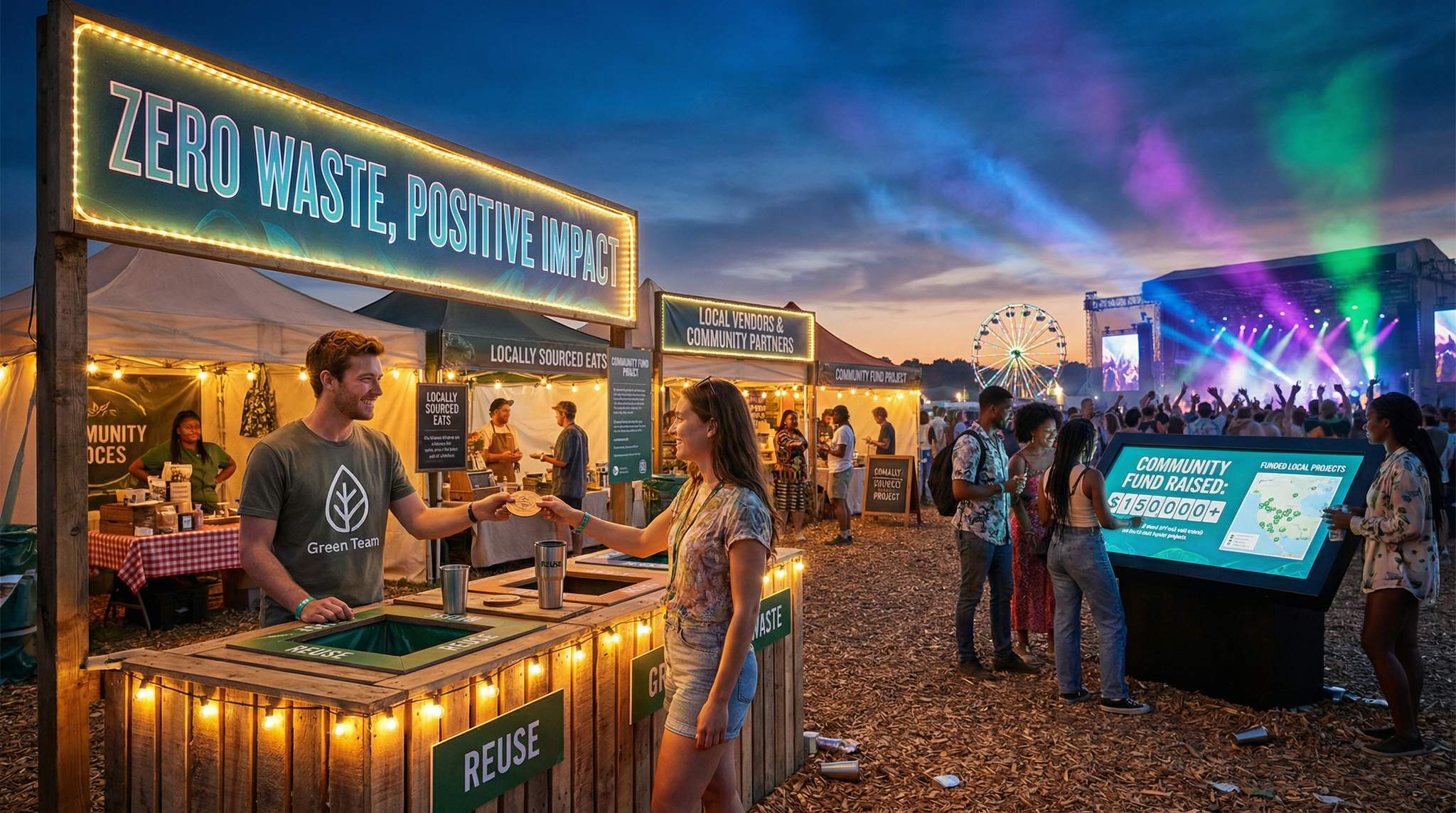
Music festivals have historically been notorious for the trash they leave behind – images of fields littered with cups, cans, and even abandoned tents are all too common. Today, leading festivals strive for a “leave no trace” ethos, planning for waste management as thoroughly as any headline act. Achieving this starts with reducing waste generation in the first place and setting up robust recycling and composting systems on-site. Organizers should implement comprehensive waste management and recycling systems at the festival by providing clearly marked bins for different waste streams (recyclables, compostables, landfill) placed conveniently throughout the grounds. Simply having recycling bins isn’t enough – they must be paired with clear signage (often with pictures) and regular servicing so they don’t overflow.
Another key tactic is the use of refundable deposits to encourage returns of items like cups or dishware. Many festivals have switched to reusable cups by charging a small deposit that attendees get back when they return the cup to a collection point. This dramatically cuts down on single-use cup waste and doubles as a souvenir system if attendees choose to keep the cup. Some events have gone further with fully reusable dish programs, where attendees “check out” a plate or utensils and return them for washing. While logistically involved, these systems can move a festival close to zero waste in food service.
Despite best efforts at reduction and recycling, there will always be some waste to manage. Planning for cleanup is critical. A dedicated green team of staff or volunteers should be tasked not only with keeping the grounds tidy during the festival (picking up litter so it doesn’t blow away or pile up) but executing a thorough sweep once the music stops. They’ll work through the night and next morning sorting remaining waste and removing every bit of debris from the venue, often in coordination with municipal waste services. On large sites, heavy machinery might be needed to collect trash or street-sweepers to cover expansive camping areas.
Free Tool: Project Your Bar Revenue
Per-head spend benchmarks by event type turned into projected bar and food revenue, with a stock-mix estimate and gross-margin line. Free calculator.
To put the scale in perspective: a massive event like Glastonbury Festival in the UK can generate on the order of 2,000 tonnes of waste over its duration. The full cleanup there takes over three weeks, involving around 1,300 volunteers alongside professionals to restore the grounds. While not every festival is Glastonbury-sized, the principle holds – a fast, effective cleanup operation is non-negotiable. This includes not just the core venue but any surrounding areas impacted (parking lots, nearby roads, campsites, etc.). Festivals should have a leave-no-trace checklist: remove all trash, repair any damage to fields or facilities, and even consider re-seeding grass or planting trees if the event caused wear to parks.
Progress is absolutely possible. Through a combination of reduction, recycling, and diligent cleanup, some festivals have achieved recycling rates upwards of 90% and send near-zero waste to landfill. For example, DGTL Festival in Amsterdam performed a meticulous material flow analysis and was able to reduce residual waste to only about 20 grams per visitor per day (down from 93 grams a few years prior) – an almost negligible amount. Their approach included treating waste as resources (e.g., turning organic waste into compost and even harnessing festival-goers’ urine to create fertilizer!). This kind of innovation is leading the way toward truly circular events.
Key Stat: A major event can leave behind a small mountain of trash if unmanaged. Glastonbury’s cleanup crews deal with roughly 2,000 tonnes of waste each year – equivalent to about 5,000 discarded tents and thousands of cans and bottles. By investing in large-scale recycling, composting, and volunteer cleanup teams, they manage to recycle or reuse a vast majority of that waste, proving that even huge festivals can drastically minimize what ends up in landfill.
Pro Tip: Turn the cleanup into a community effort. Some festivals invite local volunteers to help with post-event cleanup in exchange for a donation to a community organization or free tickets to next year’s event. This not only gets the job done faster but further strengthens community bonds – locals see firsthand that the organizers are serious about restoring the area. It can even become a proud tradition where neighbors and festival staff work side by side to make the venue spotless.
Volunteering and Local Workforce
One of the most direct ways a festival can involve and benefit the community is through volunteering and local hiring – essentially, engaging local volunteers and workforce in festival operations. Festivals large and small often rely on armies of volunteers to handle tasks ranging from ticket scanning and info booths to cleanup patrols. Engaging local volunteers gives community members a personal stake in the event’s success and can turn the festival into a point of local pride rather than just an outside venture. For the festival, volunteers provide enthusiastic labor and often ambassadorship that money can’t easily buy.
Establishing a well-run volunteer program is key. This means clearly defining roles, schedules, and responsibilities – volunteers should know exactly what they need to do and when. Training is important too; even though volunteers are not paid, they should be briefed (even via online sessions beforehand) on customer service basics, safety protocols, and the festival’s sustainability practices. Many festivals, via their volunteer coordinators, set up online portals where locals can sign up for shifts that interest them (e.g., working at a water station vs. assisting at a stage). It’s also standard to reward volunteers with perks: free or discounted tickets, merchandise, dedicated rest areas with snacks, and an appreciation party after the event all help ensure volunteers feel valued.
Grow Your Social Following With Every Sale
Require social media follows, shares, or playlist adds to unlock presale access or special pricing. Turn every ticket purchase into audience growth.
Local workforce integration goes beyond just volunteers. Festivals can pledge to hire a certain percentage of their paid staff from the local area – everything from site builders and electricians to stagehands and caterers. Hiring local not only reduces travel emissions (local crew won’t need long-distance transport or housing) but also builds skills and economic benefits within the community. Some forward-thinking events partner with local job centers or vocational schools to recruit and even train residents for festival-time employment. Over the years, these temporary jobs can rotate among community members, spreading the earnings and expertise.
A shining example of community workforce engagement is again Roskilde Festival. Each year about 30,000 volunteers (many from local associations like sports clubs and scout groups) power this 130,000-person event, and in return the festival donates to those associations. Similarly, other events partner with charities such as Oxfam or the Red Cross, whose volunteers staff positions and then receive donations or fundraising opportunities through the festival. At smaller festivals, the dynamic might be as simple as the whole town pitching in – local residents volunteering in shifts and treating the festival as a collective project.
Pro Tip: Show volunteers a path to grow. Some festivals implement tiered volunteer programs where returning volunteers can take on leadership roles (like team captain or area supervisor) in subsequent years, sometimes earning a stipend. This not only provides continuity and experience on the team but also motivates volunteers to return year after year, knowing they have opportunities to advance and take on more responsibility.
Warning: Keep the balance between volunteers and professionals. While volunteer enthusiasm is wonderful, certain critical operations (like electrical work, security oversight, or medical services) absolutely require certified professionals. Never substitute expertise with free labor in areas that could impact safety or quality. The ideal approach is to integrate volunteers under the guidance of professionals – for example, volunteer stewards working under direction of professional security, or volunteer medics who are actually qualified EMT students supplementing a core medical staff. This ensures the event runs smoothly and safely while still maximizing community involvement.
Key Stat: Large-scale volunteer efforts can save festivals huge sums and foster community spirit. Major events like Roskilde rely on roughly 30,000 volunteer crew members each year, contributing work equivalent to hundreds of full-time staff. In exchange, the festival’s charitable model means those volunteer hours translate into funding for local clubs and initiatives – a virtuous circle benefiting everyone involved.
Green Messaging and Attendee Education
Even the best sustainability plan will fall short without the cooperation of festival-goers. This is where green messaging comes in – educating and guiding attendees to participate in the festival’s eco-friendly efforts, but doing so in a way that feels engaging rather than preachy. From the moment attendees buy a ticket, the festival can set expectations: encourage them via emails and social media to bring reusable water bottles, use public transport, and keep the grounds clean. On the festival website and program, highlight your green initiatives (and why they exist) so people arrive aware and hopefully supportive.
On site, communication needs to be clear and constant. Signage is a huge part of this: every recycling station should have bright, user-friendly signs illustrating what goes where. Use simple language and visuals (for example, pictures of a plastic bottle above the recycling bin, a food scrap image above the compost bin). Many festivals create quirky, upbeat slogans to reinforce the message – Glastonbury famously posts “Love the Farm, Leave No Trace” everywhere as a reminder to respect the land. Others have fun with it, like humorous stage announcements: a performer or MC might come on and say, “Remember folks, the trash cans are lonely – feed them!” injecting humor into a serious request.
Festival organizers should also leverage the power of community and peer influence. Consider organizing volunteer “green teams” that roam the venue, helping people sort waste correctly or handing out pocket ashtrays to smokers. When attendees see other attendees actively caring for the environment, it normalizes the behavior. Interactive approaches work well too: some events set up art installations that visibly showcase collected trash or energy usage in real time, turning abstract impacts into something attendees can see. For instance, a display might show how many water bottles have been refilled at stations thus far, encouraging everyone to top up rather than buy new bottles.
Interactive digital campaigns before the event can also prime your audience. Some organizers use social media polls or email quizzes to get fans thinking about their environmental footprint. You might ask your audience a thought-provoking question like, “Which action best aligns with societal values in an eco-friendly community?” and offer multiple-choice scenarios—such as choosing public transportation for longer trips, using a bike for short trips, or participating in a carpool. By engaging attendees with these everyday dilemmas (and contrasting them with less sustainable choices, like using disposable plastic containers for lunch), you subtly educate your demographic on the very behaviors you want them to exhibit when they arrive at your gates.
It’s important to strike a positive tone. Educating festival attendees on green practices without coming across as preaching is an art in itself. Frame sustainability as a collective effort and part of the festival’s identity (“Here at Festival X, we all pitch in to keep the grounds green and clean!”). Celebrate wins publicly during the event – if by day 2 you’ve composted 5 tons of food waste, announce it and thank the attendees for making it happen. Recognition makes people feel their actions matter. Some festivals even integrate competitions or pledges (like a digital leaderboard for campgrounds that produce the least waste, with prizes for the “greenest campsite”).
Pro Tip: Weave sustainability into the festival’s story. For example, have popular artists or MCs remind the crowd to refill water bottles or clean up campsites – when the message comes from a beloved performer or via creative visuals onsite, attendees are more likely to embrace it enthusiastically.
Warning: Avoid guilt-tripping or overloading attendees with do’s and don’ts. A finger-wagging tone can cause pushback. Instead, focus on positive, actionable tips and celebrate the crowd’s eco-friendly efforts (like announcing when waste-reduction milestones are hit) to keep everyone motivated.
Awards, Certifications, and Recognition
As festivals ramp up their sustainability initiatives, many are seeking formal recognition for their efforts. Pursuing sustainability awards and certifications serves two main purposes: it provides an objective measure of your sustainability performance, and it signals to fans, sponsors, and media that your festival is truly walking the talk. One well-known program is the A Greener Festival (AGF) Award, which involves a rigorous assessment across areas like waste, energy, water, and community impact. Festivals that meet the criteria earn labels such as “Outstanding” or “Highly Commended” in the AGF Awards, effectively benchmarking them against global best practices. In 2024, over 50 festivals and events across 14 countries achieved AGF certification, reflecting how common and prestigious this has become as an industry achievement.
Another route is obtaining ISO 20121 certification – the international standard for sustainable event management. ISO 20121 doesn’t give you a public trophy, but it validates that you have a robust sustainability management system in place, which can be a selling point especially for host cities or corporate partners that prioritize ESG (Environmental, Social, and Governance) criteria. The process of getting certified can itself improve your operations, as it forces a thorough look at your supply chain, procurement policies, and impact monitoring.
There are also a host of regional and genre-specific awards emerging. For instance, the International Live Music Conference and industry publications sometimes highlight “Green Festival of the Year.” Some countries have national awards or government recognition for eco-friendly events. Even if an award is not globally known, the local publicity and morale boost for your team can be significant. Achieving a third-party accolade silences skeptics and can attract new sponsors who want to be associated with responsible events.
However, chasing awards should never become more important than the actual mission. The real goal is continuous improvement; awards are a means to that end, not the end itself. Use the criteria from these programs as a roadmap to improve – for example, if you fall short on an AGF assessment in waste reduction, treat that as valuable feedback on where to focus next year. Moreover, when you do earn recognition, leverage it: promote it in press releases, mention it in attendee communications (“You’re partying at one of the greenest festivals on earth!”), and share credit with your staff and audience because sustainability is a team accomplishment.
Pro Tip: Network with other festival organizers who have won sustainability awards or certifications. The community of eco-conscious festival producers is often very open and collaborative – many are happy to share tips or even vendor contacts that helped them achieve their goals. Attending conferences or webinars on green events can connect you to these peers. Standing on the shoulders of those who came before can accelerate your own path to excellence (and the podium at award ceremonies).
Key Stat: The trend is accelerating. A Greener Festival reported that in a recent year, over 50 festivals worldwide earned its sustainability certification or awards, a sharp increase from just a few years prior. This means more events are hitting stringent benchmarks for waste, energy, and community practices – effectively raising the bar for everyone. In a competitive festival market, being among the certified sustainable leaders can set your event apart and even allow you to command more trust from municipalities and sponsors.
Warning: Don’t engage in greenwashing – claiming to be greener than you are. The festival audience has become savvy; vague marketing about being “Earth-friendly” without data or certifications to back it up will be quickly called out. If you’re pursuing awards, be transparent about your journey, including the shortcomings. It’s better to say “We’re working towards a zero-waste goal by 2025 and currently divert 60% of our waste” than to overstate and be caught out. Authenticity and honesty are crucial, both for ethical reasons and for maintaining credibility with your fans and partners.
Case Study: DGTL Festival’s Sustainability Journey
To see these principles in action, consider the case of DGTL Festival in Amsterdam – often cited as one of the world’s most sustainable festivals. With roughly 20,000 attendees, DGTL set an ambitious goal a few years ago: to become the first circular, climate-neutral major event. This wasn’t just lip service; they reexamined every aspect of the event through a sustainability lens, making DGTL a living laboratory for green innovation.
One hallmark of DGTL’s approach was treating waste as a resource. The festival implemented an extensive Material Flow Analysis to track everything that came in (food, materials, water) and everything that went out (waste streams). Using this data, they introduced measures to close the loops. By 2022, DGTL had reduced its residual waste to astonishingly low levels – only about 20 grams per visitor per day was left that truly had to go to landfill. To achieve this, DGTL separated waste on-site into numerous categories, ensuring that plastics, metals, and paper were recycled, organic waste was composted or biodigested, and even wastewater streams were treated. A particularly innovative project turned urine collected from restroom facilities into fertilizer pellets rich in phosphates, exemplifying the circular economy in practice at a festival.
Energy was another focus. DGTL moved to renewable energy sources, powering stages with local green grid electricity wherever possible and using biofuels or battery systems instead of traditional diesel generators. The festival also invested in smart power management, matching generator sizes to actual needs to eliminate the inefficiencies of oversized units idling. On the food front, DGTL’s catering leaned heavily vegetarian (in line with research showing plant-based diets have a lower carbon footprint), and they sourced locally to reduce transport emissions.
Transport and travel were tackled by incentivizing cycling (unsurprising in Amsterdam – many attendees bike to the venue) and providing combination tickets that included public transit. DGTL also offset the relatively small carbon balance that remained via credible carbon offsets, aiming for a net-zero carbon footprint overall.
The results of these efforts gained global attention. DGTL has been recognized with top honors by A Greener Festival and other sustainability awards, and it openly shares its findings so other events can learn. Perhaps most importantly, DGTL proved that cutting-edge sustainability can coexist with a world-class attendee experience – the event remains one of Europe’s most popular electronic music festivals. Fans buy tickets not just for the music lineup, but also out of respect for what the festival stands for.
For festival producers, the DGTL story is a compelling blueprint. It shows that with leadership, creativity, and partnerships (DGTL worked with environmental engineers, waste companies, and the city government), a festival can dramatically reduce its negative impacts. Each year DGTL sets new targets – demonstrating that sustainability is a journey, not a one-time achievement. Lessons from DGTL’s journey – measure everything, experiment boldly, and engage experts – are universally applicable. In fact, the greening of DGTL Festival has been documented as a case study to help inspire and inform others in the industry.
Pro Tip: Don’t be afraid to pilot new green technologies on a small scale at first. DGTL’s success came from years of incremental trials, like testing a few solar-powered vendors one year or a small composting system for back-of-house waste, before scaling up once the kinks were worked out. Use a portion of your festival as a “green innovation zone” each year to try something new – for example, one parking lot converted into a bike-only area with free valet, or one bar operating on a solar battery. Gathering real-world data and feedback from these pilots can pave the way for event-wide adoption in the future.
Key Stat: By rethinking its operations, DGTL Festival cut its average waste per attendee by nearly 80% between 2015 and 2022 and now boasts a waste diversion rate of over 95%. Achievements like these illustrate that even large festivals can edge astonishingly close to true zero-waste, setting a new standard for the industry.
Essential Reading
- Economic Impact: Quantifying What Your Festival Brings – A guide to measuring and reporting the financial benefits your event delivers to the local economy, from attendee spending to job creation.
- Sustainable Travel: Encouraging Low-Impact Transportation for Festivals – Strategies to reduce carbon emissions and traffic by promoting carpooling, public transit, cycling, and other eco-friendly travel options for festival-goers.
- Local Partnerships and Charity: How Festivals Give Back – Examples of how festivals can support host communities through charitable donations, local hiring, and partnering with community organizations to leave a positive legacy.
- Community Relations: Being a Good Neighbor Before, During, and After the Festival – Best practices for proactive community engagement, managing noise and traffic, and ensuring resident satisfaction throughout the festival lifecycle.
- Eco-Friendly Festival Vendors: Working with Food and Merchants for Sustainability – Tips for greening your supply chain by selecting and guiding vendors to use sustainable materials, local products, and reduce waste in their operations.
- Leave No Trace: Post-Festival Cleanup and Restoration – A detailed look at planning and executing effective cleanup efforts, site restoration, and waste disposal after the event to honor the “leave it better than you found it” principle.
- Sustainability Strategy: Greening Your Festival from Start to Finish – A comprehensive approach to embedding sustainability into every stage of festival planning and production, including goal-setting, team roles, and green action plans.
- Green Messaging: Educating Festival Attendees Without Preaching – How to craft effective environmental messages and on-site campaigns that inspire attendees to participate in sustainability efforts while still having fun.
- Volunteering and Local Workforce: Engaging the Community at Festivals – Insights into building a strong volunteer program and hiring locally, including motivating volunteers, training, and the community benefits of local workforce involvement.
- Case Study: The Greening of DGTL Festival – An in-depth case study examining how one festival implemented innovative solutions to drastically reduce waste, cut emissions, and achieve a near-circular event model.
- Awards and Certifications: Striving for Sustainability Excellence in Festivals – Overview of various sustainability awards and certifications in the events industry and how pursuing these can drive improvement and bolster a festival’s reputation.
- Festival Waste Management and Recycling Systems – A detailed how-to guide on implementing effective recycling, composting, and overall waste management infrastructure at events of any size.
FAQ
Why should a festival prioritize sustainability and community impact?
Prioritizing sustainability and community impact is crucial for a festival’s long-term success. Environmentally, it helps reduce the event’s carbon footprint, waste, and strain on local resources, ensuring the festival doesn’t harm the very site and community that host it. Socially, showing care for the local community – through economic benefits, respectful operations, and charitable contributions – builds goodwill and a positive reputation. Festivals that embrace these priorities often gain easier permit approvals, attract sponsors who value corporate responsibility, and foster loyal attendees who feel good about supporting an event that gives back. In short, being sustainable and community-minded isn’t just the right thing to do; it also creates a supportive ecosystem that allows the festival to thrive year after year.
How can festival organizers measure their event’s economic impact on the community?
Measuring economic impact typically involves conducting an economic impact study. Festival organizers can start by gathering data on attendee spending: surveys can ask attendees how much they spent on hotels, dining, transportation, and shopping in the area. Additionally, organizers should track money paid to local vendors, staff, and services. Using multipliers (often provided by tourism boards or economists) helps estimate indirect impacts – for example, the ripple effect of money as local businesses re-spend those earnings in the community. Many festivals partner with local universities or economic consultants to analyze this data and produce a report. The end result is a set of metrics (total dollars contributed to the local economy, jobs supported, tax revenue generated) that quantify how the festival financially benefits its host community.
What are the best ways to reduce waste and litter at a festival?
Reducing waste at a festival starts with planning to generate less trash in the first place. Organizers can ban common waste items (like single-use plastics) and switch to reusables or compostables. Implementing a reusable cup program with a deposit is a proven method to cut down on disposable cup waste. Next, set up well-labeled recycling and composting stations everywhere so that when waste is created, it’s sorted and diverted from landfill. Education is key – use signage and announcements to encourage attendees to use the proper bins and not litter. On the operational side, ensure vendors comply by using only approved packaging and that they minimize their own waste. Finally, deploy dedicated cleanup crews during and after the event, including volunteer “green teams,” to constantly collect stray trash and ensure the venue is thoroughly cleaned (and ideally restored to its original state) once the festival concludes.
How can festivals mitigate noise, traffic, or other disturbances for local residents?
Mitigating disturbances starts with proactive communication and planning. For noise, festivals should adhere to strict sound curfews and decibel limits as agreed with local authorities – for example, ending loud performances by a certain time and orienting stages or speakers away from residential areas. Some events invest in sound buffering technology or schedule quieter programming late at night. For traffic, developing a traffic management plan in coordination with the city is essential: this can include clear signage, hiring traffic control staff or police to direct flow, arranging shuttles, and informing attendees of where to park (so they don’t end up on residential streets). Festivals often distribute resident information packs that outline what to expect, provide a hotline for complaints, and offer solutions such as resident-only passes or temporary permits to manage road access. During the event, having an active community liaison team to respond to any issues (like an overflowing trash bin on a neighbor’s property or rowdy behavior on local streets) can nip problems in the bud. The goal is to run the festival in a “good neighbor” mode – anticipating needs and concerns and addressing them so effectively that residents experience minimal inconvenience.
Are sustainability initiatives cost-effective for festivals?
While some sustainability initiatives require upfront investment, many of them prove cost-effective in the long run. For example, implementing a robust recycling program can reduce disposal costs because less waste goes to expensive landfills. Transitioning to energy-efficient LED lighting or solar-powered generators may have initial costs, but they often lower fuel or electricity bills over time. Reducing single-use items (like eliminating disposable cups) saves the cost of purchasing those items each year – a one-time stock of reusable cups can serve multiple festivals. Moreover, doing things sustainably can unlock new revenue or support: eco-minded sponsors might offer funding or in-kind help (such as a renewable energy company providing a discount on solar equipment in exchange for exposure). There are also indirect financial benefits: a festival known for sustainability can attract a wider audience segment and enjoys stronger community support, which can prevent costly conflicts or permit issues. Of course, organizers should prioritize initiatives by doing a cost-benefit analysis, but increasingly event producers find that “going green” aligns with “saving green,” especially when considering long-term and reputational payoffs.
How do festivals encourage attendees to support sustainability efforts?
Festivals encourage attendee participation in sustainability by making it easy, fun, and rewarding. Communication is the first step: festivals use pre-event emails, apps, and social media to let ticket-holders know about things like refillable water stations (so bring a bottle), recycling programs, or incentives for using public transport. Once on site, signage and frequent friendly reminders keep sustainability visible – for example, prompts at food stalls might say “Love this meal? Compost the leftovers in our green bin!” Gamification works well too: some festivals create challenges (like a scavenger hunt where picking up litter is one task) or competitions between campgrounds for who can produce the least trash. Incentives are powerful: deposit-refund systems encourage cup returns, while giveaways (like free merch or a chance at VIP upgrades) can be offered to those seen doing eco-friendly acts (many events have roving “spotters” who might randomly reward someone refilling a bottle instead of buying plastic). Another method is involving the crowd in record-setting attempts – for example, attempting “the largest group cleanup” after the final act, which can turn a chore into a communal moment of achievement. Overall, positivity and community spirit drive engagement: festivals frame green actions not as obligations, but as part of the culture and fun of the event, often backed by support from popular artists and influencers amplifying the message.
What sustainability certifications or awards can festivals aim for?
Festivals have a growing array of sustainability certifications and awards they can pursue. One of the most respected is the A Greener Festival Award, which evaluates events on comprehensive criteria like waste, energy, water, transport, and community impact. Festivals that meet the standards can be certified and earn different levels of award (e.g., “Outstanding”). There’s also ISO 20121, an international standard for sustainable event management systems; achieving ISO 20121 certification means the festival has an audited, robust sustainability plan in place. Regional awards exist too – for instance, the U.K. has the Creative Green Certification (from Julie’s Bicycle) for cultural events, and many countries’ event industry associations have annual green awards. Additionally, some festivals enter general environmental awards or competitions run by environmental organizations or media. The key is to choose a certification or award program that fits the festival’s resources and goals: some are mentorship-based and help improve practices, while others are purely recognition for reaching a high bar. Earning credible third-party recognition not only provides a goal to strive for, but once attained, it also boosts the festival’s credibility in the eyes of fans, sponsors, and local governments.
Glossary
- Carbon Footprint: The total amount of greenhouse gases (especially carbon dioxide) emitted directly or indirectly by an entity or activity. For a festival, this includes emissions from energy use on-site, attendee and artist travel, production materials, etc., usually expressed in CO2 equivalent.
- Zero Waste: A goal or philosophy of eliminating waste so that no trash is sent to landfills or incinerators. In a festival context, it means reducing, reusing, and recycling materials such that virtually all festival waste is diverted to recycling or compost, with none (or only a negligible amount) going to landfill.
- Circular Economy: An economic system aimed at eliminating waste and the continual use of resources. For festivals, adopting circular economy principles means designing the event so that materials are reused or recycled (for example, using reusable cups and repurposing stage materials) rather than disposed of after a single use.
- ISO 20121: An international standard for sustainable event management. It provides a framework for events (like festivals) to implement processes that minimize environmental impact and promote social responsibility. A festival certified to ISO 20121 has been audited for a high level of sustainability planning and continuous improvement.
- A Greener Festival (AGF) Certification: A certification and awards program run by the nonprofit A Greener Festival, which assesses festivals on sustainability criteria. Festivals that undergo the assessment receive a rating or award (such as Highly Commended or Outstanding) if they meet benchmarks in areas like waste management, emissions, and community engagement.
- Waste Diversion Rate: The percentage of waste material that is diverted away from landfill toward more sustainable pathways such as recycling or composting. A diversion rate of 85%, for example, means 85% of the festival’s waste by weight was recycled or composted and only 15% went to landfill.
- Leave No Trace: A principle originally from outdoor ethics, adopted by many festivals, which emphasizes minimizing one’s impact on the environment. In practice, “Leave No Trace” at a festival means attendees and organizers strive to leave the venue as clean (or cleaner) than they found it, with no litter or damage remaining.
- Greenwashing: Misleading claims or actions that make an organization or event seem more environmentally responsible than it really is. For instance, a festival might be accused of greenwashing if it heavily markets minor eco-friendly actions while ignoring larger negative impacts. Authentic sustainability efforts focus on meaningful changes, not just marketing.
- Renewable Energy: Energy sourced from natural processes that are replenished constantly, such as solar, wind, or hydro power. Festivals may use renewable energy to power stages and facilities (through solar panels, wind turbines, or purchasing green electricity) as a way to reduce reliance on fossil fuels and cut carbon emissions.
- Local Economic Impact: The effect an event has on the financial well-being of the local area. This includes direct spending by the festival (hiring local staff, renting local services) and by visitors (spending on hotels, food, transportation), as well as indirect impacts as that money circulates in the community. Measuring local economic impact helps show the benefits of hosting the festival.
- Triple Bottom Line: A framework that evaluates success not just on financial performance (profit) but also on social and environmental outcomes (people and planet). For festivals, a triple bottom line approach means planning and assessing the event based on its economic viability, its positive or negative impact on the community and attendees (social), and its environmental footprint.
- Corporate Social Responsibility (CSR): A philosophy where businesses (or festivals, in partnership with sponsors) take into account their effects on society and the environment, and act to promote positive outcomes. In the festival context, CSR might involve a sponsoring company supporting the festival’s sustainability initiatives or a festival launching programs that benefit the community to fulfill their social responsibility.
Conclusion
Sustainability and community impact are no longer side notes in festival production – they have become defining pillars of a festival’s identity and longevity. The world’s most admired festivals today are those that not only entertain, but also enrich their locales and steward their environments. From planning a carbon-neutral stage to forging friendships with city officials and neighbors, the work a producer puts into these areas pays dividends in the form of smoother operations, heartfelt community support, and a legacy that extends far beyond the final encore.
Implementing the practices discussed – whether it’s drafting a sustainability action plan, coordinating carpools and cleanups, or transparently measuring impact – requires commitment and collaboration. Every festival is a complex machine, but by aligning artists, vendors, attendees, and the local community around shared values, that machine runs more harmoniously. Challenges will arise, of course; yet, as seen with pioneering events like DGTL or community-driven traditions like local volunteer programs, creative solutions and continuous improvement can overcome them.
The journey toward a truly sustainable, community-positive festival is an ongoing evolution. Even small first steps, like eliminating single-use plastics or meeting with residents well ahead of the event, set the stage for bigger strides in subsequent years. Festival producers have the opportunity to be leaders in the live events industry’s green revolution – to show that celebrating culture and music can go hand in hand with making the world a better place. By prioritizing people and planet alongside profit, festivals will not only endure the test of time, they will become catalysts for change, leaving every place they touch a little brighter and greener than they found it.