Closing down busy city blocks for a festival isn’t as simple as pitching tents in a field. Inner-city festivals confront a maze of permits, noise laws, traffic jams, and neighbors at their windows. The world’s most experienced producers have learned to navigate these urban challenges, from dealing with city hall to cleaning streets before dawn. This authoritative guide distills decades of know-how into practical tactics for transforming concrete jungles into vibrant celebrations – all while keeping city officials, local businesses, and residents on your side.
Key Stat: Over half of the world’s people now live in cities, a share projected to grow to nearly two-thirds by 2050, according to Time Magazine’s analysis of sustainable urban development. As urban populations swell, the demand for inner-city festivals is rising – but so are the stakes for getting them right.
Table of Contents
– Urban Footprint & Layout
– Permits & City Stakeholders
– Power & Technology Infrastructure
– On-Street Operations & Logistics
– Security & Crowd Management
– Emergency & Medical Planning
– Sound & Noise Control
– Transportation & Mobility
– Attendee Flow & Accessibility
– Community & Business Relations
– Marketing & Partnerships
– Post-Event & Sustainability
– Essential Reading
– FAQ
– Glossary
– Conclusion
Urban Footprint & Layout
Closing down busy city blocks for a festival isn’t as simple as pitching tents in a field. Inner-city festivals confront a maze of permits, noise laws, traffic jams, and neighbors at their windows. The world’s most experienced producers have learned to navigate these urban challenges, from dealing with city hall to cleaning streets before dawn. This authoritative guide distills decades of know-how into practical tactics for transforming concrete jungles into vibrant celebrations – all while keeping city officials, local businesses, and residents on your side.
Key Stat: Over half of the world’s people now live in cities, a share projected to grow to nearly two-thirds by 2050, according to Time Magazine’s analysis of sustainable urban development. As urban populations swell, the demand for inner-city festivals is rising – but so are the stakes for getting them right.
Table of Contents
– Urban Footprint & Layout
– Permits & City Stakeholders
– Power & Technology Infrastructure
– On-Street Operations & Logistics
– Security & Crowd Management
– Emergency & Medical Planning
– Sound & Noise Control
– Transportation & Mobility
– Attendee Flow & Accessibility
– Community & Business Relations
– Marketing & Partnerships
– Post-Event & Sustainability
– Essential Reading
– FAQ
– Glossary
– Conclusion
Planning a Festival?
Ticket Fairy's festival ticketing platform handles multi-day passes, RFID wristbands, and complex festival operations.
Urban Footprint & Layout
For emerging promoters figuring out how to start a festival from the ground up, selecting the right location is often the very first tangible step after securing initial funding and defining the event’s core concept. When you decide to start your own festival, the urban footprint you choose will dictate your entire business model—from capacity limits and optimizing ticket pricing to the specific types of municipal permits required. Establishing this foundation early ensures that your creative vision aligns with the practical realities of city infrastructure.
Choosing the right site footprint in a downtown setting is the foundation of a successful inner-city festival. Organizers must evaluate which city blocks, plazas, or streets can accommodate stages, crowds, and vendor zones without paralyzing the entire district. The ideal urban footprint balances excitement with practicality – it might span a few contiguous blocks or center on a public square, but it should avoid critical intersections or emergency routes when possible. Veteran producers often work closely with city planners when assessing suitable city blocks and plazas for a festival footprint to ensure their layout aligns with traffic patterns and infrastructure limits.
In designing the site, it’s crucial to leverage the urban grid. A multi-block layout can spread attractions out to prevent over-crowding, but connectivity is key – clear “arteries” for movement and strategically placed landmarks help attendees navigate. Many producers rely on designing a multi-block festival layout through a city street grid with obvious waypoints (train stations, public art, or sponsor towers) so festival-goers can easily find stages and exits in the city maze. Pro Tip: Map out at least two pedestrian routes between every major area. If one street path becomes congested, having an alternate route (even if it’s through an alley or parking lot) keeps people moving and prevents bottlenecks.
Urban topography and hidden infrastructure also influence layout decisions. Downtown areas often hide underground utilities, basements, and transit tunnels beneath plazas and streets. Placing heavy stages or equipment without a survey can be disastrous. Savvy festival teams consult civil engineers and check underground utility lines and load ratings before placing stages on plazas or over subway stations. If a proposed stage site can’t support the load (for example, the roof of an underground parking garage), designs are adjusted in advance.
Free Tool: Size Your Festival Site
Zoned capacity planning for arena, campsite, parking and entry lanes — against UK Purple Guide and NFPA density standards. Finds your bottleneck zone.
Urban festivals aren’t confined to ground level, either. In dense cities, creative producers have even expanded vertically – from multi-story parking garages to building rooftops. Using a rooftop or multi-level venue offers stunning skyline views but requires intense safety planning. Utilizing rooftops or multi-level venues safely within downtown means accounting for structural load, safe access (elevators, stairwells), and wind dynamics at height. Warning: Never assume a city surface is solid. Always verify with city engineers whether a plaza or roof can bear the weight of stages, crowds, and equipment – or risk a collapse, massive damage, and legal nightmares.
Beyond public-facing areas, technical directors must evaluate the event organizer company office riders on formations for back-of-house compounds. Squeezing production trailers, artist dressing rooms, and operational headquarters into narrow alleys or adjacent parking lots requires precise spatial planning to ensure these restricted zones function efficiently without bleeding into the pedestrian footprint.
Need Festival Funding?
Get the capital you need to book headliners, secure venues, and scale your festival production.
To maximize the footprint’s potential, top producers often standardize a city area for event targeting. By dividing the urban grid into modular, purpose-built zones—such as a dedicated culinary block, a VIP hospitality plaza, or an all-ages interactive street—organizers can precisely target different attendee demographics. This modular zoning strategy not only simplifies crowd flow and infrastructure deployment but also makes it easier to pitch specific neighborhood sectors to brand partners looking for achieving highly focused audience engagement.
Permits & City Stakeholders
In the heart of a city, bureaucracy rules. Navigating the permitting maze is one of the first and most important hurdles for an inner-city festival producer. Major cities require multiple approvals – often from a web of departments – before the show can go on. This can include special event permits, street closure permits, sound/noise variances, building and fire safety approvals, health permits for food vendors, and signage permits for banners or wayfinding. Successfully navigating the maze of city special event, encroachment, and signage permits requires starting paperwork early and staying extremely organized. Top producers often develop a calendar working backwards from the festival date, with target submission dates for each required permit (sometimes 6+ months in advance for major cities). Missing a deadline can mean hefty late fees or even a denied permit.
Engaging city stakeholders from day one is equally critical. Unlike a private venue, city streets involve everyone from the mayor’s office to the local police precinct. The most effective festival teams hold regular planning meetings with a city’s inter-agency task force – typically including special events officials, police, fire, public works, transportation, and sometimes public health departments. By working with downtown business improvement districts and commerce chambers to enlist business district support, producers can also show city hall that the festival is aligning with local economic interests. For example, a city might be more flexible on road closures if the downtown Chamber of Commerce backs the event as a boost for restaurants and retail.
One stakeholder conversation producers cannot overlook is labor and unions. In many big cities, certain roles (like stagehands, electricians, or teamsters driving trucks) are governed by union rules and prevailing wage laws. Managing local union labor requirements and prevailing wage rules is a reality for inner-city festivals, especially in North America and Europe. Organizers must budget for union rates (often higher than non-union) and abide by work rules (like mandatory breaks or maximum hours) that could affect the production schedule. Pro Tip: Build a strong relationship with the local union business agent. Bringing union reps into the planning early, sharing the festival schedule, and negotiating crew call times can prevent costly disputes or last-minute crew shortages.
Turn Fans Into Your Marketing Team
Ticket Fairy's built-in referral rewards system incentivizes attendees to share your event, delivering 15-25% sales boosts and 30x ROI vs paid ads.
Key Stat: A major downtown festival can involve coordination with 10+ different city agencies and officials. Securing all clearances can take over a year of groundwork. For example, Chicago’s Lollapalooza must liaise with parks, police, transit, fire, health, and more – but the effort pays off, as the four-day festival draws about 100,000 attendees per day and has delivered over $2 billion in local economic impact to the city over the past decade, as reported by Block Club Chicago regarding downtown resident concerns.
Permits are not a one-and-done task – they often come with conditions and city services attached. A traffic control plan might stipulate hiring off-duty police officers for intersection control, or a noise variance might require on-site city inspectors with sound meters. In budgeting, producers should account for these “side orders” that come with permits. Mastering the art of budgeting for inner-city festivals means anticipating urban costs like permit fees, police overtime, sanitation surcharges, and utility hook-ups that rural festivals might avoid. Always allocate a healthy contingency (veterans suggest 10-15% of total budget) for unplanned city requirements – a new insurance mandate or a last-minute fire marshal request could hit just weeks before the festival.
Finally, smart producers view permits as a two-way dialogue and plan for the long term. If the festival could become an annual fixture, it pays to invest in goodwill now. That might mean funding a small park improvement or agreeing to extra clean-up in exchange for smoother approvals next year. Laying this groundwork dovetails with a year-two festival strategy with city hall to streamline renewals and upgrades. After the first festival, meet with city officials to review what worked and what didn’t. Showing that you addressed their concerns (by tweaking the layout or improving security, for instance) can make the next permit process faster and cheaper.
To maximize the scope of their urban footprint, many organizations will apply for temporary permits that allow specific exemptions from standard municipal zoning or daily operational laws. These short-term authorizations are what enable producers to legally erect multi-story scaffolding, serve alcohol outside of established brick-and-mortar licensed premises, or extend operating hours past standard curfews. Securing these provisional licenses requires demonstrating to city officials that your production team has the necessary safety protocols, insurance coverage, and crowd management strategies in place to handle the expanded operational privileges responsibly.
Power & Technology Infrastructure
Amid skyscrapers and concrete, providing reliable power and connectivity is both an opportunity and challenge for urban festivals. Unlike remote fields, city events can often tap directly into the electrical grid – if they plan correctly. Many producers favor power strategies that use city grid tie-ins versus portable generators or hybrid systems to reduce noise, emissions, and refueling logistics. For example, instead of running dozens of diesel generators (which produce fumes and sound), a festival might work with the city’s utility to install temporary electrical panels feeding off street power mains. Grid power can be cleaner and often more stable, but it requires permits and possibly hiring a certified electrician to manage the connections. Warning: Don’t assume you can plug in anywhere. Always get utility approval and use licensed electricians – tapping a city power box without permission or overload protection can blow out a street’s power or even cause a blackout.
Where generators are unavoidable, cities often demand low-noise, low-emission models. New hybrid generator-battery systems can run silently during performances, recharging during off-peak times. These are popular in urban events to comply with strict noise ordinances and carbon reduction goals. Some forward-thinking cities even have incentive programs or equipment loan schemes to encourage festival organizers to choose greener power options.
Smooth Entry With Mobile Check-In
Scan tickets and manage entry with our mobile check-in app. Supports photo ID verification, real-time capacity tracking, and multi-gate coordination.
Connectivity is another critical infrastructure component. Urban attendees expect to stay connected – posting on social media, using the festival app, and communicating with friends. Ironically, city centers can be notorious dead zones during mass events because thousands of people overwhelm the cellular networks (the “urban canyon” effect of skyscrapers can also weaken signals). To avoid a communications meltdown, organizers focus on ensuring reliable tech connectivity with fiber backbones, robust Wi-Fi, and radio systems when city cell networks fail. Many build a private fiber or cable line across the site for internal systems (ticket scanning, point-of-sale, etc.) and deploy dedicated festival Wi-Fi in public areas. High-capacity Wi-Fi offloads traffic from 4G/5G networks, keeping attendees connected and cashless payment systems running.
For critical communications (like security, medical, and operations teams), two-way radios remain king. Skyscrapers can create radio dead spots, so events set up signal repeaters or use city emergency radio networks if offered. Pro Tip: Establish a backup communication method for emergencies – for instance, a hard-wired phone line to the city’s Emergency Operations Center or a satellite phone. If a major incident occurs and cell service crashes, you’ll still be able to reach authorities. Urban festivals that planned this coordination in advance have saved precious minutes during crises by not having to rely solely on jammed networks.
Finally, consider technology partnerships with local providers. Some telecom companies sponsor festivals by providing temporary cell towers on wheels or boosting coverage in the area. Likewise, major internet service providers may be willing to run a temporary high-speed connection if it doubles as a public demo of their service. It never hurts to ask – a short-term fiber line or mobile tower can be the difference between a seamless attendee experience and thousands of frustrated posts about “no signal at the festival.” Warning: Urban connectivity isn’t just about convenience; it affects safety. Do not rely on public cellular networks for critical operations like ticket verification or emergency alerts. Always secure a private network or hardline for mission-critical systems, as city networks will get overloaded by tens of thousands of smartphones.
On-Street Operations & Logistics
Once permits are in hand and the layout is set, an inner-city festival’s success hinges on operational finesse. Urban festivals unfold in tight spaces with countless moving parts – literally, from delivery trucks to e-scooters. Planning street operations means choreographing how every supply and service enters, operates during the event, and exits smoothly.
Vendor Deliveries & On-Site Facilities
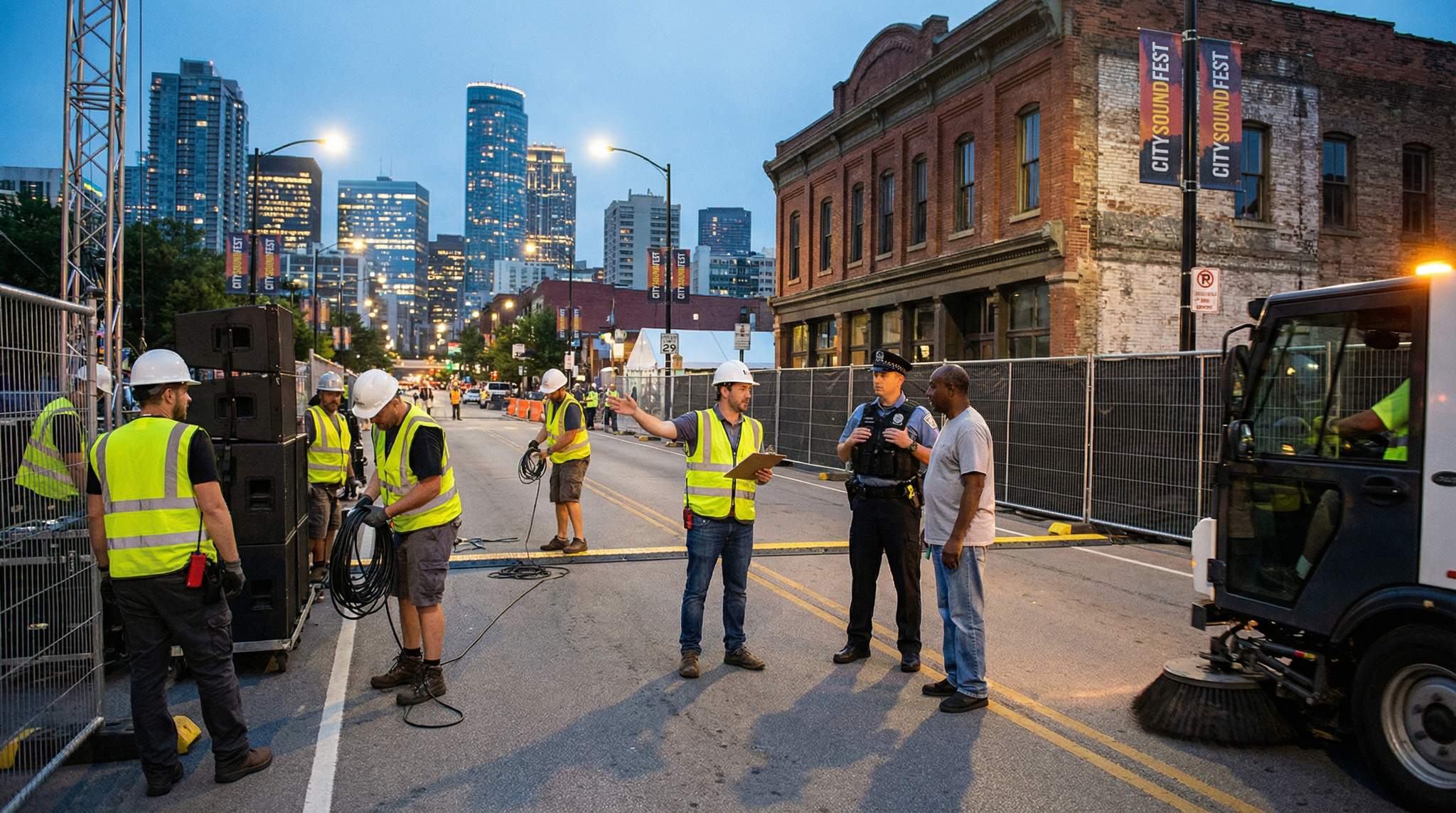
Downtown festivals often take place amid offices, shops, and residences, which rarely have the luxury of sprawling loading zones. Vendor deliveries and restocking must be precision-timed. Experienced operations managers establish dedicated delivery windows and loading dock operations for vendors in downtown festival sites – often very early morning or overnight – when they can temporarily reopen barricades to let trucks in. They also coordinate with nearby businesses: for instance, arranging to use a shopping center’s loading dock off-hours, or issuing special permits for delivery trucks to park in alleys. Pro Tip: Assign “festival street marshals” during load-in and load-out. These staff act like air traffic controllers for delivery vehicles, guiding trucks through barricades, ensuring no one blocks fire lanes or hydrants, and keeping things on schedule. A well-run load-in with marshals can turn a normally chaotic downtown unloading scene into a smooth operation that finishes hours ahead of gates.
Inner-city festivals must also provide basic amenities on asphalt and concrete. One big adaptation is restrooms – without open fields, finding spots for rows of portable toilets can be tricky. Creative solutions include building temporary platforms over parking spots or deploying micro restroom pods that tuck into alleyways. Solving restroom placement and odor control without park space, while ensuring ADA compliance is an art unto itself. Operations teams often distribute smaller clusters of toilets in multiple locations (instead of one giant toilet farm) to avoid bottlenecks and to be less conspicuous to the neighborhood. Regular pumping and cleaning are scheduled during off-peak hours to manage odor – odors travel fast between buildings, so this is a top priority to keep residents happy.
Free Tool: Project Your Bar Revenue
Per-head spend benchmarks by event type turned into projected bar and food revenue, with a stock-mix estimate and gross-margin line. Free calculator.
Food and beverage operations also take on an urban twist. Many cities require festival food vendors to prepare food in licensed commissary kitchens, since cooking on public streets may be restricted. This means vendors either cook off-site and reheat on-site or use only small, approved setups on festival grounds. All vendors must pass city health inspections on-site as well. Festival producers facilitate this by meeting food safety standards via commissary kitchens and stringent health inspections – for example, arranging for vendors to use a nearby commercial kitchen and shuttling food in warmers to their booths. Hand-wash stations, temperature logs, and proper waste oil disposal are non-negotiable in city environments and are often checked by inspectors each day. The same goes for alcohol: obtaining a temporary city liquor license can require roping off street “beer gardens” and training staff on stringent ID checks. Getting festival alcohol licenses and managing sidewalk service with controlled beer gardens is essential to avoid fines or a shutdown. Many urban festivals station police or hired security at each alcohol service area to enforce drinking age and prevent open containers from wandering off festival grounds into public streets.
Street Closures & City Services
Perhaps the most visible logistic is street closures. Closing streets in a city requires far more than just putting up barricades. A detailed traffic control plan, reviewed by the city, will dictate exactly which blocks close and how detours for cars, buses, and emergency vehicles will work. Achieving city-approved street closure and detour plans for a festival means collaborating with transportation officials months in advance. Planners often conduct dry-run simulations – if you close these four blocks, what happens to traffic flow in the 10-block radius? Will cars be able to turn around? Are there alternate bus routes for public transit? Posting clear detour signage (and notifying mapping apps like Google Maps and Waze of the closures) is crucial to prevent gridlock. Warning: Don’t surprise the city’s commuters. Always publicize your road closures weeks ahead through local news, social media, and street signage. Nothing turns public opinion against a festival faster than an unexpected Monday-morning traffic jam or blocked bus route because of leftover closures.
When streets close, vehicle mitigation becomes another focus. Urban festivals must account for the risk of vehicles accidentally or intentionally entering pedestrian areas. This has led to widespread use of anti-vehicle barriers. These can be heavy water-filled barricades, concrete bollards, or even sanitation trucks parked as blockers at key access points. Designing secure perimeters with these defenses is a must – festival perimeter design with anti-vehicle barricades has become standard practice, typically mandated by police. Event producers coordinate with public works to place and remove these barriers (since they often require machinery to move). On event days, private security or city officers man the perimeter entries, both to stop unauthorized vehicles and to manage authorized ones (e.g. emergency vehicles or vendor restock vans during designated times).
City services themselves become part of the operation. Festivals may need to cover the costs of city workers who facilitate the event – from off-duty cops managing traffic to transit staff extending train service. In some cases, cities will assign fire inspectors, building engineers, or paramedics to be on-site and then bill the festival. Always confirm which services are being provided and budgeted. For example, the city might supply trash dumpsters and collection crews for a fee, or require the event to hire a certified private ambulance company for medical coverage. Avoiding collisions with scheduled city construction or roadworks is another behind-the-scenes task – producers should check if any major construction projects or crane operations are planned near the site on festival dates and coordinate timeline or route changes accordingly.
Sanitation & Waste Management
Urban festivals have one shot to prove they can leave a city street as clean (or cleaner) than they found it. Waste management is magnified in tight quarters: piles of garbage or spilled drinks on sidewalks are not only eyesores but also public health and PR issues. A robust plan for downtown festival waste, recycling, and nightly street cleaning is essential. This typically involves deploying far more trash and recycling bins than an equivalent open-field event – you might see bins on every corner, every 50 feet of vendor row, etc., to catch litter before it scatters. Street teams or city-contracted cleaners often patrol constantly, picking up trash throughout the day.
What truly sets inner-city festivals apart is overnight cleaning. Rather than waiting until the festival ends for a big clean-up, crews often do a full sweep each night after the crowd leaves. It’s common to see street sweepers (machines) and cleaning crews out in force at midnight of a multi-day downtown festival, scrubbing the streets so morning commuters or residents wake up to a clean neighborhood each day. Key Stat: London’s two-day Notting Hill Carnival typically generates around 300 tons of trash that must be cleared overnight by an army of 200 cleaners and 30 trucks, according to waste clearance reports from the Royal Borough of Kensington and Chelsea. Urban festival producers similarly plan for massive waste removal – coordinating with city sanitation departments to bring in dump trucks, roll-off dumpsters, and even pressure-washers for sidewalks sticky with spilled drinks.
Free Tool: Model Promoter Payouts
Flat-percentage, flat-per-ticket, or tiered-bonus commission structures — get per-promoter payouts and total commission as % of gross. Free calculator.
Recycling and sustainability practices are under the microscope in cities. Many festivals now implement eco-friendly measures like banning single-use plastics, using hydration stations instead of bottled water, and providing souvenir cups to reduce cup waste. Some cities mandate recycling at events, so organizers set up sorting stations backstage or contract vendors to separate recyclables from trash. Implementing sustainability measures like grid power hookups, hydration fountains, and reusables at an urban festival not only helps the environment but also builds goodwill with the community and city officials. Pro Tip: Consider partnering with local environmental groups or a city’s sustainability office. They may offer volunteer “green teams” who help attendees recycle properly, or provide grants for sustainable initiatives (like a free bicycle valet service to encourage attendees not to drive). Visible green efforts can turn a potential criticism (trash and waste) into a festival selling point.
Security & Crowd Management
Ensuring safety in an inner-city festival is a high-stakes balancing act between public resources and private measures. The dense environment, hard boundaries (buildings, fences), and everyday city crime risk all factor into a comprehensive security plan. A successful approach typically layers multiple elements: police, professional security staff, and community “ambassadors.”
Every major city festival coordinates closely with local police. Police involvement can range from on-duty officers patrolling perimeters to off-duty officers hired privately by the event for inside the grounds. Coordinating inner-city festival security with police, private guards, and ambassador programs is critical because urban events often cannot be sealed off completely – there are transit stations, nearby businesses, and public spaces interwoven with the site. Police provide authority and the ability to respond to serious incidents, but they are also expensive and may have limited numbers available. Festival producers ration police roles for where they’re uniquely needed (like overseeing street closures or handling any violent situations), while filling other duties with trained private security.
Private security officers typically handle entry checkpoints, ID checks at beer gardens, stage pit staffing, and roaming inside the festival. In an urban setting, an experienced security firm will train staff on the specifics of the location – for example, how to manage crowds in narrow city blocks or multi-level venues. Security posts might be set up in adjacent building lobbies or rooftops to gain better surveillance vantage points over city streets, something you wouldn’t do on an open field.
An interesting component many downtown organizers add is the “ambassador” model. City tourism or business improvement districts often have ambassadors – uniformed personnel who are not police or traditional security, but act as extra eyes and helpful presences. At festivals, these ambassadors can welcome guests, give directions, and monitor for issues, all while not being perceived as intimidating. They often work outside the festival perimeter in surrounding blocks to create a buffer of friendly observation. This extends the event’s situational awareness and helps integrate it into the neighborhood. For example, an ambassador on the corner a block away might deter an intending troublemaker or guide a lost guest to the proper entrance, easing pressure on official security.
Key to crowd management is perimeter and access control. The festival perimeter in a city likely runs along sidewalks or building fronts, where securing every inch is impossible. Organizers deploy robust fencing and barricades, but also use the natural barriers of the city – aligning the perimeter along building walls or permanent fences when possible. Entry gates on city sidewalks must avoid spilling crowds into the street, so teams design queue systems like serpentine sidewalk lines with pulse releases and ADA priority access to keep waiting attendees orderly. Warning: Never underestimate the “urban canyon” effect on sound and crowd behavior. Noise can echo unpredictably between tall buildings, and dense environments can amplify crowd surges. Always have more crowd barriers, directional signs, and staff than you think you need. In city streets, once a crowd starts moving the wrong way (be it a rush to an exit or to a surprise street performance), it’s hard to redirect – so plan channeling and signage to preempt confusion.
Data-Driven Event Marketing
Track ticket sales, demographics, marketing ROI, and social reach in real time. Exportable reports give you the insights to make smarter decisions.
Urban festivals must also prepare for unique risks such as protests, demonstrations, or random incidents in the city. It’s not uncommon to have an unrelated protest march or political rally happening near a big festival. Organizers develop risk management strategies for protests, elections, or demonstrations that might intersect with the festival. This can include monitoring social media for planned protests, hiring off-duty officers specifically to liaise with protestors, or even adjusting festival programming if a major city event (like an election night) is scheduled concurrently. On another front, festivals must monitor airspace in cities – drones and laser light shows are popular but heavily regulated around airports and dense areas. Complying with drone, laser, and controlled airspace rules means getting FAA waivers or city permissions for any aerial activities and ensuring no one flies hobby drones over crowds (often banned by festival policy and enforced by security scanning the skies).
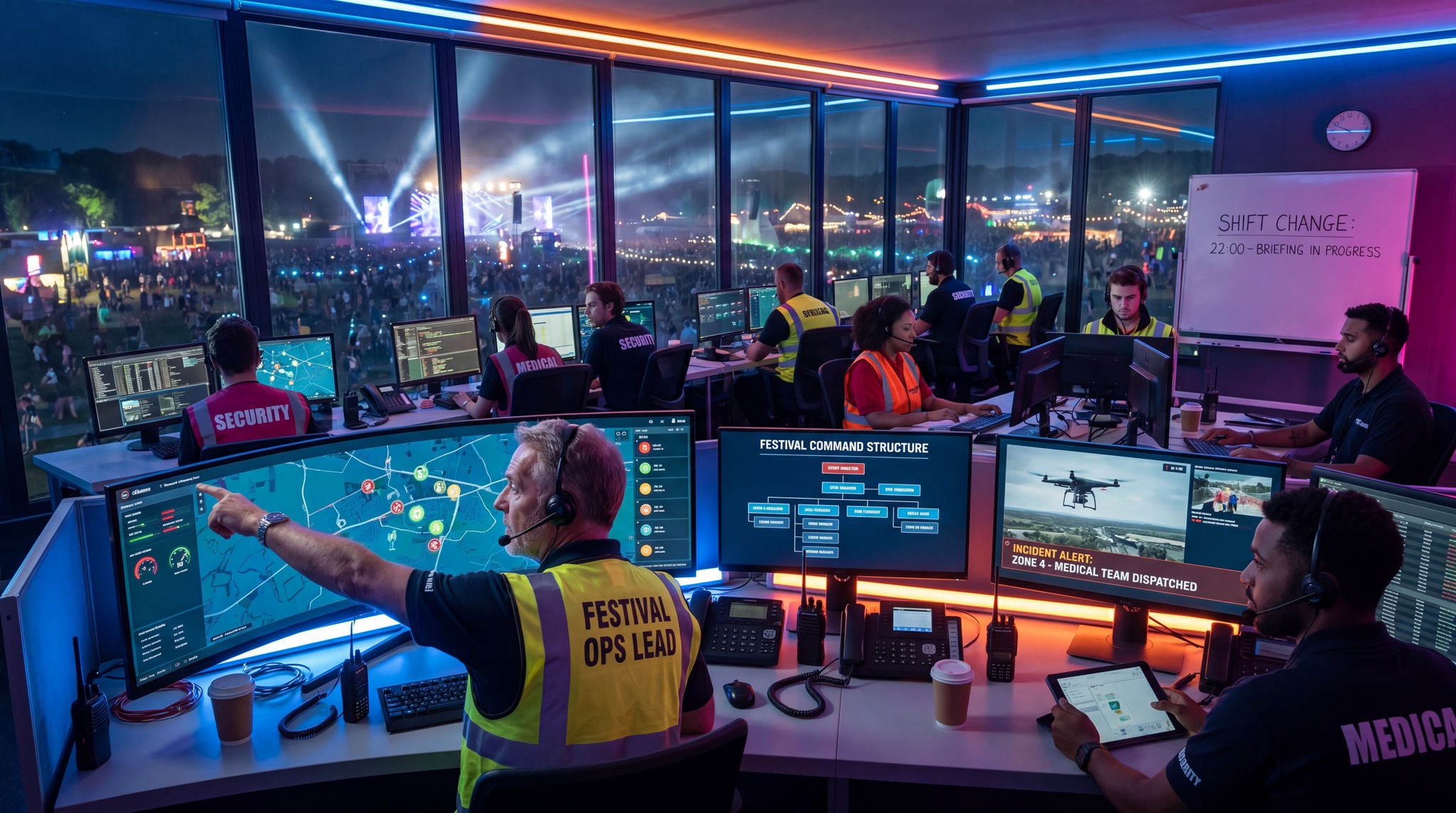
Pro Tip: Create a unified command post for security by bringing everyone together. At large urban events, the most efficient approach is a joint operations center (often a room or trailer on-site) where festival security managers, police and fire liaisons, medical lead, and city officials sit side by side with direct communication lines. This way, if an incident arises – say a report of a security threat or a missing child – decisions and information flow happen in seconds, not minutes lost in phone tag. Many top festivals invite city agencies to co-locate in this command center, building trust and enabling rapid response as one cohesive team.
Emergency & Medical Planning
Amid skyscrapers and asphalt, inner-city festivals face a distinct set of emergency scenarios – and advantages – compared to remote events. On one hand, emergency services (EMS and hospitals) are usually nearby and can reach the site quickly. On the other, urban density can exacerbate weather events or create evacuation challenges. A comprehensive emergency plan for a city festival covers everything from severe storms to first aid to large-scale evacuations.
Weather is a formidable factor. City microclimates mean flash floods can overwhelm street drains, and tall buildings can create “wind tunnels” that turn a normal breeze into a gale. Festival producers must have action plans for severe urban weather hazards like lightning, wind gusts in urban canyons, and flash flooding. For example, if lightning is detected within a certain radius, many festivals will pause shows and direct attendees to shelter in nearby parking garages or subway stations (identified in advance). Key Stat: Lightning can strike up to 15 miles away from its parent storm, based on National Weather Service lightning safety data, so urban events often use professional lightning monitoring services and enact evacuation or sheltering protocols earlier than you might in a wide-open field. Cities at least offer buildings as shelter – a huge advantage over open outdoor venues – and smart planners make those part of their plan (securing permission to shelter people in a transit concourse or public building lobby if needed).
Medical operations in a city festival typically involve a mix of on-site resources and coordination with hospitals. A first aid tent alone is not enough for a large event – producers set up micro-clinic medical stations and deploy bike medics or foot teams through tight city streets. Bike medics can weave through crowds much faster than ambulances or carts in a dense street grid. They carry trauma kits, defibrillators, and radio comms to stabilize patients until they can be moved. Foot patrol medics do the same on particularly packed blocks or multi-level venues. Meanwhile, a miniature clinic on-site staffed by doctors or paramedics can treat common issues (dehydration, minor injuries) and decide if someone needs hospital transport.
Coordination with local hospitals and emergency responders is a cornerstone of urban event planning. Large city festivals often have an advance agreement with a nearby hospital to treat festival patients, and sometimes even dedicate a separate triage area at the ER on event days. Coordinating emergency response and nearby hospital support includes sharing the festival schedule and crowd size with hospitals so they can staff up. It also involves staging ambulances on standby near the site. Because city streets may be congested, ambulance crews might use alternative routes (even driving on closed festival streets if needed) or bicycles for initial response. Warning: Don’t overlook the “everyday” emergencies. In a city, someone could have a heart attack or allergic reaction unrelated to festival activities. Ensure your emergency plan covers routine 911 calls – coordinate so city EMTs know how to enter the festival quickly or have festival medical handle stabilization until city crews arrive.
Another challenge is evacuation planning in an urban maze. If you need to clear the festival in a hurry (for instance, due to a security threat or severe weather), you must avoid sending panicked crowds into traffic or other hazards. Evacuation routes may lead people out of the festival and directly into designated safe zones like a large plaza or protected garage. Producers create detailed diagrams for different evacuation scenarios and practice them with the security team. They also plan messaging: using public address systems, text alerts, and staff with bullhorns to give clear directions. The urban environment can actually help here – digital billboards or city emergency alert systems can display evacuation notices if integrated.
Urban festivals benefit from the proximity of professional emergency services. Unlike a rural event where the festival might need its own fire truck on site, a city event can typically rely on the city fire department’s normal coverage (with maybe a dedicated unit pre-positioned nearby). Nevertheless, the festival should invite fire marshals to walk through the site each day, checking that emergency lanes are clear and all fire codes (for stages, tents, electrical cords, etc.) are met. Building a good rapport with the fire marshal pays dividends – they will be more inclined to work with you if last-minute adjustments are needed. Collaborating with the fire marshal on life safety and temporary structures ensures that everything from stage scaffolding to propane heaters at food stalls are compliant.
Sound & Noise Control
In the concrete jungle, sound management can make or break community acceptance of a festival. Cities enforce strict noise ordinances, and the physics of sound in an urban canyon are complex – bass can reverberate off buildings and travel in unexpected directions. To avoid enraging neighbors (and getting fined), festival producers invest heavily in managing festival sound under city noise ordinances and tricky urban acoustics.
First, it’s vital to understand the local noise laws. Most cities have set quiet hours (often around 10 or 11 PM) and maximum decibel levels at the property line. As part of permit negotiations, festivals might need a special noise variance – essentially permission to exceed those limits within reason, and only until a specified cut-off time. Even with a variance, smart producers err on the side of caution. They schedule the loudest acts earlier and often end amplified music a bit before the absolute legal cutoff, using the last hour for lower-volume content (like DJ sets aimed inward or a closing act on headphones-only silent disco). This helps avoid last-second complaints. Pro Tip: Hire an acoustic consultant or audio engineer familiar with the venue type. They can model how sound will bounce between specific buildings and identify speaker placements that minimize spillover. For instance, angling main stage speakers slightly inward and using more smaller speakers (distributed sound) can reduce the need to blast volume from one point.
Next, festival sound systems are tailored for the cityscape. Directional line-array speakers focus sound on the crowd and cut off sharply behind the stage to protect nearby residences. Low-frequency bass is often the culprit in traveling through walls, so audio techs might use cardioid subwoofer setups that cancel out bass in certain directions. Some urban festivals even deploy noise-monitoring teams at various perimeter points – people with decibel meters or sensors on building balconies – to give real-time feedback if levels are exceeding the plan. Designing festival sound systems to minimize impact on local hotels and hospitals is not just neighborly; it’s frequently mandated. If, say, a hospital is two blocks away, the festival may be required to ensure sound at that location stays below a threshold. The solution could involve additional delay speakers facing away from the hospital so that main stage volume can be kept lower while still delivering a good show to the crowd.
Managing sound also means planning for complaints. Despite best efforts, assume that some residents will call in noise issues. Festivals work with the city to set up a dedicated complaint hotline (manned by festival staff or a city operator) that residents can call if bothered. This shows responsiveness. The team monitoring the hotline can alert audio engineers to dial back certain frequencies if needed. Being proactive with residents – for example, giving out free earplugs in the neighborhood or sending a schedule of loudest showtimes – can significantly reduce friction. Warning: Never ignore repeated noise complaints. Cities have been known to literally pull the plug if festivals violate noise terms egregiously. If multiple warnings come in during the event, it’s better to voluntarily turn down the volume by a few decibels than to risk authorities shutting down a stage.
Finally, don’t neglect the aftermath of sound. Large city festivals have to consider how thousands of departing attendees will make noise on their way out – shouting, singing, car honking – which can also disturb locals. Staggering the end times of stages or employing a “slow roll” closure (e.g. ending with a calmer acoustic act or recorded music as people filter out) can avoid an abrupt burst of noise at curfew. Post-event, some organizers even distribute thank-you notes or small gifts to nearby residents apologizing for the noise and thanking them for their patience, to smooth relations for next time. It’s all part of treating sound not just as an internal production issue, but a community relations priority.
Transportation & Mobility
Unlike destination festivals where attendees camp onsite, inner-city festival-goers must arrive and depart through the urban transportation network. This means producers need a comprehensive mobility plan covering public transit, rideshares, biking, and parking (if any). The goal is safe, efficient movement of tens of thousands of people without gridlocking the city or upsetting neighbors.
Public transit is the backbone of most urban festival transit plans. Festivals coordinate closely with transit authorities to accommodate surges. Partnering with public transit providers to solve the “last train” problem is a common focus: if your event ends at midnight but the last subway train normally leaves downtown at 11:30 PM, you might arrange for extended service. Many cities will run extra late-night trains or buses during festival dates if costs are covered. Advertise these options heavily – festival websites and apps highlight “Take the Metro – extended hours!” etc. It benefits everyone if more attendees ride transit instead of driving.
Even with great transit, thousands will use rideshare or taxis for convenience. To prevent chaos, festivals designate specific pick-up and drop-off zones. Setting up micromobility corrals and rideshare geofences to safely manage festival transportation keeps Uber/Lyft drivers from stopping randomly and scooters/bikes from littering entrances. For example, the festival might work with ride-hail companies to geofence a few blocks where all pickups must occur, staffed by festival attendants who group riders and direct drivers efficiently. Pro Tip: Use a color-coded or numbered zone system for rideshares. Communicate to attendees “When calling a rideshare, head to Zone B on 6th Street,” and have clear signs for Zones A, B, C, etc. This prevents mass confusion and curbside hailing fights. Likewise, establish scooter and bicycle parking areas (micromobility corrals) at the festival edges. Many cities require this, and it’s better to have attendees drop devices in one spot than blocking sidewalks.
Parking for private cars is usually discouraged at inner-city festivals – and often there’s little to no event-designated parking at all. Instead, producers work with parking garage operators in the area to offer pre-booked parking passes at a premium. This limits driving to those willing to plan ahead (reducing random search traffic). Street parking is typically suspended on closed blocks, and the festival must notify and tow cars from the footprint beforehand (with plenty of notice signs to avoid wrath of car owners). Some festivals arrange park-and-ride options: attendees park at a stadium lot or suburban transit station and take a special shuttle or train in.
Another critical aspect is pedestrian flow in the surrounding area. Even those who take transit or shuttles will be on foot for part of their journey. Work with the city to ensure sidewalks can handle the load – sometimes that means getting permits to close an extra sidewalk lane or using pedestrian barricades on sidewalks to create queue space. At entry gates, figure out how lines will form without people spilling into open streets. The solution might be to extend queue lines along a closed side street or in a plaza (rather than straight back into a live street). Planning festival ingress and egress routes via sidewalks, alleys, and plazas is especially important for transit riders: if a thousand people step off a train, know which streets they’ll likely flood down and have crowd managers there.
Finally, don’t forget communication. A detailed transportation guide should be part of attendee info. List all ways to get to the festival, including transit schedules, the location of bike parking, rideshare zones, and walking routes from major landmarks or stations. Some city festivals engage volunteer “street teams” who stand at transit hubs or parking areas with signs and help direct arriving crowds (this doubles as a friendly welcome). Using commuter marketing tactics like lunch-hour teasers and street team outreach not only promotes the event but also acclimates everyday commuters to festival presence. For instance, a week before, a street team might hand out flyers at a train station alerting regular riders that next Friday will be busy due to the festival – and encouraging them to join in! By integrating into the city’s transport ecosystem, inner-city festivals can move huge crowds in and out with minimal friction, often to the astonishment of locals who expected chaos.
Attendee Flow & Accessibility
City streets weren’t built for music festival crowds, so producers must creatively adapt them for smooth attendee flow and accessibility. From entry gate designs to navigational signage, making the urban festival site easy to traverse is crucial for both enjoyment and safety.
Ingress (entry) and egress (exit) require special attention in a downtown layout. Unlike a single open field with one big gate, urban festivals often have multiple entry points – sometimes tucked between buildings or via narrow sidewalks. Organizers employ techniques like managing festival queues on city sidewalks with serpentine lines and pulse releases to prevent dangerous crowding at entrances. A serpentine queue means using barriers or rope lines to snake a long line into a smaller area, so hundreds of people line up without blocking public walkways. Security might then use “pulse” entry – letting in, say, 50 people at a time, then briefly pausing – to avoid surges once ticket scanning and bag checks are complete.
Exiting can be even more delicate: a mass exodus onto narrow city streets can overwhelm sidewalks and intersections. Festivals coordinate with police to manage traffic lights and even stop traffic entirely at peak exit times, funneling attendees away safely. The site layout should create multiple egress routes, clearly marked from inside. For example, signs or staff direct departing guests “To Metro Station ->” one way and “To rideshare pickup ->” another, distributing people rather than everyone marching the same direction. Back streets and alleys, normally off-limits, might be opened up as additional pedestrian exits in an emergency.
Once inside the event, getting around a city site can be surprisingly confusing for attendees – the usual landmarks (like a big open sky or distant ferris wheel) might be replaced by look-alike office buildings. Thus, robust wayfinding is vital. Organizers install landmarks like stations, towers, or art pieces to serve as intuitive festival wayfinding aids. For example, each stage might have a distinct color theme and corresponding banners down the street leading to it (turn right at the blue banners for the Blue Stage). Tall, inflatable towers or flags at key junctions help people orient – and can be seen above the crowd. Street signs, both physical and digital, are employed too: some festivals temporarily rename streets (“Main Stage Ave” or “Food Truck Alley”) with signage to match what’s on the festival map.
Navigating public transit as part of the festival experience is another consideration. Festivals often coordinate with transit agencies to decorate stations or provide volunteers at the nearest stops to guide arriving attendees – essentially extending wayfinding into the transit system. If the subway exit is a few blocks away, signage and staff might line that entire path during peak arrival times, turning the walk into part of the event rather than a confusing gap.
Accessibility in a city event comes with its own hurdles. Urban terrain can be less forgiving – think curbs, cobblestones, narrow old sidewalks – which can pose challenges for festival-goers with mobility impairments. To ensure an inclusive experience, planners focus on converting tricky sidewalks, curbs, and transit stations into dignified routes for attendees with disabilities. This might involve laying down temporary ramps over curbs or rough surfaces, renting portable ADA platforms to bridge stairs, and clearly marking all accessible routes on the festival map. Many city festivals maintain an Accessibility Concierge team – staff or volunteers whom attendees with disabilities can contact for assistance. For instance, someone who uses a wheelchair can be met at the entrance and guided via the smoothest path to the viewing area. Often, downtown events designate specific viewing areas for wheelchair users at stages (sometimes on raised platforms to see over crowds) and ensure ADA-compliant portable toilets in each restroom cluster.
Public transit accessibility is also addressed – if the main transit station isn’t wheelchair-accessible, the festival might offer a shuttle from the nearest accessible station. Signage for accessible paths should be high-contrast and include the wheelchair symbol so it’s immediately recognizable. Warning: Never treat accessibility as an afterthought or simply assume “the city has ramps so we’re fine.” Cities can have surprisingly inaccessible pockets. It’s the festival’s responsibility to audit the entire attendee journey – from parking or transit drop-off through security and into all key areas – to verify that someone with a mobility device, or any disability, can navigate comfortably. Moreover, visible accessibility efforts signal to everyone that the festival values all attendees, which enhances its reputation.
Beyond mobility, urban festivals consider other aspects of accessibility: providing quiet spaces or relief areas for those with sensory sensitivities (an important consideration given constant city stimulus), offering programming like youth or community stages (which ties into accessibility of culture for local residents), and ensuring all communications (signage, announcements) have accessible formats (e.g. large print, high contrast, multiple languages common to the city). In essence, smooth flow and accessibility reflect a festival’s respect for its diverse audience and the city’s infrastructure constraints.
Community & Business Relations
No inner-city festival can thrive without earning the support – or at least acceptance – of its immediate neighbors. These include residents in nearby apartments, local business owners, community leaders, and even passersby who will be affected by the event. A strategic approach to community relations turns potential complainers into allies and defuses issues before they escalate.
One foundational tactic is a robust resident communication plan well in advance. Seasoned producers execute a multi-pronged outreach: mailed letters or postcards to everyone in a certain radius, flyers in building lobbies, and meetings with neighborhood associations. Proactively communicating with residents via mailers, lobby flyers, and doorman briefings goes a long way to building goodwill. These communications typically include festival dates and times (with honesty about “loud” periods like fireworks or headliner shows), road closure info, a hotline number for concerns, and often some perks – like a resident discount code for tickets or free admission window during an early soundcheck. Pro Tip: Develop a “Good Neighbor Guide” one-pager that outlines all the steps you’re taking to minimize disruption (sanitation schedule, security presence, etc.). Distribute this to residents and businesses. When people see that you’ve thoughtfully planned around their needs, they’re more likely to refrain from complaining at the smallest inconvenience.
To formalize commitments, festivals sometimes enter a Good-Neighbor Agreement with the local community board or neighborhood association. This is essentially a written pledge covering things like noise control, cleanup, and community benefits. It might stipulate, for example, that the festival will conclude amplified sound by 10 PM on weeknights, or that a donation will be made to a local park fund. Adopting formal good-neighbor agreements and operating a 24/7 complaint hotline to stay community-friendly demonstrates accountability. Importantly, the festival sets up a complaint hotline (and publicizes it) so that if an issue arises – say a resident’s driveway is blocked or an overly loud soundcheck happens early – they can reach the team immediately, not the police or city council. A staff member empowered to dispatch solutions should monitor this hotline during the event.
Local businesses can be among the biggest opponents or supporters. Early engagement with shops and restaurants in the festival zone is crucial. Smart festivals aim to turn businesses into partners: coordinate merchant delivery schedules (so the festival doesn’t block their loading needs), offer to brand some storefronts as part of the decor, and most of all, drive foot traffic to them. Some events create a merchant program where businesses inside the footprint can register to stay open extended hours or offer special deals to attendees. In return, the festival might help cover the cost of an off-duty police officer to guard a shop’s entrance or provide them with cleanup services if foot traffic increases trash. By partnering with downtown BIDs, SIDs, and chambers of commerce to get business district buy-in, festivals often unlock cooperative marketing – for instance, a BID might co-fund street banners that welcome the festival, or local stores might hold themed window displays that add to the festival atmosphere.
Ensuring community benefits is increasingly expected for festivals on public streets. City officials and community groups will ask: “What’s in it for us?” Producers should have good answers. Common community benefits include: local hiring commitments (e.g. a percentage of festival staff or vendors hired from the neighborhood), vendor set-aside programs for local artisans or restaurants, free booth space for community organizations, and youth engagement like workshops or a stage for local youth performers. Enriching the community through local hiring, vendor set-asides, and youth stage opportunities transforms the festival from an outsider event to a community showcase. For example, a music festival might work with a city youth music nonprofit to let a teen band perform on a side stage, or hire neighborhood teenagers as paid interns to help run the event.
Visible contributions to the neighborhood’s fabric can also sway public opinion. Some festivals incorporate public art projects – murals or street art installations – that remain long after the stages are gone. Commissioning a mural on a previously blank wall (with proper permits) not only beautifies the area but ties the festival to a lasting positive legacy. Incorporating public art and murals into the festival, complete with proper permits and anti-vandal plans can engage local artists and residents in the creative process. It’s much harder for skeptics to oppose the festival when they see a beautiful mural or improved public space that came from it. Warning: Always follow through on promises. If you pledge to power-wash the streets and replant damaged landscaping after the festival, do it immediately. Post-event actions speak louder than pre-event words in earning trust for the next edition. Communities can have long memories – a single broken promise might haunt future permit discussions.
Ultimately, integrating into the community ethos – rather than parachuting in for a weekend of profit – is the mindset that separates beloved city festivals from those that face constant opposition. The best producers almost become de facto city planners for that week: negotiating the needs of festival patrons with the daily life of residents and businesses. When done right, an inner-city festival can rejuvenate and celebrate a neighborhood, becoming a point of local pride rather than contention.
For many urban events, evolving from standard street fairs into massive, multi-day cultural phenomena requires honoring the local heritage. Producers often program specific stages as a tribute to neighborhood musical traditions, ensuring the festival feels authentic to its roots. This localized approach not only wins over skeptical residents but also enriches the overall attendee experience.
To deepen this cultural investment, some organizers take it a step further by hosting a dedicated panel or partnering with a local historical society to create a “tribute to neighborhood musical traditions” conference track alongside the main event. Integrating educational or industry-focused daytime programming demonstrates to city officials that your event is a serious cultural contributor, not just a weekend party.
Marketing & Partnerships
Promoting an inner-city festival requires a blend of traditional festival marketing and hyper-local outreach. In dense cities, you have the advantage of built-in foot traffic and a diverse local audience, but also the challenge of breaking through the daily noise of urban life. Effective marketing for downtown events uses the city itself as a canvas and aligns with local institutions and sponsors.
One powerful tactic is commuter marketing – reaching people during their daily routines in the city. Using commuter marketing tactics like lunch-hour teasers and street team outreach can create buzz with the very people who work or live near the festival. For example, in the weeks leading up, the festival might host a small teaser performance at a central train station plaza during lunch hour, giving downtown workers a taste of the music or art to come (with signage and promoters handing out flyers or QR codes for tickets). Street teams can also target key hubs – handing out promo cards at subway exits, or projecting festival ads on walls in the financial district during evening rush. Unlike destination festivals that rely on online advertising across the country, an inner-city fest can go old-school and analog in the city streets for big effect.
The urban environment also offers rich out-of-home advertising opportunities. Billboards, transit shelters, digital screens on buildings – these can be leveraged to put the festival on the public’s radar. Leveraging digital out-of-home media and city billboards to reach urban audiences where they are means eye-catching creative that often references the city itself (“This weekend: Your City, Your Festival!”). Some festivals partner with the city to display content on municipal digital signs or info kiosks. Social media geotargeting is another extension – using geofilters or AR lenses tied to city landmarks brings the marketing into people’s daily Instagram and Snapchat feeds.
Local partnerships amplify marketing and add legitimacy. A key partnership for multi-day events is with the hotel sector. Tourism bureaus and hotels love city festivals that draw visitors on weekends. Forming hotel partnerships to host out-of-town festival-goers leads to cross-promotion: hotels offer special festival rates or packages (maybe including festival tickets), and in return the festival lists preferred hotels on its website or even runs shuttles from them. Hotels have marketing channels of their own – they might place festival flyers at front desks or hype it in their newsletters. Additionally, partnering with the city’s tourism board or downtown alliance can unlock marketing grants or promotional support, since the festival is seen as driving economic activity.
Sponsorship in an urban festival often includes major city-centric brands. Local media outlets (radio, TV) frequently come on as partners, trading ad space for on-site presence. Unlike rural festivals that lean on national sponsors, city festivals can attract local banks, real estate developers, or healthcare providers looking to boost community goodwill. These types of sponsors might fund things that visibly improve the attendee experience – say, a sponsor could underwrite free public Wi-Fi at the event or pay for extra street lighting (and get credited for it). City agencies can even be partners; for example, a transit authority might sponsor free late-night trains as mentioned, or the parks department might co-sponsor an area of the event.
A unique marketing angle is emphasizing the economic benefit and community aspect (as covered earlier). Festival PR should highlight not just the lineup but how the event benefits the city – e.g. “Last year our festival brought 20,000 people downtown and generated an estimated $5 million in local spending.” Conducting economic impact studies to quantify a downtown festival’s benefits provides hard data that can be used in press releases and pitches to civic-minded sponsors. Media in the city often pick up these angles, portraying the festival as a positive force.
Finally, embrace the city’s culture and identity in marketing. Cities are proud of their heritage and quirks. Tailor festival content to include local artists or themes, and market that proudly: if your city has a famous jazz scene, incorporate it and message it. Use iconic imagery of the skyline or local landmarks in your designs. Many inner-city festivals succeed by essentially branding themselves as “for the city, by the city.” It’s not just a music festival – it’s the city’s music festival. That sense of ownership can drive attendance (locals don’t want to miss their hometown event) and encourages organic word-of-mouth far more than any ad spend could achieve.
Post-Event & Sustainability
As the music fades and the crowds depart, an inner-city festival’s work is far from over. In fact, the post-event phase is when lasting impressions are made on the city. A responsible festival producer treats teardown and follow-up with as much importance as the build-up, aiming to leave the streets “better than before.”
One immediate priority is rapid restoration of the site. City streets often need to reopen to normal use within hours of the festival ending. This means orchestrating an overnight teardown: stages, tents, and fencing are swiftly removed (often that same night) by well-drilled crews. Cleaning crews then do a final sweep so morning commuters might barely notice a huge festival happened over the weekend. Festival teams work from a punch list during load-out – noting any damage (a scrapped light pole, trampled landscaping, spilled oil on pavement) and tackling it promptly. Managing post-event repairs and damage claims to leave the cityscape better than before isn’t just goodwill; it’s often stipulated in permit conditions. That can include repainting lines on the street if scuffed, power-washing sidewalks, or even repaving an area if heavy equipment left cracks. Pro Tip: Arrange a walkthrough with city officials the morning after load-out. Together, inspect the site block by block. If anything isn’t satisfactory, commit to fix it within a set timeline. This proactive approach builds trust and can prevent the city from issuing fines or withholding your damage deposit.
Many events also implement a “better than before” policy – not only fixing damage, but making slight improvements. For instance, if the city let you use a park and the grass suffered, you don’t just replace the sod, you also plant a couple of new trees as a thank-you. If a street’s paint was faded, you repaint crosswalk lines fresh. These gestures can actually leave a neighborhood happy the festival took place. Some festivals have resurfaced entire parking lots or donated security cameras to the area as part of their community give-back.
The post-event period is also time to assess sustainability outcomes. Did your eco-initiatives work? Urban festivals often partner with waste management companies to measure recycling vs trash tonnage, and with energy providers to calculate how much grid power (greener) was used versus generator fuel. Evaluating how effectively the festival implemented green measures like reusables and hydration stations allows you to report wins (“we diverted 30% of waste to recycling”) and identify areas to improve (maybe composting wasn’t as high as hoped, etc.). Sharing these metrics transparently with the city and public demonstrates accountability. Key Stat: At Notting Hill Carnival 2022, roughly 30% of the 300 tons of waste was recycled according to post-event waste reports from the Royal Borough of Kensington and Chelsea thanks to dedicated efforts – urban events can achieve similar or better with proper planning and public cooperation.
Another key post-event task is handling any damage claims from third parties. Despite best efforts, a business might claim the festival hurt their sales, or a resident might report property damage (e.g. a cracked window possibly from the bass vibrations or a minor scuffle that caused harm). It’s wise to have insurance coverages lined up for various scenarios and a clear process for claims. Festivals often set up a simple claim form and a deadline (say, submit any issues within 7 days of event) so they can address them in one organized batch. Quick, fair resolution of claims – whether by paying for repairs or offering appropriate compensation – shows that the festival stands behind its impact. Many claims can be headed off by the aforementioned walkthroughs and open communication channels; for instance, if a store owner felt they lost business, perhaps the data shows foot traffic actually increased, or the festival offers them a vendor spot next year as amends.
Finally, the post-event review with city stakeholders is crucial. This is when you discuss what went well and what needs improvement if the festival returns. It’s effectively a debrief of the “big experiment” that was staging a festival in the city. Police may have feedback on crowd flow or security gaps, transit officials might share ridership stats and ideas, and residents/businesses via community boards will voice praise or concerns. Taking this feedback seriously and incorporating changes into next year’s plan closes the loop in the continuous improvement cycle. The best urban festivals evolve year over year, often doubling down on successful community initiatives and fixing pain points (like adjusting sound levels on a stage that drew many complaints or tweaking exit pathways to clear crowds faster). By measuring outcomes, honoring commitments, and engaging reflectively with the city, festival producers turn what could be a one-off event into a beloved annual tradition that the city actively welcomes.
Essential Reading
- Selecting the right urban festival footprint: blocks, plazas, and pocket parks – How to assess city spaces for a festival layout that balances capacity with community impact.
- Permitting maze: special event, encroachment & signage permits for inner-city festivals – A detailed look at cutting through red tape and securing every permit your city festival needs.
- Union labor and prevailing wages: navigating local labor realities – Tips for working with union crews, budgeting higher labor costs, and avoiding labor disputes in urban events.
- Budgeting urban premiums: permits, security, waste & power – Master class in budgeting for city-specific costs, with strategies to prevent urban expenses from derailing your festival’s finances.
- Inner-city festival security: police, private security & ambassador model – How top festivals layer law enforcement, professional guards, and friendly ambassadors to keep city events safe and welcoming.
- Emergency response & hospital coordination for inner-city festivals – Preparing medical teams, ambulance access, and hospital partnerships to handle health incidents in a downtown environment.
- Waste, recycling & nightly street cleans: designing a downtown-ready festival waste plan – Proven tactics to manage trash and cleanliness each day so the city wakes up to spotless streets.
- Good-neighbor agreements & complaint hotlines: keeping inner-city festivals community-friendly – Real-world examples of deals and systems that prevent resident frustrations and build local support.
- Sustainability in the city: how urban festivals use grid power, hydration fountains & reusables – Eco-innovations that city festivals are adopting to shrink their environmental footprint and meet green mandates.
- Post-event repairs, punch lists & damage claims: closing out an inner-city festival “better than before” – A guide to leaving your site in top shape, handling any issues, and impressing the city in the aftermath.
- Economic impact reporting for downtown festivals – Learn how to calculate and communicate your festival’s positive economic impact on the city, turning data into a powerful PR tool.
- Venue crawl & multi-stage festival wristbanding across clubs – For festivals spread across multiple venues, discover best practices for wristband access and managing a city-wide party.
- Lighting & projection mapping on facades for urban festivals – Creative techniques to transform city architecture into dynamic art canvases that wow attendees and bystanders alike.
- Festival data sharing with city ops – without over-sharing – Balancing the city’s need for information (attendance, safety metrics) with protecting attendee privacy and festival trade secrets.
FAQ
What permits are required for an inner-city festival?
You will typically need a special event permit from the city’s events office, as well as permits for any street closures (from the transportation department) and noise variances if your festival will be loud. Additional permits often include building safety or fire department approvals for stages and tents, health permits for food vendors, and alcohol licenses if you plan to serve alcohol. Every city’s rules differ, so start by consulting the city’s event permitting guide. Prepare to navigate multiple agencies (events, police, fire, health, etc.) and submit applications well in advance – it can take 6-12 months to secure everything.
How do I control noise levels so residents don’t complain?
Begin by designing your sound system to minimize off-site impact: use directional speakers aimed at the ground/crowd and avoid pointing speakers toward residential buildings. Monitor decibel levels at the perimeter with sound meters during the event. It’s wise to keep volumes below city ordinance limits (especially at night) even if you have a variance. Scheduling louder acts earlier in the evening and ending amplified music by the agreed time (or slightly before) helps a lot. Communicate with residents – let them know the schedule and provide earplugs as a goodwill gesture. During the festival, have a hotline so residents can report issues; if you learn a particular area is getting too much noise, your audio engineer can adjust EQ or volume on the fly. Being proactive and responsive is key to preventing complaints from escalating.
How can I keep city businesses and locals happy during the festival?
Communication and inclusion are essential. Inform locals well ahead of time about festival dates, road closures, and what to expect – mail flyers, hold community meetings, and offer a contact for questions. For businesses, coordinate with them: for example, adjust your fencing to maintain access to their storefronts, or give them opportunities to be part of the event (like setting up a stall or offering a promotion to attendees). Many festivals create a residents/businesses hotline or appoint community liaisons on the team who can quickly address concerns (like a blocked driveway or excessive noise). Also, demonstrate the benefits – highlight how the festival will boost foot traffic or how you’re investing in neighborhood cleanup or improvements. When locals feel heard and see tangible positives, they’re much more likely to support the festival.
What if severe weather or an emergency happens during a city festival?
Always have a documented emergency action plan. For severe weather like thunderstorms, coordinate with city emergency management for alerts – you may need to pause the event and direct people to shelter (often nearby parking garages or buildings). Communicate clearly via stage announcements, screens, and staff guiding attendees to safe areas. For other emergencies (like a security threat or fire), work closely with on-site police and fire commanders who will take lead in evacuation or response. Inner-city festivals usually have multiple exits and use city streets as evacuation routes, so be ready to open extra gates or remove barriers fast. It’s crucial to have an incident command center where festival officials and city responders sit together – this speeds up decision-making. Drill your staff on emergency roles (who calls 911, who manages crowd direction, etc.). The city environment offers resources – nearby hospitals, ample shelter – so your job is to connect attendees with those resources in a calm, orderly way.
How can attendees get to and from a downtown festival without causing traffic chaos?
The key is to promote transit and other alternatives to driving. Partner with the city’s public transit to run extra trains or buses later than usual and advertise those options on all festival info. Set up designated rideshare pick-up zones a block or two away from the main exit – coordinate with Uber/Lyft to geo-pin that location so it’s easy for people to find rides safely without cars swarming the site. Encourage biking by providing a secure bike parking area (bike valet or racks) near an entrance. If you expect some driving, offer prepaid parking at specific garages and share walking routes from those garages to spread out vehicle flow. Communication is critical: in your festival app, website, and emails, spell out “Don’t plan to drive to the gate – here are the best ways to get here.” On-site, use signs and staff to guide people to transit stops and rideshare zones. By planfully channeling how people arrive/depart, you prevent the last-minute scramble of cars and crowds that leads to gridlock.
Do inner-city festivals cost more to produce than ones in open fields?
They often do, because you’re paying for city-specific requirements and services. Urban events usually face higher permit fees, the need for paid police overtime, lots of rented barricades and fencing, frequent trash removal, and possibly city utility hookups – all adding to the budget. Also, labor might be more expensive (if unions are involved or simply higher city wage standards). Venue costs can be lower (streets are cheaper than building a festival ground from scratch), but you might need to invest in protecting infrastructure (like putting down ground cover on streets or renting staging to cover public property). That said, you save on some logistics like attendee travel infrastructure (people use existing transit and parking). The revenue side can also be higher – city festivals often attract more sponsors and attendees due to accessibility. So while line-item costs for security, permits, and cleaning will be higher, strong attendance and community support can balance the equation. Careful budgeting and negotiating city services (for example, sometimes the city will co-sponsor by waiving certain fees) can keep costs manageable.
What is the ingress and egress meaning in events, and why is it critical for urban festivals?
In event management, the ingress and egress meaning refers to the strategic flow of attendees entering (ingress) and exiting (egress) a venue. For inner-city festivals, mastering this concept is critical because you are dealing with hard boundaries like skyscrapers, active traffic lanes, and narrow sidewalks. Proper ingress planning prevents dangerous crowd crushes at security checkpoints, while effective egress ensures that tens of thousands of people can disperse safely into the city’s transit network without overwhelming local infrastructure.
How do you standardize a city area for event targeting and sponsor activations?
To standardize a city area for event targeting, organizers divide the urban footprint into modular, purpose-built zones (e.g., a tech-focused sponsor block, a family-friendly plaza, or a VIP hospitality street). This zoning strategy allows producers to match specific demographics with relevant brand partners and programming. By creating uniform dimensions and infrastructure requirements for each zone, you can streamline vendor load-in, simplify permitting for distinct activities, and offer sponsors highly targeted engagement opportunities within the broader festival environment.
What are the foundational steps if I want to learn how to throw a festival in an urban environment?
For emerging promoters figuring out how to throw a festival from scratch, the process begins long before booking talent. First, establish a viable business model and secure initial funding, as urban events carry high upfront costs for permits and infrastructure. Next, identify a scalable footprint and initiate conversations with city stakeholders (like the special events office and local police) at least 9 to 12 months in advance. Once you have tentative municipal support, you can move on to drafting your site layout, securing your core vendors (power, staging, sanitation), and developing a comprehensive safety and traffic control plan. Mastering these operational basics is the true secret to launching a successful, recurring city event.
What are the core business requirements when figuring out how to start your own festival?
If you are researching how to start a festival as a new promoter, your primary focus must be on the business framework rather than just the creative lineup. You need a comprehensive business plan that outlines your target demographic, unique value proposition, and a realistic multi-year financial model. Securing seed capital is critical, as you will need to cover upfront deposits for city permits, venue holds, and headliner guarantees months before any ticket revenue materializes. Additionally, assembling a core team of experienced department heads—such as a technical director, a site operations manager, and a dedicated city liaison—is essential to navigate the complex logistics of launching a new live event property.
Why do many organizations apply for temporary permits, and what do they allow?
In the context of urban festival production, many organizations will apply for temporary permits that allow them to temporarily override standard city ordinances. These short-term authorizations permit organizers to close public thoroughfares, serve food and alcohol in non-commercial zones, erect temporary staging or scaffolding, and exceed standard noise limits. Essentially, these provisional approvals grant the legal framework necessary to transform everyday civic infrastructure into a fully operational, compliant event space for a limited duration.
Glossary
- Special Event Permit: The primary city authorization to hold a public event. It often covers overall festival approval and triggers input from multiple agencies (police, fire, health, etc.) before it’s granted.
- Encroachment Permit: A permit allowing use of or work in the public right-of-way (streets, sidewalks). Festivals need these for street closures, installing structures on sidewalks, hanging banners over roads, etc.
- Business Improvement District (BID): A local association of businesses in a defined area that funds improvements and services (like clean-up, marketing) through a special tax. BIDs often partner with festivals to support downtown business involvement. (Also called SID – Special Improvement District – in some cities.)
- Ambassador (Security Ambassador): Friendly personnel (often provided by a BID or hired by the event) who are not official security guards but serve as welcoming, observant festival staff. Ambassadors help answer questions, give directions, and report any issues, providing an extra layer of safety and service especially in surrounding streets.
- Grid Power Tie-In: Connecting the festival’s electrical needs to the city’s power grid via temporary panels or existing infrastructure. This contrasts with using standalone generators, and can reduce noise and emissions if managed properly.
- Urban Canyon Effect: Phenomenon where tall buildings closely spaced can affect wind flows and amplify or channel sound in unpredictable ways (like a canyon). For festivals, this means wind gusts can be stronger and sound can bounce between buildings, requiring special planning for staging and audio.
- “Last-Train” Problem: The challenge when a festival event ends late, after the last scheduled public transit (train/bus) has departed, leaving attendees without a ride home. Festivals solve this by coordinating later transit service or alternative transport for those attendees.
- Commissary Kitchen: A licensed commercial kitchen facility where food vendors can prepare and cook food off-site. Many cities require festival food vendors to use commissary kitchens for major prep to ensure health code compliance, since cooking space on street sites is limited and regulated.
- ADA Compliance: Refers to adhering to the Americans with Disabilities Act standards so that a festival is accessible to people with disabilities. This includes wheelchair ramps, accessible restrooms, sign language interpreters for performances, and overall “dignified” access to all areas and services.
- Traffic Control Plan (TCP): A detailed plan required by the city outlining how traffic (vehicles, bicycles, pedestrians) will be rerouted or managed during street closures for the festival. It includes placement of detour signs, cones, barricades, and staffing of intersections.
- Footprint (Festival Footprint): The geographic boundary of the festival site. In an urban context, it’s the specific streets, blocks, or parks being used for the event. A well-planned footprint considers entry/exit points and impact on the surroundings.
- Load Rating: The maximum weight that a structure or surface can support. When placing heavy stages or large crowds on city plazas, checking load ratings (e.g. of an underground parking deck roof) is essential to avoid structural failures.
- Prevailing Wage: A wage rate set by law or regulation (often by city or state) for work on public projects or in certain sectors. In context of festivals, if city regulations or union rules apply, you may need to pay prevailing wage to workers like electricians, stagehands, etc., which can be significantly higher than standard rates.
- Good-Neighbor Agreement: A formal agreement between event organizers and local community representatives outlining how the organizers will mitigate impacts (noise, traffic, etc.) and contribute positively. It’s a promise to be a “good neighbor” and often is used to hold festivals accountable to the community.
- Ingress/Egress: Terms for entry and exit paths. In festival operations, ingress refers to how attendees get into the event (entrances, queues, security checkpoints) and egress refers to how they leave (exits, evacuation routes). Good ingress/egress design is crucial for safety and crowd flow.
Conclusion
Inner-city festivals represent the ultimate fusion of spectacle and civic coordination. Pulling one off means becoming part event producer, part urban planner – securing political buy-in, threading stages into city blocks, and transforming everyday streets into something magical for a weekend. When executed with care, these festivals energize downtown economies, showcase local culture, and unite communities in pride. The challenges are undeniable: a single oversight with permits or neighborhood relations can ripple widely in the dense urban fabric. But as the world’s best producers have shown, meticulous planning, transparency with stakeholders, and respect for the city’s rhythms turn potential pitfalls into mere stepping stones. Ultimately, an inner-city festival thrives on partnership – between organizers and city hall, between the music and the metropolis. With the right tactics, a producer can leave not only lasting memories for attendees, but a lasting positive imprint on the city itself.