Festivals around the world are doubling down on safety as the opioid crisis casts a long shadow over live events. The days of assuming “it won’t happen at our festival” are over. Instead, leading producers treat overdose preparedness as a core part of event planning – right alongside stage design and marketing. Naloxone (Narcan), the opioid overdose reversal spray, has become as essential on-site as first aid kits and fire extinguishers. By 2026, integrating overdose prevention and response into your festival’s DNA isn’t just responsible – it’s expected by fans, insurers, and communities. This comprehensive guide draws on real-world successes (and hard lessons) to help festival organizers worldwide incorporate opioid overdose preparedness into their event plans. From training your staff in Narcan use to partnering with harm reduction nonprofits, these actionable steps will save lives and build a safer festival community.
Understanding the Opioid Threat at Festivals
The Fentanyl Era and Festival Risks
Opioid overdoses have surged into the spotlight as a critical festival risk. Overdoses are now the leading injury-related cause of death in the United States, with illicit fentanyl involved in the majority of cases according to CDC overdose prevention data. This potent synthetic opioid has contaminated not only opioids like counterfeit pain pills, but also other substances common in festival settings (from cocaine to MDMA). The result is that even attendees who don’t consider themselves “opioid users” could unwittingly be at risk. A tiny amount of fentanyl can trigger a life-threatening overdose in seconds – an unprecedented danger compared to the party drugs of past decades. Festival producers have taken notice: medical teams report that opioid-related incidents have risen sharply since the mid-2010s, and ignoring the issue is no longer an option.
The festival environment can exacerbate overdose risks. High-energy performances, heat, dehydration, and mixing substances (e.g. alcohol with opioids or other drugs) all strain the body. An attendee who might just handle a drug in a calm setting could go into distress amid the physical intensity of a festival. Crowded venues also make it harder to spot someone in trouble until it’s almost too late. These factors mean festivals must prepare for opioid emergencies even if their music genre or attendee profile isn’t traditionally associated with heavy drug use. In truth, fentanyl has permeated scenes from EDM raves to jam band festivals to county fairs – no event is “safe” by default. Seasoned safety directors treat opioid overdose as a when-not-if scenario, building response plans accordingly.
Wake-Up Calls: Tragedies Fueling Change
Unfortunately, it often takes tragedy to provoke change. In 2019, a 27-year-old attendee was found dead at Bonnaroo after ingesting what turned out to be fentanyl-laced drugs. Similar incidents – from multiple fatalities at Australian music festivals in 2018 to overdose deaths at small local events – have jolted organizers and authorities into action. Each painful loss underlines that failing to prepare means preparing to fail when it comes to overdoses. Veteran festival producers who lived through these crises now evangelize proactive measures to any peer who will listen.
Free Tool: Size Your Festival Site
Zoned capacity planning for arena, campsite, parking and entry lanes — against UK Purple Guide and NFPA density standards. Finds your bottleneck zone.
The industry’s response in recent years has been a collective course-correction toward harm reduction. Major promoters are shedding the old “zero tolerance, don’t discuss it” approach in favor of realist, life-saving strategies. In the aftermath of festival overdose deaths, some governments have also eased regulations that hindered on-site prevention. For example, Tennessee legalized fentanyl test strips in 2022 after that Bonnaroo incident (one of 44 US states by 2023 to decriminalize these strips) as reported in coverage of festival harm reduction initiatives. Meanwhile, Australia’s state authorities, confronted by public outcry, approved limited pill testing trials at festivals. The UK’s Secret Garden Party pioneered on-site drug checking back in 2016, and a study later found drug-related hospital admissions at the festival dropped by 95% after implementing testing according to The Guardian’s report on festival drug testing. These wake-up calls, though tragic, have pushed festivals worldwide to ask: How can we prevent this at our event?
2026: Safety First Becomes the Norm
By 2026, incorporating overdose prevention into festival operations has evolved from novelty to normalcy. Festivals that once feared acknowledging drug use now openly promote lifesaving services. In the U.S., a growing number of large events provide free naloxone on-site and even training for attendees. Insomniac’s EDC Las Vegas – hosting 150,000+ people per day – partnered with a nonprofit to train over 10,000 festival-goers in opioid overdose response in 2023 and distributed Narcan spray widely, a move highlighted in case studies on festival medical leadership. This would have been unthinkable a decade ago, but today it’s lauded as forward-thinking leadership. Fans, too, appreciate and even expect these measures. A recent Associated Press report noted that nonprofits like This Must Be The Place have given out tens of thousands of doses of naloxone at festivals, after early skepticism from organizers turned into enthusiastic support, as detailed in reports on national festival outreach and promoter medical program integration. The FDA’s 2023 approval of over-the-counter Narcan nasal spray has further smoothed the path – festivals can now obtain naloxone as easily as first aid supplies, without special prescriptions, a shift noted by health experts regarding OTC nasal spray.
Planning a Festival?
Ticket Fairy's festival ticketing platform handles multi-day passes, RFID wristbands, and complex festival operations.
At the same time, regulators and local communities are beginning to view proactive festival safety in a positive light. A festival that visibly cares about attendee health can earn goodwill and easier permit approvals, whereas an event that ignores risks may face pushback. Safety has become part of the brand. Just as fans demand great lineups and experiences, they also want to know the event has their back if something goes wrong. Organizers speak of “duty of care” as a core value – not a buzzword, but a real mandate in planning. In short, the best festivals of 2026 combine amazing entertainment with robust emergency readiness. As one industry mantra puts it, infrastructure and safety are the new headliners – fans expect seamless medical, security, and wellness provisions on par with the star performers, a sentiment echoed in analyses of 2026 festival tech trends. Embracing this ethos not only saves lives, it strengthens your festival’s reputation as a trustworthy, professional operation, effectively becoming the standard for risk management plans.
Planning Overdose Prevention into Your Safety Strategy
Risk Assessment: Include Overdose Scenarios Early
Effective overdose preparedness starts long before gates open. In the initial planning phase, fold opioid overdose into your risk assessments alongside hazards like bad weather, crowd crush, and fire. This means imagining both typical overdose situations (e.g. an individual found unresponsive in a restroom) and worst-case scenarios (e.g. a batch of adulterated pills causing multiple OD cases at once). Evaluate each for likelihood and impact. For example, a single overdose requiring Narcan might be rated “likely, high impact” whereas a simultaneous mass overdose cluster could be “unlikely, very high impact.” By formalizing these scenarios, you ensure mitigation measures are budgeted and in place. One festival risk manager recommends using a simple matrix like the one below to map out preparedness:
| Overdose Risk Scenario | Likelihood | Impact (if occurs) | Mitigation Strategies |
|---|---|---|---|
| Single attendee overdose in crowd | Moderate | High (fatal if unaddressed) | Roving medics with naloxone; staff training to spot signs; on-site ambulance for quick transport. |
| Cluster of overdoses from bad substance | Low (but rising) | Very High (multiple critical injuries or deaths) | On-site drug checking & alerts; extra medics on duty; mass casualty incident plan; partnership with local ER for surge capacity. |
| Attendee uses opioids alone in tent/campsite | Moderate | High | Welfare outreach teams patrolling camps; 24/7 first aid station; messaging on buddy system and “if you see something, say something.” |
| Naloxone supply runs out during event | Low | High (preventable death) | Stockpile 2–3× expected Naloxone need; coordinate refills with local pharmacies; allow security or crew to carry kits. |
This kind of exercise highlights what resources and protocols you’ll need. For instance, if you recognize that a tainted-drug mass overdose is a remote but catastrophic scenario, you can devise specific plans: set up a drug information desk with real-time updates, create an emergency alert system for attendees (more on that later), and liaise with area hospitals about handling multiple patients at once. The key is to treat medical risks with the same thoroughness as you treat logistical risks. Experienced producers often say that if a risk is on your radar and in your plan, it’s far less likely to escalate into disaster.
Aligning with Insurers and Regulations
Integrating overdose prevention isn’t just morally right – it can also make good business sense by protecting your festival’s finances. In the wake of headline-grabbing incidents, insurance companies have hiked premiums and scrutinize festivals’ safety plans more than ever, leading to a need for managing rising premiums and limited coverage. One way organizers are coping is by tightening safety and risk management protocols to reassure insurers, a strategy essential for surviving the festival insurance crunch. Showing that you have trained medics, stocked naloxone, and clear emergency procedures can make underwriters more confident in your event’s risk profile. In fact, robust harm reduction measures might even help negotiate slightly lower premiums or at least prevent further hikes. Conversely, if an insurer sees you have no plan for overdoses, they may classify your festival as high risk. Thus, from a financial perspective, investing in overdose preparedness is essentially investing in insurance for your festival’s future as noted in guides on festival production.
It’s equally important to get right with local authorities and laws. Regulations on what you can do (e.g. distribute naloxone or conduct on-site drug testing) vary widely by jurisdiction. Meet with local health departments, law enforcement, and permitting agencies early on to discuss your harm reduction plans. Be transparent that your goal is to prevent fatalities, not condone drug use, by balancing compassion and compliance. Often, if officials understand that everyone shares the goal of saving lives, they become valuable allies. For example, some forward-thinking police departments in the UK quietly supported festival drug checking by designating a tolerant zone for it at medical tents, an approach discussed in articles on legal harm reduction strategies. In the U.S., many counties have standing orders that allow events to provide naloxone under a physician’s license if needed – paperwork you can sort out in advance. Also ask about Good Samaritan laws: most U.S. states (and some other countries) have Good Samaritan overdose immunity policies, meaning neither the victim nor those who seek help can be prosecuted for drug possession in an overdose emergency. If such a policy exists, plan to publicize it to attendees (more on that in the attendee engagement section) to reduce fear of calling for help.
Be sure to bake any specific legal requirements into your plan. In some regions, events above a certain size must have on-site ambulances or a physician present. Authorities might also require you to report any overdose incidents immediately or even halt the event if multiple ODs occur – know these rules ahead of time. Incorporate them into your emergency operations plan and train your staff on compliance. It’s wise to prepare a one-page document for officials outlining your overdose prevention and response strategy (naloxone on-site, staff training, medical staffing levels, crowd communication plan, etc.). This shows regulators you’re being proactive and can smooth the permitting process. Ultimately, working hand-in-hand with authorities protects your attendees and your event’s standing. As veteran organizers have learned, an adversarial approach (“hide the harm reduction from the cops”) is risky and unnecessary when you can usually find common ground on safety, as detailed in guides on working with authorities.
Need Festival Funding?
Get the capital you need to book headliners, secure venues, and scale your festival production.
Defining Policies: Amnesty and Enforcement
A crucial planning task is defining how your festival will handle drug-related incidents in a way that prioritizes health. This often means establishing a medical amnesty policy if one isn’t already in place. A medical amnesty (or Good Samaritan) policy states that any attendee seeking help for themselves or others during a suspected overdose or other drug emergency will not be ejected or arrested for drug possession. Put simply, “If you call for help, you won’t get in trouble.” Many festivals worldwide have adopted this stance, finding that attendees reach out to medics much faster when they trust they won’t be punished, effectively marrying a safety-first philosophy with legal compliance. Work with your security team and local police liaison to formalize this: everyone from the ground-level security guards to the medics should know that health comes first, enforcement second. Of course, this doesn’t mean your festival tolerates blatant distribution of dangerous substances – you can still uphold laws and eject dealers – but your staff’s default mode for someone in medical crisis must be “care, not discipline.”
At the same time, clarify your approach to general drug enforcement. Many festivals maintain a zero-tolerance policy on paper (for legal and insurance reasons), but how that translates on-site can vary. You might instruct security to confiscate substances if found, yet not to vigorously hunt down every last joint or pill if it’s not causing issues. Some events choose to post an amnesty box at the entrance where attendees can ditch any drugs no-questions-asked, which can reduce what gets inside. The goal is to strike a balance: you don’t want a free-for-all that could invite dangerous behavior, but you also don’t want a draconian atmosphere where attendees hide emergencies for fear of being penalized. Write into your plan how security and medical should coordinate – for instance, if security encounters someone with drugs who looks unwell, the protocol might be to escort them to medical rather than straight to eviction or law enforcement, ensuring protocols are maintained with local understanding. Training your guards in a “safety first” mindset is key here. As one guide on festival security notes, today’s best practices emphasize supportive, de-escalating interactions over heavy-handed tactics, creating a visible, helpful, and de-escalatory security approach. A security team that’s approachable and well-trained in basics like overdose signs can actually prevent incidents and encourage attendees to seek help, focusing on consent, cultural competency, and crowd management. (If you’re interested in reshaping your security approach, see our detailed guide on creating a visible, helpful security culture at festivals.)
Finally, decide how you will document and review any overdose incidents that do occur (this should plug into your wider incident reporting system). You’ll want a form or log for medical staff to record key details: time, location, substance involved (if known), actions taken (e.g. “Administered 2 doses Narcan”), and outcome (e.g. transported to hospital, returned to festival). Thorough documentation serves two purposes: it helps in post-event analysis to improve safety, and it’s critical if any legal or insurance questions arise later. Many festivals integrate overdose reports into their overall safety report to insurers – demonstrating transparency and commitment to improvement, which is vital when navigating festival insurance claims and liability. In the worst case of a fatality, those records and your established protocols show that you were responsible and diligent, which can mitigate liability. (For deeper guidance on handling the aftermath of serious incidents – including communication and insurance claims – refer to our contingency planning article on navigating festival accidents and liability.)
Budgeting for Harm Reduction
Next, ensure your budget reflects these plans. Fortunately, overdose prevention is relatively inexpensive compared to other festival expenses (pyrotechnics, anyone?). Even for a mid-sized festival, the cost of a robust naloxone program is likely a few thousand dollars – a rounding error in most production budgets, and far less than the potential cost of a lawsuit or tarnished reputation from a preventable death. Below is an example budget breakdown for implementing overdose preparedness at a 10,000-attendee festival:
Free Tool: How Many Staff Do You Need?
Get a starting headcount for security, stewards, scanners, bar staff and first aid from your crowd size, event type and risk level.
| Budget Item | Details | Est. Cost | % of Safety Budget |
|---|---|---|---|
| Naloxone nasal spray kits (2 doses/kit) | 100 kits @ $75 each (OTC price) | $7,500 | 10% |
| Staff/volunteer training sessions | 3 sessions, professional trainer fee | $900 | 1.2% |
| Educational materials & signage | Overdose signs, infographics, flyers | $500 | 0.7% |
| Harm reduction partner support | Donation or stipend for NGO booth | $1,000 | 1.3% |
| Extra medical staffing (opioid coverage) | 2 additional EMTs for 2 days | $2,000 | 2.7% |
| Total Estimated Cost | $11,900 | ~15% of safety budget |
Assumptions: Safety/medical budget ~$80k (for context). Some items (naloxone, materials) might be offset by sponsorships or health department grants. Training cost could be lower if done in-house or via a free partner program. This sample shows that even generous overdose preparedness measures likely compose only a small fraction of the overall festival budget. Skimping here is perilous false economy.
Also consider that many harm reduction resources are available free or at low cost. For instance, state health departments and nonprofit programs often provide Narcan kits and training gratis as part of public health outreach. It’s worth exploring grants or local initiatives – in some areas, you might tap into an “opioid overdose prevention” fund or request a bulk supply of naloxone from authorities. Some festivals have even gotten corporate sponsors for their harm reduction tents (pharmaceutical companies or health brands keen to demonstrate social responsibility). While sponsorship can be tricky for liability reasons, an underwriting of your safety efforts can defray costs. Just remember: no sponsor branding or grant money is worth compromising the messaging of your safety initiative – attendees should perceive it as a genuine care effort, not a PR stunt.
Training Staff and Volunteers to Respond
Teach Everyone to Recognize an Overdose
When seconds count, any staff or volunteer on the ground might be the first to notice an attendee in trouble. Comprehensive training on overdose recognition and response for your team is absolutely vital. This starts with knowing the signs of opioid overdose. Trainers often use the acronym “BLUE” – Breathing (slow, shallow, or stopped), Lips (blue or grayish coloration from lack of oxygen), Unresponsive (can’t be woken up, limp body), Eyes (pinpoint pupils) – as a quick checklist. During pre-event training sessions, make sure to cover:
- Symptoms of Opioid Overdose: Very slow or no breathing; unconscious or unable to talk; choking or gurgling sounds; pale, clammy or bluish skin, especially on lips or fingertips; extremely constricted “pinpoint” pupils; slow heartbeat or pulselessness.
- Differences from Other Emergencies: For example, how an opioid OD differs from a stimulant overdose or alcohol poisoning. (Opioid OD = respiratory failure and pinpoint pupils, versus stimulant OD might involve overheating and seizures.) In practice, staff should treat any unresponsive person with suspected drug use as a potential opioid OD and act fast.
- Do’s and Don’ts: Don’t assume someone is just “sleeping it off” if they’re hard to rouse. Don’t put them in a cold shower or force them to drink water – ineffective for opioids. Do try a firm shake or a sternal rub to check responsiveness; do call for medical help immediately; and do be prepared to administer naloxone if available.
Every festival’s training approach will differ, but the rule of thumb is to train as many people as possible, as realistically as possible. Frontline roles like security, crowd marshals, zone managers, stage crew, and volunteer supervisors should get a detailed briefing at minimum. Ideally, every single staff member and volunteer should receive at least a basic orientation on overdose response (even if just a 15-minute talk during all-staff onboarding). Emphasize that saving a life is everyone’s job, not only the medics. Festivals have avoided catastrophe because a food vendor or stagehand spotted a problem and reacted before medics arrived. One case often cited by safety pros: a security guard at a California EDM festival found a collapsed attendee and used the event’s mobile app panic button to summon medics right to their GPS location – the person wasn’t breathing, but treatment arrived in under 3 minutes and saved them, showcasing how tech trends like panic buttons deliver value. Such outcomes are only possible when the first person on scene (who could be anyone) knows what to do, often facilitated by app alerts blasted to all staff.
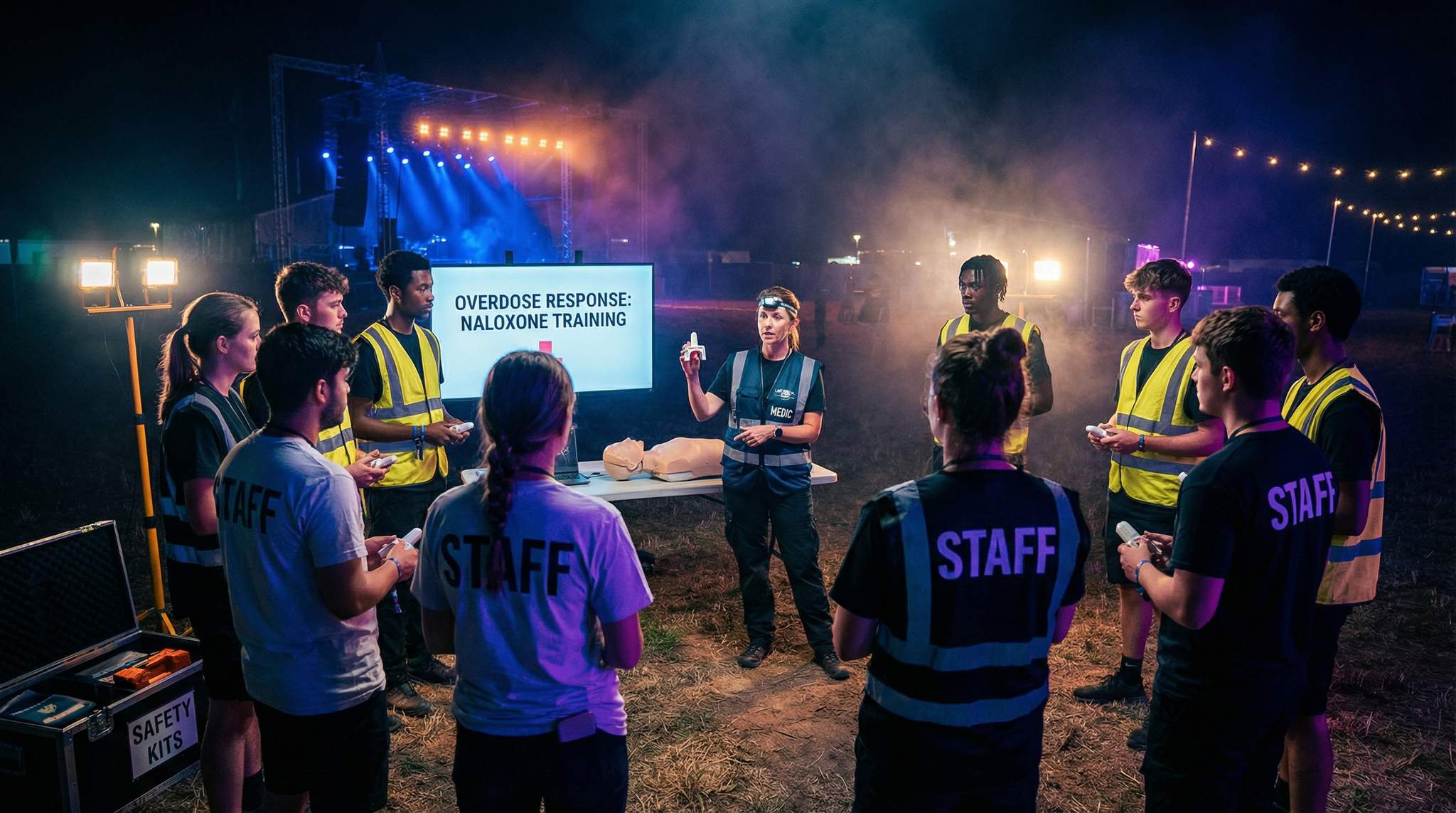
For realism, many festivals now incorporate scenario-based drills in training. Instead of just slideshow lectures, staff might practice on mannequins or enact an overdose scenario: e.g. a volunteer pretends to collapse and a team is walked through the steps of assessment and Narcan administration. If you have access to CPR dummies or can partner with a local Red Cross/EMS for a demo, do it – muscle memory and hands-on practice boost confidence. At minimum, show a video of how to administer naloxone nasal spray and have everyone mime the steps. Modern naloxone sprays are very user-friendly (insert into nostril, push plunger) and do not harm a person who isn’t actually overdosing, so staff should be told “When in doubt, use it.” Make it clear that administering Narcan is legally protected in most places and morally the right thing to do, even if it turns out to be a false alarm.
Naloxone Use: Training the Rescuers
Specific naloxone training is a must for your medical team and any designated responders (like volunteer safety patrols), and highly recommended for all staff. The good news: it’s quick and easy. Many organizations offer a brief 1-hour Narcan training course that can be done in person or even via webinar. In fact, at some festivals, thousands of attendees have been trained in just a few minutes each by harm reduction booths, a phenomenon noted in reports on festival harm reduction initiatives – which shows how straightforward it is. During staff training, cover these naloxone points:
Grow Your Social Following With Every Sale
Require social media follows, shares, or playlist adds to unlock presale access or special pricing. Turn every ticket purchase into audience growth.
- How Narcan Works: Explain that naloxone is an opioid antagonist – it knocks opioids off the brain’s receptors, reversing the overdose temporarily. It works only on opioids (won’t revive a stimulant OD, etc.), and multiple doses may be needed for potent opioids like fentanyl.
- When to Administer: If a person is unresponsive and you observe signs of opioid overdose (especially suppressed breathing or pinpoint pupils), assume opioids are involved and act immediately. If unsure, err on the side of giving it – naloxone won’t cause harm if it turns out to be another issue.
- Administration Method: Demonstrate the nasal spray (most common at festivals). It involves inserting the nozzle into one nostril and pressing the plunger to release the dose. There’s also an intramuscular injection format, but that’s typically used by medical professionals; stick to nasal spray for general staff and public use. Emphasize speed: give naloxone as soon as possible, then continue other first aid.
- Post-Naloxone Care: Naloxone typically works within 2 minutes. The person may wake up suddenly, often confused and in opioid withdrawal (which can be painful – expect possible agitation or vomiting). Coach staff to reassure the person, keep them calm and lying down. Also, opioids can re-bind after naloxone wears off (20-90 minutes), so the individual must get medical evaluation even if they revive. That’s why calling the medics or EMS is essential before and even after giving Narcan.
- Safety Precautions: Naloxone is very safe. Remind staff to still use universal precautions – e.g. use gloves if possible (for blood or vomit), and be cautious of needles if the person was injecting (don’t blindly stick your hands in pockets or bags).
It’s wise to provide quick-reference materials as part of training. For example, a one-page overdose response flowchart or a wallet card with the steps to take. Some festivals include a pocket guide in staff credential packs. Others have laminated instruction sheets at each staff point (e.g. the info booth, the ticket gate) in case someone forgets. Repetition cements knowledge: go over the protocols again during on-site briefings. The repetition could save someone’s life if an emergency happens on Day 3 when everyone’s a bit tired – that mental checklist will kick in despite the fatigue.
Specialized Roles: Medical and Peer Responders
While everyone should have baseline training, certain team members will naturally take lead in overdose situations. Define and train these special roles in advance:
* Medical Team: Your professional medics (EMTs, nurses, event doctors) are the primary responders. Ensure they are not only stocked with ample naloxone (many EMS now carry it, but double-check quantities for your crowd size) but also aligned with your overall plan. For instance, the med team leader should know if you have on-site harm reduction volunteers who might bring patients, what the protocol is for allowing patient friends to accompany to the med tent, and how to log naloxone administrations. Medical staff should also be trained in advanced airway management and ACLS (advanced cardiac life support) – an opioid OD can require ventilation support or even a defibrillator if it progresses to cardiac arrest. Most reputable event medical contractors already have this expertise, but verify it. As part of training, consider a tabletop exercise with the medical provider: What if 5 people overdose at once? Walk through triage, additional resource call-ins, etc., to make sure they’re prepared for a multi-casualty scenario.
* Security & Ground Control: Your security supervisors and any dedicated safety teams (like Insomniac’s “Ground Control” purple shirts) should be trained almost to the level of first responders. They are often the nearest to incidents in the crowd. Security staff should carry radios and know the special code or phrase to call in an overdose without causing public panic (some festivals use codes like “Alpha situation” or simply “Medical red”). They should also ideally carry naloxone if feasible. Many events now equip security golf carts or response teams with Narcan kits in addition to regular first aid. Train these teams to secure the area for medics – meaning, gently clear back bystanders to give the victim air and privacy, but also gather intel if possible (ask friends what the person took, etc., without casting blame). Security’s crowd management skills are crucial if an overdose occurs in a dense audience – they might need to create a path for medics. Drilling a simple scenario like “person down in crowd at Stage 2” with security and med staff together is very useful.
* Volunteer Harm Reduction Teams: If your festival has an internal volunteer safety crew or has enlisted an external organization (such as a chapter of DanceSafe, an on-site peer support group, etc.), these individuals can be the eyes and ears for potential overdoses. Train them to roam the grounds (especially chill-out areas, bathrooms, and edges of crowds) looking for anyone who might be in trouble. Volunteers can be taught basic first aid and Narcan use, but stress that they should always call in the professional medics as soon as they suspect something. Their role is supportive – e.g. performing rescue breathing if needed while waiting for EMTs, or just keeping someone awake and in the recovery position if they’re high but still breathing. One successful model is pairing roving teams of one volunteer and one security or medic, so the volunteer can comfort and monitor the attendee while the professional handles clinical intervention. Whatever your approach, ensure volunteers know their limits (they shouldn’t attempt complex medical procedures) and have direct communication with the medical command (often via radio or a dedicated phone line). As an example, Insomniac’s Ground Control peer team has saved countless attendees by detecting issues early and escorting people to medical tents, providing data that helps refine safety protocols. Your event’s volunteers can play a similar lifesaving role if empowered with training and a clear mandate, even in jurisdictions that don’t yet allow on-site drug checking.
Practice Makes Prepared
Finally, incorporate overdose scenarios into your overall emergency drills if you have a pre-event tabletop or on-site run-through. For instance, some festivals do a full team simulation of a major incident (like a stage evacuation or severe weather). Consider adding an element where an overdose is reported during that scenario to see how teams juggle multiple issues. It’s a great way to pressure-test your communications: did the message get to the medical team? Did security respond appropriately? Also walk through the decision making: At what point would you pause the music for a medical emergency? (Usually not for a single OD, but if several people collapse from a bad batch, you might halt a show to make an announcement – more on communicating with attendees in a later section.) By practicing these decisions, your festival command team won’t be caught flat-footed if it happens for real.
During the festival, reinforce training with quick huddles. At daily staff briefings, the safety officer or stage managers can shout out reminders like “Stay hydrated and remember, if you see someone looking passed out, don’t hesitate – radio Medical immediately and if you’ve got Narcan, use it.” Little refreshers keep awareness up through the long days. Some events even utilize their internal comms or apps to push a mid-festival reminder to crew: e.g. a scheduled text to all staff phones that says “Keep an eye on each other and our attendees – safety first!” It may sound cheesy, but a culture of constant vigilance significantly improves early intervention.
To sum up, training is the backbone of overdose preparedness. As one festival safety manager with 20 years experience put it, “The best equipment and plans in the world mean nothing if your people don’t know how to use them.” Train your team like lives depend on it – because they truly do.
Equipping Your Festival with Naloxone and Medical Support
Sourcing Naloxone: How Much is Enough?
Getting naloxone on site in adequate quantities is a critical logistics task. How many doses should you have available? The answer depends on your event size, risk profile, and the medical model. A rule some large festivals use is at least 2 doses per 1,000 attendees, distributed among medical teams and key staff – with more on standby via local pharmacies or partners. For example, a 20,000-person festival might stock 40-50 Narcan kits (each kit often has two 4mg nasal spray doses) accessible at various points. This is based on worst-case math: if a bad batch of drugs circulates, a few dozen people out of 20k could theoretically need intervention over a weekend. Smaller events might have a higher ratio per capita simply because you want a margin of safety (e.g. a 1,000-person event might still have ~4-6 kits on hand, not just 2). Consult with your medical provider: they may bring some naloxone themselves. However, don’t rely solely on medics if you want staff and possibly attendees to have access too – you should independently procure a supply as backup.
Free Tool: Forecast Every Day of Your Fair
Spread attendance across your fair days, see what rain would cost, and check gate and parking peaks before the gates open.
How to get naloxone? In many countries, naloxone can be purchased at pharmacies or via medical suppliers. Since Narcan is now over-the-counter in the U.S., festival organizers can buy it in bulk (boxes of kits) online or directly from the manufacturer. Be mindful of expiration dates (typically 1-2 years); if you’re ordering far ahead, ensure the shelf life extends through your event. Many harm reduction nonprofits (like End Overdose, This Must Be The Place, local health NGOs) offer free Naloxone distribution to events – if you partner with them, they often will bring the stock for you. This can save cost and hassle, though you should still have some on hand for contingency. Also coordinate with onsite medical; they might have injectable naloxone for clinical use, but it’s the nasal sprays you’ll want widely distributed for quick use by non-medics.
It’s a good idea to centralize oversight of naloxone inventory under a medical coordinator or safety officer. Keep a simple log of how many kits go to each location/team and have a plan for restocking if needed. Some festivals pre-stage a certain number of kits at first-aid posts, security gates, etc., and hold extra kits at the medical HQ or operations center. If a kit gets used, it should be reported so a replacement can be issued. You might include extra naloxone in each day’s medical resupply deliveries. Also, don’t forget ancillary equipment: disposable gloves, CPR masks or face shields (for rescue breaths if needed), and perhaps a few bag-valve masks and oxygen tanks for medics to manage non-breathing patients. Essentially, treat “opioid overdose” as its own category in your equipment checklist, and ensure all necessary tools are listed. Here’s an example of what that could look like:
| Overdose Response Kit Items | Recommended Qty | Purpose |
|---|---|---|
| Naloxone nasal spray kits (4mg) | 2–4 per kit | Reverses opioid overdose (2 doses per kit; multiple kits in case repeat dosing needed) |
| Nitrile gloves | 2 pairs | Protect responder from fluids |
| CPR face shield or mask | 1 | Safe rescue breathing if patient isn’t breathing adequately |
| Alcohol wipes | 2 | Clean patient’s nostrils (if needed) before administering nasal spray |
| Radio/communication device | 1 | Call for backup – though most staff carry their own, but ensure one is nearby |
| Incident report card (small form & pen) | 1 | Log time, patient name (if known), doses given – to hand off to medics or EMS |
You might assemble small pouches or boxes with these contents and issue them to certain teams (e.g. each security supervisor gets one, each medical rover gets one). Clearly label them “Overdose Kit” so anyone can grab one in an emergency. By standardizing kits, you also make training easier – staff know every kit has what they need.
A subtle but important point: make naloxone visible and accessible, but not unattended. You want staff and possibly attendees to know it’s around, yet you shouldn’t just leave kits out on a table for anyone to pocket (misuse is rare, but you don’t want them disappearing or someone spraying it as a joke). The best practice is to station naloxone with trained personnel. For instance, at each first aid tent, have a big sign or banner that says “Naloxone Available Here” to get the word out, often accompanied by emergency contact information. Some festivals put up posters at water refill stations or info boards: “Know what an overdose looks like – we carry NARCAN. Flag down staff if someone needs help!” This kind of messaging can encourage fast action when every second counts.
If your event has multiple stages or zones, ensure every zone has at least one quick access point for medical emergencies. Large festivals often use the “spokes of a wheel” model – a central medical HQ plus satellite first-aid points in each quadrant of the grounds. Each of those should be equipped for overdose response (with naloxone and trained staff). For campgrounds, consider a roving EMT or a small first-aid station near camping areas, since many overnight overdoses happen at campsites. A festival in Canada, for example, noticed that most late-night ODs occurred in the camping zone, leading them to deploy a nighttime bike medic team dedicated to the campground, carrying Narcan in their packs. These sorts of data-driven adjustments (if you have past records or can learn from similar events) refine your preparedness.
Upgrading On-Site Medical Capabilities
Overdose preparedness goes hand-in-hand with overall medical readiness. It’s worth examining if your medical infrastructure needs an upgrade to properly handle today’s challenges. For instance, an event with 20,000 attendees in 2026 might opt for a mini field hospital on-site (with multiple beds, IV fluids, advanced airway equipment) rather than a basic first-aid tent. Why? Because the severity of potential incidents – including opioid ODs – has increased, and onsite stabilization can make the difference between life and death. Look at EDC Las Vegas: they operate multiple on-site medical stations staffed by doctors and even trauma surgeons, capable of treating most emergencies in-house, where on-site doctors decide if/when an ambulance is needed. While not every festival can afford that, the principle is to provide the highest level of care you reasonably can, as fast as you can. If you can treat an overdose on-site to the point of reviving and observing the patient, you avoid the delays of external transport and unburden public EMS.
Turn Fans Into Your Marketing Team
Ticket Fairy's built-in referral rewards system incentivizes attendees to share your event, helping events sell 20% more tickets and 30x ROI vs paid ads.
Coordinate with your medical provider about specific overdose protocols. Ensure they have ample oxygen supply (most OD victims will need supplemental O? once breathing resumes). If your medics are paramedic level, they might intubate or use advanced airway adjuncts – confirm those tools are in their kit. Some progressive festival medical teams stock injectable naloxone or even IV naloxone drips for severe cases (after initial nasal doses, if the person is not responding well, medics might administer IV under physician direction). It’s also wise to station an AED (defibrillator) at med tents – opioid ODs can lead to cardiac arrest if prolonged, and though Narcan reverses the cause, the heart may still need a jump. Many first-aid posts have AEDs anyway for general safety.
Another advanced measure: consider having a fast-response team specifically for serious incidents. This could be a golf cart with two medics that can be dispatched anywhere in minutes, carrying a full kit (including naloxone, intubation gear, etc.). They act as a roaming ambulance inside the venue. Some festivals also arrange with local EMS to stage an ambulance on-site or just outside, dedicated to the event. That way, if a patient needs hospital transport (e.g. they remain unconscious or unstable even after naloxone and initial care), there’s no wait – they’re loaded and en route immediately. Work out the hand-off procedure: event medics treat and package the patient, then public EMS takes over for transport. Having on-site ambulance coverage can cut vital minutes off hospital transfer time. In remote festival settings, promoters have even hired helicopters on standby for worst-case evacuations, ensuring formal medical coverage is robust. Scale your resources to the level of risk: a city one-day festival might just lean on city paramedics 5 minutes away, but a multi-day camping festival in the woods should probably have its own ambulance or two available 24/7.
Make sure your communications systems support medical response. All security and staff radios should have a clearly identified medical channel or code. Your stage managers and production crew should know how to alert medics if they see something from the stage vantage (e.g. an artist might stop if they see a person collapse; the stage manager should then immediately call it in). If you employ a central command center during the festival (with CCTV monitors, etc.), train those staff to watch for any signs of distress in crowd camera feeds – some events task someone with scanning for unusual clusters or commotions that could indicate an emergency. In 2026, technology is lending a hand too: there are pilot programs using AI camera systems to detect when a person falls or lies down in a crowd for too long, automatically alerting security, or allowing attendees in distress to tap an app button. While such tech is still emerging, it’s something to watch, especially with sponsors focused on safety. Even simpler, ensure your team makes use of attendee reports – if an attendee runs up to staff saying “my friend is not waking up,” that should be treated with high priority and radioed to medics immediately. Empower every crew member to take such reports seriously and not assume someone else will handle it.
In summary, equip your festival medically as if you know an overdose will happen. Because if you prepare at that level, when one does occur, it will be a controlled incident rather than a chaotic one. As a festival organizer, few things are as relief-inducing as seeing your medics confidently handle an overdose and hearing later that the person was discharged safe and sound. That outcome flows directly from thoughtful preparation – the right gear, in the right hands, at the right time.
Protocols for Restocking and Nighttime Coverage
Plan for the scenario where you might need additional supplies mid-event. If on Day 1 you had multiple overdoses that used up a lot of naloxone, do you have a way to get more for Day 2? Identify a 24-hour pharmacy or a contact at the local health department who can rush-deliver extra kits if needed. It’s rare to run out, but events have faced shortages in some emergency cases (for example, a spate of fentanyl ODs in one corner of a festival could eat through a station’s supply). It’s wise to store a reserve stock of naloxone at the production office or with the medical lead – perhaps not all 100% of your supply is deployed at once; keep 20% in reserve that can be shuttled to a needed area. Good inventory tracking as mentioned before will let you know if you’re running low.
Also consider time-of-day challenges. Overdoses don’t only happen from 2pm to 10pm when the main stages are active. Late-night and early-morning hours (when people retreat to after-parties or campsites) are high risk, especially for festivals with camping or 24-hour areas. Make sure your overnight safety coverage is solid: a graveyard-shift medical team, roaming security with radios and Narcan, and perhaps a designated “chill-out” or sanctuary space open all night for anyone feeling unwell. Some events partner with harm reduction groups to operate a 24/7 sanctuary tent where attendees can find calm, monitored rest – this helps catch folks who might be on the edge of an overdose or other crisis and get them help before it’s critical. If your festival ends each night and attendees leave, you have less overnight worry, but consider that some might use opioids after the show on the way home. Having Narcan at exits (with security or medics) isn’t a bad idea, and even distributing kits to at-risk patrons as they leave could save a life later. One real-world example: an Orlando festival worked with a group to hand out free naloxone kits to departing attendees in 2025, a move covered by local news on harm reduction initiatives and Project Opioid’s distribution efforts – a forward-thinking gesture acknowledging that the event’s responsibility can extend beyond the gates.
By thoroughly equipping your festival and setting up smart logistics, you lay the groundwork for an effective emergency response. The next section will delve into those response protocols – what actually happens in the heat of the moment when an overdose is suspected on-site.
On-Site Overdose Response Protocols
Immediate Response: Step-by-Step
When an overdose emergency strikes at a festival, clear, swift action is the order of the day. Every staff member should follow a basic sequence of steps, often summarized in training and pocket guides. Here is a common step-by-step overdose response protocol adapted for festival use:
- Identify and Assess: The first person on scene (staff or even a fellow attendee) should check if the individual is responsive. Shout their name if known, or a quick “Hey, are you okay?” and perform a knuckle rub on the sternum. If no response or only a groan, and especially if they show signs of opioid overdose (very slow breathing or not breathing, limp body, blue lips, pinpoint pupils), assume an overdose.
- Call for Medical Help: Immediately alert the festival’s medical response. Staff with radios should call in “[Code Omega] at [location]” or whatever your designated emergency code is, and describe the situation: e.g. “Unresponsive person, possible OD, not breathing well, need medics and Narcan at Orange Campground near light tower 3.” If no radio, yell for help and ask someone to call 911 (if off-site EMS is used) or to run to the nearest staff. Time is critical – do not delay this step.
- Administer Naloxone: If you have a naloxone kit on hand or in a nearby venue station, use it. Lay the person on their back, tilt the head back to open the airway, hold the naloxone spray and insert into a nostril, then push the plunger to spray. Use the entire dose. (Many kits contain two doses. If no response in 2-3 minutes, you may give the second dose in the other nostril.) If you’re not personally trained but someone else on the scene is (security, medic, etc.), let them handle it – but don’t wait more than a minute for someone else if the person isn’t breathing.
- Support Breathing and Circulation: While waiting for naloxone to kick in (it may take 2 minutes), check breathing and pulse. If the person is not breathing at all or only gasping, begin rescue breaths – use your CPR mask/shield, tilt head, pinch nose, give one breath every 5-6 seconds. (Opioid ODs often just need breathing support until Narcan works.) If there’s no pulse and no breathing, this is cardiac arrest – begin full CPR (chest compressions at 100-120/minute and rescue breaths). However, in pure opioid OD, a pulse is usually present even if the person isn’t breathing – so focus on breaths.
- Safety and Crowd Control: If you’re staff, signal another staff or bystander to help direct medics to your spot (wave a flashlight or flag, etc.). Clear immediate hazards (for instance, if in a roadway or dance floor, carefully move the person out of stampede paths). Also, ensure scene safety for responders: if there are uncapped syringes or large crowds pressing in, manage those issues (use gloves for needles, ask people to give space). Keeping calm is contagious – speak in a clear, reassuring tone if others are around (“It’s okay folks, we have it under control, medics are on the way”). Many staff are trained in crowd psychology techniques to maintain calm during visible emergencies, utilizing tools like GPS pinpointing for medics or app-based emergency alerts. The idea is to avoid panic or gawking; usually a few firm but polite words to onlookers suffice, or deploy screens/tarpaulins for privacy if available.
- Handover to Professionals: When the festival’s medical team or EMS arrive (which ideally is within a few short minutes), quickly brief them: what you found, what you did (e.g. “gave 1 dose Narcan, doing rescue breaths”), and any info from friends (“they said he took a pill about 30 minutes ago”). Step back to let the medics take charge but stay available in case they need an extra set of hands. Often festival medics will load the person onto a cart or stretcher and transport to the medical tent or ambulance. If the person comes to after Narcan and tries to refuse further care, encourage them that it’s really important they go with medics – Narcan can wear off and they might slip back into overdose, plus they’ll be safer under observation.
- Documentation and Reset: Once the situation is resolved (patient handed over), staff should document the incident per your plan. Note time, location, actions taken, patient outcome as much as known. This can be done by the safety officer or lead medic later, but initial responders might jot a few notes while fresh. Also, debrief on the spot if needed – these emergencies can be intense, so check in with any staff who assisted (“You okay?”). Replace or clean any used equipment (dispose of used Narcan sprays, replace CPR mask). If drug evidence was found (like pills or powders), handle it per protocol – often medics or security will bag and label it to give to hospital docs for identification or to law enforcement if needed. But remember the priority: patient care over law enforcement in these scenarios.
Printed protocol cards can help cement these steps. Some festivals laminate a small card for staff with the basic overdose response steps on one side and important phone/radio numbers on the other. It’s also useful to include the address or GPS coordinates of the festival on these cards – if someone calls 911 directly, they can quickly convey where to come. Every step you take to streamline the response can shave off minutes, and with oxygen deprivation, minutes matter enormously. Brain damage can start in ~4 minutes of no breathing, so the goal is always to restore breathing (via rescue breaths or Narcan) before that window closes.
Coordinating the Response: Command and Comms
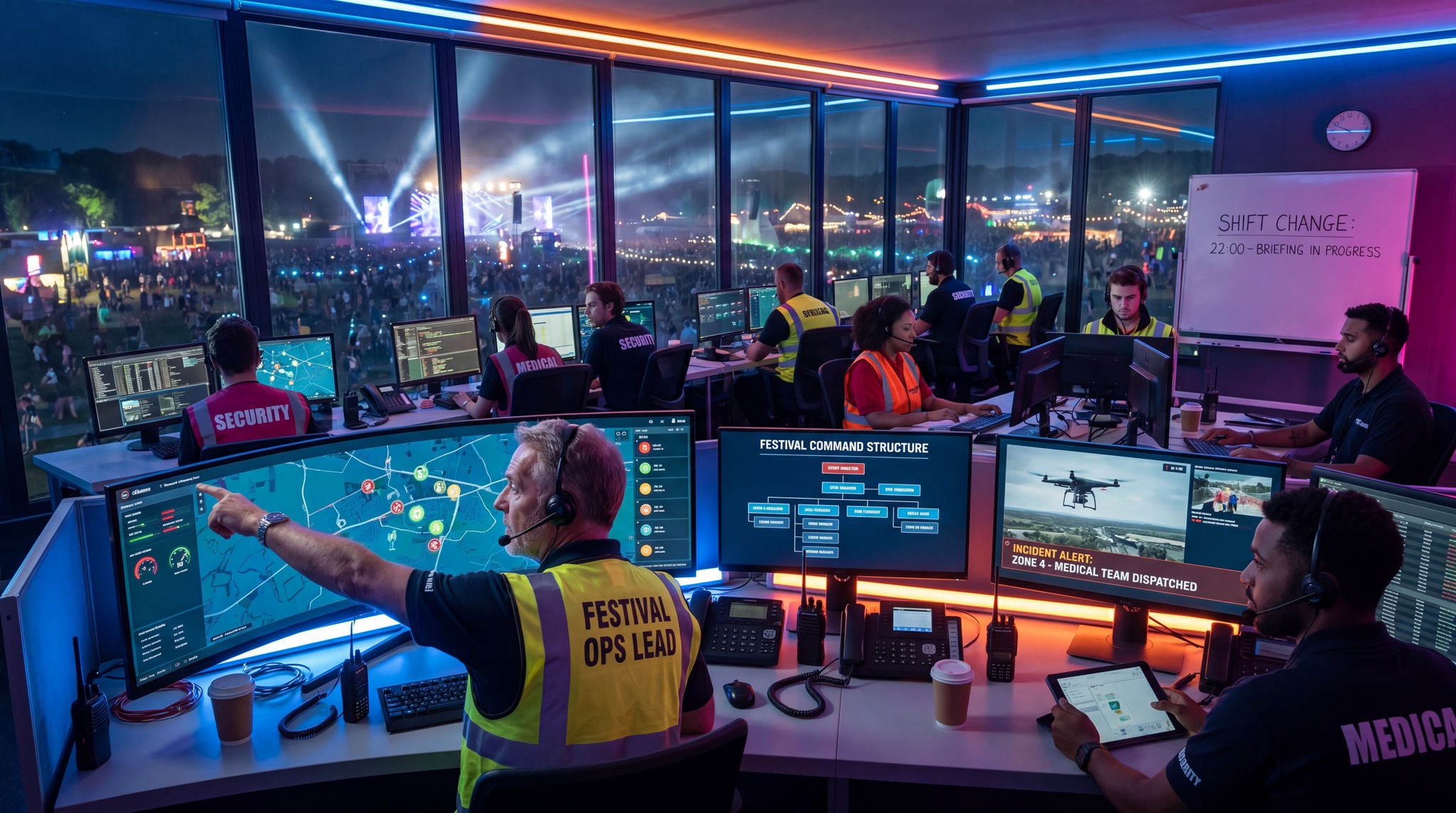
Behind the scenes of each overdose intervention, there should be a well-orchestrated communication chain. In a festival command center, an overdose call might set off a cascade: security dispatch confirms which medics are closest and sends them, the medical team lead is notified to prepare the treatment area, and festival leadership is pinged if the case is severe. Establish clear roles for managing an active medical emergency. Many events follow an Incident Command System (ICS) approach where, say, the Medical Director is the incident commander for a medical emergency, with Security providing support. In practical terms, this means once medics are on scene, they’re in charge of patient care decisions, while security handles perimeter and crowd issues, and the ops center coordinates any other needs (like calling an ambulance off-site or pausing music if needed). Everyone should know who has authority for what. Reinforce in training that during a serious medical incident, there’s no time for debating hierarchy – defer to the lead medic for care directions and to the security lead for scene control.
Radio communication protocols must be crystal clear. Have a dedicated channel for medical emergencies or a prioritized code word. It can be chaotic if multiple people are radioing about the same incident on different channels – instead, your plan might say “All overdose calls go to Channel 1 and only Medics and Safety Managers respond on that channel until cleared.” Some festivals use an emergency alert system where a dispatcher tone alerts everyone to a critical message (like a “Signal 1” or similar). Use what fits your event scale, but make sure it’s drilled. Instruct staff that once an emergency is declared, non-essential radio chatter should cease until it’s resolved. There’s nothing worse than a medic trying to report patient status over radio and being drowned out by someone asking about lost & found. Empower your comms center to enforce radio silence as needed.
Keep in mind, multiple incidents can happen simultaneously. Your medical team might be handling an overdose when another call comes in for a different injury. This is where having sufficient staffing and mutual aid agreements pays off. Stagger medical resources so not everyone is tied to one case. If one overdose overwhelms your on-site medics, be ready to call for backup (e.g. summon the on-call ambulance or have a secondary medical crew). It’s wise to brief the local EMS or hospital on festival days: “We have X medics on site but in case of multiple casualties, be ready for more calls.” Some progressive regions even set up a temporary Unified Command with festival organizers + local fire/EMS in the same room to streamline such coordination. For most festivals, a direct line between the festival Medical Lead and the county EMS dispatcher is sufficient – they can call in city ambulances quickly if needed.
Smooth Entry With Mobile Check-In
Scan tickets and manage entry with our mobile check-in app. Supports photo ID verification, real-time capacity tracking, and multi-gate coordination.
One often overlooked aspect: information flow to festival leadership. The festival director or health & safety officer should be informed promptly of any critical overdose (especially if someone is not responding to Narcan or is being transported to hospital). This enables higher-ups to make broader decisions – for instance, if two or three serious ODs have occurred from what appears to be the same batch of drugs, you may decide to make an announcement or push notification warning attendees (e.g. “We have reports of dangerous fake ‘OX’ pills circulating – seek help immediately if you feel unwell”). At Boomtown Fair in the UK, organizers did exactly this when their on-site drug checking service identified pills containing a dangerous cathinone; they broadcast alerts and likely prevented more cases, a strategy that allowed organizers to escalate warnings regarding dangerous adulterants. Your protocol should define who has authority to approve public alerts and how to issue them (main stage PA, app notification, message on the video screens, etc.). Crafting the wording is delicate – you want to inform without causing panic. A practical approach: keep a template message ready for such scenarios, which your legal/PR team pre-approves. Something like: “Attention: We have identified a dangerous substance in circulation that has caused medical emergencies. If you or your friends feel unwell, seek medical help immediately. Remember, you will not get in trouble – our only concern is your health.” Keep it short, clear, and action-oriented. And as noted, leverage all communication channels: stage MC announcements, push notifications (if your app supports it), social media, even digital signage. Many attendees might check their phones regularly, so an app alert can be very effective to spread the word fast, adding a layer of protection.
Managing a Major Incident
While a single overdose can be handled quietly, multiple overdoses in a short span can escalate into a major incident that tests your emergency plan. If three people in different areas collapse around the same time, or if one stage sees a cluster of medical pickups, consider triggering your Mass Casualty Incident (MCI) plan. Festival producers unfortunately have had to use MCI protocols after bad drug batches or other disasters; those experiences inform current best practices. Here’s how to be ready:
- Triage Plan: Ensure your medics know how to triage if numerous patients arrive at once. They may set up a triage area outside the med tent and tag patients by severity. In an overdose cluster, some might be walking wounded (dizzy but conscious), others critical (unconscious, barely breathing). Medics will prioritize as needed, but your support can be ensuring they have space and resources (e.g. bring more stretchers from storage, have security keep more bystanders out of the area).
- Emergency Medical Command Post: Establish a clear command post location where the senior medical person and festival incident manager coordinate. This could be the main medical tent or the site operations center. The goal is to centralize information – “We have 5 patients so far, all from the same area, likely same substance” – and decisions like requesting additional ambulances or stopping the music.
- Pause and Communicate: Don’t hesitate to pause performances if necessary. If multiple people are down in the crowd, you should stop the show to avoid distracting or obstructing medics. Artists will understand (many would insist on it if they know something’s wrong in the audience). Use the stage mic to calmly tell the crowd what to do: e.g. “Everyone, we need to take a 10-minute break for safety. Please give space for medical teams near the sound tower. We’ll resume shortly.” Attendees, while disappointed, generally cooperate when they realize lives are at stake – especially if you’ve fostered a communal safety culture.
- External Emergency Services: For a true large-scale incident, activate your pre-plan with city emergency services. This could mean setting up a casualty collection point for ambulances (if 10 people need hospital transport, you might coordinate a spot where multiple ambulances line up). It could also involve law enforcement if there’s suspicion of a malicious act (though in overdose clusters it’s usually accidental bad drugs). In extreme cases, the local emergency manager might activate a mass casualty response bringing field hospitals. While such scenarios are rare, thinking through them is part of being prepared. At minimum, have a contact at the nearest hospital ER so you can warn them: “We are sending multiple overdose patients your way,” allowing them to mobilize extra staff.
- Press and PR: A multi-patient overdose incident will likely draw media attention, possibly even during the event. Designate someone (typically your PR or festival director) to handle press inquiries and craft an initial statement. The statement should focus on your proactive response and concern for attendees. For example: “We experienced a medical situation tonight where several attendees became ill due to suspected substance use. Our on-site medical and security teams responded immediately, and all affected individuals received prompt care. Some were transported to the hospital for further treatment. We are closely monitoring the situation and cooperating with local medical authorities. The safety of our guests is our top priority.” Avoid speculative or accusatory language (“someone sold bad drugs” etc.) until facts are confirmed. Also, internal messaging – let your staff know the basics so they don’t spread rumors. If the event is continuing the next day, consider a push notification or gate flyer to attendees: a sober warning about dangerous substances detected and a reminder of available help. (Your legal team might weigh in here, but more and more festivals err on the side of transparency during crises.) For more on crisis communications and handling festival PR during emergencies, see our guide on crafting public statements with care in incident response.
One famous case highlighting good practice was Shambhala Music Festival in Canada a few years back: they identified a spike in drug problems on the first night possibly due to a new potent opioid in circulation. The organizers debated shutting down the event but instead chose to issue strong warnings, amp up medics on duty, and provide more naloxone to campers – and they got through the weekend with no fatalities. Their post-event data showed that because attendees were informed and not afraid to seek help, many more people came to the med tent early with concerns, preventing serious outcomes. This underscores a core tenet of emergency management: communication and trust can dramatically alter the course of an incident.
After the Emergency: Recovery and Review
Once an overdose incident (or a spate of them) is resolved, your focus shifts to aftercare and analysis. First, ensure that anyone from your staff who was traumatized or stressed by the incident has support – even a quick debrief talk can help. Some festivals have mental health professionals or chaplains on staff for critical incident stress management. Don’t neglect your crew’s wellness; responding to an overdose can be emotionally heavy, especially if an outcome was bad.
Next, collect all the information while it’s fresh. If multiple agencies were involved (e.g. local EMS, hospital), gather hospital reports or at least outcomes of patients (privacy rules permitting) – knowing if they all pulled through or if any life-threatening compound was identified can inform your next steps. Complete any incident reports required by your insurer or health authority. If law enforcement needs evidence (e.g. pills that were recovered), ensure a proper chain of custody via your security team. It’s wise to convene a quick all-hands meeting of key staff after a major incident (within 24 hours) to discuss what happened and capture any immediate lessons. Did communications work? Did any staff feel unsure of what to do? Use this feedback for improvement.
If the worst-case occurred – a fatality – then you have additional procedures like cooperating with investigators, reaching out to the victim’s family, and likely cancelling or modifying parts of the festival program as a mark of respect. Those are complex scenarios beyond our scope here, but they reinforce why we prepare so thoroughly: to avoid ever having to face that outcome.
Even for non-fatal incidents, plan some post-event reflection specifically on overdose incidents. Analyze your incident logs and data. For example, do you see a pattern in timing (were most incidents after midnight?), location (one particular stage or the camping area?), or substance (reports of a certain pill name)? This data is gold for refining your safety approach next time. If you find, say, lighting was poor in an area and people couldn’t see someone collapse, you might add more lights or patrols to pinpoint issues. If many didn’t know about the amnesty policy, next year’s communications should be louder, perhaps by placing services closer to main paths or using social media feedback to improve messaging. Some festivals produce an internal “Medical Post-Mortem Report” with stats: number of narcan doses given, number of patients treated for opioids, etc., and key takeaways. These reports can be benchmarked against other events. Industry associations and conferences (like Event Safety Alliance or IFEA) often host panels where festivals share these learnings, contributing to better practices across the board. Being a part of that dialogue not only bolsters your expertise but also demonstrates your festival’s leadership in safety.
In closing this section, remember that how you respond to an overdose emergency can literally spell the difference between a close call and a tragedy. With solid protocols, calm coordination, and compassionate action, festivals can manage even the most frightening situations. As the saying among event medics goes, “Plan for the worst, and the worst will never happen.” In the next sections, we’ll explore working with harm reduction partners and fostering a culture that hopefully prevents these emergencies from happening in the first place.
Partnering with Harm Reduction Organizations
Finding the Right Partners
You don’t have to tackle the overdose challenge alone. In fact, one of the smartest moves a festival can make is to bring in experts by partnering with harm reduction organizations. These groups specialize in keeping people safe when substances are around, and they’ve blossomed around the world as the opioid crisis and other drug risks have grown. The key is finding a partner (or a few) that fit your event’s needs and culture:
- Local Harm Reduction Nonprofits: Many regions have grassroots orgs focused on overdose prevention, substance education, or health outreach. Examples include End Overdose in the U.S. (which focuses on Narcan training), DanceSafe (active in North America, providing drug education, test strips, earplugs, etc.), Phoenix Volunteers or Harm Reduction Victoria in Australia, and numerous city-specific initiatives. These groups often have volunteer teams eager to work festivals – it gives them direct access to at-risk populations. Reach out early (4-6 months ahead) and discuss what they can offer. Often, they can supply free naloxone kits, fentanyl test strips, and trained counselors or peer volunteers.
- National/International Organizations: Some larger festivals tap bigger players like the Red Cross or St. John Ambulance (in the UK/Canada) to run first aid and also carry naloxone. There are also festival-focused charities: for example, The Loop in the UK pioneered on-site drug testing labs; KnowYourStuff NZ provides drug checking in New Zealand; Médecins du Monde has done harm reduction at European events. These might be harder to secure if you’re a small festival, but it’s worth networking. Conferences and social media groups for festival organizers can connect you to such resources. Sometimes a national org can advise your local volunteers or help with training even if they can’t attend in person.
- Public Health Agencies: Don’t overlook government health departments. Many have “event outreach” programs especially after COVID-19 taught agencies to engage public gatherings. A county health dept might be able to send an overdose education team or at least provide materials. In some cases, law enforcement itself wants to help – e.g. police departments that carry Narcan might station an officer at your event purely for medical support, not enforcement. However, this varies widely and you should gauge whether police presence would chill attendees’ willingness to seek help (a uniform can intimidate someone who’s high and afraid of arrest). Jurisdictions with Good Samaritan laws often see police embracing a supportive role, but coordinate closely on expectations.
When vetting a partner, consider their experience and approach. Have they worked similar events or large crowds before? Do they understand the festival environment (loud music, need for non-judgmental attitude, etc.)? Ask for references or examples. A good partner will want to integrate with your team seamlessly, not operate in a silo. You’ll also want to ensure their philosophy aligns with yours – most harm reduction groups operate from a place of compassion and health promotion, which is likely what you want. But if any group seemed to encourage risky behavior or was unreliable in follow-through, keep searching. Also clarify what they don’t do: for example, some harm reduction NGOs provide supplies and education but will not administer medical treatment – that’s fine as long as you know where their role ends so you can fill gaps with your medics or volunteers.
Defining Roles and Responsibilities
Once you have a partner (or multiple), sit down and clearly define each role in writing (email or memo) to avoid confusion on-site. Key points to iron out:
- Services Provided: What exactly will the harm reduction team do? Common offerings include: a booth or tent where they give out free naloxone and train attendees how to use it; distribution of fentanyl test strips and info on how to test drugs; a “chill-out” space with volunteers who talk people through difficult drug experiences; free water or electrolyte giveaways; and sometimes even drug checking (lab or reagent tests) if legal and possible. List which of these apply. For instance, “NGO X will staff a Harm Reduction tent from 2pm-2am daily, offering naloxone training, kits, hydration, and drug info. They will also have roving teams at night in camping areas.”
- Staffing and Credentials: Who are they bringing? Volunteers or paid staff? Are they medically trained (EMTs, nurses) or peers? Ensure any necessary credentials are covered – e.g. if they’re doing drug checking, do they have a license or exemption? If they’re giving prescription-based naloxone (in places OTC isn’t allowed), do they have a medical director’s oversight? Most legit groups have these figured out. Confirm numbers (how many people on their team) so you can allot the right number of passes and the space size for them.
- Coordination with Festival Teams: This is critical. Decide how harm reduction staff will communicate with your medical and security. Ideally, give their team leads a radio (or include them on a relevant channel) so they can call for medics if an overdose happens at their tent or in their wanderings. They should attend your safety briefing and daily update meetings. Encourage a two-way info flow: e.g. if they notice a bad drug circulating (people reporting strange symptoms), they tell your command center; likewise if your medics handle an OD, they can inform the harm reduction folks to possibly warn others. Basically, integrate them into the incident command structure as a support unit. Many festivals assign a liaison (maybe your assistant safety officer) to be the point person for the NGO team, ensuring they have what they need.
- Materials and Logistics: Figure out what they need you to provide and vice versa. Common needs: a tent or booth space (preferably in a location that’s accessible yet private enough for sensitive conversations), tables, chairs, lighting (if operating at night), power (for any testing equipment or fridges if they, say, need to store test samples or medications), and access to water. Some may request free parking or a staff camping spot if they’re there all weekend. Also, clarify if they will be bringing any vehicle (like a van to serve as a mobile unit). From your side, you might ask them to help distribute any festival-produced safety flyers, or to track metrics (how many people they trained, how many strips handed out, etc.) to include in your report.
- Emergency Protocols: Ensure the partner team knows your emergency plans. For example, if there’s a festival-wide evacuation (for weather or other reasons), what should they do? Or if they encounter a serious medical situation, do they handle it or immediately defer to medics? Usually, they’ll handle minor stuff (talking someone down from a bad trip) but anything life-threatening they should pass to medics ASAP. Make sure they won’t give out any substance themselves (beyond health supplies) – reputable orgs never do, but it’s worth stating that distribution of any actual drugs is forbidden (some groups at underground raves have provided things like regulated doses of MDMA or such in the name of safety – that’s not compatible with most festivals’ legal environment!).
- Branding and Messaging: Discuss how they will present on-site. Most will have a banner or sign. Encourage friendly, non-scary branding: e.g. “Safe Partying Hub” or “Help Desk – No Judgments, Just Care” works better than something that screams “DRUG CRISIS UNIT” which might deter people. If they have to abide by any rules (like not using a festival logo unless allowed), cover that. Often, festivals happily promote these services on their website or app. Plan a blurb together that you can include in attendee communications: e.g. “Look out for the Harm Reduction tent by the main stage – trained volunteers from [Org Name] will offer free Narcan (overdose reversal spray) and drug safety info. We encourage everyone to stop by and learn how to save a life!” This both boosts their impact and shows your festival in a caring light. Many orgs appreciate the shout-out as it boosts their profile and funding.
Real-World Examples of Collaboration
There’s powerful evidence that partnering with harm reduction teams works. Let’s highlight a few cases (these can also inspire ideas for your event):
- Insomniac & End Overdose (USA): As mentioned earlier, Insomniac Events partnered with the nonprofit End Overdose starting in 2022 to have a presence at all their major festivals, a partnership detailed in case studies on medical harm reduction leadership. End Overdose sets up booths offering free naloxone and quick training. For example, at EDC Las Vegas 2023, they trained over 10,000 attendees and distributed thousands of Narcan units, prioritizing education over risky partying. Attendees were reportedly enthusiastic – lines even formed at the booth. The result? Multiple reversals were performed by bystanders over the weekend (people who had gotten Narcan earlier), and the festival had zero opioid fatalities, a significant achievement for such a large event. Insomniac’s approach shows how integrating an external expert group (End Overdose) with internal teams (their Ground Control and medics) creates a safety net with many layers, acknowledging that attendees will use substances and prioritizing health through peer support and forward leadership. The partnership also earned positive media coverage, painting Insomniac as a leader in festival safety rather than focusing on past drug problems.
- C3 Presents & This Must Be The Place (USA): C3, which runs Lollapalooza, Austin City Limits, and more, in 2022 allowed harm reduction nonprofit This Must Be The Place to operate at some of their big festivals, a significant move without C3 and their security personnel initially being fully on board. This was a shift for C3, which historically had been cautious. In one year, that nonprofit gave away 46,000+ doses of naloxone through those festivals, as reported in national festival outreach statistics! At Lolla and ACL, they worked closely with festival security so volunteers could move around with kits. C3’s COO was quoted saying this wasn’t a reaction to festival incidents but to community opioid fatalities – showing a mindset that festivals are part of the solution to broader public health issues, integrating harm reduction into existing medical programs and bringing the organization into C3’s fold. This partnership marked one of the first times a major U.S. promoter fully embraced a public-facing harm reduction effort at scale. It likely set a trend for others to follow.
- Boomtown Fair & The Loop (UK): Boomtown, a 66,000-capacity extravaganza, teamed up with The Loop to run on-site drug checking and counsel in 2017-2018, allowing the team to immediately put out distress alerts. The Loop’s chemists tested samples anonymously and relayed results that enabled Boomtown to make informed safety announcements (e.g. warning about pills containing the toxic adulterant N-ethylpentylone), which allowed organizers to escalate warnings regarding dangerous adulterants. Many attendees disposed of dangerous drugs after these alerts, and serious drug incidents at Boomtown dropped noticeably in those years. The partnership had to pause in 2019 due to licensing issues, and both the festival and public were deeply concerned – which speaks to how valued the service had become, with reductions in serious drug incidents and fewer severe cases reported. Boomtown also collaborates with welfare charities to staff their “Sanctuary” tents, and local paramedics for on-site A&E (ER) facilities. Together they’ve built a reputation as a festival that truly cares for its community, turning initial criticism after some tragedies into respect for their proactive stance, openly prioritizing health and safety and growing from experiments at SGP.
- Groovin the Moo & Pill Testing Australia (Australia): We touched on this earlier – the multi-city Groovin festival worked with the Pill Testing Australia coalition and local doctors to run government-sanctioned pill test trials in Canberra, where festival drug checking found an opening. Over two years, dozens of dangerous substances were caught and binned, likely saving multiple lives on the spot despite political resistance. These trials were a collaboration among the festival, a nonprofit, and even law enforcement (who agreed not to arrest people using the service). It demonstrated the power of stakeholder partnership: by all working together under clear rules (amnesty for users, medical oversight, data collection), they proved that such harm reduction can coexist with the law and improve safety, helping attendees avoid potential overdoses and address threatening situations. For festivals elsewhere, it’s a case study in how to lobby authorities through evidence – Groovin’s success built momentum for pill testing acceptance in other Australian states, showing how attendee behavior changes when given information and encouraging government and law enforcement cooperation.
- Local Grassroots at Smaller Fests: It’s not only the big names. Many smaller boutique festivals have benefited from inviting local harm reduction teams. For instance, a regional EDM camping festival in New York partnered with Volunteer EMT squads plus a group of students from a pharmacy school to provide Narcan training – they reached a few hundred attendees, one of whom ended up reversing an overdose in the campground that night. In Ireland, volunteers from a group called Help Not Harm roam major music festivals with “sniffer” devices (to find people passed out in dark corners) and naloxone, working alongside medics. Their presence has been credited with early interventions that prevented fatalities. These stories might not make headlines, but collectively they form a strong argument: festivals that open their gates to harm reduction partners are safer than those that go it alone.
When implementing partnerships, be sure to give credit where due. Celebrate your harm reduction partners in your post-event reports and thank-you notes. Not only is it the right thing to do, it also ingrains these efforts into the fabric of your festival’s identity. Over time, attendees come to expect and appreciate seeing those familiar faces in the harm reduction tent each year. It becomes part of the community ethos – “we look after each other here.” That culture is gold; it yields safer events and fiercely loyal fans.
Overcoming Challenges with Partners
Working with outside organizations isn’t without hurdles. Be prepared to address:
- Legal/Perception Issues: Some festivals worry that having a drug safety booth might signal condoning drug use. You might get questions from stakeholders like, “Are we encouraging drug use by doing this?” The data and examples above help make the case that the opposite is true – knowledge and safety measures don’t increase use, they just decrease harm, such as distributing free Narcan nasal spray. Frame it as a health measure, akin to providing free water (which no one thinks “encourages” dehydration). Still, do some PR management: ensure your marketing doesn’t come off as “Bring all your drugs, we’ve got you if you drop!” but rather “We care about your well-being, so we’re prepared.” Many partners sign liability waivers or agreements to operate under your event insurance; consult your legal team on that. Some harm reduction activities (like drug testing) might need specific insurance riders.
- Resource Constraints: Nonprofits often run on tight budgets. They might not have enough volunteers or supplies for your whole event. Early planning helps – maybe you can recruit additional volunteers to support them (e.g. local college students in public health programs). Maybe your festival can chip in a small stipend to cover their gas or printing costs (we included a line in the budget for that). Also, coordinate on scheduling – ensure no one is expected to work an absurd 16-hour shift without relief. You might have to flex your own volunteer pool to assist, which is fine if they’re properly trained by the partner.
- Authority and Autonomy: Clashes can occur if outside staff do things that conflict with festival rules (like a well-meaning volunteer telling attendees “you can test your drugs here” in a jurisdiction that forbids it). Emphasize adherence to agreed protocols. Have a feedback loop: if security reports a harm reduction volunteer overstepped or gave questionable advice, address it through the partner team leader. Conversely, empower the partner to call out any instances where festival staff might be undermining harm reduction – like a security guard trash-talking the “drug tent” or harassing someone who sought help. Both sides should respect each other’s role. Regular check-ins during the event (perhaps a nightly debrief between your safety officer and the harm reduction lead) can nip issues in the bud.
- Continuity: Ideally, partnerships are not one-offs. If you find a great partner, maintain that relationship year after year. Debrief with them post-festival and ask for their suggestions – they have a unique perspective. Incorporate their feedback. For example, a harm reduction team might notice that the placement of their tent was too hidden and suggest moving it more central next year, or that they ran out of printed materials too soon. Growth and improvement will come from these collaborations. By 2026, many such partnerships are mature and deeply ingrained – think of how Burning Man has the Zendo Project for psychedelic support or Glastonbury works with Festival Medical Services (a charity) for decades. These enduring ties greatly strengthen an event’s safety net, with festivals increasingly being seen as leaders in public health.
In closing, forging partnerships with harm reduction and medical organizations is one of the most impactful things you can do to improve festival safety. It brings specialized knowledge, frees up your team to focus on other duties, and visibly demonstrates your event’s commitment to well-being. In an era where fans and the public scrutinize how events handle health issues, such collaboration isn’t just beneficial – it’s becoming expected. The next time your festival’s harm reduction partner hands you a report of how many overdoses were averted or lives saved, you’ll be very glad you invited them to be part of your festival family.
Educating and Empowering Attendees
Pre-Festival Outreach: Set the Tone
Your overdose preparedness plan shouldn’t only live in staff manuals and med tents – it’s important to engage your attendees with it, too. The attitude and knowledge of festival-goers can significantly influence outcomes. An attendee who knows the risks and available help is more likely to make safer choices and react properly in a crisis. So, begin education and expectation-setting before the event even starts.
Leverage your communication channels (website, ticket emails, social media) to convey a few key messages:
* Safety is a Priority: Let them know upfront that you’re a festival that cares. For example, in your info FAQs you might write, “[Festival] is committed to the safety and well-being of our community. We will have staffed medical stations, free water, and harm reduction services on-site.” This signals that seeking help is normal, not shameful. It also subtly tells people that if they’re looking for a lawless free-for-all, this isn’t it – we have a watching, caring environment.
* Good Samaritan Policy: Clearly inform attendees that you have an amnesty policy for medical emergencies. Encourage them to never hesitate to get help for a friend or themselves due to fear of security. It can be as direct as: “No one will be penalized for possession of drugs if they are seeking medical help for an overdose or illness – your life is more important to us than any rule.” Even print this on the survival guide or festival app. Fans have said that knowing this increases their willingness to intervene early, marrying a safety-first philosophy with legal compliance for attendees seeking help.
* Overdose Prevention Info: Provide some basic tips in a non-preachy way. Depending on the event’s vibe, you could include a blog post or a short video on your site about staying safe. Topics might cover: the danger of fentanyl contamination, the importance of not using alone, test strips being available, and what Narcan is. Some festivals have done creative content like artist-led PSA videos (imagine a popular DJ saying “Hey [Festival] fam, look out for each other, carry Narcan, and don’t be afraid to get help”). If you have notable harm reduction partners or new safety features, announce them: “New for 2026: Free Naloxone training at the Awareness Tent, because we’re all in this together to keep each other safe.” Highlighting these efforts can even boost ticket buyer confidence that your event is professionally run and caring.
* Encourage Preparedness: Suggest that attendees take a few proactive steps, like bringing their own small first aid kit with them or even carrying naloxone if it’s easily available. In 2025, retail pharmacies began selling Narcan OTC in many countries – so a festivalgoer could buy a kit as easily as sunscreen. You might say, “Consider adding Naloxone (Narcan) to your festival pack – it’s available at most pharmacies now without a prescription. It’s easy to use and could save a life.” This normalizes carrying Narcan as just another festival essential, which is a cultural shift we want. Also, encourage using fentanyl test strips on any drugs (if legal to mention; in many places it now is). Provide a link to instructions on how to use them properly if you can. When fans see the festival itself talking about test strips and Narcan matter-of-factly, it busts stigma and empowers them.
Remember to frame all communications in a positive, community-oriented tone, not as finger-wagging. It’s “We want you to have an amazing time and stay healthy,” not “Don’t do drugs, kids.” A good mantra is, “Party Safe, Party Smart.” Some festivals use peer ambassadors in forums or on Reddit to spread safety talk, as it can come off cooler from a fellow fan than the official channels. Also, be inclusive – mention these resources in any languages relevant to your audience if you can, and consider accessibility (e.g. add subtitles to videos). The more people who get the message, the better.
On-Site Signage and Information
Once attendees arrive, reinforce those safety messages visibly around the venue. Signs and messaging can guide those who might be too out-of-sorts to remember the pre-festival info. Key tactics:
- Directional Signage: Clearly mark where first aid and harm reduction services are. Use universally recognizable symbols (a red cross for medical, perhaps a heart or “helping hands” icon for harm reduction). Place signs at entrances (“Medical & Chill-Out Tent this way ->”) and at frequent intervals. Large banners at the medical tent that say “MEDICAL (No Judgment, Just Help)” have been effective at some events, making it absolutely clear anyone is welcome to walk in, often displayed along with emergency contact info. Some festivals list emergency phone numbers or radio channels on signage, but for a public audience it’s simpler to just direct them to personnel or locations.
- Screens and Announcements: If you have LED screens or rotating info boards, include occasional slides: “Stay Hydrated. Look out for each other. If you need help, find staff or go to Medical – you won’t get in trouble.” These reminders can run between set times. They’re short and digestible. Some festivals use creative slogans like “Better to Call than to Lose It All – if in doubt, call for help!” to stick in people’s minds.
- Printed Materials: Include safety tips in festival booklets or maps if those are given out. Even just a small “Health & Safety” box with the Good Samaritan policy, where to find free water, and a line like “Know the signs of overdose (see page X or our website) – don’t hesitate to act.” If you have a festival mobile app, push a notification on Day 1 like, “Remember: we have free water, sunscreen at info points, and our medical team is here for you 24/7. Party safe!” Attendees often just need that little nudge to be mindful.
- Harm Reduction Booth Visibility: Make sure your harm reduction or wellness tent is both easy to find and inviting. Balloons, flags, or a unique color light (some use a blue light) can distinguish it. Use approachable language on signage – e.g. “Chill Out & Help Center” instead of a sterile “Drug Resource Tent.” Many festivals call it something like “Sanctuary” or “Helping Hands” to sound friendly. If you have the staff, station a greeter who can gently invite passersby: “Hey, staying hydrated? Need earplugs or Narcan? We’ve got resources here.” People might wander in out of curiosity and end up learning something that later saves their friend.
- Peer Messaging: Encouraging a norm of looking out for each other can be done subtly through signage too. For example, some events put up banners: “You are your brother’s/sister’s keeper – if you see someone in trouble, don’t walk by. Get help!” Or a simple “We’re all in this together: See Something, Say Something (to a medic).” At a festival in Europe, the organizers printed “#WeCare” on big boards and included short stories of how attendees helped each other at past events. These kinds of campaigns create a collective responsibility vibe that supplements official efforts.
It’s also useful to educate attendees on recognizing overdoses in a concise way on-site. Perhaps a poster at the info kiosk: “Know the signs of opioid overdose: won’t wake up, breathing slow, blue lips. No pulse? Start CPR. We have naloxone – call medical ASAP.” Too much text can be ignored, so use icons or very short phrases. A QR code linking to a longer guide or a video can be there for the truly curious (some will scan while waiting in line at a food stall). But even if only 10% of attendees consciously absorb these details, that’s hundreds or thousands of potential “peer rescuers” around the grounds.
Fostering a Supportive Community Culture
Cultivating the right festival culture may be the most powerful prevention tool of all. Attendees often take cues from the environment about what’s acceptable. If your festival projects an ethos of care, many will emulate it. Some ways to build this culture:
- Artist and Influencer Messaging: If you have artists on your lineup who are aligned with safety/harm reduction values, see if they’ll give a shoutout during their set or on social media. Something like, “It’s hot out there, y’all – drink water and watch each other’s backs!” goes a long way when 50,000 fans hear it from their idol. At a major festival in 2022, an artist paused the music to point out a passed-out fan and literally coached the crowd: “Everyone take three big steps back, give them space – medics are coming.” The video went viral as an example of artist responsibility. Encourage performers to speak up if they see something wrong, and to spread positivity about party safety. Some festivals include a note in artist packets or pre-show briefings about this, which can plant the idea in their heads.
- Attendee Involvement: Consider initiatives that actively involve ticket-holders in the safety mission. For example, a “Safety Ambassador” volunteer program where attendees can sign up for a short training and a shift to help out at water stations or as roving buddies. This not only gives you extra eyes on the ground, but those volunteers become evangelists among their friend groups. Even simpler: push a social media hashtag like #raveSafe or #[Festival]Cares and encourage people to post their safety tips or buddy pics. It sounds cheesy, but making safety “trendy” helps remove stigma. When groups of friends plan for the festival, they might say “Who’s bringing the Narcan?” just like they plan who brings the tent – that’s cultural change in action.
- Positive Reinforcement: Recognize and applaud instances of attendees doing the right thing. If someone rushes to get help for a stranger, maybe your MC can give them a shoutout (with their permission) or at least generally thank “the good samaritans out there looking after others.” People love to be appreciated, and hearing that story might prompt others to act similarly. Some festivals give small rewards – a free merch item or upgrade – to people who turn in dangerous substances to the amnesty bins or who report an incident quickly. It shows that doing the responsible thing is valued by the organizers.
- Safe Spaces and Moments: Create opportunities for people to catch their breath and check in with themselves. Overdoses often happen when someone is overstimulated and doesn’t realize how badly they’re feeling. Providing ample chill-out areas (shaded, with seating and water) and encouraging their use can indirectly prevent medical issues. For example, have a quiet ambient music zone or wellness workshop that offers a break from partying. Attendees who take those breaks are less likely to push past their limits unknowingly. Promote these in your schedule (e.g. a daily meditation or yoga session – yes, even ravers do yoga at festivals nowadays – can mitigate the overall physical stress of the event). A healthier attendee is obviously less likely to overdose or suffer complications.
All these efforts contribute to what safety professionals call a “community of care.” At such festivals, an attitude emerges where attendees say “we take care of our own.” Notably, events like Burning Man and Shambhala have this vibe – they offer different context (Burning Man has minimal central authority, Shambhala has strong harm reduction presence) but in both, attendees often intervene to help long before staff even know of an issue. That’s the ideal scenario: thousands of informal guardians embedded in the crowd. By 2026, more and more mainstream festivals are trying to emulate this by weaving safety into the fan experience rather than treating it as purely a backend operation.
Technology: Empowering Attendees to Summon Help
We discussed earlier the use of festival mobile apps with panic buttons or emergency text lines, which can serve as panic buttons for attendees and enhance personal safety on the front lines. These tools are direct ways to empower attendees to get help for themselves or others with minimal friction. If your festival has an app, strongly consider adding a feature like “Tap for Medical Help”. It can be as simple as a button that calls a dedicated emergency number or sends an alert with the phone’s GPS to dispatch. Several festivals have implemented this and found it incredibly useful, especially with sponsors focused on safety and the ability to send quick app alerts. One case: a bystander at a 2022 festival used an app’s SOS feature to report an unconscious person, and medics reached them in under three minutes thanks to precise GPS data, a capability seen in documented cases of rapid response and app-based emergency communication. That’s faster than screaming for help in many scenarios.
If you don’t have a fancy app, you can publish a SMS short code or WhatsApp number as a help line. For instance, “Text SOS to 12345 with your location for immediate help.” Some events do this for harassment reports and it can work for medical too. The advantage is discreteness – someone can text without leaving their friend or without drawing attention. Just ensure the number is monitored at all times (have staff in the ops center assigned to watch it). And test it to avoid glitches.
Another tech angle: social media monitoring. People often tweet or post about emergencies when they see them. Having someone (maybe a PR team member) keep an eye on Twitter/Instagram for posts like “someone passed out at XYZ stage” can give you a heads-up. In 2026, some festivals even use geofenced Twitter alerts for keywords like “OD” or “overdose” near the venue – a bit Big Brother-ish, but potentially life-saving if it flags something unseen by staff. Just be cautious in how you respond; privacy matters. Ideally, you’d dispatch help, not publicly reply “We’re coming!” which could spark confusion.
In summary, technology isn’t a panacea but it’s a powerful force multiplier when it comes to attendees being the first to notice issues. The combination of education, culture, and tech creates an environment where the community becomes an active part of the safety team. As more festivals adopt these measures, the hope is that overdoses (and other emergencies) are caught and treated at the earliest possible moment, with minimal harm.
By educating and empowering your fans, you’re not only preventing tragedies – you’re also building trust. Attendees who feel cared for will care about your event in return, yielding a loyal audience that treasures the festival as a safe space. In a competitive market, that trust and goodwill can set your festival apart. More importantly, it will mean more of your attendees go home with amazing memories and intact lives, which is the ultimate goal.
Navigating Legal and Liability Considerations
Understanding Naloxone and Good Samaritan Laws
When integrating overdose response into your festival, it’s essential to understand the legal framework that protects your team and attendees. The good news: in many places by 2026, laws are very favorable to those trying to save lives. However, you should confirm specifics for your location (consult a legal advisor) and incorporate them into your protocols.
Most regions have some form of Good Samaritan overdose law. These laws typically provide that if someone seeks medical help for an overdose (whether for themselves or another person), neither the caller nor the victim will be arrested or prosecuted for drug possession of personal-use amounts. The exact scope varies – some protect against all drug-related charges, some have limits (e.g. they won’t protect someone caught with very large quantities or other crimes). But the spirit is to remove the fear of legal repercussions when dialing 911 or going to first aid, requiring understanding from local authorities. As a festival organizer, you should loudly support and publicize this. If your state/country has such a law, include that info in your training and attendee messaging. It can be as explicit as, “State law provides legal protection to anyone seeking emergency help during an overdose – neither you nor the patient will be charged with drug possession for aiding in an overdose situation.” Post it on signs near medical tents (some events actually display the text of the law). This not only reassures attendees but also reminds any on-duty police of the agreed approach. If your area lacks a Good Samaritan law, you can still work out an informal understanding with local law enforcement that at your event, within the venue, they will not interfere with overdose rescues. Many police departments abide by the principle even without a law, but it’s a conversation to have in advance.
Naloxone access laws are another key piece. By 2026, practically all US states and many countries have made naloxone easy to get via standing orders or OTC status. For instance, in the U.S., Narcan nasal spray was approved for over-the-counter sale in 2023, a milestone noted by health experts regarding OTC availability, meaning anyone (including festival staff or attendees) can buy and carry it without a prescription. Canada, UK, Australia, and much of Europe also allow broad access (some countries still require a pharmacist, but generally it’s not hard to get). What about liability for administering it? Virtually everywhere, Good Samaritan protections cover giving someone naloxone in good faith. Naloxone is very safe, and there are few if any cases of someone being sued for using it to try and save a life. Many jurisdictions explicitly include naloxone rescuers in their Good Samaritan laws or have separate “naloxone use immunity” clauses. For example, Delaware’s law states that any person who, in good faith, administers naloxone to someone they believe is overdosing is immune from civil and criminal liability. Check your local statute, but you will likely find that your staff are legally protected when using Narcan as trained. This is important to tell your team: “You will not get in trouble with the law or the festival for using Narcan or calling for help – even if drugs are involved. In fact, it’s what we expect you to do.” That frees them from hesitation.
One consideration: if you allow attendees to carry their own naloxone (which you should unless there’s some bizarre rule against it), ensure your security at the entrance knows what it is. You don’t want a zealous guard confiscating someone’s Narcan kit thinking it’s drugs or an unauthorized item. Brief them that naloxone inhalers are permitted medical devices – treating it like an inhaler or EpiPen. If you provide attendees with Narcan (say via a booth), check if there are any legal hoops. In many U.S. states, organizations can distribute naloxone under a “standing order” from a physician or via a state program – your harm reduction partner likely covers that. Post-OTC approval, even that is moot: you’re basically giving out an OTC product, no different than handing someone aspirin, legally speaking. But just to be safe, clear it with local health authorities. Some festivals have even registered as official “Naloxone distribution sites” through health departments, which can give extra legal cover and access to free supplies.
Drug Checking and Paraphernalia Laws
If your safety plan extends to fentanyl test strips or drug checking services, navigate those laws carefully. Fentanyl test strips (FTS) used to be considered illegal “drug paraphernalia” in some U.S. states, but as noted, a huge wave of policy change has made them legal in all but a few holdout states by 2025, with states like Tennessee leading the change. Double-check your state: by late 2023, 44 states plus D.C. had legalized test strips, as reported in coverage of harm reduction legislation, so if you’re unlucky to be in the remaining few, you’ll need to tread lightly. In a place where they’re illegal, even possessing them could technically be an offense. Festivals in those areas often simply don’t directly hand out strips but might partner with a group that does off-site, or they distribute euphemistically (“free water test kits” etc. – a bit of a grey area). However, IFEA and other industry bodies have been advocating that test strips be embraced as a health tool, and the CDC recommends them, even if promoters like C3 don’t distribute them directly, so momentum is on your side. If your legal counsel advises against open distribution on-site, you could still educate attendees about them and maybe provide info on where to get them (like a nearby pharmacy or the harm reduction group’s headquarters). Being cautious with law is important, but don’t abandon the effort – maybe you can get a letter of authorization from the county health department as This Must Be The Place did in some states, finding workarounds to operate legally.
For on-site drug checking services (pill testing), legality ranges from explicitly illegal (in many countries) to tolerated under supervision (as in parts of Europe and Australia). This is a more complex subject: it often requires law enforcement agreement not to bust people who submit samples, plus sometimes special licenses because technically the staff are handling illegal substances to test them. If you’re considering this, definitely involve legal advisors, law enforcement, and medical experts in planning. The Loop and other pioneers recommend a multi-agency agreement to protect everyone. If done by the book, your festival could even get government endorsement as a pilot program (as Groovin the Moo did). But if local authorities say no, don’t try to do it rogue – it could backfire with arrests and bad publicity. Instead, maybe fund an off-site testing service right before the festival (some cities have permanent drug checking labs or drop-off services). You can then promote that to attendees: “Get your stuff tested in town before you head to the festival.” Not as good as on-site, but better than nothing.
One more legal angle: handling of drugs found or surrendered on-site. Establish a protocol with security and police for any drugs turned in (like to an amnesty box or found on an OD patient). Usually, security should inventory and either destroy them or hand them to police at end of event for disposal. You want to avoid any perception that festival staff are “holding” or returning illicit substances. Some harm reduction groups do a practice where if someone submits a sample for testing, after the test the remaining substance is either handed back or disposed of per the person’s choice – but there may be legal nuance to that (in the UK pilots, users were shielded by a temporary amnesty while within the testing tent). Check what local cops expect. The main thing is to prevent any legal jeopardy for your staff: e.g., don’t have your medical team store a baggie of pills in the med fridge without informing authorities, because if something went awry, someone could accuse them of unlawful possession. Far-fetched, but better to have clear rules: either flush it, or tag and turn over to police, etc., under an agreed MOU. In many cases, law enforcement is happy to just have it properly disposed and not make a fuss, especially if they’re philosophically on board with harm reduction. But align on this to protect your team.
Insurance and Liability Mitigation
From a liability standpoint, doing something is far better than doing nothing. No festival wants to face a lawsuit or inquest about a patron’s death where it’s shown they ignored readily available safety measures. By implementing overdose preparedness, you are mitigating liability – you can demonstrate due diligence and standard of care. Ensure that all your efforts are documented in your event safety plan and daily logs. That way, if ever questioned, you can show: We trained X people, we had Y Narcan kits, medics responded in Z minutes, etc. As referenced earlier, insurers are now looking for such risk-reduction measures, seeking confidence to drive premiums. During insurance renewals or applications, mention your harm reduction initiatives as part of your risk management narrative. It could give underwriters more confidence to cover your event or keep premiums reasonable, especially when facing massive claims or worst-case scenarios.
That said, you should check your insurance policies to ensure there are no exclusions or conditions that your overdose plan might brush against. For instance, some general liability policies might exclude claims “arising from the use of illegal drugs” or have a clause about not facilitating any illegal activity. It’s a relic in some contracts. However, providing medical care is not facilitating drug use – so it shouldn’t void coverage. If unsure, ask your broker or insurer and get written clarification. If there’s any doubt, an insurer might add an endorsement explicitly covering overdose care on-site (they do this for events that have sanctioned alcohol or extreme sports, etc.). It’s unlikely to be a problem, but being proactive never hurts. Also, big ops like Live Nation have been openly backing naloxone availability at venues, indicating the industry consensus is that it’s a necessary safety measure. That cultural shift makes it hard for an insurer or official to claim you shouldn’t have it.
Another liability aspect: trained vs. untrained personnel administering care. Some events worry “What if our security guard gives Narcan incorrectly and the person dies – will we be liable?” Generally, Good Samaritan laws protect lay rescuers as noted, and it would be hard to prove giving Narcan incorrectly (worst case it just doesn’t work). However, to be extra safe, have anyone likely to use it—security, volunteers—go through a brief training (which you’re doing anyway). This shows you took steps to ensure competency, which shields you further. Also maintain records of who attended training and when. If you ever had to defend your festival in court, showing that you had a structured training program and certified instructors would strongly support that you met your duty of care. Some organizers even get staff “Naloxone Certified” through Red Cross or health departments, but an in-house program is fine if it covers the bases.
Finally, consider the PR liability – not legal per se, but reputational risk. All these proactive measures put you in a much better position if an incident does occur. You can face media or public scrutiny by pointing out what you had in place and possibly how those saved lives even if one was lost. Compare two headlines: “Festival ignored drug dangers, 1 dead” vs. “Festival’s new safety measures credited with preventing multiple deaths”. You obviously want the latter. Being transparent about what you do to combat overdoses generally wins praise, not criticism. We’re well past the days when admitting people use drugs at your event was seen as condemning – now it’s seen as responsibility. Just be careful not to come off as advertising that lots of drugs are present; stick to messaging about safety and health.
International and Cultural Variations
One more legal point: adjust to cultural and legal contexts if you run festivals in different countries. Some places in Asia or the Middle East have extremely strict drug laws and zero tolerance that might even conflict with having naloxone (though usually medical use is fine). In such regions, you focus on more general safety (hydration, etc.) because any whiff of “we know you might do drugs” could jeopardize your permits or put attendees at risk of arrest. It’s a tightrope: you’ll quietly equip medical staff with naloxone (every ambulance in Dubai, for example, has it), but you might not publicly promote harm reduction. Instead, you emphasize things like “Don’t over-consume alcohol, watch out for dehydration” which are more palatable ways of indirectly reducing drug harm too. Work within the law – if drug checking is illegal and taboo, maybe you can still have an amnesty medical tent but you don’t call it drug-related. As mentioned in the Festival Harm Reduction Within the Law article: adapt to what’s culturally acceptable in that region, taking care to educate your team and create spaces that are extra welcoming and safe. In some places, you focus strictly on health (heat, fatigue) and keep any drug talk very low-key.
One interesting note: some strict countries now quietly permit naloxone because of rising prescription opioid problems. For example, some Gulf states train police on Narcan for expats overdosing on painkillers. So even if they won’t tolerate drug talk, medical response is still valued. Use that angle: frame naloxone purely as a life-saving medical intervention (which it is). Ensure any foreign staff know to be discreet. Attendees in such regions are often extra afraid to seek help due to legal fear, so if anything, push even harder on confidentiality: maybe offer truly anonymous med care where no ID is checked, to reduce fear. It’s tricky, but don’t give up on safety because the law is harsh – just navigate carefully. Consult local legal counsel always.
In summary, legal and liability factors are not barriers but rather parameters to work within. By understanding and communicating the protections like Good Samaritan laws, you free your staff and attendees to do the right thing without fear, requiring understanding from local authorities. By aligning with authorities and fulfilling any requirements, you shield your festival from legal troubles. And by documenting and insuring your efforts, you shield it from financial troubles. A festival that is legally conscientious about overdose prevention stands on very strong ground. You can confidently say you did everything reasonably possible to prevent harm, which is both ethically and legally the best position to be in.
Continuous Improvement of Overdose Preparedness
Data Collection: Knowledge is Power
After implementing all these measures, it’s crucial to track how they perform. Continuous improvement in festival safety is driven by data – both quantitative stats and qualitative feedback. Begin by deciding what metrics will indicate success or areas for improvement in overdose prevention. Some key data points to collect each event:
- Number of Drug-Related Medical Incidents: How many cases did medics handle that were confirmed or suspected overdoses? Break it down by substance if possible (e.g. 5 opioid ODs, 3 MDMA overheating, etc.). Also note outcomes: how many naloxone administrations, any fatalities (hopefully none), hospital transports vs treated on-site. Shambhala’s team, for example, logs not just counts but resolution on-site vs sent out, showing that they handled 99% of cases internally, proving that investing in on-site care saves lives and reduces liability.
- Naloxone Usage: How many naloxone kits were used, and by whom? If staff used them, capture that in incident reports. If your harm reduction partner gave kits to attendees, can they estimate how many were actually deployed (sometimes people come back to say “I used my kit and got another”)? Even anecdotal saves are great to document. Early evidence from festivals with widespread Narcan shows a drop in deaths, with attendees increasingly seeing festivals as leaders – try to substantiate that with your own data over time (e.g. “0 opioid deaths in 2026 vs 2 in 2019 after introducing Narcan program”).
- Harm Reduction Engagement: Have your partner or volunteers count interactions: how many people did they train or counsel? How many test strips handed out? This can be as simple as a tally sheet or clicker at the booth. If thousands of attendees are engaging, that’s a huge win you’ll want to repeat and perhaps expand. If only a trickle, maybe reposition the booth or increase awareness next time.
- Incident Timing/Location Patterns: Record when and where incidents happen. Maybe all overdoses occurred after 11pm at the far stage with the hardcore techno. That might tell you to put extra medics or messaging there in future, or to have the harm reduction team roam that area at peak time. Or if many happened in the campsite at dawn, maybe you implement morning welfare patrols. Data can illuminate “hot spots” in time and space, which is essential to pinpoint issues, which you address by adjusting staffing and resources accordingly, checking effectiveness through surveys.
- Audience Feedback: What do attendees say about safety? Look at post-event surveys or social media. Do people mention feeling safer (or not)? For instance, if you advertise naloxone and later see comments like “I felt good knowing help was around,” that’s a success. If someone says “I saw an OD and no staff came for 20 minutes,” that’s a red flag to investigate. Consider adding a couple of safety questions to your official survey: “Did you notice the harm reduction services on site? Did you feel comfortable seeking help if needed?” You might be surprised; sometimes awareness is lower than we think, which means next time you need more promotion.
- Benchmark vs Previous Editions or Peers: If this isn’t your first year, compare stats to last time. Did medical calls for overdoses go down or up relative to the crowd size? (Of course, many factors influence that, not just your measures.) If you introduced drug checking and saw a drop in severe incidents, that’s a correlation to highlight. Also compare to the industry: if you hear that similar festivals usually have X overdoses per 10k attendees and you had significantly less, that suggests your measures work (or vice versa). Industry reports or associations might share anonymized stats that you can use for context.
Make sure all this data is compiled in your post-event report. A lot of valuable info can be lost in the chaos of load-out if not captured. The medical provider should give you a debrief with numbers. Same for any harm reduction group. If not, chase them up – those lessons are your roadmap for next year. As one after-action review maxim goes: “If it’s not written down, it didn’t happen.”
Debrief and Adapt
After each festival, hold a safety debrief meeting with all relevant parties – production heads, medical team, security, volunteers, and partner organizations. Treat overdose/harm reduction as a specific agenda item. Go through what went well and what didn’t. Encourage honesty and a blameless approach (the aim is improvement, not finger-pointing). Some prompts to discuss:
- Were there any close calls or incidents that could have been handled better? Perhaps staff response was delayed at one stage because of radio issues. Or maybe a volunteer administered Narcan smoothly in one case – what can others learn from that?
- Did all staff feel prepared? If anyone admits “I actually wasn’t sure what to do at first,” find out why. Was the training insufficient? Did they forget protocol under pressure? This could lead to changes like more frequent refresher training or simplifying the emergency code words.
- Were medical resources appropriately allocated? Maybe medics found themselves stretched too thin at a peak time. Or conversely, they sat idle in one area while everything happened elsewhere. Adjust hiring or stationing accordingly. Also, was the supply of naloxone adequate? If you ran low, increase stock next time; if you had way too much (not likely a bad problem), you know you can order slightly less.
- How did the harm reduction partnership go? Let your partner share their perspective. They might suggest improvements like “Our tent was too tucked away, next year we need a spot closer to the main path,” or “people were asking for drug checking which we couldn’t provide – maybe we can arrange that.” Also discuss any friction: if security had issues with the NGO, clear the air and find solutions (perhaps joint training for better understanding of roles). Strengthen that relationship.
- Communication review: Did the internal comms flow as planned? If there was confusion during a multi-OD event, figure out why. Sometimes drills and theory diverge from reality. Update your protocol document if needed – it’s a living thing. For instance, you might add “the nearest stage manager should stop music after 3 or more simultaneous ODs until cleared” if you realized that was necessary but not stated.
- Attendee behavior changes: Did you notice fans doing anything differently? For example, maybe lots more people carried their own naloxone after your campaign – great, double down on that message next year. Or maybe despite warnings, people still didn’t use the free water (common problem!). That might mean you need more persuasive hydration reminders, or literally handing out water in crowd at peak heat, etc. Always ask: What more can we do to keep them safe and informed?
After gathering all this, update your Festival Safety Plan for the next edition. Continuously refining is how some long-running festivals have drastically reduced their serious incidents over time. Use a version control or at least date it so you know you’re working off the latest info. It can help to maintain a checklist year-to-year (did we implement the recommendations from last year’s debrief? If not, why?).
Keeping Up with Trends and Training
The drug landscape is ever-evolving. Stay updated on emerging trends in both drug use and safety techniques. By 2026, we see various new challenges: potent synthetic opioids like nitazenes (even stronger than fentanyl) starting to appear, with naloxone administered on hundreds of occasions, benzodiazepine mixes (which don’t respond to naloxone because they’re not opioids), and the notorious animal tranquilizer xylazine (“tranq”) being found in illicit opioids. Xylazine causes severe sedation and wounds and is not reversed by Narcan (since it’s not an opioid). This is a growing issue in parts of North America. If that hits festivals, medics need to know to focus on supportive care (breathing support) because Narcan alone might not revive someone fully. Then there’s stimulants: the CDC noted a rise in stimulant-involved overdoses alongside opioids, often involved in most fatal overdoses. People are mixing cocaine or meth with fentanyl inadvertently. So your training for staff should periodically refresh to cover these twists: e.g. mention that an overdose might not always respond immediately to naloxone if other depressants are involved – you still continue rescue breathing and get them to advanced care.
Keep an eye on industry reports (Pollstar, Billboard biz, Event Safety Alliance releases) and public health alerts. If something new is being seen at clubs or raves, assume it will surface at your festival sooner or later. Also, adapt to cultural shifts – for instance, if psychedelics become more common (with decriminalization in some areas), you might need to prepare more for hallucinogen-related crises (different from opioid ODs, but still a safety issue). That could mean training a set of volunteers in trip sitting or having a quiet space for freakouts – which many harm reduction teams already provide. So coordinate overlapping concerns (overdose vs psychological distress) between medics and welfare teams.
Also, innovations in harm reduction are happening. Newer tech like drug checking devices (infrared spectrometers) are becoming more portable – maybe in a year or two you can deploy a device at your event that analyzes pills in seconds without needing a full lab. Stay connected with harm reduction networks to know what’s possible. Some festivals in Europe are trying vending machines for free test strips and naloxone kits – an interesting idea to reduce the stigma of asking in person. If that proves effective, you might pilot it.
In training, consider rotating in new scenarios or guest trainers to keep things fresh. Perhaps invite a firsthand speaker, like someone who survived an overdose at a festival, to briefly share with your staff how grateful they were that people helped – that can really motivate crew and make it real. Or have your team attend an Event Safety Alliance workshop or other professional training on medical response if available. Invest in your safety team’s education; it will pay dividends by upping their expertise and commitment. Remember, festivals are dynamic beasts – being ready for the next curveball is part of the job for top producers.
Building Institutional Knowledge
If your festival grows or if you run multiple events, create a knowledge base or playbook for overdose prevention. Document the resources, contacts, and lessons so that it’s not all in one person’s head. For instance, maintain a list of “Preferred Harm Reduction Partners” with notes (X group was great for naloxone, Y group has the testing van), contacts at local pharmacies, and any special considerations discovered. This way, if staff changes happen, the new team can pick up the baton smoothly. Some multi-festival production companies even centralize certain harm reduction efforts – e.g. they might purchase naloxone in bulk for all their events each year, or develop a standard training module used across festivals. If you produce more than one festival, this consistency can help (and is more efficient than reinventing the wheel each time). We are seeing the emergence of industry standards for festival medical and harm reduction. By staying engaged with industry groups like the ESA, IFEA, or local event alliances, you contribute to and benefit from that collective wisdom.
Finally, celebrate your successes. It’s motivating for your team to hear at the end of a festival: “We had 4 overdose emergencies and thanks to quick action, all 4 people are alive and recovering. We potentially saved four lives this weekend – that’s why we do this.” Too often, staff only hear negatives or problems. Highlighting the positive outcomes reinforces the importance of their training and effort. It can also be shared carefully with your audience (like a post thanking everyone for looking out and noting “no serious incidents” if true, or that those who fell ill were helped). It shows accountability and closes the feedback loop with the community.
In essence, treat overdose preparedness as an ongoing journey, not a one-time project. Each year, new music trends and new challenges will come, but if you foster a culture of continuous improvement, your festival will adapt and thrive. The fact that you’re reading and applying a guide like this already sets you on the right path – many events will follow in your footsteps. In a few years, we might see festival overdose deaths become virtually unheard of, because the combination of education, tools like naloxone, and community vigilance make it a preventable rarity. That’s the vision we’re working toward: festivals where everyone can immerse in the joy of music and art, knowing that if something goes wrong, a robust safety net is there to catch them.