Introduction
Rigging is the backbone of any festival stage production. It refers to the process of safely hanging and supporting all the heavy equipment overhead – from dazzling lighting fixtures and powerful speaker arrays to massive video screens. Every festival attendee who gazes up at a stage sees the magic, but behind that magic is a complex network of trusses, motors, and cables. If anything in this network fails, it can lead to dangerous accidents. Therefore, understanding rigging 101 is crucial for festival producers: it’s about ensuring every light and speaker stays exactly where it should – securely above the stage, keeping performers and audiences safe.
What is Rigging in Events?
When promoters and producers ask, “what is rigging in events?”, the answer extends beyond just massive outdoor music festivals. Event rigging encompasses the structural planning, suspension, and securing of all overhead production elements across any live gathering—from corporate conferences and brand activations to indoor arena tours. Whether you are flying a small lighting truss for a VIP tent or suspending multi-ton LED walls for a main stage, the core principles of this discipline remain the same: calculating load limits, utilizing certified hardware, and ensuring absolute safety for everyone below.
The Basics of Festival Rigging
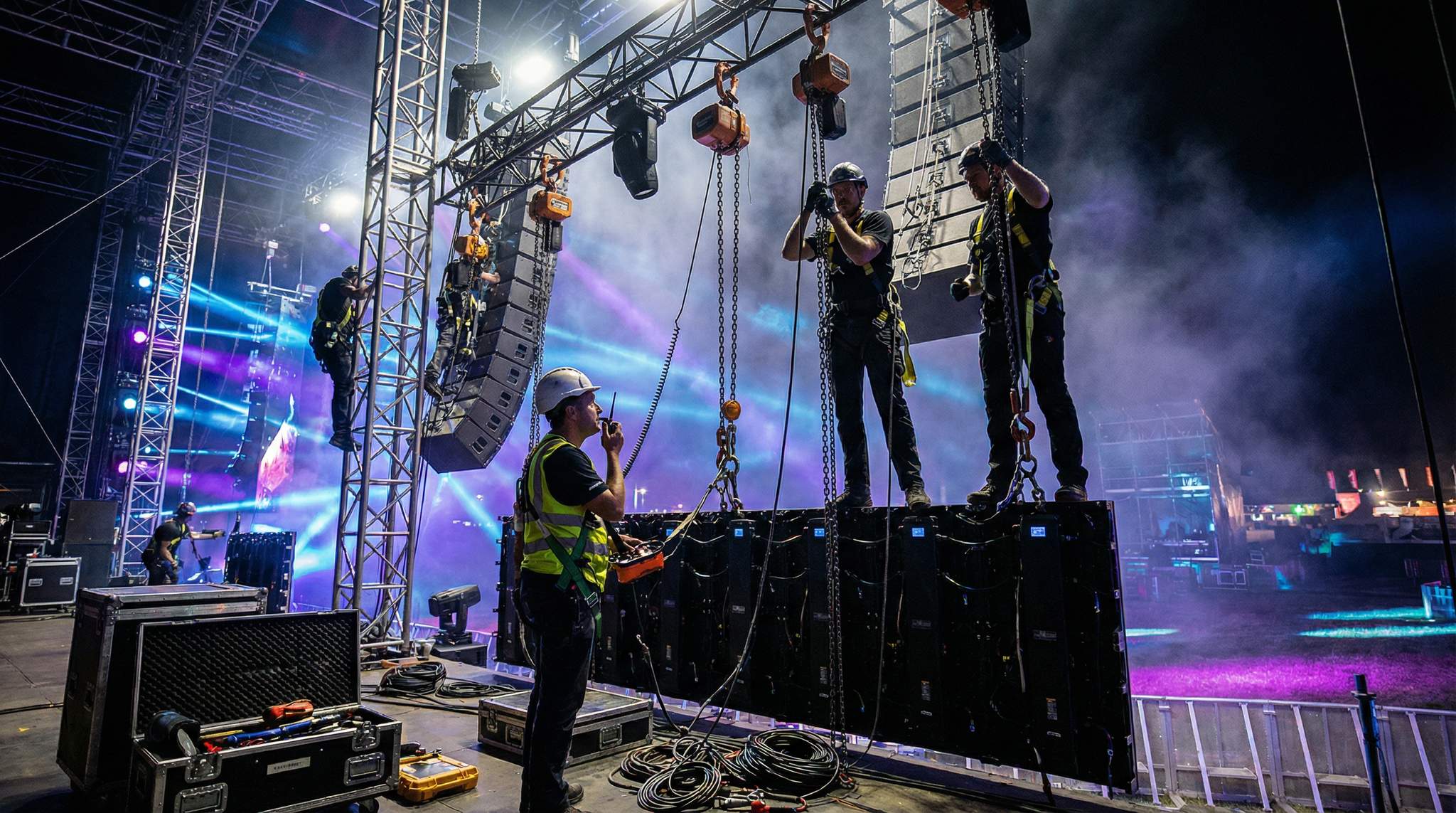
In simple terms, rigging involves hanging equipment from a structure (like a stage roof or truss system) in a balanced, secure way. For festival stages, this often means using a combination of trusses (metal beams that span the stage), chain hoists or motors (to raise and lower gear), and steel cables or straps to attach lights, speakers, and screens. Every piece of gear has a weight, and the structure holding it has a maximum load capacity. The role of a rigger (the specialist responsible for rigging) is to make sure those weights are properly distributed and well within safe limits. This involves creating a rigging plot – a detailed plan or diagram showing exactly where each item will hang and how it will be supported. By carefully planning what goes where, riggers ensure that nothing is overloaded and that the stage structure can handle the combined weight of all equipment.
At the core of this setup is the structural framework—often referred to simply as the rigging or truss system. This modular architecture serves as the primary mounting point for all audiovisual elements. When executing professional AV rigging, stage crews rely on specialized hardware to attach fixtures to these structures. The primary item that the stage crew uses to hang the lighting and speakers is a load-rated clamp (such as a cheeseborough or O-clamp). These clamps securely fasten individual units to the truss chords, ensuring that every moving light and line array stays locked in position.
Free Tool: Size Your Festival Site
Zoned capacity planning for arena, campsite, parking and entry lanes — against UK Purple Guide and NFPA density standards. Finds your bottleneck zone.
Case in point: Imagine a large LED video screen hanging above a stage. Such a screen might weigh several hundred kilograms. If it’s not rigged correctly – say too much weight on one side of a truss – the entire structure could become unstable. There have been instances at smaller events where an overloaded truss bent or failed, causing equipment to fall. These incidents underscore why getting the basics right is non-negotiable. Proper festival rigging prevents mishaps and keeps the show running smoothly.
While the fundamental principles remain consistent across the industry, concert rigging scales dramatically depending on the venue type. Indoor arena tours typically utilize existing structural steel within the building’s ceiling to suspend hoists. Conversely, outdoor rigging for concerts relies entirely on temporary, ground-supported roof systems or massive scaffolding towers. Regardless of the environment, the ultimate goal of rigging lighting, video, and audio is to deliver a flawless, safe production that meets the rigorous demands of modern touring acts.
Planning a Festival?
Ticket Fairy's festival ticketing platform handles multi-day passes, RFID wristbands, and complex festival operations.
When transitioning from multi-day outdoor festivals to dedicated touring models, rigging for concerts introduces a different set of logistical demands. A standalone concert rigging setup must be highly modular, allowing the production team to load in, fly the grid, and load out within a strict 24-hour window. For promoters routing a tour across diverse venues, standardizing the rigging concert plot ensures that the audio, lighting, video, rigging, and staging elements can scale up for a stadium or scale down for a mid-sized amphitheater without compromising the artist’s creative vision or structural safety.
Beyond the structural framework itself, organizers must account for the sheer volume of festival stage equipment that relies on this grid. From automated moving heads and heavy-duty PA cabinets to massive LED video panels and atmospheric effects machines, every piece of production gear adds to the total suspended weight. Managing this extensive inventory requires precise coordination between the rigging team and the various technical departments to ensure that all overhead assets are safely supported and optimally positioned for the show.
Rigging 101: Core Components Every Promoter Should Know
For event organizers stepping into production management, a true rigging 101 foundation starts with understanding the primary hardware categories. While you won’t be climbing the steel yourself, knowing the terminology helps when reviewing quotes for rigging lighting and audio systems. The infrastructure generally breaks down into three main areas: the truss (the aluminum or steel framework that forms the structural skeleton), the hoists or motors (the mechanical chain systems used to lift the grid into place), and the suspension hardware. When it comes to speaker rigging, the requirements often differ significantly from visual elements. Audio line arrays require specialized bumper bars and precise pullback points to angle the sound correctly, whereas lighting fixtures are typically distributed more evenly across the span using heavy-duty clamps.
When coordinating audio, lighting, video, rigging, and staging, production managers must take a holistic approach to the grid design. Effective stage lighting rigging isn’t just about hanging fixtures; it requires strategic placement to ensure moving heads and wash lights don’t obstruct LED video walls or interfere with the acoustic trajectory of the PA system. Whether you are overseeing massive outdoor event lighting rigging or managing precise exhibition lighting rigging in an indoor convention center, the structural demands remain rigorous. Particularly for stage lighting and rigging in the United States, compliance with stringent safety standards dictates that every automated fixture, strobe, and laser is accounted for in the master rigging plot, ensuring seamless integration across all visual and auditory departments.
Free Tool: Project Your Bar Revenue
Per-head spend benchmarks by event type turned into projected bar and food revenue, with a stock-mix estimate and gross-margin line. Free calculator.
For many festival organizers, managing these disciplines separately can become a logistical nightmare. This is why contracting a comprehensive production partner who handles audio, lighting, video, rigging, and staging under one roof is often the most efficient strategy. A unified vendor ensures that the structural design inherently supports the visual and acoustic requirements from day one. When the same engineering team calculates the load for the PA system, designs the video wall suspension, and plots the lighting grid, the risk of miscommunication between departments drops significantly. This integrated approach not only streamlines the build schedule but also provides promoters with a single point of accountability for the entire stage infrastructure.
Strategic Considerations for Event Lighting Rigging
When developing a comprehensive production plan, event lighting rigging requires meticulous coordination between the creative vision and structural reality. Festival producers must ensure that the lighting designer’s plot aligns perfectly with the physical limitations of the temporary roof system. This means evaluating how automated moving heads, heavy wash fixtures, and massive strobe arrays will be distributed across the truss grid. A well-executed lighting suspension strategy not only maximizes the visual impact for the audience but also maintains the crucial balance of the overall festival rigging structure. By treating the illumination setup as an integrated component of the broader staging architecture, organizers can prevent localized overloading and ensure that every visual element operates safely throughout the event.
Need Festival Funding?
Get the capital you need to book headliners, secure venues, and scale your festival production.
Furthermore, any successful rigging event deployment relies on continuous communication between the lighting crew and the head rigger. If a touring act requests additional lasers or heavy practical effects at the last minute, the production manager must verify that the existing event rigging plot can safely accommodate the extra weight. Proactive planning in this area prevents costly delays during load-in and guarantees that the visual spectacle never compromises the structural integrity of the stage.
Beyond the visual aesthetics, integrating these elements requires a unified approach to procurement. When promoters source vendors for a major tour, bundling the audio, lighting, video, rigging, and staging contracts often yields better technical synergy. A single-source provider ensures that the event lighting rigging plot is cross-checked against the PA system’s weight, eliminating day-of-show conflicts where a heavy video header might otherwise overload a truss span intended for automated moving heads.
Best Practices for Rigging Line Array Speakers
When coordinating the audio deployment for a large-scale event, rigging line array speakers demands a highly specialized approach compared to standard visual fixtures. Because sound behaves directionally, rigging speakers isn’t just about getting them off the ground; it’s about precise acoustic targeting. Production managers must ensure that the audio team uses manufacturer-approved bumper bars (or fly frames) designed specifically for the PA system being deployed. These frames serve as the critical link between the hoist motors and the top cabinet of the array.
Furthermore, as you link multiple audio cabinets together to form the array, the cumulative weight increases rapidly. A standard festival PA hang can easily exceed a ton per side. To manage the center of gravity and achieve the correct downward angle for audience coverage, riggers utilize pullback points attached to the lowest cabinets. This dual-point suspension method—lifting from the top bumper while pulling back from the bottom—stabilizes the entire column, preventing unwanted rotation and ensuring the sound hits the crowd perfectly rather than bleeding into adjacent neighborhoods.
Accept Payments Across 13 Countries
Local currency processing via Stripe, Razorpay, Xendit, Paystack, and OXXO across 13 countries with region-specific payment methods.
Beyond just the physical hang, modern audio rigging requires tight integration with acoustic prediction software. Before a single motor lifts the PA, system engineers generate a 3D model of the festival site to determine the exact trim height and splay angles for the cabinets. This data dictates the suspension plot, specifying the precise load on each hoist and the required pullback tension. For festival producers, understanding this workflow is vital: it means that any last-minute changes to the stage height or audience perimeter will directly impact the structural calculations, requiring the sound team to re-evaluate their strategy to maintain both safety and sonic clarity.
Another critical factor in audio rigging is managing the dynamic interaction between the PA system and other flown elements. When high-powered subwoofers and line arrays are suspended, they generate significant acoustic energy and physical vibration. Riggers must ensure that these vibrations do not transfer into the lighting trusses or video wall headers, which could cause visual jitter or loosen hardware over a multi-day festival. Isolating the audio suspension points from sensitive visual equipment is a hallmark of advanced stage engineering.
Load Calculations: Know Your Numbers
One of the most critical aspects of rigging is performing accurate load calculations. Every truss, motor, and support in use has what’s called a Safe Working Load (SWL) or Working Load Limit (WLL) – essentially, the maximum weight it can safely support. When planning a festival stage, all the weights of hanging equipment (lights, speakers, screens, scenic elements, etc.) must be added up. Then, each support structure (like a roof beam or a truss span) should be evaluated to ensure this total weight does not exceed the SWL at any point.
Rigging professionals often build in a safety factor as well (for example, using only 50% of a truss’s rated capacity) to add an extra margin of safety. They consider not just the static weight (how heavy something is when still) but also dynamic forces. Dynamic forces include things like the swaying of a hanging speaker array or sudden movements – even wind gusts can create extra force on hanging equipment (imagine a strong wind pushing on that big LED screen like a sail). All these factors mean the rigging design must handle not only the steady weight but unexpected stresses too.
To illustrate, consider a festival where a large speaker line-array is flown (hung) on either side of the stage. Each array could weigh a ton or more. Riggers will calculate how to distribute that weight across multiple points: perhaps using two chain hoists per array, each taking half the load, and connecting to different truss points to spread the force. They’ll check that each motor, shackle, and cable in that setup is rated well above the portion of the load it carries. Proper load calculations ensure the structure can handle it comfortably. This prevents any single point from carrying too much weight – a key to avoiding structural failures.
If you were to describe and explain the challenges associated with speaker arrays and rigging, wind load and center of gravity would be at the top of the list. Modern speaker rigging involves suspending curved line arrays that can act like massive sails in outdoor environments. Unlike static lighting fixtures, audio arrays require precise angling to achieve optimal sound coverage across the festival grounds. This means riggers must calculate not only the sheer vertical weight but also the rotational forces and wind resistance applied to the hoist motors and truss spans. Balancing these acoustic requirements with strict structural safety limits is one of the most complex tasks in festival production.
Free Tool: Model Promoter Payouts
Flat-percentage, flat-per-ticket, or tiered-bonus commission structures — get per-promoter payouts and total commission as % of gross. Free calculator.
Use Certified Rigging Hardware
Rigging is no place for makeshift solutions or subpar gear. The hardware used to hang equipment must be purpose-built and certified for overhead lifting. This includes things like grade-8 bolts, alloy steel shackles, steel safety cables, rated hoist motors, and load-rated slings or chains. Each of these components comes with documentation of how much weight it can hold. Professional riggers stick to reputable brands and equipment that meet industry standards (such as ANSI, OSHA, or EU safety standards depending on the region).
Using certified hardware also means regular inspection and maintenance. For example, a truss that has been used outdoors for multiple festivals should be inspected for any signs of metal fatigue or damage. Chain hoists should be serviced and load-tested periodically. Even smaller items like shackles and clamps are examined for wear and tear. It’s worth noting that something as simple as a single damaged bolt or a cheap un-rated clamp can become a catastrophic failure point if it gives way. So, every shackle pin is checked to be sure it’s secured, and every lighting fixture hanging overhead has an additional safety cable attached (a secondary cable that will catch the fixture if its primary clamp somehow loosens or fails). By using only certified, well-maintained rigging hardware, festival organizers are investing in a safe show. Skimping on proper gear is simply not an option when lives and reputations are on the line.
Involve Professional Riggers
While small events might tempt organizers to handle things in-house, hanging heavy lights or speakers is not a DIY job for those lacking proper training. Experienced, certified riggers (often with certifications like ETCP Rigging credentials or other regional equivalents) should be part of the production team. These professionals have deep knowledge of physics, engineering principles, and hands-on experience with complex setups. They know how to read loads, tie knots or terminate cables properly, and how to respond if something needs adjustment on the fly.
A professional rigger will often start by reviewing the venue or stage structure. They will ask for structural documentation – for instance, how much weight a roof beam in a tent can support, or what the approved hang points are in a concert hall. They collaborate with lighting, audio, and video departments to understand what needs to go where. Then they figure out the safest way to achieve that vision. If a design is too ambitious (for example, if a band’s production wants to hang an enormous chandelier prop that’s too heavy for the stage), the rigger is the voice of reason who will point this out early and suggest alternatives.
Consider a scenario: a festival planned to suspend an array of decorative LED globes above the crowd. The initial concept looked spectacular on paper, but the weight of the cabling and motors to move those globes was significant. A professional rigger assessed the design and realized that if all that gear was hung in one area of the roof, it would approach the structure’s limit. He reorganized the rigging plot, spreading the globes across more points and recommending lighter-weight cabling. This adjustment kept the installation well within safety margins. The lesson is clear – having a seasoned rigger onboard means potential problems are caught and fixed before they become dangerous.
Safety Protocols On Site
Rigging safety isn’t just in planning – it’s an ongoing priority during the festival setup, show, and teardown. On site, several protocols keep everyone safe:
- Regular Inspections: Each day before the festival opens, the rigging team should visually inspect all hanging equipment and structures. They look for anything unusual – a clamp that’s slipped, a bolt that’s come loose, or a frayed cable. If the event runs multiple days, daily checks are a must.
- “Safety First” Zones: When riggers are working overhead (for instance, climbing trusses or focusing lights), the ground area below is usually cordoned off. No crew should walk under a lifting load. If something must be moved or adjusted above, people on the ground are kept clear as a standard practice.
- Communication: Clear communication saves lives in rigging work. Riggers use radios or hand signals to coordinate lifts (like raising a lighting truss evenly at multiple points). They also have a universal warning call – if someone accidentally drops a tool or any object from above, they shout “Heads!” as a loud alert so that everyone below can immediately move out of the way or look up and protect themselves. This simple protocol ensures that if a wrench slips from a rigger’s hand 30 feet up, those below are warned in a split second.
- Proper PPE: Personal protective equipment is mandatory for rigging crews. This includes hard hats for anyone below, and for those up high: safety harnesses with lanyards, non-slip shoes, and often gloves. Harnesses are always attached to certified anchor points – if a rigger slips while walking along a high truss, the harness will catch them and prevent a fall.
- Weather Monitoring: Festival rigging also involves keeping an eye on weather conditions. High winds, for example, can be extremely dangerous; they can cause suspended loads to sway or put extra force on structures. A good protocol is to have defined wind speed limits. For instance, if winds exceed a certain speed, the team might lower all the sound arrays and video walls to ground level as a precaution, or even evacuate the stage area. Rain can add weight to canopies or cause electrical hazards, so riggers work closely with stage managers to respond to weather alerts quickly. In one success story, a thunderstorm warning led a festival crew to promptly lower and secure lighting pods that were hanging high. The storm passed without incident, and once it was safe, the riggers hoisted everything back up and the show continued – all because there was a plan in place.
- Emergency Plans: Part of rigging safety is having a Plan B. A professional rigging team will have an emergency procedure. If a motor fails or a piece of equipment slips, a qualified crew knows how to respond — whether that means clearing the area, lowering a truss immediately, or calling in an expert to fix a critical issue. Everyone on the crew should know these plans. It is also wise for the production to designate a rigging supervisor or safety officer on site, someone empowered to stop the show or halt setup if a serious hazard is spotted.
These protocols underscore a core message: safety isn’t accidental. It is deliberately built into the rigging process at every stage.
Rigging Successes and Cautionary Tales
History has both encouraging examples and stark warnings when it comes to rigging at festivals. On the successful side, many festivals each year go up without a hitch precisely because of careful rigging. Every time a massive scenic element or a heavy speaker cluster hangs securely and performs flawlessly, that’s a quiet win for the rigging team. For example, an internationally renowned festival once featured a huge moving lighting rig shaped like a ring above the stage. It moved and tilted throughout the show. Thanks to meticulous planning, engineering oversight, and skilled riggers, this complex setup went off perfectly – becoming a highlight of the production and a testament to what safe rigging can achieve.
Contrast that with some failures that became sobering lessons. One infamous incident occurred when a small outdoor concert attempted to hang too much lighting equipment from an aging roof structure that wasn’t rated for the load. Mid-event, the structure gave way on one side, causing several fixtures to crash down. Thankfully, there were no serious injuries, but it was a clear warning that ignoring load limits and safety protocols can nearly cause tragedy. In another case, severe weather caused a partially rigged stage to collapse before the show, destroying equipment; investigators later found that shortcuts in anchoring and bracing the roof contributed to the failure. These stories travel through the industry, and every seasoned festival producer takes them to heart. They remind everyone that no matter how exciting a festival’s design is, it must never come at the cost of safety.
Conclusion: Rigging Makes It All Possible
Behind every breathtaking festival stage is an unsung hero: the rigging team and the standards they uphold. Proper rigging is the backbone of stage production in festivals. It literally supports the lights that create the atmosphere, the sound systems that blast music to thousands, and the screens that captivate the crowd. More than that, it supports the safety of everyone under that roof.
Whether you are advancing a massive outdoor weekender or coordinating concert rigging for a mid-sized amphitheater tour, the core philosophy remains identical. Flawless festival rigging requires an uncompromising commitment to structural limits, certified hardware, and experienced personnel. By prioritizing these elements, promoters ensure that the complex web of rigging lighting and audio arrays performs safely under any condition.
Aspiring festival producers should treat rigging with the respect it deserves. That means budgeting for professional riggers, allocating time for thorough planning and safety checks, and never cutting corners with equipment. Seasoned producers know that when rigging is done right, nobody in the audience notices it – and that’s a good thing. It means the show can go on without interruption, and everyone from the artists to the fans stays safe.
In the end, investing in safe rigging practices isn’t just about avoiding accidents (though that is paramount); it’s also about enabling creativity. When a production team has confidence in the stage infrastructure, they can design spectacular productions that wow the crowd. The lights, sound, and screens can do their job brilliantly because the rigging is doing its job quietly in the background. That is the art and science of rigging 101: making the impossible seem effortless, and doing it with safety at the forefront every step of the way.
Frequently Asked Questions
What is festival stage rigging?
Festival stage rigging is the process of safely hanging heavy production equipment, such as lighting fixtures, speaker arrays, and video screens, from an overhead structure. It utilizes a network of trusses, motors, and steel cables to securely support and distribute these loads, ensuring the safety of performers and audiences while enabling complex stage designs.
What is rigging in events?
In the broader context of live production, event rigging is the specialized practice of safely suspending overhead equipment—such as lighting, audio arrays, video screens, and scenic elements—using temporary structural frameworks. For event organizers, it involves coordinating with certified professionals to ensure all flown gear complies with strict weight limits and safety regulations, regardless of whether the gathering is a massive outdoor festival or an indoor corporate conference.
How do riggers calculate safe loads for festival stages?
Riggers calculate safe loads by summing the weights of all hanging equipment and ensuring the total does not exceed the Safe Working Load (SWL) of any truss or support beam. They often apply a safety factor, such as using only 50% of the rated capacity, to account for dynamic forces like swaying speakers or wind gusts.
What certified hardware is used in stage rigging?
Professional stage rigging relies on purpose-built, certified components including grade-8 bolts, alloy steel shackles, rated hoist motors, and steel safety cables. All hardware must meet industry standards like ANSI or OSHA and possess documented weight ratings. Riggers also use secondary safety cables to catch fixtures if a primary clamp or bolt fails.
Why is it important to hire certified riggers for events?
Hiring certified riggers is essential because hanging heavy equipment requires specialized knowledge of physics, load distribution, and engineering principles that prevent structural failure. Professionals with credentials like ETCP certification can accurately interpret structural documentation, create detailed rigging plots, and identify potential hazards that untrained personnel might overlook, ensuring a safe production environment.
What safety protocols are followed during rigging setup?
Rigging crews enforce strict protocols including daily equipment inspections, mandatory PPE like hard hats and harnesses, and establishing exclusion zones under overhead work. Clear communication is vital, utilizing radios and the universal “Heads!” warning call for dropped objects. Additionally, teams monitor weather conditions to lower equipment if high winds or storms threaten stability.
How does weather affect outdoor festival rigging?
Weather significantly impacts rigging safety by introducing dynamic forces, such as high winds pushing against large LED screens or rain adding weight to canopies. Riggers establish specific wind speed limits and protocols to lower suspended equipment like speaker arrays if conditions become unsafe, preventing structural instability or collapse during the event.
What are the main challenges of speaker and AV rigging?
The primary challenges in AV rigging, particularly with speaker arrays, involve managing dynamic loads, wind resistance, and precise directional angling. Speaker rigging requires suspending heavy, curved line arrays that catch wind easily, meaning riggers must account for both static weight and environmental forces while ensuring the audio coverage hits the audience perfectly without compromising the structural integrity of the truss.
What are the fundamental principles of rigging 101 for event organizers?
For festival producers, rigging 101 revolves around three core principles: understanding load capacities, hiring certified professionals, and using rated hardware. It means recognizing that every piece of suspended equipment—from lighting fixtures to PA systems—must be calculated into the total weight limit of the truss structure, ensuring the safety of the entire stage environment.
What is the structure used to build stages and hang lighting and sound called?
The framework used to construct a stage roof and suspend audiovisual equipment is universally referred to as a truss system or rigging structure. In international event production, this modular aluminum or steel architecture serves as the primary mounting grid for all overhead lighting, sound arrays, and video walls.
What are the key considerations for stage lighting and rigging integration?
Successful event lighting rigging requires seamless coordination between audio, visual, and structural departments. When planning stage lighting and rigging, organizers must ensure that the truss infrastructure can support the combined weight of automated fixtures, LED video walls, and heavy PA systems without obstructing sightlines or compromising structural integrity. This holistic approach to audio, lighting, video, rigging, and staging ensures a safe and visually spectacular production.
What are the essential components for rigging line array speakers?
Rigging line array speakers requires manufacturer-specific fly frames (bumper bars), heavy-duty chain hoists, and specialized rigging pins to link the individual audio cabinets together. Additionally, riggers use pullback cables attached to the bottom of the array to adjust the tilt and secure the center of gravity, ensuring optimal sound dispersion across the festival grounds.
What are the main differences between indoor concert rigging and outdoor festival setups?
Indoor concert rigging typically utilizes existing structural steel within an arena or theater ceiling to suspend hoists and trusses. In contrast, outdoor festival setups rely entirely on temporary, ground-supported roof structures. Rigging for concerts outdoors also introduces severe environmental variables like wind loads and rain, requiring specialized weather-rated gear and stricter dynamic load monitoring compared to climate-controlled indoor venues.
What are the specific requirements for audio rigging compared to other stage elements?
Audio rigging demands specialized hardware like bumper bars and pullback cables to handle the immense, concentrated weight of line array speakers. Unlike lighting, which is often distributed evenly across a truss, suspending sound equipment involves hanging heavy, linked cabinets in a single vertical column. This requires precise center-of-gravity calculations and acoustic targeting to ensure the sound is directed accurately at the audience while maintaining strict structural safety margins.
Why should festival organizers hire a unified vendor for audio, lighting, video, rigging, and staging?
Hiring a single production company to manage audio, lighting, video, rigging, and staging ensures seamless integration across all technical departments. It eliminates communication gaps between separate vendors, streamlines the load-in schedule, and guarantees that the structural truss design safely accommodates the combined weight and spatial requirements of all audiovisual equipment.
What are the best practices for event lighting rigging?
Effective event lighting rigging requires distributing the weight of heavy automated fixtures evenly across the truss system to prevent localized overloading. Production managers must ensure that the lighting plot is fully integrated with the audio and video suspension plans, utilizing certified clamps and secondary safety cables for every fixture to maintain a secure and balanced overhead grid.
How does rigging for concerts differ from multi-day festival rigging?
While the core safety principles remain identical, rigging for concerts on a touring schedule prioritizes rapid deployment and modularity. A concert rigging plot must be adaptable to various venue sizes—from arenas to amphitheaters—allowing crews to safely fly the audio, lighting, video, rigging, and staging elements and load them out within a single day. In contrast, multi-day festival rigging often involves massive, custom-built ground-supported structures designed to remain in place and withstand environmental factors over an extended period.
How does rigging support different types of festival stage equipment?
Rigging provides the essential structural framework required to suspend all major festival stage equipment safely above the performance area. This includes heavy audio line arrays, complex lighting fixtures, LED video walls, and scenic elements. By utilizing load-rated trusses and motorized hoists, riggers ensure that this diverse inventory of production gear is securely flown, properly angled for the audience, and kept well within the safe working load limits of the stage roof.