Outdoor festivals are thrilling experiences, but achieving excellent sound quality in such open environments is no small feat. The absence of walls and ceilings means there’s nothing to contain or reflect sound towards the audience. As a result, audio design becomes an art of precision and power. A world-class performance can fall flat if the sound is muddy or too quiet for half the crowd, so festival organizers must prioritize a top-notch sound system setup. From giant line array speakers and strategically placed delay towers, to advanced mixing consoles and coping with wind and noise challenges, every detail matters. Careful audio design and experienced engineers ensure that every listener – from the front row to the farthest field – enjoys clear, powerful sound without disturbing the surrounding community.
Line Array Speakers: Covering Vast Crowds with Clarity
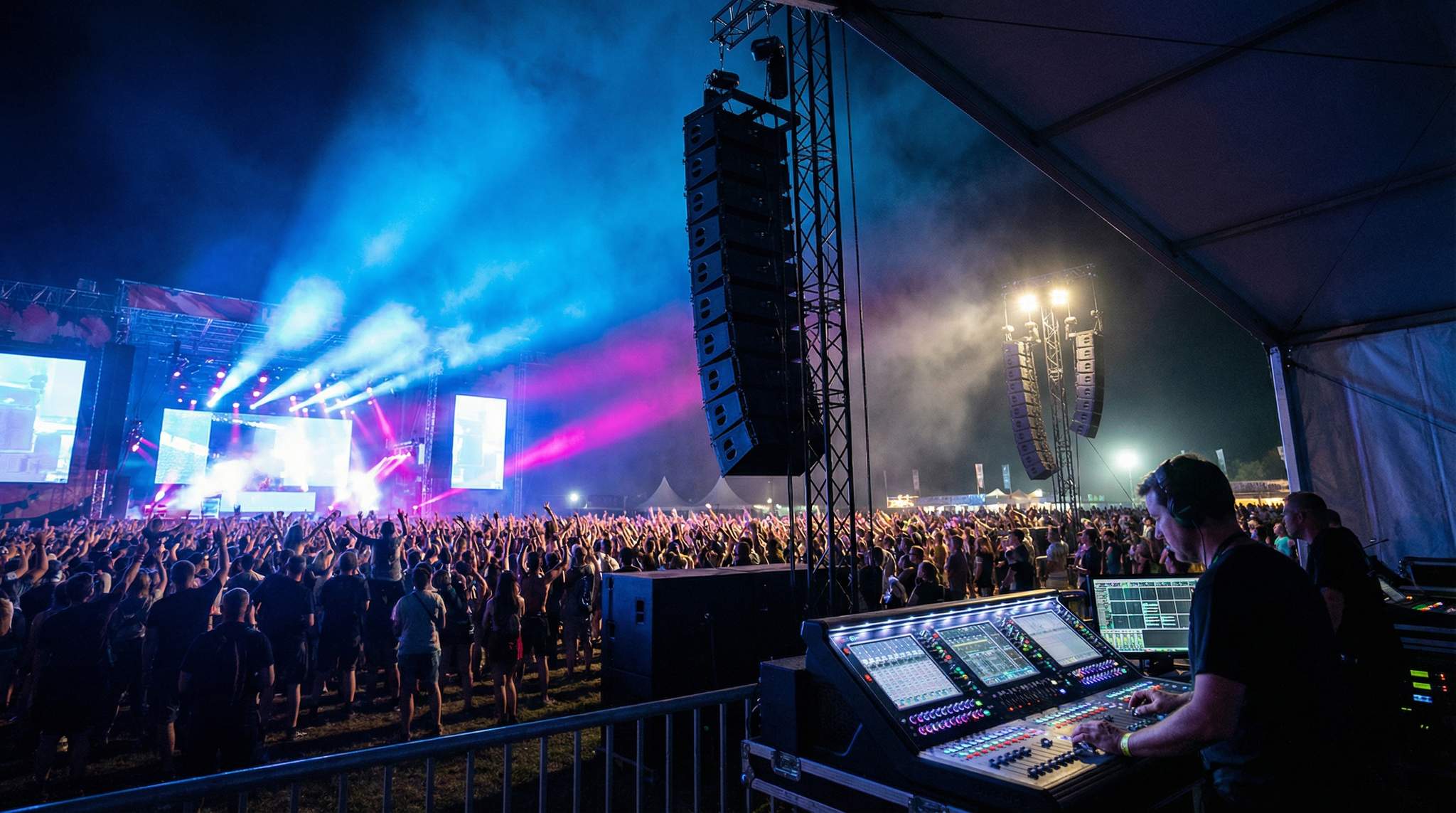
Modern outdoor festivals predominantly rely on line array speaker systems for one simple reason: they deliver clear and consistent audio coverage to a huge audience. Line arrays are those towering columns of speakers you’ll see hanging beside stages. Each speaker is aligned in a vertical line, allowing the system to project sound further and more evenly than traditional single-point speakers. This configuration focuses audio energy toward the crowd and minimizes sound being wasted upward or to the sides. The result is uniform sound – the fans at 200 feet away can hear almost as clearly as those at 20 feet.
Line arrays have revolutionized festival audio since their rise in the early 2000s. In the past, large concerts used stacks of “point source” speakers that often left the front rows blasted with volume while the back rows struggled to hear. Today’s line arrays solve that imbalance. For example, at a large music festival hosting 50,000 attendees, a typical setup might involve a dozen or more speaker elements per side, finely tuned to cover the entire main audience area. Engineers carefully adjust the angle of each cabinet in the array so that sound reaches both the front and rear of the crowd at appropriate volume levels. This means no dead zones and no excessive volume pockets – everyone gets a great audio experience.
To maximize their effectiveness, line arrays are often flown (suspended from towers or stages) to elevate the speakers above the crowd’s heads. This positioning helps sound travel unobstructed and directs it downward into the audience. The improvement in clarity is dramatic: vocals stay intelligible and instruments remain balanced, even in open air. For smaller festivals or second stages, compact line arrays or well-placed smaller speaker stacks use the same principles on a scaled-down level. The key is planning coverage patterns – overlapping speaker output just enough to avoid gaps without causing destructive interference (which can happen if speakers are misaligned). Careful calibration by system engineers – setting the right EQ, delay, and volume for each speaker cluster – is essential so that all speakers work together as one cohesive system.
Free Tool: Size Your Festival Site
Zoned capacity planning for arena, campsite, parking and entry lanes — against UK Purple Guide and NFPA density standards. Finds your bottleneck zone.
Trends in the Best Sound Systems for Festivals in 2025
As production standards continue to rise, the best sound systems for festivals in 2025 are defined by advanced networking, lighter materials, and hyper-directional control. Promoters are increasingly looking for rigs that offer immersive audio capabilities and improved energy efficiency. Modern line arrays now integrate sophisticated DSP (Digital Signal Processing) directly into the cabinets, allowing system engineers to steer audio with pinpoint accuracy. This evolution means organizers can deliver concert-grade fidelity while strictly adhering to local noise ordinances. When evaluating the various types of speakers for events, from massive main-stage hangs to compact point-source fills for VIP areas, the focus has shifted toward scalable, networked ecosystems that provide real-time telemetry and seamless integration across the entire festival site.
Choosing the Best Festival Speakers for Your Event
Selecting the best festival speakers isn’t a one-size-fits-all endeavor. The ideal music festival speakers depend heavily on the genres you are hosting and the topography of your site. For instance, an electronic dance music (EDM) event requires a festival speaker system with massive low-frequency extension, meaning a heavy reliance on high-output subwoofers paired with crisp top boxes. Conversely, a folk or jazz gathering might prioritize speakers for festivals that deliver pristine mid-range clarity for acoustic instruments and vocals. When evaluating options with your audio vendor, discuss the specific demands of your lineup. The right combination of top-tier festival speakers will ensure that whether a DJ drops a heavy bassline or a singer-songwriter strums an acoustic guitar, the sonic delivery is flawless.
Planning a Festival?
Ticket Fairy's festival ticketing platform handles multi-day passes, RFID wristbands, and complex festival operations.
Festival Speaker Setup: Configuration Best Practices
Once you have selected the appropriate hardware, the actual festival speaker setup dictates how effectively that equipment performs. A professional configuration goes beyond simply stacking boxes on a stage. System engineers must calculate the precise splay angles of line array cabinets to ensure seamless vertical coverage, while subwoofer arrays are often deployed in cardioid or end-fire configurations to steer low-frequency energy forward and keep it off the stage. For promoters, understanding the footprint of your festival speaker system is critical for site planning. You must allocate sufficient physical space for ground-stacked subs, amplifier racks, and cable runs, while ensuring the stage roof structure has the load-bearing capacity to safely fly heavy speaker hangs.
Delay Towers: Reaching the Distant Corners
For truly massive festival grounds, even the best line arrays have limits to how far their sound can carry effectively. This is where delay towers come into play. If you’ve ever been at a huge festival and noticed additional speaker columns halfway back in the audience area (or heard clear sound even when far from the stage), you’ve encountered delay towers. These are secondary speaker systems placed further out in the crowd, designed to pick up where the main stage speakers start to fade, ensuring far-off listeners still hear the music with punch and clarity.
The trick with delay towers is timing. Sound travels relatively slowly (about 343 meters per second), so if the speakers in a delay tower just blasted out the same audio as the main stage at the same time, listeners near the tower would hear an echo or a lag from the main stage. To prevent this, engineers introduce a precise audio delay to the signal feeding these towers – essentially holding back the sound by a fraction of a second. This way, the audio from the delay speakers hits the ears of listeners at the same moment as the sound arriving from the distant main speakers. The transition is seamless: it simply feels like the main sound system extends further, without any weird slap-back effect.
At large-scale festivals (think crowds of 80,000 or more spreading across a field), multiple delay towers are often spaced out systematically. For example, at a festival as large as Coachella, you might see the first delay tower about 100 meters from the stage and another set further behind near the outskirts of the crowd. Each set is calibrated with increasing delay time corresponding to its distance from the stage. Designing this requires skill – too few towers and the distant audience will struggle to hear; too many or improperly timed and you risk overlapping sounds and reduced clarity. Experienced system designers will map out the coverage using acoustic modeling software, deciding exactly how many delay points are needed and where to place them for optimal coverage.
Free Tool: Project Your Bar Revenue
Per-head spend benchmarks by event type turned into projected bar and food revenue, with a stock-mix estimate and gross-margin line. Free calculator.
For festival organizers, it’s important to budget for delay towers once the audience area exceeds a certain size. They can be the difference between a cohesive concert experience versus a tale of two audiences (one that hears everything and one that barely catches the sound). A practical tip: work with audio engineers early in the planning phase to determine if delay towers are needed based on your expected crowd size and layout. Incorporating them into the site plan (and notifying the staging/structures team, since towers need physical support structures) well in advance avoids last-minute scrambles.
Mixing Consoles: Command Centers for Clear Sound
While speakers broadcast the sound, the mixing console is where that sound is sculpted and controlled. At the heart of the front-of-house (FOH) position sits a professional mixing desk – essentially the command center for the festival’s audio. Modern digital mixing consoles allow engineers to finely balance every vocal, guitar, keyboard, drum, and electronic sound coming from the stage, ensuring the mix that reaches the audience is well-blended and clear. For outdoor festivals, the console’s role is even more critical: the engineer may need to adjust the mix on the fly to account for weather changes, crowd noise, or an artist’s preferences.
Need Festival Funding?
Get the capital you need to book headliners, secure venues, and scale your festival production.
For those new to large-scale production terminology, you might wonder exactly what is FOH in concert environments. FOH stands for “Front of House,” referring to the primary audio control position typically located in the middle of the audience area, facing the stage. This strategic placement allows the lead audio engineer to hear exactly what the crowd hears, making it the optimal vantage point for mixing the main festival sound system. The FOH footprint requires careful integration into your site map, as it necessitates a secure, covered structure, dedicated power drops, and a clear line of sight to the performers.
Choosing the right mixing console (and an experienced FOH engineer to run it) is a major consideration for festival production. High-end digital consoles from reputable brands are popular on festival stages because they are reliable, support a large number of input channels (important when you have big bands or orchestras), and allow quick scene recall. Scene recall means the engineer can save settings for each band’s soundcheck and then instantly pull them up when that band hits the stage. This is invaluable in a festival scenario where different acts rotate quickly – often with only minutes to line-check between sets. With saved scenes, the mix for each act can be dialed in swiftly, providing consistency and reducing errors.
Another factor is familiarity: touring sound engineers often carry show files for certain console models so they can plug into a festival’s system and have their preferred settings ready. That’s why many festivals provide industry-standard consoles at FOH (and at monitor world) – it smooths the collaboration between the festival audio crew and the bands’ own engineers. For example, it’s common to see consoles like an Avid Venue, DiGiCo, Yamaha or Midas desk at major festival FOH positions, because most sound professionals know them. As a festival organizer, ensure your audio vendor provides consoles that meet artists’ technical riders; this avoids last-minute problems if an incoming band’s engineer isn’t comfortable with the equipment provided.
In terms of audio quality, a good console with a skilled engineer can work wonders. They will manage the EQ (equalization) of each channel, cut out any nasty feedback frequencies, and balance the mix so that the vocals cut through while the bass and drums still hit with impact. Outboard processing or built-in digital effects are used to add polish (for instance, a touch of reverb on vocals or compression to even out levels). During the show, the FOH engineer is constantly listening and making micro-adjustments – pushing up a guitar solo here, taming a boomy frequency there – to adapt to the live dynamics of the performance and the venue.
Collect Any Attendee Data at Checkout
Add custom registration fields to your checkout — dietary needs, t-shirt sizes, company names, and more. Conditional logic and per-ticket-type fields.
Meanwhile, don’t forget the monitor console on the side of the stage, which is equally crucial but focused on what the artists hear. A well-monitored band will perform better, which ultimately translates to better sound for the audience. While the crowd might never see the mixing consoles, these desks and the experts operating them are responsible for translating a band’s on-stage output into an exhilarating sonic experience out in the field.
Wind, Weather, and Acoustic Challenges
The outdoors can be unpredictable, and weather is a formidable factor in festival sound. A sunny, calm afternoon might give way to an evening of gusty winds or a sudden downpour – and each of these conditions affects audio. The most common weather issue for sound is wind. Even a moderate breeze can deflect sound waves, meaning the mix that was perfect during soundcheck could start to shift in certain parts of the venue. High frequencies (like vocals or cymbals) are particularly susceptible to being scattered by wind, sometimes causing the sound to seem to “come and go” for the audience downwind. Strong crosswinds can even create pockets where audio drops out momentarily.
Experienced audio crews anticipate this. One strategy is to conduct soundchecks at different times of day if possible – since wind patterns often change from afternoon to evening – and walk the field to identify any spots where audio might be lacking. Engineers may adjust the high-end frequencies or overall system EQ in real time during the show if wind is affecting clarity. Wind screens or mesh covers are routinely placed on microphones to reduce wind noise through the PA, and in some cases, temporary sound barriers (like acoustically transparent netting) are erected at strategic points to block gusts from hitting the microphones or even the speaker arrays too directly.
Beyond wind, temperature and humidity can also shape the sound over distance. Cool air at night, for instance, can allow sound to carry farther (sometimes causing the festival to be audible miles away if not controlled), while hot daytime air can cause sound to refract upward, reducing how far it travels along the ground. Humidity affects high-frequency attenuation – dry air lets highs travel farther, whereas very humid air will dull them faster. It’s complex science, but in practice the takeaway is: what sounded perfect at 2 PM might need fine-tuning by 8 PM. This is another reason having skilled sound engineers is so important – they know how to tweak delay settings or EQ as the environment shifts.
And of course, there’s rain and moisture. Rain can be a show-stopper if it’s heavy, not just for the performers and audience comfort, but for the safety of audio equipment. Outdoor-rated speakers and waterproof covers are a must in any open-air event. Critical gear like mixing consoles at FOH should always be under a sturdy tent or cover; a sudden squall shouldn’t be allowed to fry the sound board and silence the show. Wise festival producers have contingency plans, such as pausing performances during extreme weather and quickly covering or powering down equipment if a storm hits. Even light rain requires vigilance: cables, connectors, and power supplies must be kept dry to prevent shorts and failures.
To handle weather unpredictability, redundancy is your friend. For instance, some festivals keep spare amplifiers or even a backup console on site in case key equipment fails due to weather or power issues. Investing in weather-proofing and backup plans may not seem glamorous, but it can save the event if things go south (literally, if a sudden southern wind brings in a dust storm!). The bottom line is that outdoor sound systems have to be robust and prepared for nature’s curveballs.
Free Tool: When Should You Announce?
Pick your event date and genre — the free planner outputs a recommended announce, presale, on-sale and reminder schedule anchored to how your audience actually buys.
Noise Management: Great Sound Without Nuisance
One person’s music can be another person’s noise. A festival’s sonic success isn’t only measured by the concert-goers’ experience, but also by how well it avoids disturbing the surrounding community. Large outdoor events often face strict noise regulations from local authorities – usually expressed as maximum decibel levels at the perimeter of the event or at the nearest residences, especially during nighttime hours. Failure to control noise bleed can result in fines or, worse, jeopardize the festival’s future if the venue loses its license due to neighbor complaints.
Professional festival organizers tackle noise management on multiple fronts:
-
Sound Direction and Design: When designing the main stage sound system, the coverage should be aimed inward toward the audience and away from residential areas. Line array speakers by nature can be very directional; by tilting and focusing them correctly, engineers minimize how much sound spills beyond the crowd area. Subwoofers (which produce the deep bass that travels furthest) can be arranged in a cardioid array or other directional setups that cancel out bass energy behind the stacks. This means the chest-thumping beats stay mainly in front of the stage, and there’s less low-frequency “boom” leaking out to the town beyond the festival.
-
Delay and Volume Control: Using multiple delay towers as described not only helps the audience hear better, it also means the front-of-house system doesn’t have to be obnoxiously loud just to reach the back. This balanced approach results in a lower overall volume that still satisfies the crowd but reduces the chance of bothering distant neighbors. Sound engineers also employ limiters and real-time monitoring systems: if the wind shifts and suddenly carries more sound outward, these systems can automatically or manually trim the volume to stay within allowed levels at the fence line.
-
Monitoring and Compliance: A noise management plan is often a requirement for permit approval. This typically involves hiring acoustic consultants or dedicating an audio team member to monitor sound at the site’s boundaries. They use decibel meters (and nowadays, wireless sensor networks) around the venue to constantly check noise levels off-site. The team communicates via radio or a messaging system to the FOH engineer, who can adjust certain frequencies or overall levels if a threshold is being approached. It’s a delicate balance – you want roaring sound for the crowd, but you might have to pull back the sub-bass a bit after 10 PM, for example, to respect a local noise curfew.
-
Scheduling and Curfews: Another practical tool is smart scheduling. Savvy festival planners might place the loudest, bass-heavy acts in daylight or early evening slots, and have slightly more subdued acts later at night. Many locales enforce a strict curfew (say, music off by 11 PM). Sticking to these rules – and gradually tapering down the volume toward the end of the night (perhaps ending with an acoustic encore instead of a full-volume finale) – can go a long way in community relations. Clear communication with residents (for example, informing neighbors of the festival dates and main stage showtimes) also helps manage expectations and reduce complaints.
Free Tool: Model Promoter Payouts
Flat-percentage, flat-per-ticket, or tiered-bonus commission structures — get per-promoter payouts and total commission as % of gross. Free calculator.
In the UK, the Glastonbury Festival, which is surrounded by small villages, has long employed strict noise-control measures – from monitoring stations around the site to carefully directing speakers inward – to keep peace with its neighbors. In recent years, other major festivals around the world have also made headlines due to noise complaints, prompting them to invest in better sound containment strategies. These include more precise speaker angling, advanced sound modeling software to shape the coverage, and even experiments with active noise cancellation at the boundaries (still an emerging technology for large-scale events). The lesson is clear: being proactive about noise isn’t just courteous – it’s essential for a festival’s longevity.
After all, a festival should create great memories, not lasting grudges with the locals.
Expert Audio Engineers: The Unsung Heroes
Even with the best gear in the world – the latest line arrays, state-of-the-art consoles, perfectly positioned delay towers – the festival’s sound will only be as good as the people running it. That’s why having experienced audio engineers and technicians is absolutely crucial. Live sound engineering in a festival context is equal parts technical skill, artful listening, and on-the-spot problem solving. These are the individuals who design the sound system, set it up, tune it, and then operate it throughout the event, often making split-second decisions to keep the audio on point.
There are several key roles on an audio team. The system engineer (sometimes called the PA tech or sound designer) plans the overall speaker deployment and tuning. They use their expertise (and modeling software) to decide how many speakers are needed, where to position them, and how to EQ and time-align them for optimal performance. They also “ring out” the system – a process of dialing out frequencies that cause feedback or muddiness – and ensure it’s calibrated for the venue’s acoustics (or lack thereof, in an open field). Then there’s the FOH engineer, who mixes the sound live for the audience, and the monitor engineer on stage who handles what the artists hear. In larger festivals, each major stage might have its own audio crew, often led by an audio crew chief who coordinates with production management.
Seasoned festival engineers carry a toolkit of lessons learned from many events. For instance, they know how to quickly troubleshoot a blown speaker driver or swap a bad microphone without interrupting a performance. If high winds suddenly kick up, an experienced FOH engineer might subtly increase the volume of the lead vocals or high-frequency instruments to cut through the gusts, or momentarily rely more on the delay towers if the main hangs are swaying. They also have the know-how to keep things running safely – watching out for that ominous weather alert, muting channels during a stage changeover to avoid pops, and ensuring generators and power distribution aren’t overtaxed (a sudden power loss can be a sound nightmare).
Perhaps just as importantly, veteran audio crews excel at communication and adaptation. Festival days can be chaotic: multiple bands, minimal soundchecks, and lots of moving parts. When the visiting engineer for the headliner shows up with a custom setup or unusual requests, a competent festival audio team will know how to integrate it smoothly or offer a solid backup plan. This kind of professional coordination only comes with experience and good teamwork.
Festival producers should invest in attracting and hiring top-notch audio talent, just as they invest in headlining artists or stage visuals. It may not be visible to the audience when all is going well – in fact, the best-case scenario is that nobody in the crowd is thinking about the sound at all, because it just sounds right. But the difference becomes painfully clear if something goes wrong due to inexperience. Imagine if the delay towers weren’t properly time-aligned – the audience in the middle of the field might hear a distracting echo. Or if an underqualified operator pushes the system too hard into distortion, the music could turn into a fuzzy mess. These are the nightmares that seasoned engineers know how to avoid or fix in an instant.
On the flip side, there are countless behind-the-scenes victories that concertgoers never hear about. Maybe the audio team kept a show running through a torrential downpour by quickly re-routing signals when a mixer went down, so the performance could continue uninterrupted. Or perhaps a sharp-eared sound tech cleverly re-angled a few speakers on the fly to cover a section of the crowd that suddenly grew (e.g., when another stage’s act finished and more people poured in). The audience might never realize how close they were to a sound issue, thanks to the pros working behind the scenes.
Event Sound System Management: Coordinating the Big Picture
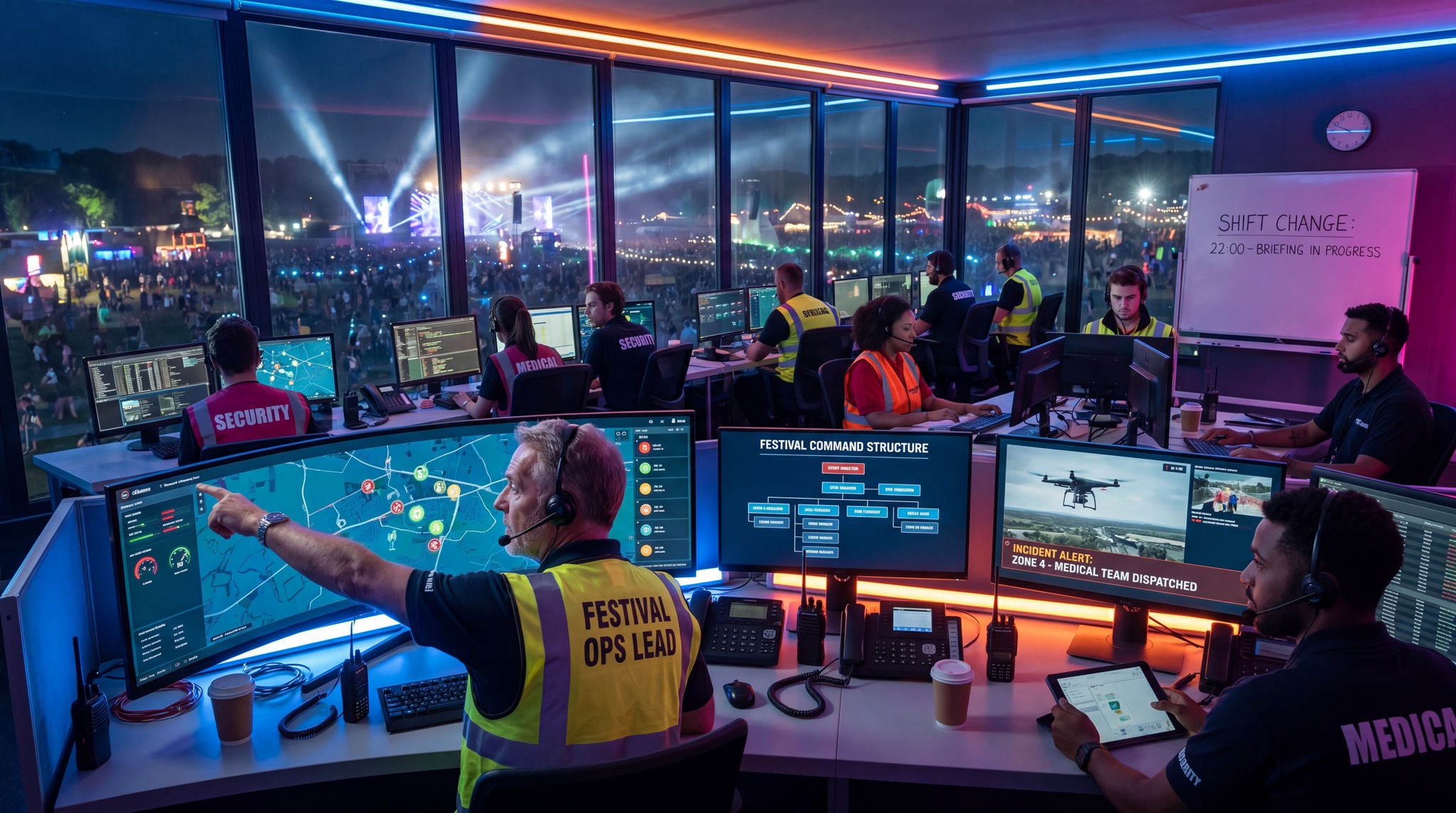
At a multi-stage festival, deploying gear is only half the battle; effective event sound system management is what keeps the entire production running smoothly. This discipline goes beyond simply mixing bands. It encompasses the logistical oversight of audio across the entire site, including radio frequency (RF) coordination for hundreds of wireless microphones and in-ear monitors, continuous sound pressure level (SPL) logging to satisfy local noise ordinances, and managing the power draw of massive amplifier racks. When evaluating the best sound system for events of this scale, organizers must look for networked audio capabilities—like Dante or AVB—that allow system techs to monitor the health of every amplifier and speaker from a central control tent. Proper management ensures that if a sudden issue arises at the dance tent, the lead audio systems engineer is alerted instantly, preventing a minor glitch from becoming a main-stage disaster.
Integrating Festival Sound and Lighting
While pristine audio is the heartbeat of any outdoor event, the visual spectacle is what elevates a good performance into an unforgettable experience. Coordinating festival sound and lighting requires meticulous cross-departmental planning. Organizers must ensure that the structural integrity of the main stage roof can support the immense weight of both flown line arrays and extensive lighting trusses. Furthermore, power distribution must be expertly managed; running audio and visual equipment on the same circuits can introduce unwanted electrical hums or buzzes into the PA system. By facilitating early communication between your lead audio engineer and the lighting designer, you can seamlessly integrate these technical elements, ensuring that dynamic visual cues perfectly sync with the sonic delivery without compromising safety or clarity.
Sourcing Your Festival Audio Solutions: Hiring the Right Vendor
For most promoters, acquiring a top-tier festival sound system doesn’t mean purchasing millions of dollars worth of gear; it means partnering with a reputable production vendor. Navigating festival sound system hire requires vetting audio companies based on their inventory, track record, and ability to scale. A boutique electronic gathering of 2,000 attendees has vastly different requirements than a sprawling multi-stage mega-festival. When sourcing a sound system for big events, you need a vendor capable of providing comprehensive festival audio solutions—from the main stage festival speakers and subwoofers to the intricate networking cables and power distribution systems.
When evaluating bids for a sound system for a festival, look beyond the equipment list. The best audio vendors supply not only industry-standard PA systems but also the seasoned system techs and engineers discussed earlier. Ensure their proposal includes comprehensive site surveys, acoustic modeling, and contingency plans for equipment failure. By treating your audio provider as a strategic partner rather than a simple rental house, you guarantee a cohesive, high-fidelity experience that scales perfectly with your audience size.
Budgeting for Your Festival Sound System
Allocating the right budget for your festival sound system is a balancing act that directly impacts attendee satisfaction and retention. While it might be tempting to cut corners on secondary stages, experienced promoters know that inconsistent audio quality can harm a brand’s reputation. When negotiating a festival sound system hire, factor in the hidden costs of logistics, such as trucking, crew accommodation, and specialized power requirements. Investing in premium festival audio solutions—especially when sourcing a robust sound system for big events—often yields a high return on investment by minimizing technical delays, satisfying high-profile artist riders, and ensuring the crowd stays engaged from the first act to the headliner.
Mastering Outdoor Concert Sound System Design
Effective outdoor concert sound system design begins long before the first speaker is flown. For festival producers, the design phase involves collaborating with acoustic consultants to map the venue’s unique topography. Unlike indoor venues, open-air environments lack natural acoustic boundaries, meaning deploying a reliable sound system for festival environments requires engineering the rig to project energy precisely where the crowd is, while mitigating spill into unwanted areas. Advanced 3D acoustic modeling software allows audio teams to simulate how different PA configurations will perform across the grounds. By investing time in meticulous audio architecture, organizers can ensure optimal speaker placement, accurate delay tower timing, and a cohesive auditory experience that scales seamlessly for any audience size.
Beyond Music: The Utility of Festival Audio
While delivering pristine musical performances is the primary goal, organizers must also consider how sound in a festival is used as a critical operational tool. A robust public address infrastructure serves multiple functions beyond entertainment. It is essential for crowd management, allowing stage managers to communicate schedule changes or direct attendee flow between sets. More importantly, your audio network is a vital component of your emergency action plan. In the event of severe weather or a site evacuation, the main PA system must be capable of overriding the performance mix to broadcast clear, authoritative safety announcements across the entire festival grounds.
Designing Sound for Success
When it comes to outdoor festivals, sound isn’t just another box to check – it’s a foundational element that can make or break the entire event. Success lies in balancing many factors: powerful technology, smart planning, and human expertise. As outlined above, the tools of the trade – from towering line arrays and well-placed delay towers to cutting-edge mixing consoles – provide the means to cover a vast outdoor audience with music. But using those tools effectively requires understanding the venue’s geography, the physics of sound, and even the whims of weather.
Perhaps the biggest takeaway for an aspiring festival producer is the importance of working with professionals who have done it before. Lean on the knowledge of sound engineers who can map out the field and foresee challenges. Build a budget that treats audio as a priority, not an afterthought. It can be tempting to overspend on flashy visuals or marketing and then trim the sound budget, but remember: attendees might forgive long lines, expensive food, or even a bit of rain – but they won’t forgive not being able to hear their favorite artist properly.
By investing in the right audio infrastructure and team, and by planning for worst-case scenarios (like high winds or strict noise curfews), you set the stage for something truly magical: every fan hearing the music as it’s meant to be heard, and the surrounding neighborhood hardly noticing the festival at all except for a faint bassline before closing time. That balance is achievable with the careful application of the principles outlined above.
In the end, delivering quality audio outdoors boils down to respect – respect for the music, for the audience’s ears, and for the community around you. A festival that nails its sound system setup creates an immersive sonic experience that becomes part of the event’s legend. Long after the lights go down, people might not talk about the speakers or the mixing desk, but they will remember how amazing their favorite song sounded echoing across that open field under the stars. And that is the hallmark of a festival done right.
Frequently Asked Questions
Why are line array speakers used for outdoor festivals?
Modern outdoor festivals use line array speaker systems because they deliver clear, uniform audio coverage to massive audiences. By aligning speakers in a vertical line, these systems project sound further and more evenly than traditional point sources, ensuring fans at the back hear almost as clearly as those in the front row.
How do delay towers work at music festivals?
Delay towers are secondary speaker systems placed within the crowd to extend sound coverage. Engineers introduce a precise audio delay to the signal feeding these towers so the sound arrives at the listener’s ears simultaneously with the sound from the main stage, preventing distracting echoes or lag for distant audience members.
How does wind affect outdoor concert sound?
Wind deflects sound waves, causing the audio mix to shift or momentarily drop out for parts of the audience. High frequencies like vocals are particularly susceptible to being scattered by gusts. Engineers mitigate this by using windscreens on microphones and adjusting the system EQ or volume in real-time during the show.
How do festivals prevent noise complaints from the community?
Organizers manage noise by directing line array speakers inward toward the audience and using cardioid subwoofer arrays to cancel rear-facing bass energy. Audio teams also monitor decibel levels at the venue perimeter using sensors and adhere to strict curfews to ensure sound does not disturb nearby residential areas.
What is scene recall on digital mixing consoles?
Scene recall allows audio engineers to save specific settings for each band’s soundcheck and instantly retrieve them when the act takes the stage. This feature is vital for festivals with quick set rotations, ensuring the mix is dialed in swiftly and consistently without requiring a full soundcheck between every performance.
Why is audio system calibration necessary for outdoor events?
System calibration involves setting the correct EQ, delay, and volume for each speaker cluster to ensure the entire setup functions as one cohesive system. Proper calibration prevents destructive interference between speakers and eliminates dead zones, ensuring that every listener in the field experiences balanced and powerful sound.
What should organizers look for when hiring a festival sound system?
When arranging a festival sound system hire, organizers should look for a full-service audio vendor that provides scalable solutions, industry-standard speakers, and experienced system engineers. A reliable partner will offer acoustic modeling, comprehensive site surveys, and robust contingency plans to ensure the sound system for the festival performs flawlessly under demanding outdoor conditions.
What are the best speakers for music festivals?
The best music festival speakers depend on the event’s size, genre, and location. Most large-scale events rely on premium line array systems from top-tier manufacturers because they offer precise directional control and scalable coverage. Organizers should work with audio vendors to select a festival speaker system tailored to their specific lineup, ensuring adequate subwoofer support for bass-heavy acts and clear mid-range projection for live bands.
What is included in comprehensive festival audio solutions?
Comprehensive festival audio solutions encompass much more than just the main stage speakers. A full-service package typically includes the primary line arrays, subwoofers, delay towers, digital mixing consoles for front-of-house and monitors, stage wedges, in-ear monitor systems, microphone packages, and all necessary power distribution and networking cables. Additionally, top-tier audio vendors provide the acoustic modeling, system design, and experienced engineering staff required to operate the equipment safely and effectively.
What is involved in event sound system management?
Event sound system management involves the comprehensive oversight of all audio operations across a festival site. This includes designing the PA layout, coordinating radio frequencies for wireless gear, monitoring sound pressure levels for compliance, and managing the network infrastructure that connects multiple stages and delay towers.
How do organizers choose the best sound system for events?
Choosing the best sound system for events requires analyzing the venue’s topography, the expected crowd size, and the musical genres being performed. Promoters should partner with experienced audio vendors who use acoustic modeling software to recommend the ideal combination of line arrays, subwoofers, and delay systems tailored to the specific site.
What are the key elements of outdoor concert sound system design?
Effective outdoor concert sound system design relies on comprehensive site surveys, 3D acoustic modeling, and strategic speaker placement. Audio engineers must account for the venue’s topography and weather patterns to configure line arrays and delay towers that deliver uniform coverage while minimizing noise bleed into surrounding neighborhoods.
How do organizers coordinate festival sound and lighting production?
Successful coordination of festival sound and lighting requires integrated site planning, shared rigging schematics, and separate power distribution to prevent electrical interference. Promoters often hire full-service production vendors or ensure strict communication between audio and visual crew chiefs during the design phase to guarantee both elements operate flawlessly together.
What is FOH in concert production?
FOH, or Front of House, is the primary audio and lighting control position located within the audience area, facing the stage. This setup allows the lead sound engineer to mix the audio from the crowd’s perspective, ensuring the festival sound system delivers the best possible experience to the attendees.
What defines an optimal festival speaker setup?
An optimal festival speaker setup involves strategically configuring line arrays and subwoofers to provide even, full-frequency coverage across the audience area while minimizing sound spill. This requires precise acoustic modeling, correct speaker splay angles, and proper time alignment between the main stage hangs and any delay towers.
How is sound in a festival used beyond musical performances?
Beyond amplifying artists, sound in a festival is used as a vital operational and safety tool. The PA system facilitates crowd management announcements, schedule updates, and critical emergency broadcasts, ensuring organizers can communicate clearly with attendees across the entire event site.
What defines the best sound systems for festivals in 2025?
The top festival audio rigs in 2025 prioritize advanced digital signal processing (DSP), networked audio capabilities (like Dante or AVB), and hyper-directional sound control. These modern systems allow engineers to steer audio precisely, maximizing audience coverage while minimizing noise bleed into surrounding neighborhoods.
What are the main types of speakers for events?
Event organizers typically utilize line array systems for main stage coverage, subwoofers for low-frequency extension, and point-source speakers for fills, VIP areas, or smaller secondary stages. Delay towers are also deployed to extend the primary audio signal to distant crowd zones without losing clarity.