When crowd conditions or weather hazards turn dangerous, every second counts. Festival organizers must be ready to stop the show at a moment’s notice to prevent tragedies. History has shown that swift action can avert disaster, while hesitation or confusion can lead to chaos. From deadly crowd surges to sudden lightning storms, knowing when and how to pause a performance isn’t just prudent – it’s a critical safety skill. This guide draws on real-world incidents and veteran knowledge to help any festival, large or small, build a rock-solid “stop the show” protocol into their safety plan.
Learning from Close Calls and Tragedies
When Seconds Count: Quick Action vs. Costly Delay
Major festivals have experienced both lifesaving interventions and devastating failures in emergencies. Astroworld 2021 in Houston is a stark example of what can go wrong. As crowd crush conditions developed, on-site first responders were performing CPR on attendees, yet the performance continued for critical minutes, as reported by CNN and local news outlets. Houston’s police chief later revealed they had urged event organizers to stop the show once they saw people receiving CPR, but ultimate authority rested with festival production and the performer, according to police statements. The delay in shutting down the music contributed to 10 fatalities and hundreds of injuries. This tragedy underlined that without a clear, empowered safety chain of command, staff on the ground may recognize an emergency but feel unable to halt the performance in time.
Contrast that with Lollapalooza 2012 in Chicago, where swift action likely saved lives. When a severe thunderstorm was detected, organizers didn’t hesitate – they suspended the festival and evacuated roughly 60,000 attendees into pre-designated shelters before the storm hit, a move praised for prioritizing attendee safety. A spokesperson for promoter C3 Presents summed up their approach: “We regret having to suspend any show, but safety always comes first.” The storm blasted the empty park with high winds and rain, but thanks to proactive steps, no one was harmed and the event resumed after the weather passed with an adjusted schedule, minimizing disruption while ensuring safety. Lollapalooza’s handling has since been cited as a model for weather preparedness, especially after earlier years when plans were less clear, according to local news analysis. The lesson is clear – act early, act decisively, and crowds will follow your lead.
Europe learned similar lessons the hard way. At Roskilde Festival 2000 in Denmark, nine people died in a crowd crush during Pearl Jam’s set when fans surged forward on rain-slicked ground, prompting new crowd safety measures. Band members eventually begged the crowd to step back and stopped playing, but by then the damage was done. The tragedy spurred European festivals to introduce front-of-stage divided barrier pens and better crowd monitoring. It also showed that artists must sometimes assist in calming the audience, a vital strategy for preventing surges. On the other hand, quick artist intervention has prevented harm in many cases – from Linkin Park halting a 2001 London show mid-song to pull up fallen fans (with vocalist Chester Bennington urging, “We gotta look out for safety first… Nobody gets hurt”), an example of artist intervention prioritizing fan safety, to Adele stopping her 2011 concert when she saw a fan faint and demanding medics reach them, showing that performers can control the room and ensure immediate medical attention. These examples, across continents and genres, reinforce a key point: Empower your team – including performers – to pause the show at the first sign of danger. It’s better to deal with a brief interruption or unhappy headliner than a preventable catastrophe.
Notable Festival Emergency Stop Cases:
| Event (Year, Location) | Hazard | Response | Outcome & Lessons |
|---|---|---|---|
| Astroworld (2021, USA) | Overcrowding & crowd crush | Show not stopped promptly despite distress signals in crowd. | Catastrophic: 10 fatalities, hundreds injured; highlighted lack of clear stop-show authority and communication, as reported by CNN and confirmed by police. |
| Lollapalooza (2012, USA) | Severe thunderstorm | Festival paused early; ~60,000 attendees evacuated to shelter before storm. | Successful: No injuries; event resumed after storm with adjusted schedule. Cited as a model for effective weather evacuation, driven by safety priorities and ensuring the show continued safely. |
| Roskilde Festival (2000, DK) | Crowd surge in rain | Band eventually halted performance as fans fell and were pulled out. | Tragic: 9 fatalities; led to new front-of-stage barrier designs and stronger artist involvement in crowd safety in Europe, prompting new crowd safety measures. |
| Pukkelpop (2011, BE) | Sudden windstorm, stage collapse | Festival in progress when extreme winds hit; main stage collapsed. | Disastrous: 5 fatalities, many injured; prompted industry-wide focus on real-time weather monitoring and structural safety protocols. |
Every incident above shows why having a stop-show plan is non-negotiable. In emergencies, time lost is lives lost. The following sections detail how to build and implement a protocol so your team can pause or cancel performances immediately when needed – and do so in a way that keeps the crowd safe and informed, with minimal chaos.
Planning a Festival?
Ticket Fairy's festival ticketing platform handles multi-day passes, RFID wristbands, and complex festival operations.
Building a “Stop the Show” Protocol into Your Safety Plan
Stopping a performance for safety reasons should never be an ad-hoc decision. It needs to be baked into your overall Emergency Action Plan (EAP) from the start. Here’s how to establish a clear protocol and chain of command that empowers your team to act without hesitation.
A well-documented show stop procedure serves as the operational backbone during these critical moments, transforming a potentially chaotic situation into a highly organized, step-by-step response.
Clear Authority: Who Can Halt the Show?
In any festival emergency plan, it must be crystal clear who has the authority to stop the music and halt a performance, a critical step in festival emergency procedure drills. Typically, this responsibility lies with the Festival Director or a designated Safety Officer on site. It’s often done in consultation with key officials – for example, a senior safety officer in the event control room conferring with the head of security, or with on-site police/fire commanders if they’re present. What’s critical is that everyone from stage managers to the performing artists knows exactly who gives the “stop” order. Decisiveness is crucial – the faster the event is paused, the faster attendees can shift their attention to safety instructions instead of the performance, minimizing chaos during emergencies.
Establish this chain of command early in planning. Document it in the EAP and brief all departments: “In an emergency requiring a show stop, [Name/Role] has the final call to cut the music.” At large events, this might be the Event Safety Officer or Operations Director in the Unified Command center (where festival officials and emergency services work together). At a small 500-person event, it might just be the organizer themselves. The key is that frontline staff never waste time figuring out “who do we ask to stop the show?” when seconds matter. They should have a direct line (usually via radio) to that decision-maker or a protocol to follow immediately.
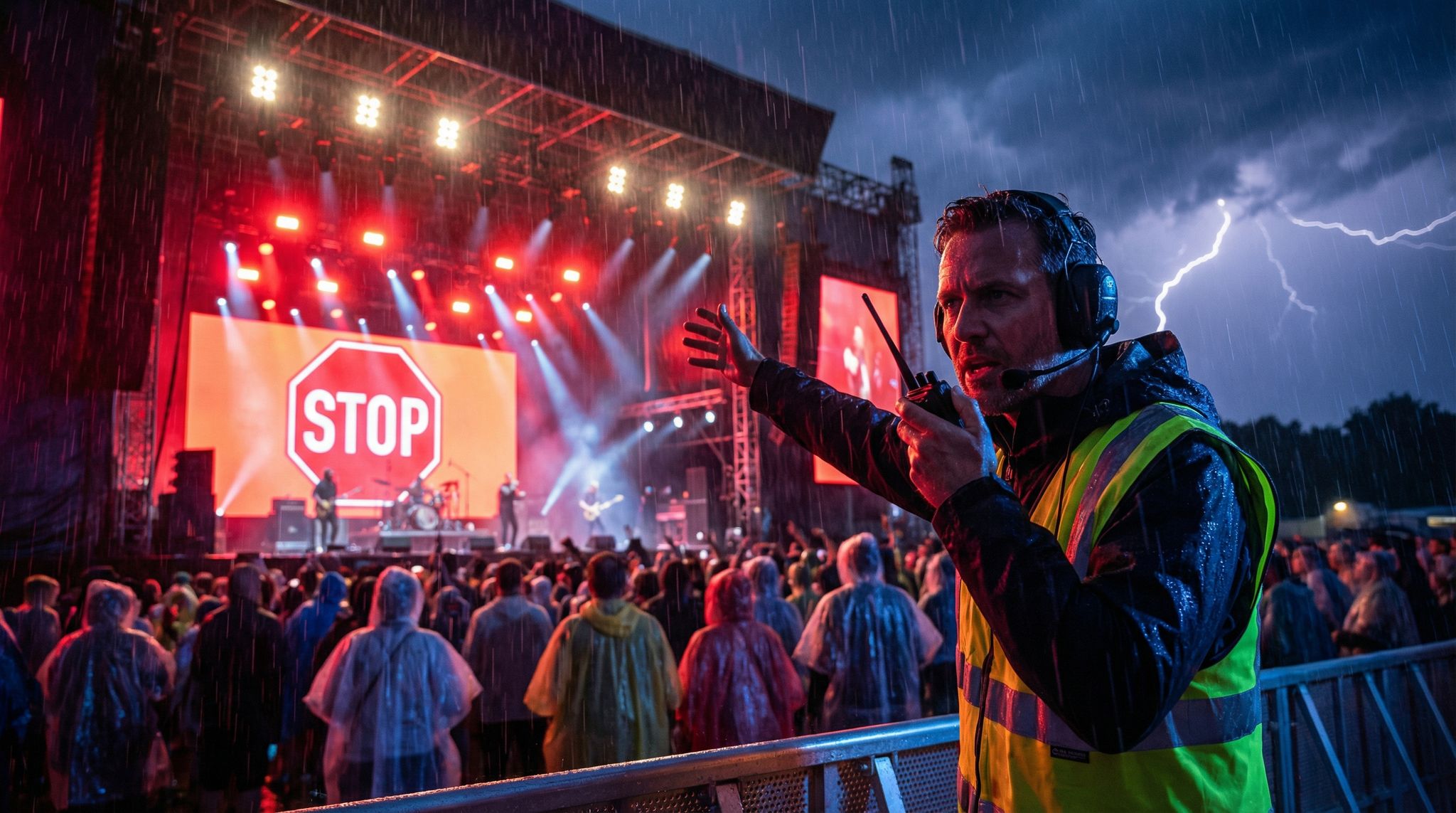
Many festivals adopt an Incident Command System (ICS) approach, uniting all key responders under one structure, effectively coordinating with on-site emergency services. Under a unified command, the person with stop-show authority is in constant communication with security, medical, and technical leads. For example, at a major EDM festival the Safety Officer might be monitoring crowd density and weather in real time from the control center. If a serious hazard is confirmed – say, lightning within 6 miles or a crowd collapse – they can radio the Stage Manager, “Code RED, stop the music now,” and simultaneously instruct the sound engineer to cut power. This authority should also extend off-hours if needed: if dangerous conditions arise before the festival day starts (e.g. an incoming morning storm), that official can delay gate opening or suspend performances proactively.
Pro Tip: Define a backup for the stop-show decision. If the primary person (e.g. Festival Director) is unreachable or incapacitated at the moment of crisis, who’s next in command? Having a deputy (like the Head of Security or Operations Manager) authorized to pull the plug ensures there’s never a single point of failure in your safety chain of command.
Pre-Set Triggers: When to Press Pause
Determining when to stop a show shouldn’t rely on gut feeling in the heat of the moment. Experienced producers set specific trigger criteria in advance for various scenarios. By establishing these thresholds, your team isn’t debating what constitutes an emergency – they know ahead of time what the red lines are.
Some common stop-show triggers and thresholds:
– Severe weather: Define precise weather triggers from your contingency plan. For example, the widely adopted “30/30 rule” for lightning dictates that if the flash-to-thunder time is 30 seconds or less (lightning ~10 km away), immediately suspend outdoor performances and tell attendees to seek shelter, a standard expert on-site operations guideline. Only resume 30 minutes after the last thunder clap. Many major festivals follow this standard to prevent lightning strikes in crowds, reducing weather-related injuries. High winds are another – you might plan a “wind hold” if sustained winds exceed, say, 25–30 mph (especially for stages with roofs or hanging sound/lighting gear), ensuring weather-safe festival structures. In practice, this could mean pausing the show and dropping (lowering) any high rigging elements until winds subside, setting clear wind speed triggers and defining hold vs. drop protocols for securing major structures. Rain on its own might not stop a show, but electrical storms, hail, or flash flooding should all have predefined action points (e.g. “if water starts pooling on stage or winds make it unsafe for techs, pause and secure equipment”). Early-warning weather systems or an on-site meteorologist can feed you data, but the plan must say: at X condition, we pause – no exceptions.
– Crowd safety hazards: Use your risk assessment to set crowd-related triggers. One example is crowd density or distress at front-of-stage. If security observes fans getting crushed against a barricade, or multiple people needing extraction due to fainting or panic, that stage’s performance should stop immediately. Front barricade security are trained to signal the stage crew or DJ to cut the music if they see people in danger, a key part of security incident response and ensuring rapid communication. Another trigger: if a barricade or structural element starts to fail (barrier bending, floor bending, tent pole tipping), staff should halt the show right away to avoid total collapse, prioritizing safety over the show. Modern festivals often deploy real-time crowd monitoring tech (cameras, AI counting systems) that can alert when a zone is over capacity or a surge is forming, utilizing modern technology for crowd monitoring. But even low-tech observations count – if your security team or spotters see waves of movement that indicate a developing crush, stop and investigate. As the saying goes, “If in doubt, take a time-out.”
– Serious medical emergencies: A single injury usually doesn’t justify stopping an entire show – medics can work while music plays. But certain situations do. If someone is unconscious in a dense crowd or requires CPR (cardiac arrest, seizure, etc.), it can warrant pausing the performance on that stage. This prevents added jostling, allows medics to literally hear each other and the patient, and focuses the crowd’s attention on assisting (e.g. making space). Artists should be briefed to watch for distress signals (fans waving arms, calling for help) and to cooperate fully if they’re asked to pause for a medical emergency. Many acts will do this on their own once they notice a problem – there are famous clips of performers like Linkin Park, Dave Grohl, Billie Eilish and others stopping mid-song to call for medics in the crowd. From a protocol standpoint, empower your pit security or stage manager to cut sound if needed when a critical medical rescue is underway in front.
– Security threats or violence: If a major fight, weapon threat, or other security emergency erupts, you may need to stop the music and possibly initiate an evacuation or shelter-in-place. Smaller disturbances (a fistfight) can often be handled quietly by security without stopping the show. But any incident involving a weapon, active threat, or mass panic is cause to hit pause and get people to safety. For instance, reports of shots fired (even unconfirmed) at a venue should trigger an immediate show stop and instructions for cover or exit – you cannot continue entertainment in that scenario. Coordinating with on-site police in advance is key here; if law enforcement or your security control calls an emergency, your team should trust that and pause.
– Fire or structural issues: A fire in any festival area is a no-brainer show stop signal. Whether it’s a blaze on stage (e.g. an electrical fire in an amp) or a tent catching fire in the food court, you need to get the crowd’s attention away from the performance and onto evacuation or fire response. Likewise, structural collapse risks like a swaying stage roof, falling lighting truss, or swamped scaffolding mean immediate hold. In 2018, part of a stage at a Spanish festival began to buckle from overload; organizers spotted it in time and cleared the area moments before a collapse – averting injury. The show stoppage in that case likely saved lives. The takeaway: if something looks dangerously unstable, don’t hope it holds – stop, clear the area, and fix it before resuming.
The above triggers should be integrated into your plan as explicit statements. For example: “If lightning is within 6 miles, Festival Control will suspend all outdoor performances.” Or “If any stage barricade shows signs of failure or crowd crush, that stage’s act must pause immediately and will not resume until the Safety Officer gives all-clear.” This removes ambiguity. Seconds count, so you want the entire team to act in unison once a threshold is met – not waiting for five different approvals. As one industry safety guide bluntly notes, “history has shown that delaying an evacuation or failing to halt a show when weather threatens can lead to catastrophe”, as expert operations teams know. It’s far better to err on the side of caution and have a brief interruption than to gamble and face a disaster.
The Mechanics: How to Stop a Show Safely
Halting a performance is not as simple as flipping a switch – but it needs to feel that immediate to your team. Here’s how festival veterans orchestrate a safe and orderly stop:
Grow Your Social Following With Every Sale
Require social media follows, shares, or playlist adds to unlock presale access or special pricing. Turn every ticket purchase into audience growth.
- Have a signal and procedure in place: Decide on a code word or signal that means “stop the show now” and ensure all staff know it. Commonly, festivals use a specific radio call (e.g. “Code Red at Main Stage”) to trigger an emergency stop, as outlined in festival emergency procedures. Some events also have a visual cue for stage crews – for example, a red strobe light at the monitor desk or a red card that a stage manager can flash to an artist/DJ. In smaller venues, simply killing the main power amps or stopping the music track serves as an immediate cue. Make sure the protocol is: when the designated authority issues the stop order, sound engineers immediately mute audio, and if at night, lighting engineers bring up house lights (to illuminate the area), helping manage the crowd environment. This dual action – cut sound, raise lights – is very effective. It snaps performers and attendees out of “performance mode” and signals that something else needs attention, effectively signaling a shift to safety.
- Brief the performers and crew: Before the festival (or each set), inform artists and their teams that a show stop may occur on your instruction for safety reasons. Incorporate a note in the artist advance pack and have stage managers remind them. The artist should know that if they see house lights go on or crew waving them down, they must stop playing immediately. No finishing the song or hyping the crowd – just pause and await instructions. Top festival production managers recount that most artists are cooperative when they understand it’s about fan safety. In fact, many performers appreciate knowing the event has thought this through. (It can also be written into the performance contract/clause that the festival has the right to interrupt the set for safety.) Drummers, pyrotechnics operators, and others on stage should also be told: lights on means stop everything for now. Reassure artists that the music will resume as soon as it’s safe – or if not, that they’ll be taken care of. This avoids panic or frustration on their end.
- Train your tech staff on emergency cues: Do at least one run-through with your stage crews and sound/light teams about executing a stop. For example, practice a scenario where the call comes to pause Stage 2: the stage manager radios “All stop now”, audio fades out, the MC or safety officer takes the mic for an announcement, etc. Time it – how long does it take from the decision to stop to the music actually halting and message being delivered? Aim for well under one minute. Every second an emergency is unfolding while music blares is a second people may not hear instructions or may remain oblivious to dangers. Some festivals even have a “kill switch” system where the control center can override and cut power to stages remotely if needed. However, this is a blunt tool – it’s better when a human at the stage can coordinate the pause smoothly (abrupt silence in a huge crowd can cause confusion if not immediately followed by an announcement). The bottom line is practice the mechanics: who calls whom, what steps happen, and how you’ll communicate to the crowd, so it’s almost muscle memory.
- Coordinate with security and operations: The moment a show is stopped, security teams should spring into their secondary roles. Brief your security supervisor and volunteers that a pause means they might need to assist in guiding the crowd or responding to whatever issue prompted the stop. For instance, if it’s a crowd crush concern, as soon as music stops security can use the lull to direct fans to “take two steps back” from the front – something artists or MCs can also lead. If it’s a weather issue and an evacuation may follow, security should move to exit posts ready to guide people out calmly. Essentially, a show stop triggers a broader emergency protocol, so all departments – not just stage crew – need to know their part in those first moments.
Implementing a formalized show stop procedure ensures that every technical and security team member understands their exact role the moment an emergency is declared. This includes mastering both the visual cues and knowing exactly what to say when giving the signal to get off the stage via the artist’s monitors. As the live event industry moves toward more rigorous crowd management safety protocols for 2026, having these standardized, documented steps will become a mandatory compliance standard for venue operators and festival producers alike.
By defining the exact triggers and having rehearsed procedures to stop a show, you remove uncertainty. Your team gains the confidence to make the tough call immediately when needed. And as we’ll discuss next, stopping the music is just step one – what you say and do next with the crowd determines whether the pause goes smoothly or descends into chaos.
Need Festival Funding?
Get the capital you need to book headliners, secure venues, and scale your festival production.
Communicating With the Crowd During a Pause
Once the music has been cut for an emergency, clear and calm communication with attendees becomes the top priority. The sudden silence or lights can alarm people – your job is to inform them why this is happening and what they need to do, in a way that maintains order. This is where a well-crafted messaging plan and trained personnel make all the difference.
Calm, Clear Announcements (Not Panic)
The first thing the crowd should hear after a show stop is an authoritative, reassuring voice on the microphone. Ideally, a pre-designated person (the Stage MC, festival director, or safety officer) will address the audience immediately. Prepare a brief script for various scenarios so you’re not scrambling for words. For example:
- Weather pause: “Ladies and gentlemen, due to unexpected weather conditions, we need to pause the show for your safety. Please listen carefully and follow our instructions. We ask everyone to calmly proceed to the nearest exit and take shelter in the parking garage or your vehicles. The performance will resume once the storm passes and it’s safe. Please walk slowly and stay calm – safety is our priority.”
- Medical emergency in crowd: “Attention everyone: we have a medical situation at the front. Please step back and give our medics space to work. We are temporarily stopping the show. Remain where you are and stay calm. If you’re near the incident, please follow staff directions. We’ll continue the music as soon as we’ve given the proper care. Thank you for your cooperation.”
- Security issue (requiring evacuation): “Ladies and gentlemen, your attention please. Due to an unexpected emergency, we need to stop the event at this time. For your safety, we require everyone to calmly make their way to the exits and follow the directions of staff and security. There is an issue that requires us to clear the area. Walk, don’t run, and please assist those around you. We appreciate your cooperation – everyone’s safety is our top concern.”
Notice the tone in these messages: direct but non-alarmist. Using phrases like “for your safety” and “please stay calm” reinforces that the situation is under control (or being managed) and that the organizers are looking out for attendees. Avoid triggering words like “panic”, “terrorist”, “bomb”, or overly dramatic language. If it’s a weather issue, say “unforeseen weather” rather than “dangerous lightning” – the crowd just needs to know it’s not safe right now and what to do next. If it’s a potential threat, you might not want to specify (“there’s a threat”) which could incite fear – it’s often enough to instruct evacuation without detail. Clarity is king; tell people exactly where to go: “nearest exit and to your cars or the garage” is better than “find shelter” in vague terms, utilizing mobile apps for alerts and keeping instructions simple. Give geographically relevant guidance if possible (e.g., “those in the north field, use Walnut Gate; south field, use Pine Gate”). And always encourage calm movement: people take cues from the announcer’s demeanor.
Repeat the announcement at least twice, in standardized form. The first time, many will be stunned or not catch all details. A second pass (or periodic repeats) helps reinforce it. Also, utilize all channels: as you speak over the PA, have the same message (if possible) displayed on any large LED screens or tickers, reinforcing the message visually. If your festival has a mobile app with push notification ability or an SMS alert system, send out the announcement text simultaneously. Modern mass notification tools let you blast to texts, app, social media, and even electronic signage within seconds, using emergency mass notification tech and ensuring multi-channel communication. The key is a consistent, unified message across all platforms, so maintain a single authoritative source. Attendees should not be hearing conflicting information from different sources – that breeds confusion. This is why writing these messages in advance is so important. You can store pre-written alerts for things like weather evacuation, then just fill in a blank (like which shelter location to go to) and hit send when needed, preventing confusion from piecemeal instructions and ensuring messages come from a single authoritative source.
Go Cashless With RFID Technology
Enable contactless payments, faster entry, and real-time spending analytics with RFID wristbands and NFC-enabled ticketing for your events.
Multi-Channel Alerts and Staff Coordination
Relying on a single communication method is risky. Loud music may have just been playing, ears could be ringing, not everyone will hear the first announcement. A best practice is to use a multi-channel alert system to ensure everyone gets the word, leveraging multi-channel alert systems. Here are layers to consider:
- PA system: Your primary tool. Ensure your PA can override all stages/zones if needed (or at least each stage PA for localized issues). It should be loud and clear. If power is out, have battery-powered bullhorns as backup at each stage.
- Visual displays: Use video walls or LED screens to flash instructions (“SEVERE WEATHER – PLEASE EVACUATE TO PARKING LOT A” in big text). Even a simple text crawler is useful in noisy environments. For multi-language audiences, rotating messages in the top 2-3 languages can be invaluable (or use universally recognized symbols for exits/shelter).
- Mobile alerts: If you have attendee phone numbers from ticketing, an emergency SMS blast can reach thousands instantly, a key takeaway for organizers. For instance, a text like: “Festival Update: Lightning in area. ALL guests must evacuate to shelter NOW. Follow staff to exits. Updates to follow.” People nearly always check a text. Push notifications via a festival app can similarly notify those who installed it – though SMS covers even those without the app. Ticket Fairy’s festival ticketing platform gives organizers access to attendee data and integrates with email and messaging tools, which means you can swiftly contact all ticket-holders via text or email in a crisis. Leveraging such tech ensures no one misses the memo if they’re away from a stage or in the restroom when announcements hit.
- Social media & website: Quickly post the same emergency message on your official Twitter, Instagram, Facebook, and event website. Attendees often look online for info when something’s up. A unified post saying “We have paused the festival due to weather – all attendees are directed to the arena concourse for shelter. Stay tuned for updates.” both informs those on-site and reassures those off-site (like parents or friends) that the situation is being handled. Keep updating periodically on these channels with status (e.g. “Storm passing, hoping to resume in 30 minutes, stay sheltered until 5:00 PM”).
- Staff on the ground: Technology aside, human messengers are critical. Train security, volunteers, and staff to echo key instructions to people directly, allowing staff to take action without inciting fear. For example, security guards at each exit can calmly say “Please make your way out this gate and into the parking garage for shelter, folks. Take it slow, there’s plenty of time.” Front-of-stage crew can turn to the crowd and use hand signals and shouts to “Back up, back up” if it’s a crowd crush stop. People are more likely to move orderly if staff near them are modeling calm behavior and giving the same message as the PA. Consider having bilingual staff or pre-printed prompt cards if you have a very international audience and need to convey instructions in multiple languages, utilizing clear pictogram signage.
- Visual guides: If evacuating, have exit signs clearly visible (lighting up emergency exit signs if it’s dark) and even think about directing people via lighting – e.g., flashing lights pointing toward exits or using LED wristbands (if your festival uses those) to signal an alert color. In some cases, recorded voice announcements or tones can supplement live instructions (some mass notification systems play a loud siren or tone to get attention before the voice message – stadiums often do this).
Finally, maintain communication throughout the incident. Don’t leave the crowd in the dark (figuratively). After the initial instruction, give updates every few minutes, even if just “Thank you for your cooperation, please remain in shelter, we are waiting for the storm to pass and will update you in 10 minutes.” Silence or lack of info breeds rumors and fear, so always plan for the next event. If it’s a longer suspension, consider playing a calm ambient music track or have an MC tell a few jokes (if appropriate) once the initial urgent action is done – anything to keep people calm and assured. If the event must be canceled outright, that message should be delivered as soon as the decision is made, with clear info on next steps (like “stay tuned for email info on refunds or follow staff to exit safely now”).
The goal of all this is to reduce panic and encourage cooperation. A crowd that understands what they need to do and why will usually do it, even if disappointed. For example, when a massive storm hit a European festival in 2019, pre-scripted multilingual announcements directed attendees to secure areas; attendees later reported how orderly the evacuation felt because staff were well-prepared and the messaging was clear and calm. Many even thanked the organizers on social media for putting safety first. You want that kind of outcome – not viral videos of confusion or stampedes.
Resuming the Show (or Not) and After-Action Steps
One of the great advantages of a well-executed show stop is that you can often resume the event once it’s safe, and do so without major backlash from the crowd. Fans will generally understand a pause or cancellation if they see it was handled competently and for the right reasons. That said, knowing how to restart after an interruption – or decide not to – is an important part of the protocol.
All-Clear and Safety Checks Before Restart
Never rush to resume entertainment until the original hazard is truly abated. This may mean waiting out a storm, confirming a structural fix, or getting a medical all-clear. Your safety officer (with input from relevant experts) should give the “all-clear” signal when it’s OK to continue. For example, after a lightning delay, standard practice is to wait at least 30 minutes from the last observed lightning before resuming, a standard safety guideline for weather. If you evacuated to shelters, check the weather radar and have your meteorologist or local officials confirm the storm cell has passed. Inspect critical infrastructure before calling people back: stage crew should examine whether the stage, lights, sound, and video walls are all intact and safe after high winds or rain. In one case, a festival was set to restart after a storm pause, only to find that a speaker stack had loosened – had they not checked, it could have fallen when music restarted. Take the time to walk the front-of-house, barricades, and other areas for any signs of damage or new hazards, ensuring equipment is dry and functional after a storm. It’s hard to keep an excited crowd waiting, but announcing “just a few more minutes for safety checks” is far better than restarting too soon and experiencing a second incident.
When conditions are confirmed safe, do a reverse communication: announce the good news! For example: “Thank you for your patience – the storm has passed and we’ve gotten the all-clear from safety officials. We will resume the show at 4:00 PM. Please make your way back in calmly; our staff will guide you. The schedule will adjust but the music will continue!” Let people know if you’re skipping certain acts or extending the schedule to make up time (within reason and local curfew limits). Most fans will be just happy the event is continuing. Use screens and social media to amplify the update as well. If you had a partial evacuation, you might reopen only certain areas first – communicate any phased return (“those in the south garage can re-enter first by Gate A,” etc.).
Consider playing some upbeat but lower-volume music as people file back in, to lift the mood and signal a return to normalcy. Have MCs or artists acknowledge the situation positively: e.g., “Give it up for yourselves for handling that so well – we’re back and we’re gonna make it worth the wait!” This helps turn a potentially sour experience into a bonding moment for the audience. They went through a trial but came out safe and can now celebrate.
Importantly, if during the pause you determine it’s not safe to continue the show at all – whether due to persistent weather, a safety issue that can’t be fixed, or a security situation – then prioritize a smooth, safe cancellation process. Announce clearly that the event will not resume and provide immediate guidance (like whether attendees should evacuate fully, where to go for more info, etc.). You may not have all the answers in the heat of the moment (like refund details), but focus on getting everyone out calmly. After a full cancellation, follow up via email or social channels within hours to explain next steps (this is more about PR, but it helps maintain trust that you put safety first and will make things right by the ticket holders).
Post-Incident Debrief and Improvements
Once the dust has settled – later that night or the next day – gather your team for a debrief. Review how the stop-show incident went. Key questions:
– Did we detect the issue early enough? (If not, how can we improve monitoring or get front-line staff to report faster?)
– How fast did the show actually stop once we gave the order? (Were there any delays or confusion in cutting the sound, notifying the artist, etc.?)
– Did our communications reach everyone effectively? (Any reports of attendees not hearing the announcement or being confused? This is where attendee feedback and staff observations are valuable.)
– How did the crowd behave and how did staff perform? (Were there any choke points during evacuation or return? Staff all in position? Any signs of panic that could be prevented next time?)
– What went well, what didn’t? (Maybe your SMS system was slow or a generator failed, but volunteers did a great job helping those with disabilities move – note it all.)
Document these findings and update your emergency action plan accordingly. These real experiences are gold for refining training. You might realize, for example, that your code word wasn’t obvious enough, or that you need more bullhorns at exit gates. Or maybe the incident revealed a need for better crowd insurance or liability coverage in your planning (e.g., weather insurance, etc.). Always loop back and fix the gaps for next time, ensuring you never leave attendees wondering.
Also consider a public follow-up: if the stop made news or caused a lot of social media chatter, a transparent explanation on your website or through media can bolster your reputation. For instance, “We stopped our festival yesterday due to a weather emergency. We want to thank attendees for cooperating – about 45,000 people calmly took shelter and we were able to resume after 90 minutes when it was safe. Huge thank you to our safety team and local authorities. We know it was an inconvenience, but your safety comes first. Here’s some photos of everyone making the best of it in the parking garages – truly the best fans!” That kind of recap not only clears any confusion but turns the narrative into a positive one of competent management.
Finally, recognize your team for a job well done. If security guards, volunteers, or any staff went above and beyond to execute the pause smoothly, acknowledge them in the debrief and even publicly. These situations are stressful, and your crew’s composure is what made it work. Celebrate that success (or well-managed crisis). It reinforces the safety-first culture and empowers everyone to handle future incidents with even more confidence.
Frequently Asked Questions
Who has the authority to stop a festival performance during an emergency?
The Festival Director or a designated Safety Officer typically holds the final authority to stop a performance. This chain of command must be established in the Emergency Action Plan so frontline staff know exactly who to contact. In unified command structures, this decision often involves consultation with police or fire officials.
What are the common triggers for stopping a live music performance for safety?
Standard triggers for pausing a show include severe weather like lightning within 6 miles, visible crowd distress or crushing at the barricades, structural failures of the stage, or serious security threats. Experienced producers set specific thresholds, such as wind speeds exceeding 30 mph, to remove ambiguity during a crisis.
What is the 30/30 rule for lightning safety at outdoor festivals?
The 30/30 rule dictates that outdoor performances must be suspended if the time between lightning and thunder is 30 seconds or less, indicating the storm is within roughly 6 miles. Organizers should evacuate attendees to shelter and wait at least 30 minutes after the last thunderclap before resuming activities.
How should organizers communicate a show stop to the crowd to avoid panic?
Organizers must use a calm, authoritative voice over the PA system to deliver clear, pre-scripted instructions immediately after the music stops. Messages should explain the reason briefly, direct attendees to specific exits or shelters, and be reinforced through video screens, mobile app push notifications, and SMS alerts to ensure compliance.
What signs indicate a crowd crush requires stopping a performance?
Immediate show stops are necessary if security observes fans being crushed against barricades, waves of uncontrolled movement, or multiple people fainting and requiring extraction. Front-line staff and artists should watch for distress signals like fans waving arms or calling for help, as swift intervention prevents fatal surges.
What is the technical procedure for halting a concert stage during an emergency?
The technical protocol involves a designated code word or signal, such as “Code Red,” that triggers sound engineers to mute audio and lighting crews to bring up house lights immediately. This dual action snaps the audience out of performance mode and signals that attention must shift to safety announcements.
When is it safe to resume a festival performance after a weather delay?
Performances should only resume once the Safety Officer issues an “all-clear” based on expert data, such as confirming a storm cell has passed. Before restarting, crews must inspect critical infrastructure like stage rigging and audio equipment for damage to ensure the venue is safe for artists and attendees.
Why is it critical to include a “stop the show” protocol in festival planning?
A pre-defined protocol ensures staff can act instantly to prevent tragedies like crowd crushes or weather disasters without hesitation. History shows that delays in stopping a performance can lead to fatalities, whereas empowered teams with clear authority and triggers can evacuate crowds safely and potentially resume the event later.
What is the standard signal to get an artist off the stage during an emergency?
The most effective signal to get an artist off the stage combines visual and audio cues. Stage managers typically use a direct verbal command through the performer’s in-ear monitors—such as “Safety hold, clear the stage immediately”—while simultaneously flashing house lights or using a universally recognized hand gesture, like crossing arms in an ‘X’ above the head. Knowing exactly what to say and do removes any confusion during a high-stress moment.
What are the essential elements of a formal show stop procedure?
A comprehensive show stop procedure must include a clearly defined chain of command, pre-set environmental or crowd triggers (such as severe weather or barricade failure), standardized visual and audio signals to halt the performance, and pre-scripted emergency announcements to safely guide the audience.