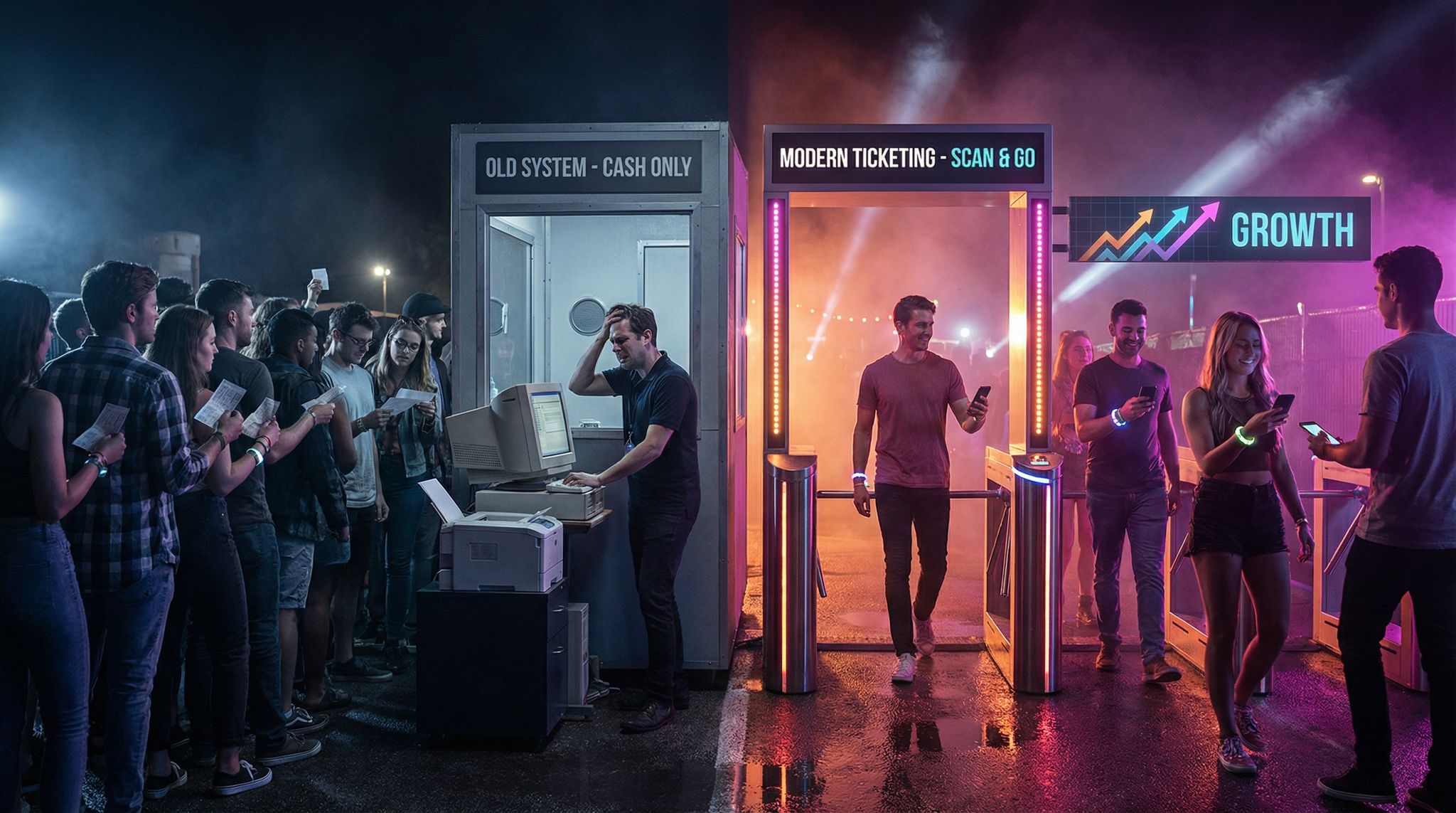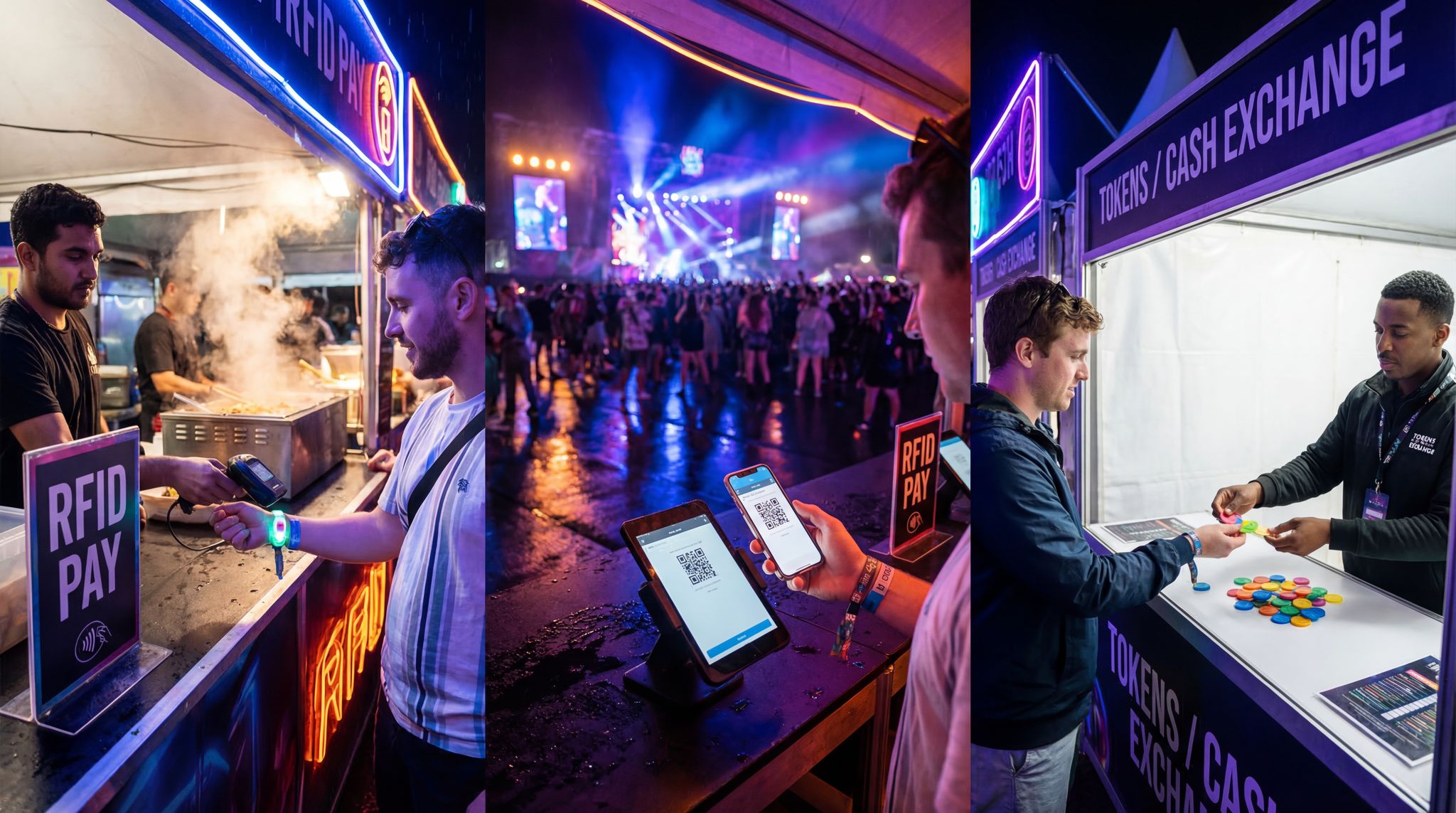
From massive 100,000-person music festivals to intimate local food fairs, organizers worldwide are phasing out physical cash in favor of cashless payment system for festivals. The reasons are compelling: faster transaction speeds, higher spending per attendee, and improved security. But which cashless approach is right for your event? In this showdown, we compare RFID wristband systems, mobile app-based payments, and old-school token systems – digging into setup costs, reliability, speed, and the attendee experience for each. Using real examples from festivals that have tried them, we’ll explore the pros and cons so you can evaluate the best cashless payments for events like yours. By the end, you’ll have a clearer picture of whether slick RFID tech, smartphone payments, or simple tokens (or a hybrid) will lead to smoother transactions and happier attendees at your festival.
RFID Wristband Payment Systems
How RFID Cashless Works
RFID (Radio Frequency Identification) wristbands have become a popular cashless payment system for festivals over the past decade. Each attendee wears a wristband embedded with an RFID chip that serves as a digital wallet. Festival-goers load funds onto the wristband – either by pre-loading money online before the event or topping up at on-site stations – and then simply tap their wristband at vendors to pay for food, drinks, or merch. A contactless reader at the point of sale deducts the purchase amount from the wristband’s balance. Importantly, the transaction can be authorized locally (within the festival’s network) without needing to contact a bank for each payment. This closed-loop design means a well-configured RFID system can process payments offline if needed, syncing to the central system when connectivity allows, which ensures seamless offline transaction processing and provides rich data collection capabilities. For festivals, RFID wristbands often double as the attendee’s access credential too – the same wristband grants entry through the gates and verifies VIP or age status, creating an all-in-one solution.
Rolling out RFID cashless requires partnering with a specialist provider for the physical wristbands, the scanners/POS devices, and the software backend. Major RFID vendors (e.g. Intellitix, Weezevent, or Billfold) offer full-service packages, or some festival ticketing platforms integrate directly with RFID. Attendees typically receive their wristbands by mail in advance or at the gate, and on-site top-up stations (manned kiosks or self-service machines) are set up for adding funds. Many events encourage topping up online ahead of time to reduce lines on-site. At the vendor booths, staff use handheld or countertop RFID readers linked to the central system (often via a local Wi-Fi network or wired connection). Each tap transaction usually takes less than a second to register. Modern systems also allow auto top-ups – an attendee can link a credit card to automatically reload their wristband if the balance drops below a threshold, avoiding mid-festival cash top-ups.
Pros, Cons, and Use Cases of RFID
RFID wristband payments shine in high-volume festival environments where speed and reliability are paramount. An RFID tap transaction can be under 1 second, which dramatically cuts down queuing. For example, a bar that might serve 10 people per minute with cash can serve 20+ per minute with RFID – effectively doubling throughput, as RFID scans take under a second. This frictionless speed often leads to higher spend per head. Organizers report that going RFID cashless delivers a significant revenue boost: one UK festival saw average bar sales per attendee jump ~24% in the first year they went fully cashless, which significantly boosts overall event revenue, and many festivals have seen 15–30% increases in on-site spending after implementing tap-and-go payment solutions. With no one fumbling for change or running to ATMs, attendees tend to buy more, and vendors can serve more customers.
Go Cashless With RFID Technology
Enable contactless payments, faster entry, and real-time spending analytics with RFID wristbands and NFC-enabled ticketing for your events.
Another major advantage is data. Every RFID transaction is logged, giving organizers real-time insight into sales. You can see which food stall is busiest at 7 PM or how merchandise sales spike after a headliner’s set. This data goldmine enables dynamic decision-making (like reallocating staff to busy bars) and rich post-event analysis. For instance, Coachella’s adoption of RFID payments yielded granular data on what 125,000 attendees bought each day, helping inform vendor choices and sponsorship strategies in subsequent years. RFID also virtually eliminates cash leakage and fraud. There’s no physical cash to miscount or steal at vendor booths, and the system’s audit trail means every dollar is accounted for. Large festivals that once dealt with lost cash or under-reporting by vendors have found those issues largely vanish with RFID, which enables faster and more accurate vendor payouts and provides detailed digital transaction records.
RFID is battle-tested at scale. Mega-festivals like Tomorrowland in Belgium, Electric Daisy Carnival (EDC) in Las Vegas, and Lollapalooza in Chicago have all made RFID wristbands central to their payment systems. In fact, Lollapalooza was one of the U.S. pioneers – as far back as 2014 it introduced “Lolla Cashless” wristbands, letting 100,000 attendees simply swipe their wrist for a beer or T-shirt purchase by using their pre-loaded RFID wristbands where attendees can easily enter their information. Crucially, Lollapalooza’s system allowed offline transactions: vendors’ POS devices could process payments even if the network momentarily went down, syncing later to ensure purchases won’t be interrupted. This set a standard for reliability, acknowledging that cell service often chokes with tens of thousands of fans on-site.
Planning a Festival?
Ticket Fairy's festival ticketing platform handles multi-day passes, RFID wristbands, and complex festival operations.
Despite its benefits, RFID does come with challenges. Upfront costs can be significant. Durable, encrypted wristbands with RFID chips might cost $1–$2 each (for large orders), and the infrastructure – from payment terminals at every vendor to system servers – often runs into tens of thousands of dollars (or more for very large events). A large festival can easily spend $100,000+ on a full RFID cashless setup, once you factor in hardware rentals, software licensing, and staffing for deployment. For smaller festivals on a tight budget, this cost may be prohibitive. There’s also more logistics and lead time: wristbands must be produced and distributed in advance, and technical setup/testing needs to happen well before gates open.
Technical risk is another consideration. While modern RFID systems are robust, a network failure or system crash at the wrong moment can grind sales to a halt. Download Festival 2015 (UK) provided a cautionary tale: they rolled out a new RFID “Dog Tag” payment system for ~80,000 rock fans, but on day one the network failed and thousands of attendees were suddenly unable to buy food or drinks when the system failed for thousands of attendees. People waited in long queues unable to load money onto their wristbands, vendors couldn’t get paid, and social media erupted with fury (“Cashless? More like clueless,” as one attendee tweeted). The festival hadn’t prepared a backup payment method, so the chaos continued for hours, leaving the payment system completely non-functional and underscoring crucial lessons for festival tech implementations. In the end, Download scrapped RFID the following year and returned to cash & card, illustrating that a badly-executed rollout can set the technology back. The lesson for producers is clear: if you adopt RFID, invest in network redundancy and offline capabilities. Provide generators and dedicated Wi-Fi or wired lines for the payment system, have an offline mode that allows cached transactions, and keep an emergency fallback (like paper vouchers or a token stash) just in case. With proper contingencies and thorough testing (even a small-scale pilot event first), RFID failures are rare – many festivals run for years with RFID without major incidents – but you must respect the complexity.
RFID is best suited for mid-size to large festivals (say 5,000 attendees up to 100k+) where the volume of transactions is huge and the efficiency gains justify the cost. It’s especially popular for multi-day music festivals, large food & beverage festivals, and any event where attendees are expected to spend a lot on site. If your festival has multiple stages, campgrounds, and dozens of vendors, the ability to centrally manage all that commerce with RFID is a game-changer. Just be sure you have the budget and tech partner to do it right. Seasoned organizers also emphasize clear attendee communication when rolling out RFID: explain how it works ahead of time, make it easy for fans to refund any unused balance after the event, and offer on-site support like roaming “cashless ambassadors” to help anyone who has questions at the point of purchase. With these practices, RFID wristbands can significantly boost revenue and enhance security by maximizing sponsorship ROI and inventory tracking and driving post-event merchandise sales, all while giving attendees an ultra-convenient way to pay.
Mobile App-Based Payments
How Mobile App Payments Work
Not every event needs dedicated hardware or special wristbands to go cashless. App-based payment systems leverage the fact that most attendees already carry a powerful payment device in their pocket – their smartphone. Mobile payments at festivals can take a few forms:
– Mobile Wallets (Open-Loop) – Simply accepting standard mobile wallet payments like Apple Pay, Google Pay, or Samsung Pay at vendors. In practice, this means equipping vendors with normal contactless card terminals that also accept phone tap-to-pay. From the attendee perspective, they just tap their phone (or smartwatch) at the vendor as if making a retail purchase.
– QR Code Payments – A system popular in parts of Asia and at tech-forward events. Vendors have a QR code displayed; attendees scan it with a payment app (like Alipay, WeChat Pay, PayPal, or a banking app) to send the payment, or the attendee’s festival app generates a personal QR code that the vendor scans to charge their account. For example, in India many festivals tap into the ubiquitous UPI system – a vendor prints a UPI QR code and guests pay through any UPI app on their phone.
– Dedicated Festival App with Integrated Payments – Some organizers release a festival smartphone app that includes a “wallet” feature. Attendees create an account, link a credit card or load money into the app, and then pay on-site by scanning their app’s barcode/QR at vendors. Coachella and Tomorrowland have had official apps with such features, and smaller festivals sometimes white-label third-party event apps that support payments. This approach keeps everything inside one app (tickets, schedule, map, and payments).
The appeal of mobile app-based payments is obvious: no special wristbands or tokens needed. Attendees use the device they already have, and vendors might only need a tablet or smartphone to scan QR codes or a basic card reader. Setup costs are generally lower than RFID – you might only invest in a good point-of-sale app or rent contactless terminals. There’s also less lead time; you’re not printing and shipping thousands of wristbands, just configuring software. And for attendees, using their own phone can feel very natural in 2026. We live in a world of Venmo, PayPal, and tap-to-pay – festival-goers increasingly expect the convenience of paying with a tap or scan, without carrying cash.
Pros, Cons, and Use Cases of App Payments
One big advantage of mobile payment systems is convenience and familiarity. There’s no extra “thing” for attendees to keep track of (unlike a token or separate festival card). Younger, tech-savvy crowds especially appreciate being able to pay with a device they already use daily. In regions like China and India, going to a festival and scanning a WeChat or UPI code to pay is second nature, especially since younger demographics skew heavily toward smartphone usage and these attendees require zero new setup. Even outside Asia, many festivals find that a large share of their audience will happily adopt app payments if given the option. For example, at a food festival in Beijing, nearly every attendee might already have WeChat Pay set up – the organizers simply put “WeChat Pay accepted here” signs on each stall and saw near-universal uptake because mobile payments offer significant convenience advantages. The friction to adopt is low when people can use an app they trust.
Need Festival Funding?
Get the capital you need to book headliners, secure venues, and scale your festival production.
Lower cost and complexity is another plus. Rather than deploying a proprietary network of RFID, an app-based approach often piggybacks on existing financial infrastructure. If you use open-loop (normal card) payments, the fees per transaction (usually ~2-3%) are the main cost, and vendors may already have the hardware. Even with a custom festival app, you’re mostly investing in software development and perhaps some inexpensive QR code scanners. There’s no need to manufacture currency (wristbands or tokens), and no central cash-out/reconciliation for each vendor because each sale goes straight to the merchant account through the app. In addition, a festival app with payments can enable instant promotions: you might send a push notification offering a discount or special to everyone with the app wallet (“$2 off any coffee in the next hour if you pay with the festival app!”). This can drive engagement and spending in ways physical currency can’t.
However, mobile payments come with a critical dependency: connectivity. Unlike RFID – which can be designed to work with local offline mode – most app transactions require real-time internet access, either for the vendor’s device or the attendee’s phone. In a packed festival site, mobile networks get congested and Wi-Fi can be spotty. If the signal drops at the moment of a QR code scan or mobile tap, the transaction might fail. Organizers in India found that while QR-based payments (through the national UPI system) were extremely popular, they faced serious slowdowns at peak times simply due to overloaded cellular networks affecting payments, proving that connectivity is the Achilles heel of mobile systems. Attendees with dying phone batteries or no service became unable to pay – a scenario as troubling as a card reader outage. To mitigate this, festivals using app payments must invest in network infrastructure: consider on-site cell boosters, high-density Wi-Fi for vendor areas, and even offline caching features. Some modern event apps anticipate these issues by caching a user’s payment info or pre-loading a QR code that can be scanned offline and verified later by integrating an offline QR code feature. Additionally, providing charging stations or battery swap services on-site can help attendees keep their phones alive for that final order of late-night fries.
Another challenge is audience inclusivity. Not everyone is comfortable using a smartphone app to pay, especially at a festival where they might be juggling other concerns. Older attendees or anyone who isn’t tech-savvy could be hesitant. There are also segments of the population without smartphones or who prefer not to tie their credit card to an app. If you go entirely app-based, you risk alienating these customers. A common solution is to offer a hybrid model: allow mobile payments, but also have a backup option (like accepting credit cards the traditional way, or offering an RFID wristband on request). Some festivals have a small stash of RFID wristbands ready for those who can’t or won’t use the app – they can load it with cash at a customer service booth so they’re not excluded, providing a reliable backup for those who opt out. Essentially, while mobile payments might be the best cashless payment solution for tech-forward events, it’s wise to provide an alternative for the edge cases.
Despite these caveats, mobile app payments can work very well for small to mid-size events and urban festivals. If your event is in a city center or established venue with strong network coverage (e.g., a convention center or stadium show), leveraging open-loop contactless payments or a simple QR code system is often straightforward. Single-day events or those with <5,000 attendees frequently choose this route to avoid the overhead of RFID. It’s also a great option for conference-style events or mixed-format festivals where attendees will already be using a phone app for tickets or schedules – adding payments is a natural extension. For instance, SXSW in Austin enabled attendees to pay for drinks at official venues through the festival’s mobile app, streamlining the experience for thousands of badge-holders who always had their phones handy.
Data-Driven Event Marketing
Track ticket sales, demographics, marketing ROI, and social reach in real time. Exportable reports give you the insights to make smarter decisions.
One bonus: with app payments, refunds and balance handling are easier. If an attendee’s $50 app deposit isn’t fully used, the remaining balance might simply stay in their account or get auto-refunded to their card. There’s no physical token to redeem or lost wristband balance to claim. This can lead to better customer satisfaction, as long as any refund policies (or lack thereof) are clearly communicated. Organizers should be transparent if there are transaction fees or if unused funds will be donated or forfeited (practices which sometimes draw ire). Overall, mobile app-based payments can deliver a smooth, low-friction purchase experience that boosts sales – as long as you’ve fortified your festival’s connectivity and kept less tech-oriented guests in mind.
Token-Based Payment Systems
How Token Systems Work
“Old-school” token systems remain popular at many festivals due to their simplicity. In a token system, the festival creates its own physical currency – whether plastic tokens, wooden coins, paper drink tickets, or coupons – and attendees use this currency to make purchases on-site. Typically, a attendee will go to a centrally located token booth or cashier to buy tokens (say, 10 tokens for $10, or whatever the conversion rate). They might also receive a starter number of tokens with their ticket (e.g. some beer festivals include a few tasting tokens in the admission price). Once armed with tokens, the attendee goes to vendors and pays by handing over the required number of tokens for an item. Vendors collect the tokens and later redeem them with festival organizers for real money – the festival essentially settles up with each vendor after counting their tokens.
Tokens can be 1:1 with currency (e.g. 1 token = $1) or have a conversion (like 1 token = $2 or 1 token = £1.25). Some festivals deliberately choose odd conversions (like $1 = 0.5 tokens, so $10 gets you 5 tokens) to encourage bulk purchasing or to create “funny money” that obscures real prices. For example, Tomorrowland’s famous “Pearls” currency — loaded onto attendee wristbands — has an exchange rate around €1 = 0.36 Pearls (in 2024), according to Tomorrowland’s official cashless information guide, so attendees often buy more credit than they use. In pure token festivals, though, the currency is tangible: you might see people walking around with a stack of tokens on a lanyard or a pocket full of drink tickets. Events like the Great British Beer Festival have long used paper beer tokens, and Taste of Chicago (USA) historically sells sheets of tickets that attendees tear off to exchange for food samples, acting as a dedicated tasting currency.
Setting up a token system is straightforward. You’ll need to design and produce the tokens or tickets (plastic coins, printed vouchers, etc.), set the pricing (e.g. 1 token for a soda, 2 for a beer, etc.), and staff the sales/redemption points. Security features might be considered if counterfeiting is a risk – many festivals use custom-molded tokens, holographic stickers on paper tickets, or unique colors each year to thwart fakes. Vendors are briefed to only accept official tokens, and at the end of each day or the event, they submit their collected tokens back to the organizer. The organizer then calculates payouts (sometimes minus a commission if agreed upon). It’s a closed economy but entirely analog: no internet, apps, or connectivity needed, just old-fashioned counting.
Pros, Cons, and Use Cases of Tokens
The token model has persisted because it offers some solid benefits, especially for smaller events. First, it centralizes cash handling away from the vendor booths. All real money transactions happen at the token banks, meaning individual food or craft vendors don’t need to handle cash or cards at all. This can simplify operations and improve security – less risk of theft at dozens of booths when the only cash is at a few secure points. It also gives organizers a high level of control and oversight on revenue. You know exactly how many tokens were sold (hence how much cash came in), which puts you in a strong position for auditing and reconciling vendor sales, whereas counting physical tokens can take hours. Vendors can’t under-report their takings; they literally must return tokens to get paid. This helps prevent any shady dealings or off-the-books sales. Many festivals trust tokens for this reason: “if it’s not paid in our tokens, it didn’t happen.”
Compared to high-tech solutions, tokens are cheap and low-tech. Printing a roll of custom drink tickets or manufacturing a few thousand plastic tokens with your logo is not very expensive (maybe a few cents per token). There’s no software integration, no hardware rental, and no learning curve to speak of – attendees understand “give token, get item” intuitively. For a community festival run by volunteers, or an event in an area with poor internet service, tokens can be a reliable choice. There is essentially zero risk of a “system outage.” As long as you physically have more tokens, you can keep selling them. Even power loss won’t stop commerce (aside from the lights going out) since tokens will work by flashlight. This robustness makes tokens a common fallback or backup currency at events that primarily use tech. We’ve seen festivals that went cashless still keep a stack of paper vouchers as a contingency in case the digital system goes down – a smart insurance policy.
Tokens can also help with regulatory compliance in certain scenarios. Some alcohol licensing laws (especially in parts of the U.S. and India) prohibit all-you-can-drink models and require that each drink have a separate transaction. Using tokens at a beer festival, for example, forces a per-pour transaction and can satisfy authorities who don’t want “free-flow” alcohol. By making attendees purchase tokens (and thus consciously “pay” for each serving, even if the money was pre-spent), festivals demonstrate they’re not encouraging uncontrolled consumption in the way an unlimited wristband might, effectively metering consumption and controlling alcohol distribution while allowing lighter drinkers to pay per pour. Tokens basically create a metering mechanism that can appease regulators – one reason they became standard at many brew festivals and tasting events.
However, there are significant downsides to tokens, especially in the eyes of modern attendees. The biggest one is friction. While paying with a token is quick at the vendor (usually faster than a card swipe), the process of obtaining tokens can introduce delays. If your festival has only a couple of token booths and a rush of attendees arrive, you might get long queues of people waiting to buy tokens – effectively just moving the line from the bar to the token tent. Poor planning here leads to frustration (“I spent 30 minutes just to buy tokens”). Organizers must forecast demand and have plenty of token sale points (with enough staff or even vending machines) to keep this smooth and avoid attendees needing exact change. Also, if attendees run out of tokens mid-event, they have to trek back to a booth to buy more, which isn’t as seamless as topping up a wristband via phone. This interruptive experience is a key reason many big festivals moved away from tokens when tech alternatives emerged.
Another issue is lack of real-time data. With physical tokens, you don’t automatically know which vendor is doing the most business until after the event, when you count tokens. You lose the granular insights of what was purchased when. For a small event this might not matter, but larger festivals crave the kind of live data that digital systems provide. Token counts also mean delayed reconciliation – vendors often have to wait hours or days to get the final token tally and their payout, whereas an integrated cashless system could produce a sales report instantly. It’s doable (and many vendors are used to it) but not ideal for agility.
Tokens are also prone to loss and fraud. Attendees can lose physical tokens (dropped in the grass or forgotten in a pocket). Lost tokens are essentially found money for the organizer, but a lost wallet of tokens could sour someone’s experience if they choose not to spend more to replace them. Counterfeiting is a rare but real problem: a clever attendee might attempt to copy paper drink tickets or even mold fake plastic tokens. In one large wine festival in California, organizers discovered hundreds of duplicate paper tasting coupons had been photocopied by some attendees and redeemed – a scam that forced the festival to redesign tickets with better security the next year, highlighting the need for diligent procedures and strict physical oversight. Physical currency requires physical oversight; using unique colors or serial numbers and keeping an eye out for fakes is necessary when significant money is at stake. Additionally, if staff or volunteers pilfer rolls of tokens, that can be hard to track until after the fact. Proper controls (like numbered token batches and strict inventory of unsold tokens) are important to prevent internal shrinkage.
For attendees, tokens can cause confusion or annoyance, especially if the conversion rate isn’t 1:1. People might constantly do mental math (“wait, 3 tokens at $2 each is $6 for a hot dog”). If pricing isn’t transparent (list prices in both tokens and approximate dollars), some guests will feel they’re being manipulated. And unused tokens are a classic point of contention. If someone leaves your festival with 5 tokens they didn’t spend, that’s essentially money they gave you without receiving product – some don’t mind and keep them as souvenirs, but others will be unhappy. Refund policies for tokens vary: some events allow refunds at the end of the night (which adds another queue and operational hassle), others explicitly make tokens non-refundable and encourage donating leftovers to charity (not a bad PR move), or allow using them at next year’s festival. Regardless, communicating this policy is crucial. As an organizer, you’ll typically gain a little revenue breakage from unredeemed tokens, but you must balance that against potential goodwill loss if attendees feel short-changed.
Overall, token systems tend to work best for smaller festivals (say a few hundred up to a few thousand attendees), one-day events, or those run by community groups who simply don’t have the capacity to deploy high-tech solutions. They can also make sense for certain formats like tasting festivals where you want to cap how much each person consumes (through a fixed token allotment system). Many charity events, school fairs, and niche food festivals successfully use tokens to create a fun, controlled environment. If you choose the token route, invest in good signage and attendee education (“Here’s how to buy tokens”) and ensure you have enough token sellers to meet demand. With planning, tokens can indeed keep lines moving at vendors and simplify life for booth operators. Just be aware that as festivals grow, the lack of scalability and data with tokens often pushes producers to consider digital alternatives.
Choosing the Right Cashless Payment System for Festivals
Now that we’ve explored the three main cashless options individually, how do you evaluate which is best for your festival? The “right” choice depends on your event’s size, budget, audience demographics, and even regulatory environment. There’s no one-size-fits-all answer in the RFID vs app vs token debate – each has a sweet spot. Let’s compare key factors side by side and then discuss how to make an informed decision.
Side-by-Side Comparison: RFID vs. App vs. Tokens
To distill the differences, here’s a comparison of these cashless systems on core criteria:
| Factor | RFID Wristbands | Mobile App Payments | Physical Tokens/Tickets |
|---|---|---|---|
| Setup & Upfront Cost | High – Requires RFID chips, readers, software integration. Significant investment (can be tens of thousands for large events). | Moderate – Using existing payment apps or simple QR systems keeps costs lower. Need good Wi-Fi/cellular setup. | Low – Print tokens or tickets cheaply. Minimal tech needed. Main cost is staffing token booths. |
| Transaction Speed | Very fast – <1 second tap payments, minimal queue times even at scale, as event organizers prioritize seamless transaction speeds. | Fast (if network is solid) – NFC tap or QR scan in 1–3 seconds, but can slow if connectivity lags. | Fast at vendor – handing over tokens is quick. Buying tokens upfront can create separate queues. |
| Reliability Offline | Strong – Can be designed to work offline; transactions sync when network is back, making them ideal for challenging festival environments. Power/network backups recommended. | Dependent – Needs live internet for each transaction unless offline mode is built-in. Outages can stop sales since connectivity remains a critical vulnerability. | Very strong – No connectivity needed at all. Works under any conditions (even no power). |
| User Convenience | Convenient – Just wear a wristband. No wallet/phone needed once loaded. Widely embraced at big festivals. | Convenient if tech-savvy – uses device attendees already carry. May exclude those without smartphones or with dead batteries. | Simple but less convenient – must purchase/carry tokens. Can be confusing if exchange rate isn’t 1:1. |
| Data & Insights | Excellent – Every purchase is logged to an attendee account. Rich data for analysis and real-time monitoring of sales and detailed per-attendee spending patterns. | Good – Digital payments can be tracked per item if integrated, though data may be siloed in payment provider’s system. | Poor – Only aggregate token counts per vendor. Limited insight (no timestamp or item details automatically). |
| Security & Fraud | High – Reduces theft (no cash with vendors). Secure chips hard to clone. Need safeguards for lost wristbands (PIN or deactivation), unlike with cash, as vendors use secure digital payment terminals. | High for payments – Uses banking security (encryption, etc.). Some risk of account misuse if phone stolen/unlocked. | Moderate – Centralizes cash (easier to secure overall), but tokens can be lost or counterfeited without careful design, requiring strict token inventory and oversight procedures. |
| Attendee Acceptance | Generally positive – youth and veteran festival-goers have adapted to RFID quickly, enjoying the ease. Some initial learning curve for newcomers. | Mixed positive – most under 50 are comfortable with mobile payments. Older or less techy attendees may resist or need assistance. | Familiar – People immediately understand tokens, especially at local events. Some attendees dislike the hassle of buying them or ending with unused tokens. |
| Typical Event Fit | Large-scale festivals, multi-day events, high-volume beer/food fests where long lines are a big issue and budget exists for tech. | Small to mid-sized festivals, events where attendees use phones heavily (tech conferences, urban events), venues with solid network. Also as a hybrid option alongside RFID or tokens. | Smaller community festivals, one-day events, tastings, or anywhere a simple, low-cost solution is needed. Often used if tech infrastructure is not feasible. |
Table: Comparison of RFID, Mobile App, and Token payment systems across key factors.
As the table shows, each system has clear strengths and weaknesses. RFID excels in speed, data, and scalability – making it ideal for large festivals pushing tens of thousands of transactions, where those extra sales and insights offset the higher setup cost. App-based payments score on convenience and low cost, great for tech-friendly crowds and venues with good connectivity, but you must invest in network reliability and have a backup for edge cases. Tokens win on simplicity and offline reliability, which is why they remain loved by smaller festivals and in scenarios where keeping things analog has benefits. The trade-off is less data and a bit more hassle for attendees.
Evaluation Criteria and Hybrid Approaches
When choosing a cashless payment system for your festival, consider these key questions:
– What’s the size and scale of your event? For a 500-person local festival, RFID would likely be overkill – tokens or a basic app reader might cover your needs. For a 50,000-person multi-stage festival, manually handling tokens could be chaos and limit revenue, making RFID or mobile payments a smarter choice to avoid technical issues and service delays.
– What is your budget for payment infrastructure? A tight budget might rule out RFID due to upfront costs. However, also calculate potential ROI: if going cashless could boost spending by 20%, a more expensive system might pay for itself. Some festivals secure sponsorships or tech grants to fund RFID systems, or work with ticketing partners to offset costs (for instance, Ticket Fairy Capital offers advance funding to cover production costs for qualified events, which could help finance new tech). If budget truly won’t allow, tokens can accomplish the core goal of removing cash without much spend.
– How tech-savvy is your audience? Demographics matter. A downtown electronic music fest with a 20-something crowd might integrate an all-app payment system with hardly a complaint – attendees will adapt quickly and appreciate the modern approach. In contrast, a family-oriented county fair or a heritage festival for an older demographic might face confusion or pushback going fully digital. In those cases, providing a familiar option (tokens or cash backup) alongside newer methods is wise. Always gauge your community’s openness – even via pre-event surveys – before forcing a change.
– What are the venue and regulatory constraints? If your festival is in a remote field with spotty cell service, an app-only strategy is risky without major investment in connectivity (consider satellite internet or local networking). If local laws require tracking alcohol by the drink, a token or RFID system might help with compliance reporting. Check if any regulations restrict a completely cashless event; some U.S. jurisdictions require that consumers have a cash option for equity reasons. In 2023, cities like New York and Philadelphia even passed laws that businesses cannot refuse cash, so ensure a workaround if applicable (e.g., a reverse-ATM where people can exchange cash for a payment card or wristband on-site).
– How important is data and integration for you? If you want real-time visibility and the ability to leverage purchase data (for marketing or sponsorship value), RFID or integrated mobile payments clearly outperform tokens. Also, consider the integration with your ticketing platform. Modern festival management platforms (like Ticket Fairy) can tie ticket purchases to cashless accounts, so attendees’ wristbands arrive pre-linked to their ticket profile and even pre-loaded with credit. This creates a seamless user journey and a unified data set of an attendee’s entire spending and attendance behavior. If you’re using an outdated ticketing system that doesn’t support cashless integration, you might miss out on these efficiencies, making it crucial to leverage these modern tools to your advantage. In fact, festival industry veterans often stress that upgrading outdated ticketing/tech is key to unlocking features like cashless payments, referral marketing, and data analytics that drive growth, as migrating from outdated platforms helps festivals reap significant rewards in ticket sales and fan engagement.
– Do you want to eliminate all physical currency on-site? Some organizers go cashless partly for safety (reducing cash means reducing theft risks for staff) and speed, but are fine still accepting credit cards at vendors. Others want to completely banish traditional payments to simplify accounting and drive everyone into a unified system. If you’re aiming for 100% cash-free operations, RFID and tokens create a closed loop that is easier to manage. App payments can also achieve it, but you might still end up processing dozens of individual card charges (just via phones). Decide how “all-in” on cashless you want to be. Many festivals adopt a hybrid model initially: for example, going mostly RFID but still allowing vendors to accept standard card payments as a backup (some large U.S. festivals did this during their first RFID year to reassure vendors and attendees). Hybrid models can ease the transition – you get many benefits of cashless while having a safety net.
In practice, we see plenty of hybrid implementations. A festival might use RFID for the main bars and food courts (where speed and data are critical) but use traditional card terminals for merchandise vendors. Or an event could use tokens for alcohol purchases (to comply with liquor rules) but let people use a festival mobile app to buy merch or ride tickets. While it adds complexity to have multiple systems, it can also combine the advantages of each. If you go hybrid, just be extra clear in your communications so attendees know when/where they can use each method.
One often overlooked factor is attendee psychology and trust. Whichever system you choose, be transparent about pricing and policies. If you’re using a proprietary currency (digital or physical), clearly state the exchange rate and avoid overly convoluted conversions. Publish your refund policy for unused balances or leftover tokens before tickets go on sale. Fans will tolerate a lot if they feel you’re honest with them, but if they sense a cashless system is a sneaky way to squeeze extra money (for example, non-refundable credit or dynamic pricing surprises), expect backlash. Avoiding practices that erode trust – like surge pricing on tickets or hidden convenience fees – is crucial in the current climate, provided the underlying technology backbone is solid and you offer perks like advance payout programs. (Notably, platforms like Ticket Fairy have gained favor by eschewing dynamic pricing and only charging the face value, which can make attendees more comfortable embracing new tech at your event.) The goal is to show that cashless is being adopted to improve their experience, not just the festival’s bottom line – even if in truth it benefits both.
In summary, match the solution to the problem you need to solve. If long concession lines and lack of spending data are holding your festival back, RFID or a robust mobile payment system could be transformative. If budgets are slim and the priority is simply eliminating wads of cash changing hands, tokens might do the trick with far less fuss. Many festival producers in 2026 opt for a phased approach: start with one system and gradually evolve. For instance, you might begin with tokens one year, then pilot an RFID system for VIPs or one activation the next, and expand it event-wide once you’ve tested the waters. Or roll out a festival app with optional payments and see the adoption rate before removing other options. Pay attention to attendee feedback at every stage – if people love the convenience (as many do with cashless), you can lean in further. If you hear grumbles, identify whether it’s a communication issue, a tech hiccup, or genuine preference for the old ways.
Finally, remember that any cashless system is a means to an end: smoother transactions, better sales, and happier attendees. Keep those goals in focus. If a fancy new system isn’t delivering those, don’t be afraid to pivot. As one veteran producer put it, “The best cashless payments solution is the one your crowd doesn’t even notice – it just works.” When fans can grab what they want and get back to dancing or exploring with minimal friction, you’ve succeeded.
Frequently Asked Questions
What is a cashless payment system for festivals?
A cashless payment system for festivals replaces physical money with digital or alternative currencies to speed up transactions and improve security. Organizers typically use RFID wristbands, mobile app payments, or physical tokens. These systems centralize funds, reduce vendor theft, and often increase overall attendee spending.
How do RFID wristbands work at music festivals?
Attendees load funds onto an embedded RFID chip online or at on-site top-up stations. At vendor booths, they simply tap the wristband against a contactless reader to pay for food or merchandise. The system deducts the purchase amount instantly, processing transactions in under one second without requiring physical cash.
Why do music festivals use cashless wristbands?
Festivals use cashless RFID wristbands to drastically reduce queue times and increase overall event revenue. Because tap transactions take under one second, vendors can serve twice as many customers. Organizers frequently report a 15 to 30 percent increase in on-site spending after implementing these frictionless payment solutions.
How much does an RFID cashless system cost for a large festival?
A full RFID cashless setup for a large festival can easily exceed $100,000. This significant upfront investment covers durable encrypted wristbands costing $1 to $2 each, payment terminals for every vendor booth, software licensing, and the staffing required for deployment and on-site top-up stations.
What happens if the internet goes down at a cashless festival?
Well-configured RFID systems can process payments offline by authorizing transactions locally and syncing data when connectivity returns. However, mobile app-based payments usually require real-time internet access. To prevent sales from halting, organizers must invest in network redundancy, offline caching features, or provide physical backup tokens.
Which is better for events: RFID wristbands or mobile app payments?
RFID wristbands are better for large-scale festivals because they process transactions in under one second and operate reliably offline. Mobile app payments are ideal for smaller, urban events with strong cellular networks, as they offer lower setup costs and let attendees use their own smartphones without requiring physical hardware.
Why do beer festivals still use physical drink tokens?
Beer festivals use physical tokens to comply with strict alcohol licensing laws that prohibit all-you-can-drink models. Tokens force a per-pour transaction, effectively metering consumption. Additionally, tokens centralize cash handling away from individual vendors and remain completely reliable even without power or internet connectivity.
How do mobile app payments work at outdoor events?
Mobile app payments utilize attendees’ smartphones through standard mobile wallets like Apple Pay, scannable QR codes, or dedicated festival apps. Vendors use basic card terminals or tablets to scan the customer’s device. This method eliminates the need for custom wristbands but heavily relies on strong on-site cellular or Wi-Fi connectivity.