Cashless Society: Future of Festival Transactions
Embracing a Wallet-Free Festival Experience
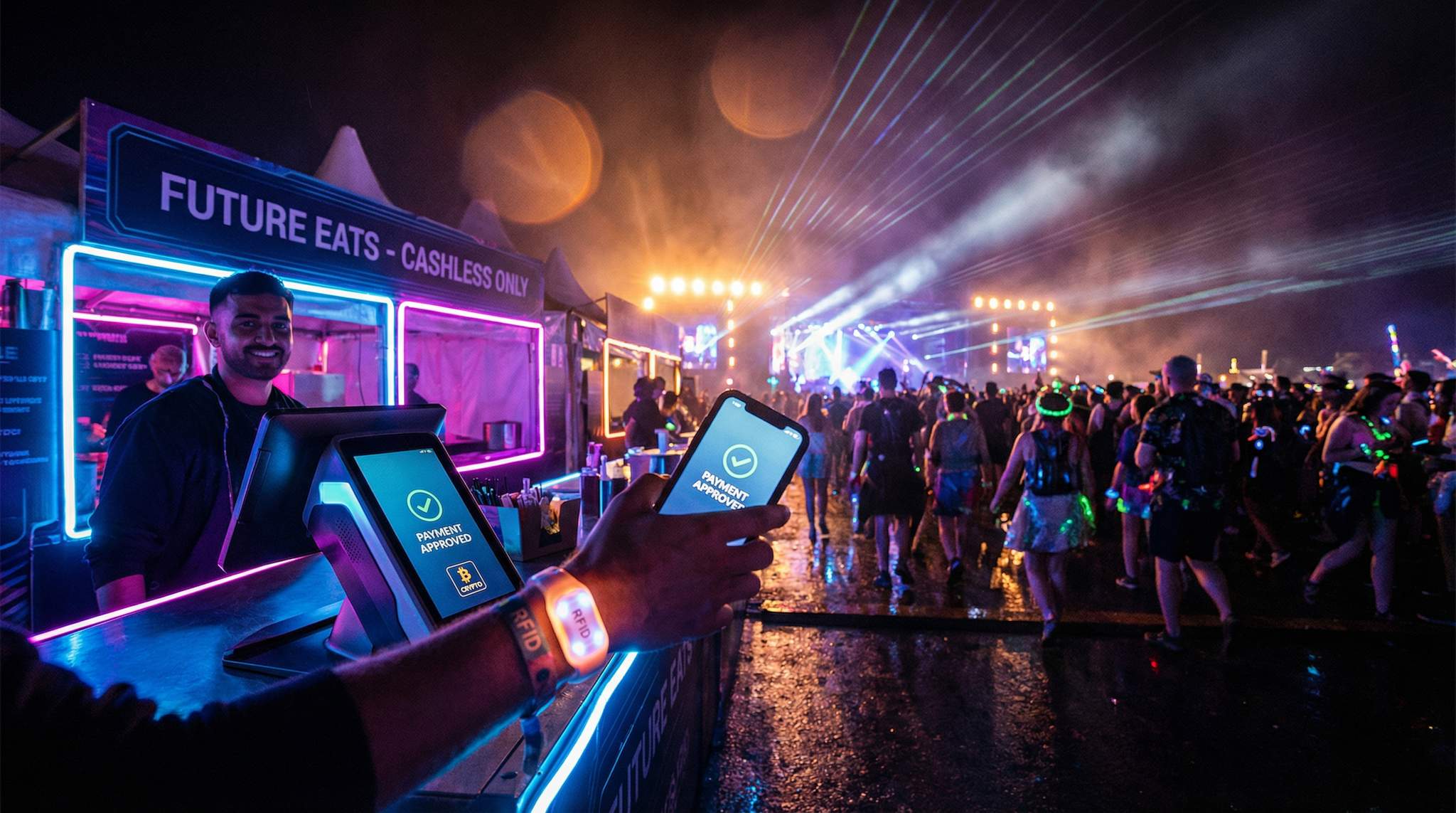
The festival scene is steadily marching toward a cashless society, where paper money and even physical credit cards could become relics of the past. Attendees already expect quick, seamless transactions – no one wants to fumble with cash while juggling a plate of food or festival merchandise. Many events have adopted RFID wristbands and mobile payment options to streamline entry and purchases. Now, forward-thinking festival organizers are exploring what lies beyond RFID: from facial recognition payments to tapping phones and even cryptocurrency. This glimpse into the near future shows how festivals might run on purely digital transactions, creating an ultra-convenient (but carefully managed) experience for all.
Defining the Cashless Event Model
For modern promoters, understanding the true meaning of a cashless event goes beyond simply banning physical currency at the gates. Operationally, it signifies a comprehensive shift toward a fully integrated digital ecosystem where every on-site transaction—from VIP upgrades to food and beverage sales—is routed through a centralized, trackable network. This model empowers organizers with real-time revenue visibility, eliminates the logistical liabilities of cash handling, and fundamentally transforms how attendee spending data is captured and utilized for future event planning.
Adapting Cashless for Concerts and Standalone Shows
While mega-festivals often dominate the conversation, implementing cashless for concerts and single-night live music events requires a slightly different operational approach. Promoters managing standalone shows typically pivot away from closed-loop wristbands—which require pre-loading funds—in favor of open-loop contactless systems. By outfitting venue bars and merchandise stands with tap-to-pay terminals, organizers can rapidly process standard credit cards and mobile wallets. This strategy is particularly effective for maximizing revenue during the brief 20-minute changeover between an opening act and the headliner, where minimizing queue times is essential for capturing high-volume beverage sales.
From RFID to Face and Mobile: The Next-Gen Payments
RFID Wristbands have become a common solution in recent years, allowing attendees to load money onto a wristband and pay with a tap. This system speeds up lines and reduces theft or loss of cash. However, technology never stands still. Mobile payments are rapidly gaining ground – instead of topping up a separate wristband system, some festivals let fans simply tap their smartphone or smartwatch at vendors, using services like Apple Pay, Google Pay, or a festival’s own app QR code. This cuts out an extra step and uses devices people already carry.
Go Cashless With RFID Technology
Enable contactless payments, faster entry, and real-time spending analytics with RFID wristbands and NFC-enabled ticketing for your events.
For many large-scale events, deploying a dedicated wristband payment system remains the gold standard for connectivity and speed. Unlike mobile wallets that rely on a user’s cellular data or battery life, a closed-loop wearable setup ensures transactions process instantly at the point of sale, even in remote festival grounds with poor internet reception. Organizers benefit from pre-event top-ups, which secure revenue before the gates even open, while on-site vendors experience significantly faster checkout times compared to traditional credit card processing.
Even more cutting-edge are biometric payments, such as facial recognition or fingerprint scanning for transactions. Imagine walking up to a merch booth or beer stand and paying with a smile – literally having a camera identify your face to charge your linked account. A few pioneering events have tested facial-recognition for entry gates or cashless payments. The appeal is clear: no device or token needed at all. Yet adoption has been slow, partly because of privacy concerns and the complexity of implementing it reliably. Some major music festivals have even publicly pledged not to use facial recognition until privacy issues are resolved. For now, these biometric methods remain experimental, but they hint at a future where your face or fingerprint could be your festival “wallet.”
Planning a Festival?
Ticket Fairy's festival ticketing platform handles multi-day passes, RFID wristbands, and complex festival operations.
Optimizing Outdoor Vendor Payment Processing
For food and merchandise operators working in challenging environments, reliable festival payment processing is critical. The best use cases for tap-to-pay and NFC contactless payments often involve high-volume outdoor festival market vendors where speed is paramount. By deploying ruggedized, weather-resistant POS terminals that support offline processing, organizers ensure that even remote food trucks or craft stalls can continue accepting payments during temporary internet drops. This seamless approach to festival payments prevents revenue loss and keeps vendor lines moving efficiently, regardless of the physical setting.
Cryptocurrencies and Festival Transactions
Another frontier that tech-savvy festival producers are watching is cryptocurrency. With digital currencies like Bitcoin and Ethereum becoming more mainstream, a handful of festivals have dabbled in accepting crypto for tickets or on-site purchases. For example, one large European festival made headlines by allowing ticket purchases with Bitcoin, positioning itself as an innovator and appealing to the crypto-enthusiast crowd. In other cases, boutique festivals with tech-oriented audiences have offered options to pay for admission or even concessions using crypto via mobile wallets.
The potential benefits are intriguing. Cryptocurrency transactions can be fast and borderless – international attendees wouldn’t need currency exchange, and all payments could occur on a secure digital ledger. Smart contracts might even automate certain transactions or token-based perks for attendees. However, this trend is very much in its infancy. Event organizers must weigh the drawbacks: cryptocurrencies can be volatile in value, the user experience might confuse those unfamiliar with digital wallets, and transaction fees or slow processing times (on some blockchains) could frustrate buyers. As a future possibility, crypto payments at festivals remain a niche experiment, but one that could grow as digital currency adoption increases globally.
Pros of Pushing Transaction Tech Boundaries
Embracing the newest transaction technologies can offer festivals several advantages:
– Speed and Convenience: Digital payments – whether via phone, face recognition, or crypto wallet – promise faster checkouts and shorter lines. Attendees spend less time paying and more time enjoying the event.
– Higher Spending & Revenue: Reduced friction at the point of sale often leads attendees to spend more on food, drinks, and merchandise. It’s easier to buy that extra item when a quick tap or scan is all it takes, potentially boosting vendor sales and revenue.
– Improved Security: Eliminating cash means less risk of theft or loss. Digital systems (including closed-loop RFID or mobile wallets) provide secure, traceable transactions. Biometric payments ensure the person paying is authorized, potentially reducing fraud or ticket scalping if tied to identity.
– Rich Data Insights: Every digital transaction can feed into analytics. Organizers can learn which booths are most popular, peak spending times, or how attendee purchase behavior changes over a multi-day festival. These insights help in planning layouts, staffing, and inventory for future events.
– Modern Image and Sponsorships: Being on the bleeding edge of tech can enhance a festival’s brand. A reputation for innovation attracts tech-savvy attendees and can entice sponsors (like fintech or crypto companies) who want to showcase their products in a live event setting.
Free Tool: Project Your Bar Revenue
Per-head spend benchmarks by event type turned into projected bar and food revenue, with a stock-mix estimate and gross-margin line. Free calculator.
Beyond simply projecting a modern image, understanding how cashless payments can increase event sponsorships is a major advantage for promoters. When an organizer transitions to a fully cashless event, they unlock highly granular purchasing data. Brands and corporate partners are eager to sponsor activations where ROI can be measured through exact digital interactions, such as tracking how many attendees used a specific branded RFID wristband to purchase a sponsored beverage. This level of verifiable engagement makes cashless payments for events a powerful bargaining chip during sponsorship negotiations.
Furthermore, transitioning to a fully cashless festival environment allows production teams to dynamically adjust staffing and inventory based on live sales velocity. When utilizing advanced cashless payment systems for festivals, food and beverage directors can instantly identify which bars are overwhelmed and which are underperforming, enabling them to redeploy resources on the fly to maximize throughput and profitability.
Need Festival Funding?
Get the capital you need to book headliners, secure venues, and scale your festival production.
Streamlining the Festival Payment System
When organizers upgrade their core festival payment system, the operational benefits extend far beyond the ticket gates. Transitioning to a fully contactless payment festival environment drastically reduces cash-handling errors, theft risks, and the logistical headache of armored transport. By centralizing all festival payments through a unified point-of-sale (POS) network, promoters gain real-time visibility into vendor performance and inventory depletion. This shift not only secures funds but also simplifies end-of-night reconciliations for food, beverage, and merchandise directors.
Cons and Cautions on the Bleeding Edge
While the upside is enticing, veteran producers caution that new technology comes with challenges:
– Technical Glitches: Relying on complex systems means that if the network crashes or the power goes out, transactions can grind to a halt. Imagine thousands of attendees unable to buy water because the facial recognition payment server is down – a scenario to avoid at all costs. Robust offline backups or hybrid solutions are essential.
– Privacy and Trust Issues: Technologies like facial recognition raise valid privacy concerns. Festival-goers may feel uncomfortable or exposed if asked to enroll their biometrics. News about data breaches or misuse can quickly erode trust. Organizers must navigate these concerns transparently and possibly hold off on certain tech until it’s proven safe and ethical.
– Adoption Gaps: Cutting-edge payment methods might leave less tech-savvy attendees confused or alienated. Not everyone knows how to use a crypto wallet or has the latest smartphone. If the check-out process becomes too unfamiliar, it can frustrate customers and staff.
– Cost and Infrastructure: Implementing new payment tech can be expensive. RFID wristbands, biometric scanners, or crypto payment gateways all add costs for hardware, software, and training. Smaller festivals especially have to consider if the investment will pay off. Sometimes sticking with a simple solution (like standard contactless card readers) is more economical until tech prices come down.
– Learning from Failure: Being first means you might encounter pitfalls others haven’t. There have been festivals that rolled out new systems only to face backlash – for example, an app that failed during an event, or a cashless wristband system that had refund issues, souring attendees’ experience. Each failure is a lesson, but it can hurt a festival’s reputation in the short term.
Inclusion and Accessibility
A forward-looking festival should strive for innovation without exclusion. As transactions go digital, it’s crucial to have options for those without smartphones, contactless cards, or crypto accounts. For instance, if a festival encourages mobile payments via app, they could also offer on-site top-up stations where attendees can load cash onto a temporary RFID card or wristband. Similarly, biometric or app payments should have an alternative like a staffed kiosk for anyone uncomfortable with the new system.
Inclusivity isn’t just about technology access – it’s also about comfort and habit. Some attendees (including older generations or underserved communities) may simply prefer cash or a physical card. Organizers should communicate changes clearly and provide walkthroughs or support. Hybrid solutions work best during transitions: allow digital payments as the primary method but keep a backup method available. This ensures nobody is left unable to make a purchase because they didn’t have the “right” technology. The goal is to make the festival experience smoother for everyone, not to create new barriers to entry.
Data-Driven Event Marketing
Track ticket sales, demographics, marketing ROI, and social reach in real time. Exportable reports give you the insights to make smarter decisions.
Preparing for a Cashless Future
For festival producers eyeing the cashless revolution, preparation and balance are key. It’s wise to pilot new technologies on a small scale before committing event-wide. For example, test a new facial recognition entry system at a side stage or a single entrance, or trial a crypto-based merch booth as a novelty, while keeping conventional methods elsewhere. Collect feedback from these trials – both from attendees and operational staff – to understand what worked and what needs improvement.
When evaluating different cashless payment systems for festivals, organizers must look beyond the basic hardware. A robust solution for a cashless festival should integrate seamlessly with existing ticketing platforms, point-of-sale (POS) networks, and inventory management software. Furthermore, staying current with cashless payments festival news and industry reports can help promoters identify which vendors are successfully deploying these technologies at scale, ensuring they partner with reliable providers rather than untested startups.
Selecting the Right Infrastructure for Cashless Festivals
Transitioning to a fully cashless festival requires careful evaluation of the underlying network architecture. When comparing different platforms, promoters should prioritize solutions that offer robust offline capabilities and real-time data syncing. A dependable setup ensures that all festival payments—from VIP upgrades to general admission bar sales—are processed securely without interruption. By investing in scalable infrastructure, organizers can confidently manage high transaction volumes and deliver a frictionless purchasing experience that maximizes on-site revenue.
Another best practice is to work closely with tech providers and have contingency plans. If you implement a cutting-edge payment system, ask the provider about offline modes or manual overrides. Train your staff thoroughly, and have extra support on call during the event. Sometimes, having a simple printed QR code as a backup (for instance, to switch to a basic PayPal/Venmo or card payment if a fancy system fails) can save the day. Wise organizers also keep an ear to the ground, learning from other events. Industry conferences, case studies, and peer networks are great for staying informed about the real-world performance of new transaction tech.
When evaluating the best cashless payment systems for events, promoters must weigh hardware durability against software flexibility. The ideal setup for large-scale cashless events goes beyond simple transaction processing; it includes comprehensive inventory tracking, real-time revenue reporting, and seamless integration with existing ticketing platforms. Whether you are producing a multi-day music festival or a sprawling food and wine expo, selecting a system that supports both closed-loop RFID and open-loop mobile wallets ensures maximum reliability and attendee convenience.
A Glimpse Ahead
Imagine a festival in the near future where attendees stroll through the gates after a quick face scan that doubles as age verification for the bar. No one carries wallets – their festival app, biometric ID, or digital currency handles everything. Buying a drink is as easy as nodding at a camera or tapping a phone; receipts ping instantly to your email or app. In this envisioned reality, lines are shorter, cash handling is history, and lost wallets are a thing of the past.
Accept Payments Across 13 Countries
Local currency processing via Stripe, Razorpay, Xendit, Paystack, and OXXO across 13 countries with region-specific payment methods.
The industry is not fully there yet, but each season brings it closer to that vision. The savvy festival producer is keeping one eye on the horizon – exploring innovations that can enhance the fan experience – while also grounding each decision in practical reality. The future of festival transactions is undoubtedly cashless and increasingly frictionless. By embracing these changes thoughtfully and inclusively, the next generation of festivals can be more efficient, immersive, and enjoyable, all while ensuring that every attendee can join in the fun, whether they pay with a tap, a token, or just their smile.
Frequently Asked Questions
How do biometric payments work at music festivals?
Biometric payments allow festival attendees to purchase items using physical characteristics like facial recognition or fingerprint scanning. Instead of using cash or cards, a camera identifies the user’s face to charge a linked account. This creates a frictionless experience where your face becomes your wallet, though privacy concerns currently limit widespread adoption.
Can you use cryptocurrency to buy festival tickets?
Some forward-thinking festivals now accept cryptocurrencies like Bitcoin and Ethereum for ticket purchases and on-site concessions. This option appeals to tech-savvy audiences and international attendees by eliminating currency exchange fees. While currently a niche experiment due to market volatility and transaction speeds, crypto payments offer a borderless, secure digital ledger for event transactions.
What are the benefits of cashless payment systems for festivals?
Cashless systems offer increased speed and convenience by reducing time spent in lines. They improve security by eliminating physical cash theft and provide organizers with rich data insights into attendee spending behavior. Additionally, reduced friction at points of sale often leads to higher revenue, as quick taps encourage attendees to purchase more food and merchandise.
How can cashless festivals remain inclusive for attendees without smartphones?
Festivals ensure inclusivity by offering hybrid solutions and on-site top-up stations. Attendees without smartphones or credit cards can load cash onto temporary RFID wristbands or cards at staffed kiosks. This approach prevents exclusion, allowing everyone to participate in the digital transaction ecosystem while accommodating those who prefer cash or lack specific technology.
What is the difference between RFID wristbands and mobile payments at events?
RFID wristbands require attendees to load money onto a specific wearable device for tap-to-pay transactions, often used to speed up lines. In contrast, mobile payments utilize smartphones or smartwatches via services like Apple Pay or Google Pay. Mobile options eliminate the extra step of topping up a separate system by using devices attendees already carry.
What are the risks of using facial recognition technology at festivals?
Facial recognition technology raises significant privacy and trust concerns regarding how biometric data is stored and used. Technical glitches, such as server crashes, can halt transactions entirely if offline backups are not in place. Furthermore, high implementation costs and potential alienation of less tech-savvy attendees make this cutting-edge payment method a complex investment for organizers.
What is the meaning and purpose of a top-up counter at a concert or festival?
In the context of live events, a top-up counter (or top-up station) is a designated physical kiosk where attendees can exchange cash or use a credit card to load digital funds onto an RFID wristband or event-specific payment card. For organizers, strategically placing and adequately staffing these counters is critical for maintaining a smooth cashless payment festival environment, as it ensures guests who prefer not to link their smartphones or bank accounts can still participate in the digital economy.
What components make up a reliable festival payment system?
A robust festival payment system typically includes ruggedized point-of-sale (POS) terminals, secure payment gateways, and reliable local networking, such as dedicated Wi-Fi or cellular mesh networks. For a seamless contactless payment festival experience, organizers must also integrate inventory management software and ensure offline processing capabilities to prevent transaction downtime during internet outages.
What is the meaning of a cashless event in the festival industry?
A cashless event refers to a festival or live gathering where physical paper money and coins are entirely replaced by digital transaction methods. For organizers, this means deploying closed-loop RFID wristbands, mobile wallet integrations, or biometric scanners across all vendors and points of sale. The primary goal is to streamline operations, reduce cash-handling liabilities, and capture real-time purchasing data to improve the overall event experience.
How does a wristband payment system improve festival operations?
A wristband payment system streamlines festival operations by utilizing RFID or NFC technology embedded in attendee wristbands. For organizers, this closed-loop network reduces transaction times, eliminates the need for cash handling at individual vendor booths, and functions reliably even during cellular network outages. Additionally, it provides real-time data on vendor sales and attendee purchasing patterns, allowing promoters to optimize site layouts and inventory management on the fly.
How does offline festival payment processing work?
Offline festival payment processing allows vendors to continue accepting transactions even when internet connectivity drops. The point-of-sale (POS) terminals securely store the encrypted transaction data locally. Once the network connection is restored, the system automatically syncs and processes the batched payments, ensuring that outdoor market vendors and bar staff never miss a sale during temporary outages.
What are the best cashless payment systems for events?
The best cashless payment systems for events combine rugged, weather-resistant point-of-sale hardware with robust offline processing capabilities. Top-tier solutions offer hybrid functionality, supporting both closed-loop RFID wristbands for areas with poor connectivity and open-loop mobile wallets for general use. For organizers, the ideal platform also features real-time data analytics, inventory management, and seamless ticketing integration to streamline overall event operations.
How do cashless payments increase event sponsorships?
Cashless payments increase event sponsorships by providing brands with highly accurate, verifiable data on attendee purchasing behavior and engagement. When organizers transition to a fully digital transaction model, they can track exactly how many users interacted with a sponsored activation or purchased a specific branded item using their RFID wristband or mobile wallet. This granular ROI reporting makes sponsorship packages significantly more valuable and easier to sell to corporate partners.
How do promoters implement cashless for concerts compared to multi-day festivals?
While multi-day festivals often utilize closed-loop RFID wristbands for durability and offline reliability, implementing cashless for concerts typically relies on open-loop systems like tap-to-pay and mobile wallets. For single-night shows, promoters prioritize speed at the bar during short set breaks, using contactless POS terminals to process credit cards and smartphone payments without requiring attendees to pre-load funds.