One Producer, Many Festivals: Strategies for Managing Multiple Events in the 2026 Season
Mastering the Multi-Festival Mindset
Scaling Up from One Festival to a Portfolio
The live events boom means many organizers are evolving from running a single festival to managing a whole portfolio. It’s a competitive landscape – the U.S. alone now hosts hundreds of music festivals each year. Major promoters like Live Nation and AEG Presents oversee dozens of events globally, leveraging bigger teams and budgets similar to large corporate live music promoters. But even independent festival producers are expanding to multiple events to stay relevant in an oversaturated 2026 festival season. Embracing a multi-festival mindset means recognizing the opportunities (diversified revenue, year-round fan engagement) and the challenges (complex logistics, resource strain) that come with scaling up.
Opportunities and Synergies of Multi-Event Calendars
Managing several festivals offers unique advantages. A portfolio of events can create year-round engagement with your audience and sponsors, instead of a one-off burst. Skills, suppliers, and content from one festival can sometimes be repurposed for another – a form of economy of scale that big festival groups exploit by forming resource sharing alliances to cut costs. For example, a production company might invest in high-quality staging or ticketing systems and use them at multiple festivals, spreading out the cost. Similarly, a multi-event producer can offer sponsors cross-event packages (e.g. presence at both a summer music festival and a winter food festival) for greater overall value. This synergy can make each individual festival stronger; lessons learned at one event inform improvements at the next. Research suggests that treating events as a coordinated portfolio (rather than isolated one-offs) can create synergy, continuity, and greater strategic value for host communities – benefiting both the business and the local stakeholders.
Hidden Challenges and Risks of Juggling Events
On the flip side, running multiple festivals in one season multiplies the complexity. Overlapping timelines, stretched staff, and financial risk are all amplified. A mistake like underestimating equipment needs or permitting timelines won’t just affect one event – it could snowball into delays or cost overruns for several festivals. Veteran producers warn of “festival fatigue” for both teams and audiences if events are too frequent or too similar. There’s also a risk of quality dilution: when attention is divided, details can slip through the cracks. For instance, a producer might be wrapping up one festival’s site teardown while already deep in planning the next, creating a scenario where neither event gets 100% focus. Additionally, financial missteps can cascade – overspending on the first festival might leave the later ones underfunded. Understanding these risks upfront is critical. Successful multi-event producers adopt robust planning and “lessons learned” reviews so that failures at one festival aren’t repeated at the next. In the next sections, we’ll explore concrete strategies to capitalize on the opportunities while mitigating the pitfalls of managing many festivals at once.
Building a Master Timeline for 2026
Integrated Calendar Planning Across Events
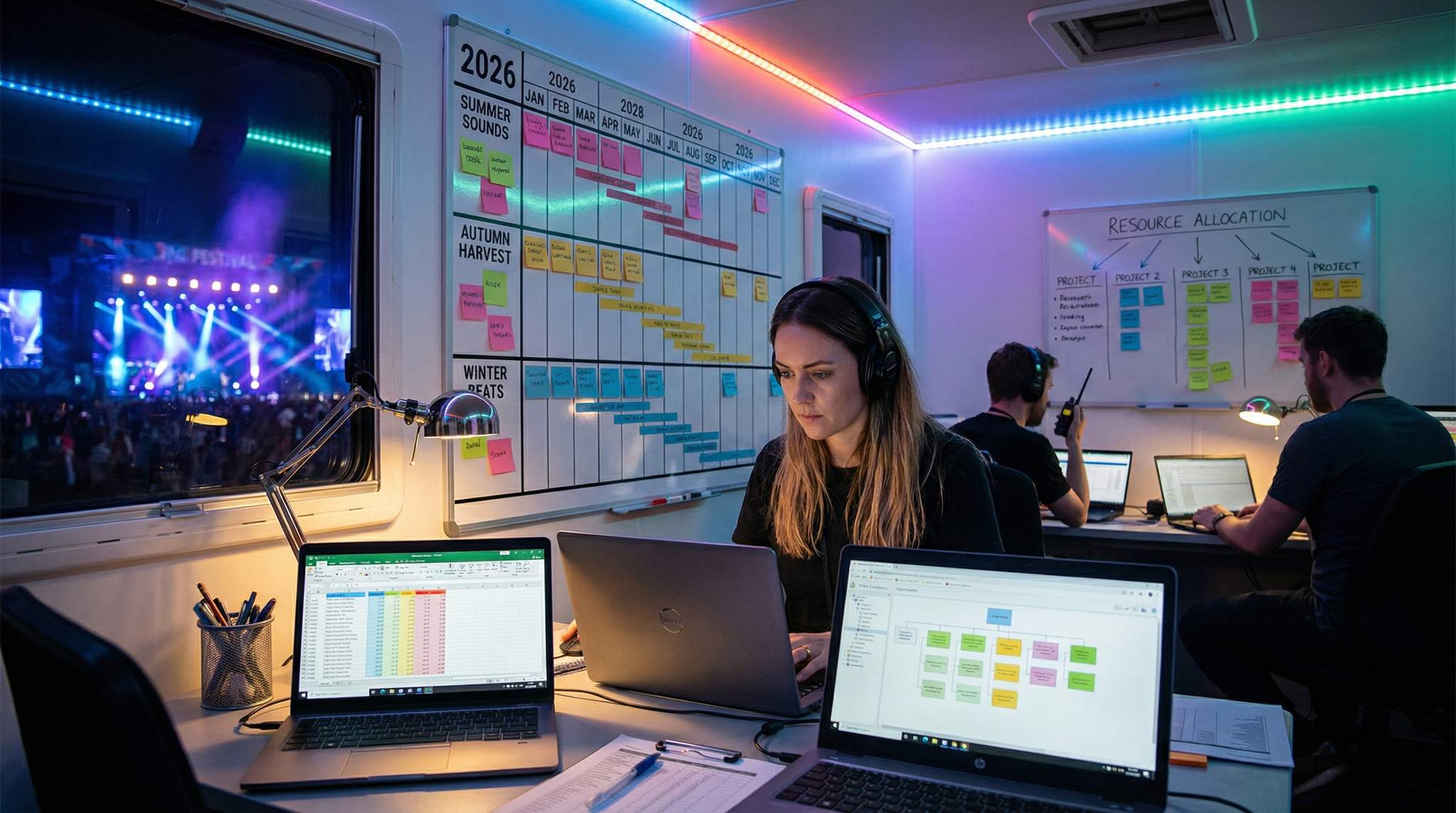
Planning is everything when juggling multiple festivals. Start by plotting all your 2026 event dates and working backward to map key milestones for each. Create a master calendar that shows the entire year at a glance – include major tasks like venue deposits, ticket launch dates, lineup announcements, production load-in, event dates, and post-event debriefs for every festival. This integrated view makes it easy to spot conflicts or crunch points. Many veteran producers use Gantt charts or project management software (e.g. Asana, Monday) to visualize overlapping timelines. By mapping out all festivals together, you can adjust deadlines to ensure critical phases don’t collide. For example, if two of your festivals are scheduled a month apart, you might stagger their marketing campaigns and vendor booking deadlines to avoid overloading the team in the same week. An integrated calendar also helps identify dark weeks (periods with no major tasks) where the core team can recharge.
Free Tool: How Many Tickets to Break Even?
Enter your venue, artist, production and marketing costs with your ticket price. See how many tickets cover your costs and how many you still need to sell.
To illustrate, here’s a simplified master timeline for two hypothetical festivals in 2026:
| Month | Festival A (Event in July) | Festival B (Event in November) |
|---|---|---|
| Jan – Feb | Secure venue; Initial sponsor outreach | Venue scouting; Theme/vision defined |
| Mar – Apr | Talent booking in progress; Tickets on sale | Sponsor outreach; Begin talent booking |
| May – Jun | Marketing ramp-up; Finalize vendors & permits | Tickets on sale; Marketing soft launch |
| Jul (Event) | Festival A event execution (late Jul) | (Dark period) core team recoup & focus A |
| Aug | Post-event teardown & debrief; Team rest | Marketing ramp-up; finalize vendors & permits |
| Sep – Oct | Planning 2027 dates; (light tasks only) | Intense prep: production build, staff training |
| Nov (Event) | (Dark period) no big tasks for A team | Festival B event execution (early Nov) |
| Dec | Wrap-up reports; budget reconciliation | Post-event teardown & debrief; team rest |
In the above timeline, Festival A’s busiest planning period is spring to early summer, whereas Festival B’s crunch time is fall – this staggering helps ensure the core team isn’t in two places at once. Build your calendar with such intentional overlaps and gaps, and share it with all department heads so everyone understands the year’s flow.
Planning a Festival?
Ticket Fairy's festival ticketing platform handles multi-day passes, RFID wristbands, and complex festival operations.
When drilling down into individual event timelines, applying best practices for mapping out a multi-day festival becomes essential. Unlike single-day shows, multi-day events require overlapping operational matrices—such as managing 24-hour site security shifts, coordinating overnight camping logistics, and scheduling daily vendor restocks. Organizers should break the multi-day schedule into distinct operational blocks (e.g., pre-gates, peak hours, overnight reset) to ensure that resources are allocated efficiently across the entire weekend without burning out the core team.
Avoiding Date Conflicts and External Clashes
Scheduling multiple festivals requires a 360° awareness of what’s happening both inside and outside your organization. Internally, avoid scheduling your own events so close together that you cannibalize attendees or stretch your crew too thin. Give enough breathing room for equipment and staff to travel from one site to the next. Externally, watch out for major events that could impact your plans. Global spectacles like the FIFA World Cup can dominate consumer attention and resources – for example, the 2026 World Cup runs mid-June to mid-July, prime festival season. Many experienced producers are proactively adjusting festival dates and tactics to thrive during that global spectacle by avoiding key match days and leaning into football-themed fan engagement. Likewise, check your regional calendar for any big competing events, holidays, or elections that might conflict. If one of your festivals is in the same city as a major concert tour or sports final, consider shifting dates or coordinating with local authorities on traffic and security.
It’s also wise to coordinate with industry peers when possible. If you oversee a genre-specific festival, find out if others in the region have events around the same time – booking artists and vendors could become harder if you overlap. Some independent promoters even share calendar info through associations or informal networks to prevent stepping on each other’s toes. For instance, in the UK, members of the Association of Independent Festivals often communicate to minimize direct date clashes in the same market. In practical terms, locking in your dates 12–18 months ahead is ideal when running multiple events. Early dates give you first pick at venues and talent, and allow more flexibility if you need to tweak timing. Mapping out high-risk dates and “safe zones” well in advance will save you from headaches down the line.
Parallel Processing vs. Focused Sprints
A key timeline decision is how much to overlap the planning phases of your festivals versus handling them sequentially. In reality, you’ll likely do a bit of both. Certain activities can run in parallel – for example, you might be finalizing the lineup for Festival A while starting sponsor outreach for Festival B. Other moments demand full-team focus – the weeks immediately before each festival, your whole crew might concentrate on that one event. The art is knowing when to divide your attention and when to concentrate it.
Data-Driven Event Marketing
Track ticket sales, demographics, marketing ROI, and social reach in real time. Exportable reports give you the insights to make smarter decisions.
Experienced production managers often stagger major milestones so that high-intensity phases don’t coincide. A useful technique is the “ready-check-launch” cycle: ensure that when one festival is in its final preparation stage (ready to launch), the next festival is still in an early check-in or planning review stage, not also about to launch. For example, aim to finish the critical design and booking decisions for Festival B before Festival A’s on-site crunch begins. That way, while you’re on-site at Festival A, the next event’s blueprint is largely set and team members can continue progress with minimal oversight. It may be tempting to delay tasks for Festival B until Festival A is over, but front-loading as much as possible will prevent a post-event pileup.
One practical tip from veteran producers is to assign “primary” and “secondary” focus periods to each event. For instance, March might be primary focus on Festival A (finalizing lineup, launching marketing), secondary on Festival B (early logistics planning), and no focus on Festival C (which might be much later in the year). In April, the focus allocation shifts. By communicating these focus rotations to your team, everyone knows which festival has priority at a given time. This avoids the trap of constantly multitasking on everything, which can lead to errors. Instead, teams work in focused sprints on one festival’s critical tasks while keeping the other projects simmering without neglect. Overall, the goal is to maintain steady progress on all events without letting any single one fall behind – a balancing act that your master timeline will continually inform.
Need Festival Funding?
Get the capital you need to book headliners, secure venues, and scale your festival production.
Team and Resource Allocation Across Events
Structuring Your Team for Multiple Festivals
When one producer runs many festivals, organizational structure becomes crucial. You’ll need to decide: do you maintain one centralized team that works on all events, or set up dedicated sub-teams for each festival (or a hybrid of both)? The answer often lies in your festival sizes and overlap. Large festival organizations tend to have departments (marketing, operations, talent booking, etc.) that serve all events in the portfolio, with event-specific teams or leads under each department. For example, you might have a single Head of Production who oversees production managers for Festival A, B, and C. This centralised model ensures consistency and allows sharing of best practices. However, it can also stretch leaders thin if all events peak at the same time.
Alternatively, some producers assign fully separate crews to each festival, especially if the events are simultaneous or far apart geographically. This can be more expensive (you’re duplicating roles), but it guarantees focus – each event team can give 100% without distraction. A common compromise is a hybrid structure: a small core HQ team sets overall standards and handles year-round tasks (finance, ticketing platform, sponsor sales, etc.), while each festival has a dedicated on-site team for execution. Many mid-sized festival companies operate this way: the core staff (maybe 5–10 people) work year-round across all events, and each festival then brings in freelancers, local vendors, and volunteers as needed under that core’s guidance. Clear roles and chain-of-command are vital so people know who they report to for each event. It can help to create an org chart for each festival and highlight which roles are shared versus unique. Don’t assume everyone will just “figure it out” – formally define the team structure in advance.
For instance, here’s an example of how roles might be allocated in a multi-festival team (shared vs. dedicated):
| Role/Department | Festival A (Dedicated Lead) | Festival B (Dedicated Lead) | Shared Resource? |
|---|---|---|---|
| Executive Producer | CEO/Founder (oversees all events) | CEO/Founder (same person) | Shared – oversees both |
| Event Director | Project Manager Alice (100% on A) | Project Manager Bob (100% on B) | Not shared (unique PMs) |
| Marketing Manager | Marketing Dir. (HQ staff) | Marketing Dir. (HQ staff) | Shared – runs marketing for both |
| Talent Booking | Booking Team (coordinate artists for A) | Booking Team (same team for B) | Shared – same talent team books both fests |
| Production Manager | Prod Manager (contractor for A) | Prod Manager (contractor for B) | Not shared – separate on-site leads |
| Ticketing & Analytics | Ticketing Coordinator (HQ staff) | Ticketing Coordinator (HQ staff) | Shared – one system/team |
| Volunteer Coordinator | Coordinator (seasonal hire for A) | Coordinator (seasonal hire for B) | Separate – local to each event |
| Safety Officer | H&S Manager (consultant for A) | H&S Manager (consultant for B) | Possibly shared if scheduling allows one person to do both |
In this scenario, high-level roles like the Executive Producer and Marketing Director are shared across festivals, maintaining a unified vision and brand consistency. Meanwhile, on-the-ground roles like Event Director or Production Manager are allocated separately to ensure each festival has a leader fully focused on its execution. Documenting this structure and communicating it to all team members (and vendors) prevents confusion such as two festivals “fighting” over the same staffer or misallocating responsibilities.
Free Tool: Will the Money Be There in Time?
Map your deposits and balances against when ticket money reaches you. See your lowest balance and how much you need to find before it arrives.
Dividing and Delegating Responsibilities
Multi-event production is the ultimate test of delegation. No single person – not even a superhuman festival producer – can be everywhere at once. Industry veterans recommend identifying strong deputies or co-producers for each event who can make decisions in your absence. As the overall producer, you might act as a “CEO” of your festival portfolio, but appoint a trusted “GM” for each festival. Give these event leads the autonomy to run day-to-day planning and on-site management for their specific festival, within the frameworks you’ve set. This way, while you’re busy with Festival A’s artist hospitality issue, your Festival B lead is confirming permits with the city without needing to ask you about every detail.
Delegation also means empowering department heads. If your marketing manager is shared across three festivals, ensure they have coordinators or assistants dedicated to each event’s campaign so they’re not trying to individually handle three social media calendars themselves. The same goes for operations: your technical director can define equipment standards and negotiate supplier deals for all events, but each festival might have an on-site tech lead to handle implementation and troubleshooting. Cross-training team members is invaluable. For example, train your operations staff on multiple venues so they can step into each other’s events if needed. Some producers rotate junior staff through different festivals in the offseason, giving them a broader skill set and making the overall organization more flexible.
A lesson learned by many experienced organizers is to avoid over-centralizing every decision. Early on, it might feel natural to personally sign off on every artist booking, every decor element, every food vendor for each festival – after all, these are your “babies.” But as your portfolio grows, that micromanagement becomes a bottleneck. One missed email while you’re on-site at another festival could hold up critical decisions. Instead, set clear guidelines (e.g., brand values, budget limits, safety standards) and let each festival’s team operate within them. Regular check-ins – say bi-weekly portfolio meetings – keep everyone aligned without requiring you to be in the weeds constantly. “Experienced producers know that trusting your team is not a luxury but a necessity,” as one 30-year festival veteran put it. A culture of accountability (everyone knows their deliverables and deadlines) allows you as the producer to focus on steering the ship rather than rowing every oar yourself.
Sharing Vendors, Suppliers, and Equipment
One of the biggest advantages of running multiple festivals is the potential to streamline logistics and cut costs through shared resources. Start by analyzing your vendor list across events – are there partners you could use for all festivals? For instance, if you’re happy with a staging company from Festival A, negotiating a package deal for Festivals B and C could yield significant discounts. Production equipment like generators, lighting rigs, video screens, fencing, and tents can sometimes be rented once and used sequentially across events (if the schedule allows transport in between). Some multi-event producers even invest in owning certain assets – buying a stage or sound system might be cost-effective if you can use it at four different festivals each year. However, be careful: only go that route if you have the storage, maintenance, and transport capabilities, or you could end up with costly headaches. Many opt to bulk-buy expendables (wristbands, RFID chips, merch inventory, etc.) for multiple events to get unit prices down.
There’s also operational efficiency in standardizing suppliers. Using the same ticketing platform, for example, means one learning curve for your staff and consistent data across events. The Ticket Fairy platform, for instance, allows promoters to manage multiple event brands under one account and team – simplifying oversight of sales and marketing. Likewise, sticking to a few trusted food and beverage vendors who can cater all your festivals might secure you a loyalty rate and ensure reliable quality. Just confirm that those vendors have the bandwidth to handle your dates (don’t assume the amazing taco truck you had in June is automatically free for your September festival – lock them in early for each gig). Another smart move is coordinating logistics between events: if Festival A and B are geographically close and a week apart, can you use the same fencing and have it trucked directly from one site to the next? Cooperating festivals often share gear and bulk-buy supplies to slash costs, and you can apply the same principle within your own portfolio.
That said, avoid the trap of forcing a shared vendor on a festival if it doesn’t fit their needs. Each event might have unique requirements – maybe Festival B is in a remote area where the staging company from Festival A doesn’t operate, or one festival’s vibe demands a different style of decor vendor. In those cases, prioritize the right fit over uniformity. Also, if you’re using one vendor for multiple events, be transparent with them about your timeline and quality expectations. A common mistake is over-relying on one supplier who then gets overstretched and underperforms. Ensure they scale their team or inventory to meet your multi-event demand. Some producers even build “backup vendor” plans – if the primary stage supplier falls through or under-delivers at Festival A, have a secondary on call for Festival B. Redundancy is your friend when so much is on the line.
Free Tool: Size Your Festival Site
Zoned capacity planning for arena, campsite, parking and entry lanes — against UK Purple Guide and NFPA density standards. Finds your bottleneck zone.
To execute this seamlessly across a portfolio, you must deploy robust vendor coordination strategies for festivals. Managing dozens of food trucks, staging companies, and merch sellers across different dates and cities requires centralized oversight. The most effective producers use dedicated platforms to manage contractors and crew efficiently, handling everything from initial onboarding and shift scheduling to site access communication and post-event reporting. By standardizing how suppliers submit their insurance certificates, power requirements, and arrival times, you eliminate the chaos of scattered email threads and ensure every partner is fully prepared before they even hit the festival grounds.
To take this a step further, adopting a robust digital management platform gives you all the tools you need to manage your contractors and crew efficiently—from onboarding and scheduling to access communication and post-event reporting. A unified workspace ensures that whether your crew is building a main stage in Miami or tearing down a site in Chicago, everyone is operating from the same real-time data.
Coordinating Talent and Programming Across Festivals
A unique resource consideration for multi-festival producers is artist bookings and programming. If your festivals are similar in genre or audience, you might be tempted to book the same headliner or attractions at multiple events. There can be cost efficiencies in doing so: agents might offer a discounted rate if an artist gets a mini-tour of your festivals (since it guarantees them multiple paydays with less overhead). In a time of soaring artist fees, coordinating bookings is a savvy tactic. For example, two reggae festivals in different cities a month apart could jointly book a Jamaican headliner, splitting airfare costs and routing logistics. In fact, talent sharing has been a strategy among some independent festivals to afford bigger acts by co-presenting shows on adjacent weekends. If you manage events in different markets, agents may give you first dibs on tour dates because you represent several opportunities.
However, be cautious: booking the same lineup for every festival can backfire. Fans might skip your smaller event in favor of the bigger one if it’s all the same names. To preserve each festival’s unique identity (more on that soon), use talent overlap strategically. It works best when festivals are in different regions or cater to distinct fan bases – then you’re not cannibalizing, you’re efficiently extending an artist’s reach. Also be upfront with artists and agents about your multi-festival intentions; ensure contracts clarify each appearance. Logistically, staggering the performance dates is important if an artist is playing multiple of your events – you’ll need to work out travel and possibly gear shipping between those shows. Many producers avoid scheduling their own festivals too close together if they want to use the same performers, because an artist generally can’t play two festivals on the same weekend (unless they’re in extremely close proximity and schedules allow, which is rare).
Another aspect is non-musical programming – think installations, stages, or theme elements. A multi-festival producer might develop a particularly successful attraction (say a VR experience or a themed stage) that could be replicated at another event. This can save on creative development costs. Yet again, moderation is key: if a special art piece was beloved at Festival X, bringing it to Festival Y can delight fans there, but if you have a lot of crossover attendees or media, it might diminish the novelty. One approach is to create variations on a theme – for instance, a series of interactive art installations that share a stylistic thread but are customized to each festival’s theme or locale. This provides a coherent brand story across your events (a plus for sponsors as well) without making them cookie-cutter copies of each other.
Budgeting and Financial Strategy for Multiple Events
Financial Planning for a Multi-Festival Season
Handling finances for one festival is challenging enough – doing it for several in one year requires next-level rigor. Start with a macro budget: look at your entire portfolio’s finances for 2026, including shared overhead and individual event costs. This top-down view helps you allocate capital appropriately and plan cash flow. Often, certain expenses can be centralized. For example, your year-round staff salaries, office costs, insurance policies, and major equipment purchases might be classified as “global” or shared costs spread across events. Meanwhile, direct costs like artist fees, local staffing, venue rental, and on-site operations will be allocated per event. It’s critical to decide how you’ll split shared costs in your accounting – some producers prorate by event size (e.g., the bigger festival absorbs a larger percentage of the annual overhead), others split evenly or by expected revenue. Choose a method and apply it consistently so you know each festival’s true profitability.
Go Cashless With RFID Technology
Enable contactless payments, faster entry, and real-time spending analytics with RFID wristbands and NFC-enabled ticketing for your events.
Cash flow is a notorious challenge. If one festival’s ticket revenue comes in late (say most sales occur just weeks before the event), will you have funds to pay deposits for another festival happening later? Map out a month-by-month cash flow forecast for the year, including when big expenses hit (deposits, final balances, payables) and when income arrives (on-sale launches, sponsorship payments, etc.). This might reveal pinch points – for instance, in spring you might be laying out cash for two summer festivals at once. In such cases, you may need a line of credit or reserve fund. Many multi-event organizers essentially float costs from one event to the next, especially if the events are back-to-back. Be very careful with this approach: if Festival A underperforms on ticket sales and you already spent that anticipated income on Festival B’s upfront costs, you’re in trouble. Industry veterans highly recommend maintaining a contingency fund or access to emergency capital when you’re executing multiple festivals, as a buffer against one event’s shortfall affecting the whole portfolio.
Consolidating Costs and Finding Economies of Scale
As mentioned earlier, running multiple events can unlock cost savings – if you plan for them. Some efficiencies will occur naturally (buying in bulk, reusing gear), but others require conscious strategy. When drafting budgets, identify which line items could be reduced on a per-festival basis by consolidating. For example:
- Marketing & Design: Instead of hiring separate designers or agencies for each festival, you could invest in an in-house graphic designer or a single creative agency for all events, negotiating a yearly retainer. The result is consistent branding and lower total design costs than paying piecemeal. Similarly, you might run combined advertising campaigns for multiple events if they target similar audiences (e.g. a Season Pass promo that markets all your festivals together).
- Insurance: Some insurers offer multi-event policies or allow bundling for a better rate. Rather than buying separate insurance for each event, explore an annual liability policy covering all your festivals (ensuring coverage limits meet the largest event’s needs). You might save on premiums overall.
- Equipment Rental: As discussed, locking in one rental company for staging, lights, or AV across all your festivals can give you bulk pricing. If your event dates are spaced out, you might get a discount by essentially “block booking” the gear for multiple dates upfront. One caution: verify that the rental company can handle the turnaround logistics (transport, setup) from one fest to the next.
- Ticketing and Payment Processing: Using one ticketing platform and merchant account for all events could reduce fees through higher volume. Ticketing providers often have tiered pricing – the more tickets you sell in aggregate, the lower the per-ticket fee. By consolidating on one system (like Ticket Fairy, which supports multi-event management), you maximize your leverage in fee negotiations.
- Staff Training & Hiring: Combine training sessions for staff/volunteers across festivals. Instead of training security or volunteers separately for each event, do one larger onboarding session that covers all basics, then brief on event-specific differences. This not only saves time but also creates a pool of trained staff you can draw on for multiple events.
Consolidated systems also allow you to implement custom ticket rules for multi-location festivals. For example, you might want to offer a specialized “season pass” or geo-targeted pricing tiers that apply across your entire portfolio. A unified platform makes this seamless while maintaining ticket quality in terms of maintaining chronology of events—ensuring that early-bird sales, tier price jumps, and VIP upgrades trigger in the correct sequence across all your overlapping festival timelines without manual intervention.
Let’s look at a simple hypothetical budget comparison to see how consolidation can save money. Suppose you have Festival A (larger, 20,000 attendees) and Festival B (smaller, 5,000 attendees). Planned costs might look like:
| Expense Category | Festival A (Standalone) | Festival B (Standalone) | Multi-Event Plan (shared resources) |
|---|---|---|---|
| Talent (Artists/DJs) | $300,000 | $150,000 | $450,000 (no change, separate lineups) |
| Production (Staging, Sound, etc.) | $400,000 | $200,000 | $550,000 (shared vendor deal saves $50k) |
| Marketing & Advertising | $150,000 | $80,000 | $200,000 (shared team/ads saves $30k) |
| Core Staff & Overhead | $100,000 | $60,000 | $130,000 (shared staff roles saves $30k) |
| Total Direct Costs | $950,000 | $490,000 | $1,330,000 (vs. $1,440,000 separate) |
| Estimated Revenue | $1.2M | $600k | N/A (revenues tracked per event) |
In this rough scenario, by sharing production vendors, a marketing team, and some full-time staff across the two festivals, the producer saves around $110,000 (about 7.6% of the combined budget) compared to funding them completely independently. That’s money that can improve profit margins or be reinvested into enhancing the attendee experience. While every situation will differ, the principle holds: find the categories where 1 + 1 can equal 1.8 (instead of 2) in cost. Keep in mind that some costs won’t scale down – artist fees won’t magically drop just because you booked them twice (unless you actively negotiate a multi-event deal). And remember to factor in the additional costs of managing multiple events, like higher travel expenses for staff shuttling between festivals or the overhead of a central management team. Those need to be offset against your savings.
Budget Management and Tracking per Event
Even as you realize efficiencies, it’s essential to track each festival’s budget separately. You need to know the P&L (profit and loss) of each individual event, not just the aggregate. It’s not uncommon for one festival to essentially subsidize another, especially when launching a new event that might lose money its first year. But you should consciously decide if you’re doing that, rather than it happening by accident due to sloppy accounting. Set up separate budget ledgers or tabs in your spreadsheet for each festival’s direct expenses and income. Allocate shared costs transparently (e.g., you might allocate your $130k core staff cost as $80k to Festival A and $50k to Festival B based on staff effort). This way, when the dust settles, you can evaluate the financial performance of each event and adjust for next year – maybe Festival B needs a new venue to reduce costs, or Festival A can afford to spend more on talent if it saw a bigger surplus.
Smart Promo Codes & Presale Access
Create percentage or flat-rate discount codes with usage limits, date ranges, and ticket type restrictions. Plus unlock codes for private presales.
Another best practice is to avoid robbing Peter to pay Paul – in other words, don’t pull budget from one festival to cover unexpected overruns in another without a clear plan. It can be tempting in the heat of the moment: “Ticket sales for Event X are slow, let’s use some of Event Y’s marketing budget to push X.” Occasionally shifting resources is fine (after all, the success of the overall portfolio is what matters), but do it too often and you endanger the later events. Maintain discipline by earmarking contingency funds for each festival. For instance, you might set a 5-10% contingency in each budget, and only if absolutely necessary, tap one event’s contingency to help another – and even then, document it so you reconcile afterward.
Regular financial check-ins are a lifeline. Convene your finance manager or accountant monthly (or biweekly during peak season) to review actuals vs budget for each festival. This helps catch early if one event is consistently overspending so you can course-correct or find savings elsewhere. In multi-event management, small budget variances can add up across events, potentially putting the whole operation at risk. One festival going 15% over budget is troublesome; four festivals each 5-10% over budget could be disastrous if unaddressed. The goal is no surprises: by the time you hit each festival weekend, you should have a very clear picture of expected expenses and breakeven points.
Leveraging Bulk Buying and Partnerships
Beyond internal efficiencies, a multi-festival producer can harness their scale to forge stronger partnerships and deals. Use your growing portfolio as a selling point: vendors, sponsors, and even investors are more likely to give advantageous terms if they see you as a significant, long-term player rather than a one-off event. For example, approach a nationwide staging supplier with the proposition of a multi-year, multi-event contract. They may cut rates knowing they’re your exclusive partner across, say, six events per year. The same logic applies to sponsorship: instead of pitching each festival separately to brand partners, consider a combined proposal for the whole season. Brands are increasingly data-driven in 2026, and they’ll appreciate the larger audience reach and consistency you offer by bundling. You might secure a title sponsor for the entire festival series, or negotiate a deal where a beer brand is the “Official Beer” at all your events, which could net a higher dollar commitment than piecemeal deals, similar to the ownership of the promoter Goldenvoice which manages vast portfolios.
However, ensure any partnership still allows each festival to maintain its character (more on that in the next section). If one of your festivals is a family-friendly food fest and another is an EDM rave, the same marketing activations won’t fit both, even if the sponsor is the same. In those cases, structure deals such that the sponsor gets presence at all events but perhaps in different ways appropriate to each audience. Delivering value to partners across multiple events can actually increase your renewal rates – sponsors love a one-stop shop. Just be cautious not to oversell deliverables; coordinating a sponsor’s needs across several events adds another layer of project management.
Finally, keep an eye on the big financial picture: multiple festivals mean multiple revenue streams (tickets, concessions, merch, sponsorships, perhaps streaming or conference components). This diversification can stabilize your business – if one event has a bad year, others might carry it. It’s similar to an investment portfolio. But if something like a major economic downturn or a pandemic hits (knock on wood), it could impact all your events simultaneously. That’s why multi-event producers often invest in insurance products like event cancellation insurance or even parametric weather insurance to protect finances across the board. Essentially, as you scale up, think like a CFO as much as a showrunner.
Maintaining Quality and Consistency Across Events
Establishing Standard Operating Procedures (SOPs)
One secret to ensuring every festival you run meets high standards: process and consistency. When you’re juggling multiple events, you can’t reinvent the wheel each time – nor should you. Instead, develop a playbook of Standard Operating Procedures for core festival functions. This might include checklists for site build and teardown, protocols for security and entry, communication flows for emergencies, standard forms for vendor load-in, etc. By having SOPs, you create a baseline of quality that all events should adhere to. For example, you might mandate that every festival you produce conducts a full site safety inspection 24 hours before gates open, using the same detailed checklist. Similarly, your cash handling procedures at the box office might be standardized so there’s less room for error or loss, regardless of which event it is.
Documentation is key here. Experienced multi-festival teams build knowledge repositories (shared cloud folders, manuals, or an internal wiki) where all procedures and templates are stored. New team members can be onboarded faster, and there’s less reliance on institutional memory (“Oh, I thought Jim was checking the generators, he always does that at Festival A – but at Festival B, no one did it!”). An SOP doesn’t mean rigidity or stifling creativity – think of it as the safety net that catches essential tasks, while still allowing flexibility in areas that define an event’s uniqueness (like creative decor, lineup, etc.). When the main stage power failed at a 40,000-capacity festival one veteran producer was managing, his team was able to respond in under 5 minutes because they had a predefined emergency power SOP. At the next festival in their season, they didn’t have the same issue – but they still ran the power fail drill with the crew, just in case. This kind of procedural discipline ensures that even when you’re not physically present at a festival site, your team acts with the same professionalism and thoroughness you would.
Nowhere is this procedural discipline more critical than during site load-in and load-out. Planning and executing the build and break phases of your event is no small task, but with a standardized production schedule and rigorous SOPs, your site operations are in safe hands. When you are running multiple festivals, a delay in one event’s teardown can literally prevent those same staging assets from arriving on time for the next festival’s build. Detailed, minute-by-minute load-in matrices ensure that heavy machinery, staging crews, and site decor teams operate in a synchronized dance rather than a chaotic traffic jam.
A good approach is to implement a “festival audit” system. Before each event (ideally a few weeks out), do an internal audit against your SOPs: Has every permit been obtained and double-checked? Are all staff trainings completed? Has the stage plot been reviewed by the safety officer? You can even have teams audit each other’s events – the team prepping Festival B reviews Festival A’s readiness using the checklists, and vice versa. Fresh eyes might catch issues the other team overlooked, and it creates a sense of unified quality culture. Post-event, perform the same audit in retrospect: did we follow our SOPs? Were there deviations, and if so do we need to adjust the SOP or re-train staff? This continuous improvement loop will elevate the consistency across your portfolio year after year.
Ensuring Consistent Production Quality
Each festival may have its own personality, but the quality of execution should be uniformly high. Fans might forgive a small community fest for some hiccups, but if you’re charging premium prices at a larger event, expectations are sky high. When one producer’s name (or company) is attached to multiple festivals, your reputation is only as strong as the weakest execution. To maintain quality, consider having a roving “tiger team” of expert crew who travel to each of your festivals in a quality control capacity. For instance, you might have a crack audio engineer or stage manager who rotates through all your events to ensure the main stage production is up to snuff everywhere. Their job isn’t to run the whole show, but to support local crews and uphold standards (correct sound calibration, proper stage safety measures, etc.). This is especially useful if your events are in different cities and you hire local production teams for each – a few well-trusted overseers can align all parties on what “great” looks like.
Another technique is to benchmark and cross-pollinate between your festivals. If Festival A got rave reviews for its efficient entry process (maybe they tested new fast lanes or better signage), make sure Festival B adopts those improvements next time. Conversely, if an issue like long bar queues or insufficient restrooms cropped up at one event, proactively address it at the others before it becomes a problem there. Use metrics wherever possible: attendee-to-toilet ratios, average wait times for entry, stage changeover duration – track these per event and compare. If one festival consistently outperforms in an area, find out why and try to replicate that approach at the others. Some large festival producers use secret shoppers or NPS (Net Promoter Score) surveys at all their events to gauge quality from the audience perspective uniformly.
Vendor and crew quality control is also paramount. When dealing with multiple events, there’s a temptation to hire cheaper or less experienced contractors for the smaller festivals to save money. Be wary of a two-tier system developing, where one of your festivals gets the “B-team.” If anything, your smaller or newer events need the A-team even more to build their reputation. Strive to give every festival – regardless of size – professional staging, sound, security, and so on. This might mean spreading your top tech staff across events (as mentioned) or training vendors to meet your criteria. Provide all contractors with your production handbook or guidelines. If you expect the sound check to be completed 30 minutes before gates open, that should happen at every event, not just the flagship one. The more you can standardize quality expectations in contracts and briefings, the better. It can help to hold kickoff meetings with all vendors for each festival and reiterate, “We expect the same standard here as any major festival.” Setting that tone early often leads vendors to bring their best effort, as they know they’re part of a bigger family of events and future work might depend on good performance.
Lastly, don’t overlook community and compliance standards as part of quality. Noise curfews, local resident relations, environmental cleanup – meeting these obligations consistently will uphold your brand’s trustworthiness. If one festival leaves a mess or angers the neighborhood, it tarnishes how authorities and communities view your other events too. By maintaining a spotless track record across the board (permits in order, sites left clean, zero safety negligence), you not only avoid fines and bad press but also grease the wheels for future expansions. A multi-festival producer often relies on a general goodwill reservoir; each event should refill that reservoir, not drain it.
Rapid Problem Response and Knowledge Transfer
In a multi-event season, the learning cycle is accelerated. Issues that occur in one festival can be fixed and prevented in the next – but only if there’s a deliberate process for knowledge transfer. Hold a debrief meeting immediately after each festival (within 1-2 weeks, while memories are fresh). Include key staff from all levels: production, marketing, ticketing, safety, volunteer management, etc. Identify what went well and what went wrong. Crucially, for anything that went wrong or was merely “acceptable” but not excellent, discuss solutions and write them down in a shared “action items” list. Now, before your next festival, review that list and ensure those solutions are implemented.
For example, if Festival X had an issue with long lines at the shuttle bus pickup late at night, and the team’s solution is to add more buses or better queue management, then Festival Y (coming up next) should proactively add those measures even if Festival Y never had that issue historically. You’re effectively inoculating each subsequent event with the lessons from the previous. This can drastically improve the overall season outcome. Many producers treat the first festival of the year as a real-world test – they might even soft-launch new initiatives there – and then refine for the bigger events later in the season. In doing so, you turn your multi-event schedule into an iterative improvement process. Just be careful if each festival is in a different environment; an outdoor camping festival might have different needs than an urban one, so adapt lessons appropriately rather than copy-paste blindly.
Communication across event teams is vital for this knowledge flow. Encourage an environment where Festival A’s crew shares what they learned with Festival B’s crew. Perhaps set up a short cross-event conference call or group chat after each festival specifically for this purpose. It can be as simple as: “Hey team, at last weekend’s fest we tried a new wristband scanning system that cut entry wait times by 30%. Here’s what we did and the pitfalls to avoid. You might consider it for your event.” This peer-to-peer sharing is gold. It might also cover warning lessons: “Our generator placement was too close to the camping area – we got noise complaints. Don’t make that mistake next month.” These real-life experiences are more impactful than any generic advice and will resonate with crews preparing for their turn.
Finally, empower your teams to stop small problems before they become big. If something slipped through the cracks due to multi-tasking or oversight, it should trigger a review of your process. Maybe you discover that while you were busy with one festival, the other festival’s permit application was filed late. The fix might be creating a redundant reminder system or assigning a deputy to double-check critical admin tasks. Each stumble is a chance to strengthen your approach for all upcoming events. In sum, a multi-festival producer must be part firefighter, part detective: quickly extinguish issues at one event, then investigate the cause and implement safeguards so it never happens again at any event.
Preserving Each Festival’s Identity and Community
Distinct Branding and Positioning for Each Event
While you gain efficiency by standardizing operations, marketing and branding are where you don’t want to copy-paste. Each of your festivals likely has its own identity – and maintaining those unique vibes is crucial for community loyalty. Fans should feel that each event is special, not just a franchise or cookie-cutter replication. Start with the basics: give each festival its own brand style (logo, color scheme, voice) and social media presence. Even if your company name is behind them all, the outward-facing branding can and should be distinct. For example, Goldenvoice produces both Coachella and Stagecoach in California – the former is an eclectic boho music safari, the latter a country music hoedown. They occur on the same grounds just a week apart, yet everything from the art direction to the catering menus is tailored to the different audiences. As a multi-festival producer, you must be almost chameleon-like in switching hats between brands.
One practical tip is to create separate marketing teams or brand managers for each festival (even if they report to a central marketing director). Their job is to live and breathe that festival’s culture and tone of voice. The content calendar, language, and partnerships they pursue might be very different from your other events. This helps ensure that promotional materials don’t blur together. It can be tempting to cross-promote heavily (“If you liked Festival X, come to Festival Y!”), and cross-promotion has its place (discussed later), but be careful not to dilute the brand identity. Each event should stand on its own merits. Use unique themes or storylines each year to further differentiate – maybe one festival has a sci-fi theme in 2026 while another celebrates local folk heritage.
When booking talent and programming, curate with that identity in mind. Even if you can get a great deal on an artist to play two of your festivals, ask whether they fit both brands. An underground techno DJ might be perfect for your urban night-time block party festival, but totally out of place at your family-friendly daytime festival in the park. Tailor stage designs and site layouts to suit the ethos: one event might have a healing sanctuary and yoga sessions, another a 24/7 rave tent. These choices reinforce to attendees that the producer cares about the authenticity of each experience, not just about scaling up. A successful example is the AFROPUNK festival series, which takes place in cities from Brooklyn to Paris to Johannesburg. While it’s a global brand with core values (celebrating Black music, art, and activism), each city’s edition incorporates local artists and cultural elements – the Paris edition features French afro-punk bands and local food vendors, Johannesburg’s edition highlights South African creatives, etc. Attendees feel a pride and connection that their AFROPUNK is unique, even as they recognize the common spirit across them.
Community Engagement and Local Flavor
The more festivals you run, the more communities you touch – and each community will have its own stakeholders, expectations, and opportunities. Engaging the local community is not just a nicety; it’s often the make-or-break factor in an event’s longevity. To preserve each festival’s unique identity, lean into the local flavor. This means working with local city officials, neighbors, businesses, and cultural groups for each festival in a personalized way. Don’t assume what worked for one location works elsewhere. Instead, take the time to understand each host community. If one of your festivals is in a small town, maybe involve the town council or local volunteers in planning; if another is in a big city, connect with neighborhood associations or advocacy groups relevant to your audience.
Many top festivals build advisory boards or local committees when they expand to a new location. Consider doing this even if you’re the same producer – basically, have a sounding board of community members for each festival to keep you grounded in that locale’s needs. For example, when expanding a festival brand to a new country or city, producers often partner with a local promoter or cultural expert to ensure the event is culturally sensitive and appealing. As an illustration, when Primavera Sound (originally from Barcelona) launched a sister festival in Los Angeles, they collaborated with local event staff in LA to navigate the local regulations and audience expectations, rather than just parachuting in with the exact Barcelona blueprint.
One huge aspect of local identity is incorporating local artists, vendors, and staff. Even if your festival has big international headliners, featuring regional talent on the lineup not only gives it a unique flair but also earns good will from the community. The same goes for food and craft vendors – a festival in Mexico City should have some awesome local taco stands or craft makers to feel authentic, rather than identical food trucks you’d see in London. When communities see that a festival is providing opportunities and showcasing homegrown culture, they are far more supportive and proud of the event. As a bonus, it differentiates your festivals from each other. Attendees might travel to multiple of your events precisely because each offers something regionally special – think of it like they’re visiting different “worlds” you’ve created.
Consider how Glastonbury Festival in the UK (though a single festival) deeply integrates with its local Somerset community, supporting local charities and employing local staff, giving it a grassroots soul despite its massive size. On a smaller scale, if you operate, say, a series of EDM festivals in various countries, you might ensure each has local stage hosts or cultural performances alongside the main EDM acts, to root the event in the local scene. These choices preserve the festival’s identity and reinforce community impact, which can also be a compelling story for sponsors and media. Your marketing materials should highlight these local partnerships (“Featuring over 50 local wineries from the region!” or “Built in collaboration with the Nollywood film community!” for example) to show that each event isn’t just copy-paste, but genuinely of its location.
Avoiding Cannibalization and Audience Fatigue
When you produce multiple events, especially in the same genre, there’s a risk of cannibalizing your own audience. If two festivals are too similar or timed too closely, fans might choose one or the other – or worse, get tired of your brand altogether. To avoid this, maintain clarity in what makes each event distinct, and communicate that clearly in your marketing. Differentiate by theme, by season, by setting, or by musical niche. For instance, you might run one festival that’s camping-oriented and another that’s an urban day festival. Some hardcore fans will attend both, but casual attendees will self-select the experience they prefer – ensuring you’re growing the overall audience pie, not splitting the same pie. Staggering your event dates across the year also helps; people might attend a spring festival and be ready for another by fall, but two in the same month is a harder sell (and tougher on their wallets).
It’s also important not to oversaturate your marketing to the same database with constant pushes for tickets to yet another event. Strategic cross-promotion can increase awareness, but it should be done in a way that feels helpful, not spammy. One strategy is to create a loyalty program or festival pass where superfans can buy a bundle or earn rewards for attending multiple of your festivals. For example, some multi-festival producers offer a season pass for all their events at a discount – this can actually deepen loyalty without confusing each event’s branding (the pass is promoted as a special offer, but each festival is still marketed separately with its own identity). Another example is giving previous attendees first dibs or a small discount on tickets for your other events, as a thank you. This cross-pollinates audiences gently.
Pay attention to feedback that might indicate fatigue. Are your surveys showing diminishing satisfaction among repeat attendees? Are social media comments saying “these lineups all look the same”? If so, you need to inject more differentiation or maybe scale back something. It might sound counterintuitive, but sometimes less is more – community-centric festivals build lasting success by prioritizing depth over breadth, and scaling an event down or spacing it out could lead to better long-term success than chasing growth for growth’s sake. Some festival producers actually skip years or rotate locations to keep things fresh (though that requires strong strategy and isn’t always feasible contractually). At minimum, ensure each festival has one signature element that others do not. Maybe one has a famous parade, another a stunning mountain location, another a niche genre focus. These unique selling points are what you highlight to audiences so they understand why attending multiple of your events is worthwhile.
Cannibalization isn’t just about attendees, either – think about media coverage and sponsor interest. If your festivals are too similar, press might only cover one of them (whichever is seen as bigger) and sponsors might say, “We’ll just do one, thanks.” Instead, position them so that they appeal to different press angles and brand categories. For example, one event could lean into lifestyle and fashion aspects (attracting style media and fashion brand sponsors), while another leans into tech and innovation (drawing tech press and gadget sponsors). This way, your portfolio is complementary rather than duplicative. In summary, treat each festival as a unique star in your constellation, not interchangeable planets, and your galaxy of events will shine brighter as a whole.
Preventing Burnout for You and Your Team
Pacing the Season and Scheduling Downtime
Producing even one festival is a high-stress marathon; doing several in a row can quickly lead to burnout if not managed carefully. Understanding how to prevent festival crew burnout and mental health strategies is essential for long-term sustainability. Both you as the organizer and your extended crew need periods of rest – and it’s your job to bake that into the plan. Remember that master calendar we discussed? One of its purposes is to find and protect recovery windows. After each festival, schedule at least a short cooling-off period where the core team can take time off or at least switch to lighter duties. A good rule of thumb used by industry veterans is: for a multi-day festival, give the team at least one day off for each day of the event (or more) before the next big push. It’s tempting to say “on to the next one!” immediately, but running your team ragged will cause mistakes, low morale, and people quitting mid-season.
As the producer, set an example by actually taking those downtime days yourself (if you can’t, that’s a sign you need more delegation or additional staff). It might sound luxurious, but think of it as an investment in performance. A crew member who’s had a week to recuperate will be far more effective for three months after than one who’s been grinding non-stop for 6 weeks. Some festival companies implement mandatory rest periods: they literally forbid overtime for a week after an event, or force employees to use vacation days to disconnect. This might not always be practical in a lean team, but at least encourage comp time or flexible schedules post-event.
When scheduling your events, also consider the physical and mental toll of each. For example, an intense camping festival where crew are on-site for 7 days straight requires a longer recovery than a one-day city festival. If your season includes a behemoth event, try not to sandwich it immediately between two others. One approach is to have an “A team / B team” rotation for some roles – after the A team finishes a major event, the B team (or fresh contractors) handle immediate wrap-up tasks and the next event’s prep for a short while, giving A team a breather. You might also rotate key personnel such that not everyone works every single festival. Perhaps your head of operations leads three events and an assistant leads the fourth one, giving the ops head a break (under supervision). Cross-train your staff so they can fill in for each other without catastrophe.
Supporting Mental Health and Crew Welfare
Festival work is as much mental as physical. Long hours, high pressure, and the emotional rollercoaster of events can strain anyone’s mental health. Multi-event scenarios add cumulative fatigue and anxiety (“I have to do this all over again next month!”). Acknowledging this openly is important – let your team know that stress is normal but strategies exist to cope. Many seasoned festival producers bring in mental health strategies for production teams to support their crew. This could mean having a counsellor or therapist on call (or on-site) that crew can talk to, especially during multi-day events. Some large events even set up a quiet “crew wellness tent” with basic therapies like massage, stretching, earplugs for quick naps, etc. For a series of events, you might extend those resources through the season – for instance, offer crew free access to a meditation or wellness app, or organize group debrief sessions after each festival where folks can vent and share stories (kind of like group therapy meets feedback meeting). These practices show the team that their well-being is a priority, building loyalty and resilience.
Shift management is another critical piece. Don’t schedule the same people for 16-hour shifts at consecutive festivals. Stagger your crew so some can take lighter loads at one event and heavier at another. Bring in reinforcements if needed; better to slightly overstaff and have some folks underutilized than to burn out your MVPs entirely. Also, encourage a culture of speaking up when overwhelmed. Your team should feel safe saying “I need a break” without stigma. As a leader, watch for signs of burnout: exhaustion, irritability, declining work quality, absenteeism. If a team member is nearing a breaking point, step in and adjust their duties or find help. It’s far better to proactively relieve someone than to have them quit mid-season or make a serious error on site due to fatigue.
Don’t forget about your own mental health as the producer. It’s easy to play superhero and neglect yourself while caring for the team and the events. But you are effectively the linchpin of the whole operation. If you collapse, the house of cards can come down. So build your own support system – maybe that’s a co-producer who can shoulder responsibilities, a mentor you can call for advice, or simply scheduling personal time where you’re truly off duty. Some veteran organizers practice mindfulness or have routines (like an exercise regimen or journaling) to stay centered during the chaos. It might help to keep a perspective: you’re creating amazing experiences, but no festival is life-and-death. Reminding yourself and your team that it’s okay to step back can reduce the psychological pressure. As one festival director put it, “It’s a marathon, not a sprint – pace yourself, celebrate small wins, and don’t lose sight of life outside the festival circuit.”
Leveraging Automation and Tech to Reduce Workload
Smart use of technology can be a lifesaver when human resources are stretched thin. In the 2026 season, many festivals are adopting tools that automate repetitive tasks or enhance efficiency, effectively doing more with less staff. As a multi-festival producer, you should absolutely take advantage of this tech – it can lighten the load across all your events. For example, if managing on-site ticketing and entry is eating up a lot of manpower, consider switching to a fully cashless RFID wristband system or app-based tickets. This can speed up entry and reduce the number of staff needed at gates (freeing those people to work elsewhere). Self-service ticket scanning kiosks or turnstiles can similarly cut down on required volunteers. Cashless payment systems in general (for bars, food, merch) not only improve attendee experience but also minimize cash handling headaches for your team and reduce shrinkage.
Another area is communication automation. Instead of manually answering thousands of attendee questions via email or social media, deploy chatbots or a robust FAQ and communications plan. AI-powered chatbots can handle common queries 24/7 and escalate only the tough ones to your team. Scheduling software can automate crew rostering and volunteer sign-ups, preventing endless spreadsheets and phone tag. For planning, project management apps with automated reminders ensure deadlines aren’t missed even if you’re busy on another festival – you’ll get pinged when payments are due or when it’s time to submit that permit application, acting as a virtual assistant.
Behind the scenes, data integration across your multiple events will simplify life. Using one centralized system for things like accreditation or artist advancing means you’re not reinventing processes each time. For instance, if artists at all your festivals submit their tech riders through the same online portal, your production team gets a uniform format to work with, and can more easily repurpose the info or compare needs across events. Many producers also harness radio and IoT tech for safety and operations – like real-time crew tracking or asset tracking via GPS, which helps a smaller team manage a large site more effectively. In 2026, some festivals are even testing drones for site overview or deliveries, and wearable tech for crew welfare during long hot festival days to monitor health during long shifts.
Crucially, any tech adopted should be reliable and well-tested before you depend on it across your season. It’s worth doing a dry run at a smaller event or an off-season gathering to ensure, say, your new scanning system won’t crash on opening day. Once vetted, though, these tools become extra “team members” that ease the human workload. The caveat is not to let tech create a sense that you can understaff too much; technology assists humans, it rarely replaces them entirely in a festival context. But it can mean that your existing team’s energy is spent on high-value tasks (creative problem solving, interpersonal guest service, critical decision-making) rather than menial or very exhausting ones.
By reducing grunt work and automating routine workflows, you also alleviate stress that contributes to burnout. The team isn’t up until 3am reconciling paper ticket sales or manually building schedules – software does the heavy lifting, and the team gets a bit more sleep. As always, training is important so staff trust and know how to use the tech tools. Early in the season, invest time in getting everyone comfortable with these systems so that by the time you’re in the thick of back-to-back events, the tech is smoothly integrated into operations. Embracing innovation, while keeping a human touch where it counts, is a hallmark of modern festival management and streamlining operations to save money and time can be your secret weapon to surviving a packed 2026 schedule.
Another critical area ripe for technological intervention is credentialing. Managing your event accreditation can be complex and time-consuming, especially when dealing with thousands of artists, media personnel, and VIPs across different cities. However, utilizing a centralized ticketing and credentialing system ensures the process becomes streamlined and efficient. By setting up automated approval workflows and tiered access levels, your team can eliminate the dreaded box-office bottleneck across your entire multi-location festival portfolio.
Building a Sustainable Team Culture
Beyond immediate tactics, think long-term about crew culture across your festival portfolio. High turnover or a disillusioned crew can derail a multi-event run. You want people to be excited to work the next event, not dreading it. To that end, foster a sense of camaraderie and shared mission. Celebrate successes after each festival – even small thank-you gestures like an appreciation dinner, shout-outs on social media, or a highlight reel of the event can boost morale. When crew know their hard work on Festival A will be recognized and that they’re part of a “family” gearing up for Festival B next, they’re more likely to stick around and give their all again, helping in preventing festival crew burnout.
Transparency also builds trust. Keep your team in the loop about the company’s trajectory and why multiple events are beneficial (e.g., “If we nail all three festivals, it solidifies our reputation and could mean more resources or bonuses next year”). Let them see the bigger picture – they’re not just working one gig, they’re contributing to a growing enterprise. Many seasoned producers hold briefings or send newsletters to crew that cover recaps of the last fest and previews of the next, sharing positive feedback from fans or interesting stats (“Our new stage design got 95% positive ratings!”). This helps everyone feel progress and momentum rather than a Groundhog Day of endless events.
Also, consider upskilling and rotation opportunities as rewards. Someone who did a great job in a support role at one festival might get a shot at a lead role at the next (with proper support). This keeps talented folks engaged because they see a path for growth. It’s also practical: you develop versatile crew who can step up wherever needed. Offer training sessions during off-peak times – whether it’s a workshop on advanced rigging, a first aid certification, or leadership training for stage managers. Investing in your people’s development is not just altruistic; it pays off when you have a pool of skilled, loyal crew ready each time. As the old adage goes, “take care of your people, and they’ll take care of the festival.”
In summary, preventing burnout in a multi-festival season is about smart scheduling, support systems for well-being, prudent use of tech, and nurturing a resilient team culture. By prioritizing these, you’ll increase the odds that you and your crew reach the season finale not only intact, but proud and eager to do it all again next year (after a well-deserved rest, of course!).
Marketing and Sponsorship Across Multiple Festivals
Cross-Promotion Strategies Without Losing Authenticity
One of the perks of having multiple festivals under your wing is the built-in cross-promotional opportunities. However, effective cross-promotion must be handled delicately to avoid blurring identities or tiring your audience. The key is to find intersections in audiences while respecting differences. Start by analyzing your attendee data (from ticketing info, surveys, social media) to see how much overlap exists. If Festival A and Festival B share, say, 40% of the same attendees or demographic, those are prime for cross-marketing. If the overlap is minimal, you’ll market them mostly separately. For the overlapping fans, you can create campaigns like “From the creators of Festival A, check out brand-new Festival B this fall!” – leveraging the reputation of one to boost another. This works especially well when launching a new event: your past attendees are your warmest leads.
But remember, contextualize the message for each audience. If pitching Festival B to Festival A’s fans, highlight the elements of B that would appeal to A’s crowd. For example, suppose Festival A is an electronic music fest and you’re promoting your new mixed-genre camping festival (Festival B) to them. You might emphasize that Festival B will have an all-night dance tent or well-known DJs on the lineup – aspects that align with their interests – rather than pushing the folk or rock acts which might not resonate. Inversely, if telling folk festival fans about an EDM event, you might focus on the arts, workshops, or scenic venue that might attract a music lover even if the genre is different.
A useful tactic is bundle offers or loyalty perks. As mentioned, offering multi-event passes or discounts is not only good business, it also frames attending multiple events as a special privilege. For instance, you could have a “Festival Passport” that, once someone attends one of your events, gives them a code for 10% off tickets to your other events in the same year. This kind of cross-promotion rewards loyalty and can boost attendance, especially for smaller or newer festivals that benefit from the established ones’ fanbases. Just ensure any bundled marketing still makes clear the distinct experience each event provides. The messaging might say: “As a valued guest of Festival X, we invite you to experience our new event, Festival Y – a beachside celebration of reggae and world music. Use your exclusive code by May 1st.” The italic part immediately tells them how Festival Y is different (and hopefully intriguing) compared to Festival X.
It’s also wise to coordinate content calendars across your events’ marketing teams. You don’t want to flood your shared email list with back-to-back blasts for different festivals. Space them out and maybe combine updates when appropriate (“Here’s what’s coming from [Your Company] this summer: Festival A lineup drop, Festival B early-birds on sale,” etc.). Social media cross-posting can be done occasionally – like a story or tweet from one festival account mentioning the other – but don’t overdo it or it appears spammy. Perhaps during the off-season or holidays, a fun post that rounds up all your upcoming events can raise awareness without hard-selling. During festival season, keep each account mostly focused on its own event to maintain authenticity.
Unified vs. Separate Marketing Teams and Agencies
As addressed earlier, you likely have a marketing team that works across all events, with possibly sub-teams for each. Deciding how unified or separate to keep marketing efforts can impact your overall success. A unified approach means you could leverage combined budgets for bigger impact – for example, buying a full-page ad or a billboard that promotes the entire festival series rather than just one event. This can be cost-effective and build your company’s brand (people start recognizing “Oh, these are all by the same folks”). Some multi-festival producers create a umbrella brand or tagline that ties their events together loosely in marketing materials, almost like a seal of quality. If you go this route, make sure it adds value (e.g., a recognizable production quality or theme) and doesn’t confuse ticket buyers.
On the other hand, separate marketing efforts allow for hyper-targeting and personalization for each audience. You wouldn’t market a boutique jazz weekend the same way you do a 50,000-person EDM rave. Thus, even if the same team or agency handles it, they should approach each with dedicated attention and potentially even different media buys. For example, your strategy for one festival might rely heavily on TikTok and Instagram influencers (if it skews younger), while another might lean on local radio, print, or community outreach (if it has an older or family demographic). Trying to have one monolithic plan for all could mean you miss those nuances.
Whichever path you choose, coordination is crucial. If using an external agency, consider using one that can scale to handle all your events but assign different account managers or creative teams per event, under one contract. This ensures consistency in contractual terms and reporting, yet specialization in execution. If using internal staff, perhaps each festival has a brand manager (an internal champion who knows that event deeply) but they share resources like the graphic designer or digital advertising specialist. Have regular inter-festival marketing meetings to share insights – for instance, if one event’s ad campaign on a certain platform yielded great ROI, others can try it. Or if one festival experienced backlash over something (say, an insensitive ad or miscommunication), others can learn to avoid it.
Budget allocation for marketing should align with each festival’s goals and challenges. Your flagship event might warrant heavy national advertising, whereas a niche one might focus on targeted local marketing and content marketing. Resist the urge to just split the marketing budget evenly or by size without analysis – sometimes a smaller new festival needs a higher marketing spend per capita to establish itself. As a portfolio manager, you may subsidize one event’s marketing with revenue from another if it’s a strategic long-term growth play. Just be transparent in your accounting as mentioned, so you know what’s truly profitable.
In summary, strike a balance: centralize the marketing infrastructure and knowledge sharing for efficiency, but differentiate the strategies and messaging to keep each festival’s marketing effective and genuine to its audience. In doing so, you benefit from being a larger enterprise (more bargaining power with media, ability to cross-promote) without losing the authentic connection that each unique festival has with its community.
Attracting Sponsors Across Multiple Events
Sponsorship is a domain where managing multiple festivals can be a huge advantage – if leveraged right. Brands love reach and frequency; by offering a presence at several events, you become more valuable to them. When pitching sponsors, consider creating a tiered package option: they can sponsor one event, or for a better ROI deal, sponsor the entire series or multiple events. For example, you might say to a beer company, “Sponsor Festival A for $50k, or sponsor Festivals A+B for $80k total, and we’ll throw in additional perks across both.” This encourages brands to increase spend in exchange for amplified exposure. It’s not unlike bulk-buy pricing. Many sponsors have regional marketing budgets, so a national brand might happily consolidate with one promoter if you can cover key markets they care about with your spread of events.
However, executing multi-event sponsorships requires more coordination on your part. You’ll need to ensure the sponsor deliverables are consistent (or appropriately tailored) at each festival. Create a sponsorship playbook that outlines how the brand will be activated at each event – this might involve different activation teams or local partners, but the sponsor should feel they got a seamless “campaign” run through your season. For instance, if a tech sponsor wants to demo a new gadget, at one festival it might be a booth in the vendor village, at another it could be an onstage mention and giveaway, depending on what fits each event’s feel. Communicate these plans clearly so the sponsor isn’t unpleasantly surprised that their involvement looks different from one event to another – frame it as customizing to engage that audience best.
One thing sponsors care about in 2026 is data and ROI tracking. With multiple events, you can offer aggregated data that’s compelling: total on-site footfall across all events, combined social media impressions, overall attendees in their target demographic reached, etc. If each festival alone is a modest size, their combined impact might be what impresses the sponsor. Use technology (scanners, apps, post-event surveys) to capture metrics the sponsor is interested in. For example, if they gave you a budget for a presence at three festivals, report back with a unified sponsorship report: “Over the three events, you engaged with 10,000 consumers, collected 3,000 emails, achieved $X in direct sales on-site, and got logo exposure to 100,000 attendees total.” Many promoters cite such cumulative reach to justify big partnerships, employing strategies to thrive during a global spectacle like the World Cup to attract major brands.
Be mindful of category exclusivities. If one brand signs on across your portfolio, you may have to forgo taking a competitor as a sponsor at any of the events. Make sure the multi-event deal value reflects that concession. Alternatively, some producers sign a primary sponsor for the whole series (like a presenting sponsor name across all festivals), and still allow unique smaller sponsors per event that don’t conflict. For instance, a bank could be the presenting sponsor at all your festivals (non-conflicting with most other categories), while each fest still has its own local beer sponsor or stage sponsor. Clarity in contracts is vital here: outline which festivals are included, what rights the sponsor gets at each, and any category lockouts.
Don’t neglect local sponsors and partners when focusing on national deals. Some festivals might thrive on community sponsors (a local brewery, a regional arts council grant, etc.), which might not translate to other events. Keep those relationships separate and tailored. You can have parallel sponsorship tracks – big multi-event sponsors and local one-off sponsors – as long as they don’t overlap categories. It might mean more work juggling, but often local sponsors are easier to maintain for those individual events and add to the grassroots authenticity, while the big ones provide the serious financial backbone.
Lastly, delivering for sponsors across multiple events can strengthen your authoritativeness and trustworthiness in the industry. When you successfully manage a complex sponsorship across 4 festivals – hitting all the KPIs, adapting to each environment, and providing a great experience – sponsors talk. Case studies like that can attract other brands to work with you, since you’ve proven you can execute at scale. It’s another virtuous cycle: the more events you have, the more you can appeal to sponsors; the more sponsors you secure, the more resources to enhance your events. Just guard against over-commercialization. Attendees will still want each festival to feel organic and not like a branded clone. The best multi-event sponsorships are those where the activations blend into the festival fabric – perhaps a cool interactive art installation presented by a brand, or a useful service like free water stations sponsored by a company, rather than aggressive sales pitches.
Coordinating Media and PR Efforts
Media relations can also benefit from a multi-festival approach. If you have several events, you might find it efficient to have a central PR agency or publicist pitching stories that bundle your festivals as part of a trend or series. For instance, a magazine might be interested in profiling you as a producer managing a diverse festival portfolio (“Meet the producer behind 5 of the summer’s hottest events”). That’s great exposure for all your events at once. Trade publications (like IQ, Pollstar, Billboard) often cover business angles – you could get an interview about how you’re innovating in festival management which indirectly shines light on each of your fests. Don’t shy away from tooting your multi-tasking horn in the press; it’s an interesting narrative in itself.
On the other side, when it comes to local or niche media, keep the outreach specific to each festival. Separate press releases for each event with its particular angle (lineup, community impact, etc.) will get more traction than a generic announcement of all your events. However, you can coordinate timelines: maybe you do a press push for one festival in March, another in April, etc., so they don’t cannibalize each other’s media coverage windows. If you’re doing a media partnership (like a radio station or online publication sponsoring/covering your event), you might negotiate that one partner covers multiple of your festivals. For example, a radio network could run promotions for all your events through the year as part of a package. This can be cost-effective, but ensure the partner has reach/relevance for each market (national radio vs local, etc., as needed).
An area to exploit is content recycling – in a good way. If you produce high-quality photos, videos, or aftermovies at one festival, you can sometimes repurpose them to promote the vibe of another (as long as it’s not misleading). For instance, drone footage of massive crowds at Festival A might be used in a sponsorship deck or overall brand video that also mentions Festival B and C. Or an artist interview conducted at one event could be published on your general blog to keep fans of your other events engaged year-round. Aggregate content like “highlights of our festival season” can show the scope of what you do and excite fans for the next cycle.
In dealing with press on-site, if you have media attending multiple of your festivals (like a journalist who hits two of them), try to make their experience consistent in professionalism. Centralize your press accreditation process if possible – a single portal to apply for any of your events’ press passes ensures uniform vetting and data collection. But then brief the press teams at each festival on any media who are doing multi-event coverage so they might tailor their hospitality (“Welcome back! You saw us at Event X, great to see you here at Event Y.”). These little touches build rapport and can turn media folks into champions of your brand of festivals as a whole.
Overall, marketing and PR for multiple festivals is a juggling act of its own: you synchronize where beneficial and disentangle where necessary. A successful strategy will amplify the reach of your entire festival portfolio while keeping each event’s individual magic intact in the eyes of fans and media. If you strike that balance, you’ll not only sell more tickets but also craft a powerful brand story that can attract opportunities (like new markets to expand into or partnerships) for years to come.
Conclusion and Key Takeaways
Sustaining Success Across Multiple Festivals
Managing multiple festivals in one season is undeniably an ambitious endeavour. By now it’s clear that success requires not just hard work, but smart work – strategic planning, adaptable teams, and continuous learning. The most seasoned festival producers treat their multi-event portfolio as an ecosystem: each festival is unique, yet all benefit from shared wisdom and resources. Throughout 2026, you’ll need to be part ringmaster, part logistician, part mentor. There will be long days (and nights), unexpected hurdles, and moments you question why you took on so much. But there will also be incredible payoffs – the sight of diverse crowds at different events all having the time of their lives, the growth of your brand’s reputation, and the forging of a resilient team that can handle anything the season throws at it. By focusing on structure, communication, and quality at every turn, you set the stage for each festival to shine on its own and for your operation as a whole to thrive.
The Path Forward in 2026 and Beyond
Looking ahead, the trend in the live events landscape is toward greater collaboration and consolidation. More producers are expanding their portfolios, and cities are looking at events calendars as year-round attractions rather than one-offs, recognizing the strategic value for host communities. This means competition can be stiff, but it also means the playbook for multi-festival management is growing richer. The strategies outlined here – from overlapping timelines and shared staffing, to preserving identity and preventing burnout – will likely become standard practice for the next generation of festival organizers. Staying ahead of the curve will involve keeping an ear to industry developments: new technologies, evolving audience behaviors like the late-ticket-buying trend discussed in this definitive guide for producers, and the ever-important sustainability and safety standards that apply across all events. Remaining adaptable is your superpower. The lessons you learn in 2026 will inform refinements in 2027 and beyond. Treat every festival not just as an event to deliver, but as an opportunity to innovate and improve your craft as a producer.
Perhaps the most rewarding aspect of managing multiple festivals is the community you build around each and across all. You’ll witness how a well-run event can leave a positive legacy – from energized local economies to lifelong memories for attendees. Multiply that impact by however many festivals you produce, and you start to see your broader contribution to culture and society. That is no small feat, and it’s why careful, passionate festival production matters. As you implement the strategies in this guide, remember why you undertook this journey: the love of the experience, the music, the food, the art, and the people. Keep that at the heart of your decisions. If you do, you will not only survive a busy 2026 season – you’ll orchestrate a series of festivals that each stand out and collectively elevate your legacy as a producer.
Frequently Asked Questions About Managing Multiple Festivals
What are the best practices for mapping out a multi-day festival?
Effective planning for a multi-day event requires breaking the schedule into distinct operational phases: load-in, daily peak operations, overnight site resets, and load-out. Key strategies include staggering staff shifts to prevent fatigue, establishing clear communication protocols for 24-hour site management, and utilizing robust scheduling software to track overlapping vendor and artist timelines.
How can organizers implement custom ticket rules for multi-location festivals?
Using an advanced ticketing platform allows promoters to set up geo-targeted pricing, multi-event season passes, and VIP upgrades that trigger sequentially. This ensures that early-bird tiers and bundled discounts are applied correctly across different dates and venues without manual backend adjustments.
What are effective vendor coordination strategies for festivals?
Centralizing communication through a dedicated management portal is crucial. Standardize the onboarding process by requiring all contractors to submit insurance certificates, power needs, and arrival times through a single system. This eliminates scattered email threads and ensures every supplier is fully briefed before arriving on site.
How do you streamline event accreditation for a multi-location festival?
Managing your event accreditation can be complex and time-consuming when handling multiple guest lists, artist riders, and media passes across different venues. The best approach is to use a centralized digital credentialing system. This allows organizers to establish custom ticket rules for multi-location festivals, automate approval workflows, and issue smart passes that grant specific access levels, ensuring the process becomes streamlined and efficient regardless of the event site.