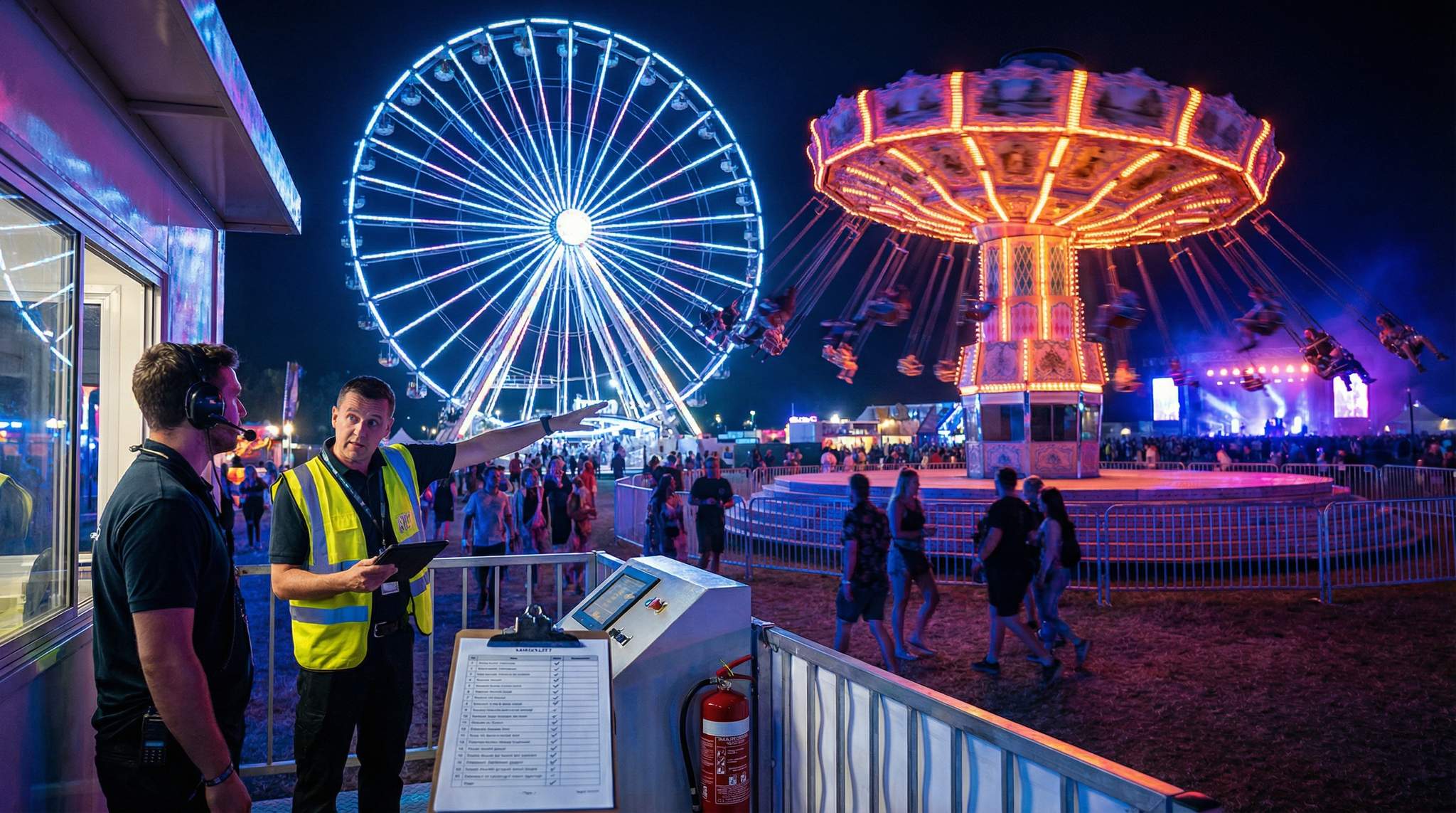
Carnival rides can elevate a festival from a mere concert to a full-fledged fairground spectacle. A towering Ferris wheel or a zippy zip line adds visual drama, entertainment between sets, and even iconic photo ops. But with great thrills comes great responsibility. Veteran festival producers stress that integrating rides must be done without compromising safety, crowd flow, or compliance. This comprehensive guide draws on decades of hard-won experience to ensure you can add carnival-style attractions without the unwanted spills – keeping fun high and risk low.
Selecting Safe and Reliable Ride Vendors
Choosing the right ride vendor is the foundation of ride safety. Not all carnival operators uphold the same standards, so careful vetting is essential. Experienced festival producers treat ride vendors like they would stage builders or power suppliers – with thorough due diligence and written agreements. Below we break down how to evaluate and select reputable ride providers who will put safety first.
Verifying Safety Certifications and Inspections
Seasoned organizers begin by confirming that each ride offered has passed all required safety inspections in its jurisdiction. The first step in ride safety is ensuring every ride and inflatable has passed safety checks. Demand proof: ask for current inspection certificates, engineering reports, or decals proving compliance with standards. For example, in the UK a traveling Ferris wheel or carousel should have an ADIPS (Amusement Device Inspection Procedures Scheme) certificate and any inflatable bounce houses need a PIPA tag and adherence to BS EN 14960 standards. Checking for up-to-date safety tags reduces the risk of hiring them. In the US, rules vary by state – some require a state or county inspector to check every carnival ride setup, while others rely on third-party certified inspectors. It is crucial to verify all required safety inspections for rides and inflatables. Regardless of location, insist on documentation. A trustworthy vendor will readily share proof their rides were inspected and passed all safety tests in the current season, so never take the risk of hiring unverified operators.
Beyond certificates, confirm the age and condition of the equipment. Older rides aren’t automatically unsafe, but they require extra scrutiny. Find out the manufacture year and whether major components (motors, cables, structural parts) have been refurbished or replaced on schedule. A chilling example of ignoring equipment age comes from the Ohio State Fair: an 18-year-old swinging ride broke apart mid-operation in 2017 due to unseen internal corrosion, killing one rider and injuring others. This incident highlights the serious risks of traveling carnival parks. The manufacturer later revealed the ride’s support beam had dangerously thinned over years. This tragedy underscores the danger of aging equipment during operation. The lesson for festival organizers is clear – never assume a ride is safe just because it’s assembled. You need evidence of upkeep. Reputable vendors will implement manufacturers’ safety bulletins (for instance, retrofitting rides with new seat belts or restraints when advised). When vetting, ask if they’ve addressed any recent safety notices. If a vendor seems unaware of industry safety updates or can’t produce inspection records, it’s a red flag that they might be cutting corners.
Checking Maintenance Records and Safety Track Record
A vendor’s past performance is one of the best predictors of future safety. Ask for maintenance logs and safety records for each ride. Daily and weekly maintenance checklists, lubrication schedules, and part replacement records show that the operator is proactive. Many well-established carnival companies have detailed logbooks or digital systems tracking every inspection and fix. Look for signs of a strong safety culture: Do they have a maintenance technician on staff? How often do they strip down and inspect critical components (hydraulics, ride vehicles, etc.)? A quality operator might mention non-destructive testing of metal arms or regular X-rays of pins and bolts – these advanced checks can catch metal fatigue before it causes a failure. This level of scrutiny prevents issues with carousels, mini roller coasters, and other attractions.
Just as importantly, research the vendor’s safety history. Speak with other event organizers who’ve hired them, and search news archives for any incidents. Veteran festival managers often share intel through informal networks – if a traveling carnival outfit had a serious accident or is known for lax practices, word spreads quickly. Conversely, a vendor with an excellent track record will have references who sing their praises. Don’t shy away from tough questions: “Have any of your rides ever failed or had an injury incident? How did you respond?” A confident, transparent operator will openly discuss any past issues and the improvements made. For instance, if a minor incident occurred, they should explain how they updated procedures or equipment afterward. On the flip side, if they dismiss safety questions or claim “we’ve never had a single issue” without evidence, be cautious – no operator is 100% incident-free, and what matters is how they learn and prevent repeat problems.
Planning a Festival?
Ticket Fairy's festival ticketing platform handles multi-day passes, RFID wristbands, and complex festival operations.
Also inquire about crew training and turnover, since a ride is only as safe as the person operating and assembling it. High employee turnover or using temporary labor for complex assembly can be risky. Ideally, the vendor crew has been with the company for multiple seasons and undergone formal training (some countries require carnival ride operators to be licensed or certified). One international safety inspector notes that most ride accidents stem from operational errors. That’s why you want experienced operators who know their machines inside out. A vendor that invests in staff training – sending their team to safety courses or achieving certifications like those from NAARSO (National Association of Amusement Ride Safety Officials) – is demonstrating professionalism. Statistics show that a safe ride environment relies on proper maintenance and operation. Bottom line: choose a vendor with a paper trail of safety and a proven safety mindset. It might cost more than a fly-by-night operator, but it’s literally the difference between delight and disaster.
Insurance and Contractual Protections
Never allow a ride or high-risk attraction on site without proper insurance in place. Even with the safest vendor, accidents can happen, and you need to shield your festival legally and financially. Require every ride vendor to carry comprehensive general liability insurance and to provide a Certificate of Insurance (COI) naming your festival (and venue) as an additional insured. This way, if an incident occurs on that ride, the vendor’s policy will cover claims against the festival. Verify the coverage limits meet your needs – many festivals insist on at least $1–5 million USD in liability coverage per occurrence for ride operators, or higher for major attractions. Internationally, insurance norms vary significantly. (In the UK, equivalently, public liability cover of £5–10 million is common for festivals, where vendors’ insurance endorsements should clearly cover liability.) Check local norms and err on the side of higher limits if unsure. It’s far better to be slightly over-insured than face a lawsuit with insufficient coverage.
For smaller events or municipal gatherings, securing dedicated carnival ride insurance is equally critical. Specialized brokers can provide tailored short-term coverage that specifically underwrites mechanical amusements, inflatables, and midway games. This ensures that even if you are operating on a tight budget, your liability shield remains impenetrable against ride-related claims.
Beyond verifying the COI, scrutinize policy details: the COI should clearly list that amusement rides or devices are covered activities. Some general policies exclude pyrotechnics or carnival rides by default. If the vendor’s policy excludes the specific ride or has any lapse during your event dates, do not proceed until it’s rectified. Also confirm the policy’s effective dates cover your entire event including load-in and teardown (when many ride accidents, like tip-overs or worker injuries, can occur). A pro tip from veteran producers is to set a hard deadline (e.g. 30 days pre-festival) for receiving all vendor COIs. The rule is simple: no insurance certificate, no show. That way you’re not chasing documents during the busy load-in week. Keep copies of these COIs in your files; they may be needed for permit applications and, worst case, claims.
Free Tool: Size Your Festival Site
Zoned capacity planning for arena, campsite, parking and entry lanes — against UK Purple Guide and NFPA density standards. Finds your bottleneck zone.
Finally, protect yourself with a solid vendor contract. The contract with the ride provider should specify that they adhere to all safety regulations, maintain insurance, and indemnify your festival against ride-related claims. Include clauses requiring daily pre-opening inspections and a right for your team to shut down any ride that is operating unsafely. It’s wise to have a festival attorney review these contracts or use templates recommended by industry associations (for example, the International Association of Amusement Parks and Attractions or relevant local bodies). If the vendor balks at any of these safety or insurance requirements, find another vendor. Any reputable carnival company will be familiar with these demands – in fact, they’ll likely volunteer their safety protocols and insurance info early on because they’re proud of them. Remember, up-front diligence and paperwork might feel tedious, but it’s infinitely easier than dealing with legal fallout from a preventable mishap later. As one industry saying goes, “If it’s not in writing, it doesn’t exist.” Make sure safety expectations are not just understood, but signed on the dotted line.
Meeting Regulatory and Insurance Requirements
Bringing in carnival rides triggers additional regulatory oversight in many regions. From permits to engineering approvals, you’ll need to navigate a maze of rules designed to keep the public safe. Complying with these regulations (and documenting that compliance) isn’t just about avoiding penalties – it’s about ensuring no detail is overlooked in keeping riders safe. Equally critical is aligning your insurance and liability planning with these attractions. In this section, we cover the key permits, standards, and insurance steps to integrate rides by the book.
Need Festival Funding?
Get the capital you need to book headliners, secure venues, and scale your festival production.
Permits, Inspections, and Local Regulations
First, research what permits or licenses are required for amusement rides at your festival site. Requirements vary widely around the world and even between local jurisdictions. Commonly, you might need an “amusement ride permit” or have to notify a state ride safety bureau that you’re operating temporary rides. For instance, most U.S. states mandate an inspection by a state-certified inspector for carnival rides each time they are set up at a new location, requiring all required safety inspections for rides and inflatables. You must also ensure anchoring and structural safety meets minimum standards. Some states like New Jersey or Ohio have very robust fairground safety units (partly in response to high-profile accidents), while others leave more responsibility to the ride owner. In the UK and much of Europe, rides fall under national safety regimes – in the UK, the ADIPS certification we mentioned is effectively a permit to operate each ride, and local authorities may still want to see ADIPS papers on-site. Australia requires compliance tags issued by state workplace safety agencies (e.g. SafeWork NSW), and in many countries like India or Brazil, local municipalities must sign off before rides run. The onus is on you as the event organizer to know the rules where your event is held. Consult local authorities months in advance. Seasoned producers often reach out to the city or county advisors and inspectors early – not only to ensure they get the paperwork right, but also to build goodwill and demonstrate you’re taking safety seriously.
In practical terms, expect to submit documentation such as:
- Engineering reports or structural certifications for any large ride (especially Ferris wheels, drop towers, etc.). Some regions require a licensed engineer’s sign-off that the ride is assembled correctly on your site.
- Site layout plans highlighting where rides will be, including safety perimeters (discussed more in the next section) and distances from other structures.
- Insurance certificates from the ride vendor (as covered above) and possibly from your festival. Some municipalities want proof you, the organizer, carry an overall event liability policy of a certain minimum.
- Emergency plans specifically for the rides (e.g. what happens if a ride gets stuck, how will evacuation or rescue work). Detailed emergency procedures can be part of your overall safety plan but still emphasized for rides.
- Inspection reports: If a government inspector will check the rides on-site, schedule this for well before gates open. For example, a county official might need to approve each ride on the morning of the event. Coordinate with your vendor so rides are fully setup in time for any official inspections.
It’s critical not to treat these permits and inspections as a rubber stamp. History has shown that events ignoring permit requirements or rushing the process can face shutdowns. One infamous example was the attempted Woodstock 50 festival in 2019, which struggled with authorities and ultimately got canceled after officials repeatedly denied permits due to safety plan inadequacies. This illustrates the high cost of regulatory missteps and disputes. The message: get it right, get it early. Aim to have all ride-related permit applications in months ahead of the festival, and maintain open communication with regulators. When they see you’re proactive, they’re more likely to become allies and even offer guidance (some inspectors will informally advise you on how to fix minor issues so permits can be granted). On the flip side, if you spring a surprise carnival on the fire marshal at the last minute, expect friction at best and an event license revocation at worst. As part of your overall festival licensing, list out every planned attraction – transparency prevents nasty surprises during an inspection when, say, an official asks “what’s that bungee trampoline doing here unpermitted?”. In short, do your homework on local regulations and follow them to the letter. It’s a non-negotiable part of safe ride integration.
Furthermore, be aware of evolving municipal ordinances that govern the broader festival environment around your rides. In many urban and suburban jurisdictions, new regulations restrict costumes, behavior, bands, and vehicles during carnival operating hours to minimize neighborhood disruptions. For instance, local councils may enforce strict curfews on live music playing near the ride zone, limit heavy transport movement during load-in, or even mandate behavioral codes for roaming performers in the midway. Staying ahead of these hyper-local rules ensures your footprint doesn’t trigger noise complaints or permit violations.
Go Cashless With RFID Technology
Enable contactless payments, faster entry, and real-time spending analytics with RFID wristbands and NFC-enabled ticketing for your events.
Aligning Insurance Coverage with Ride Risks
Standard festival insurance policies don’t always cover carnival rides by default, so you must ensure you have the right insurance coverage in place well before the event. This has two layers: the vendor’s insurance (already discussed) and your own festival insurance. Even though the ride company carries liability insurance, prudent organizers also inform their own insurer about the rides and double-check if an endorsement is needed. Many festival general liability policies have exclusions for “amusement devices” or anything mechanically propelled. Speak with your insurance broker as soon as you plan to add rides; describe each attraction (mechanical rides vs. inflatables vs. extreme sports elements) so they can advise how to cover it. Often, insurers will add an “amusement rides endorsement” to your policy for an additional premium. This protects you if, for instance, a claimant sues both the ride operator and your festival. You don’t want a gap where the vendor’s insurance denies a claim and your policy also says “not our department.” It’s worth the extra cost to know every scenario is insured.
Keep in mind insurance is a safety net, but it also enforces discipline: insurers won’t cover high-risk activities unless certain safety measures are met. They might require proof that the ride vendor has a current inspection certificate, or they might mandate higher medical coverage limits on your policy if you’re doing something like a zip line over the crowd. Some underwriters even ask for your emergency plan related to rides. By engaging them early, you benefit from their risk mitigation perspective. As one risk advisor might say, “Most festivals of your size carry $X million for rides – better to be safe than sorry,” thus avoiding costly legal pitfalls related to carnival rides. This benchmarking can guide your decisions on coverage limits. Additionally, if any rides involve participant waivers (common for extreme attractions like bungee jumps or high ropes courses), coordinate the waiver process with both the vendor and your insurer. The waiver should name both parties and be legally sound. However, note that waivers are not a substitute for insurance – they’re just an extra layer of defense and a way to inform riders of risks.
Finally, set up a process to document everything for insurance purposes. That includes the pre-event inspections (take photos of every ride’s setup, anchors, connections) and maintaining an incident log on-site (more on this later). If a claim does arise, having meticulous records that you took all reasonable precautions will be invaluable in your defense, proving precautions were taken despite unforeseen occurrences. Insurers love documentation; it helps them fight frivolous claims and support genuine ones quickly, as logging incidents serves multiple insurance purposes. In sum, treat your insurance planning as part of safety planning: tailor it to the rides, close any exclusions gaps, and keep your insurer in the loop. This approach not only protects you financially but also forces you to think through worst-case scenarios in advance – a hallmark of trustworthy, risk-aware festival operations.
Waivers, Age Restrictions, and Legal Considerations
When integrating carnival attractions, especially high-thrill or hands-on ones, there are a few extra legal considerations to keep in mind. Age and height restrictions are chief among them. We’ll discuss operational enforcement later, but from a legal standpoint you must clearly communicate any limitations in advance. Publish on your website or event app if certain rides have minimum height requirements (e.g. “Riders must be 48 inches/122 cm tall to ride the mega-drop tower”). This manages expectations and could protect you from disputes on-site. It can also tie into your ticketing terms and conditions. Many festivals include a clause in their attendee T&Cs like “By entering, you acknowledge that some attractions have age, height, or health restrictions and agree to comply with posted rules.” Working with your legal team to add such language is a good step – it won’t excuse gross negligence, but it reinforces personal responsibility for attendees which can help in claims.
For extreme attractions (consider anything beyond a tame Ferris wheel or carousel – e.g. zip lines, climbing walls, bungee jumps, mechanical bulls), it’s common to implement participant waivers. Often the specialist vendor running that attraction will provide waiver forms or a digital waiver system. Make sure your team reviews the waiver’s wording: it should release not just the vendor but your festival and venue from liability to the extent permitted by law. In many cases the festival can be listed in the waiver text as a released party. Have waiver signing managed efficiently – perhaps integrated into your ticketing or a QR code on-site to do it via mobile (some events even let attendees pre-sign waivers online for activities to save time). Check local law on the enforceability of waivers, especially for minors. For children under 18, a parent/guardian signature is typically required; plan staffing for that (you might need an extra staffer at the zip line platform to verify that little Johnny’s parent signed off). Also ensure waiver stations don’t become choke points – set them slightly away from ride loading areas so folks aren’t holding up the line while filling forms.
Lastly, consider labor and licensing laws related to the rides. Are the ride operators properly licensed to work in your region? This can matter if you’re bringing an out-of-state or overseas crew. For example, if a UK festival hires a German ride operator touring with their own big wheel, they must meet UK requirements – sometimes that means the operator needs to register with the local HSE or get permits to work. Similarly, mind working hours and breaks for ride staff. Running a Ferris wheel non-stop for 12 hours can be exhausting; ensure the vendor has enough crew to rotate shifts. You as the organizer could be held partly responsible if an overworked operator makes a fatigue-induced mistake (labor regulators do pay attention, and in some places, festivals have been cited for allowing vendor staff to work beyond legal hour limits). It is important to know these limits, since contracts, permits, and licensing disputes can cancel events. A best practice is to include in your contract that the vendor will comply with all applicable labor laws and provide adequate staffing. And don’t forget local tax or business license issues – some localities require transient ride operators to have a city business license or pay an amusement tax per ticket sold (if you’re charging for rides). These can be easy to miss. Check with a local event consultant or the permitting office about any such requirements.
In short, think beyond just the fun – ensure the legal groundwork (waivers, notices, licenses) is laid so both your attendees and your organization are protected. By anticipating these wrinkles and addressing them in advance, you’ll avoid scrambling on festival day to solve an avoidable compliance problem.
Smart Site Planning for Rides and Attractions
The placement and layout of carnival rides within your festival requires strategic planning. A poorly planned ride area can create crowd bottlenecks, noise conflicts with stages, or even structural hazards if the ground is unsuitable. On the flip side, a well-integrated layout will make the rides a seamless part of the event – attendees can enjoy them safely without detracting from other experiences. This section covers how to design your site for rides, from ground conditions and spacing to power supply and fencing, all while maintaining the overall festival flow.
Location, Ground Conditions, and Space Requirements
Start by selecting the right location on your festival grounds for the rides. Ideally, it should be a flat, open area with enough space to accommodate not just the rides themselves but also queues and safety buffers. Avoid sloped terrain or uneven ground – a leaning tilt-a-whirl is an obvious no-go, and even a slight grade can affect the safe operation of tall rides or inflatables. Perform a site walk with the vendor (if possible) or at least share detailed site maps and photos to get their input. They might point out, for example, that a spinning swing ride needs a diameter of X meters clear of obstacles, or that a particular area’s soil won’t hold the stakes for an inflatable slide. Soil or surface testing is important: heavy rides like Ferris wheels exert large ground pressure. If you’re on soft turf or sand, you may need to lay down ground protection (e.g. steel road plates or crane mats under the support legs) so the ride doesn’t sink or tilt. During one beach festival in Southeast Asia, organizers brought in compacted gravel pads for each ride after a test assembly revealed the sand alone couldn’t stabilize them. This kind of issue is easier addressed in advance than on the eve of the festival!
Also consider proximity to other festival elements. Keep rides a safe distance from stages, not only for physical clearance but for experiential reasons. For instance, you wouldn’t want a loud generator powering the rides right next to an acoustic stage, or a flashing neon ride distracting from a video art installation. Many festivals cluster rides in their own “carnival corner” or spread small attractions around if space is tight. If you do cluster them, ensure sufficient spacing between rides. Each ride will have manufacturer-recommended clear zones. A general rule is at least 5–10 meters clearance from any ride to the nearest crowd area or structure (more for large rides) so that if something swings or a person drops something from height, it won’t hit anyone. Crowding rides too close can also lead to a cascade effect – one ride failure could entangle another if they’re adjacent. It’s better to have one big safety radius around the whole ride zone with controlled entry/exit points.
In terms of site planning, also think about sightlines and navigation. Rides are tall and visible, which is great for orientation. Leverage that – e.g. the Ferris wheel can become a meeting landmark (“meet by the Ferris wheel”), as Coachella famously does, where the Ferris wheel continues to be an iconic landmark. However, tall rides can also block sightlines for security or cause people to congregate. Position them such that security staff or CCTV can still monitor around them (don’t create blind spots where trouble could brew unseen). And keep them far fromany stage viewing areas where they could block the view or encourage dangerous crowd behaviors (like climbing a ride structure to see the stage – yes, it’s happened!).
One often overlooked factor is underground utilities and overhead lines. Check what’s under the ground where rides will anchor – you don’t want to drive a stake into an electrical cable or water line. Many large venues have utility maps; if not, use non-invasive anchors like concrete ballasts instead of deep stakes. If the event site is outdoors, look up as well – ensure no overhead power lines could be touched by the highest point of a ride or a person atop it. Local safety codes usually mandate a minimum clearance (often 10 feet / 3 meters or more) from power lines. Frankly, you should avoid any area near overhead lines entirely for rides. Also, be mindful of tree limbs and branches, both for clearance and because falling leaves or sap could affect operations (for example, leaves cluttering a track or a branch that could break in wind). Trim back trees in the immediate vicinity if needed, with proper permissions.
Infrastructure: Power, Lighting, and Utilities
Carnival rides have specific infrastructure needs that must be planned alongside your stages, vendors, and other festival systems. Electrical power is the big one – most mechanical rides will need a robust power supply. Determine early whether the vendor is providing generators or if they expect you to supply power. Many traveling ride operators bring their own diesel generators mounted on the ride trailers, which makes them self-sufficient. If that’s the case, decide where those generators will sit (and ensure you have enough fuel on site if you’re responsible for refueling). Generators should be placed with safety and attendee experience in mind: at least a few meters away from crowds, ideally barricaded or fenced off, and downwind from audience areas so exhaust doesn’t blow into people. If you need to provide power from your grid, consult with your electrical team about the load. Rides can draw significant amperage – a large Ferris wheel might require a 100A three-phase feed or more, especially at startup (inrush current). Confirm the voltage and plug types; often these are heavy industrial connections. Never run a ride on a sketchy power hookup – voltage drops or sudden outages can themselves be dangerous (imagine a midway swing ride losing power mid-swing). Use proper distro (distribution boxes) and consider a backup generator for critical rides if a power failure could lead to riders stuck in vulnerable positions.
Beyond power, think about lighting. If your festival runs into the evening, the ride area requires adequate lighting for safety. That includes both operational lighting (so operators can see controls and passengers clearly when loading rides at night) and ambient lighting for the crowd (so people can see where they are walking in the ride zone and navigate queues). Rides often come with flashy lights as part of the experience, but those aren’t enough for functional safety lighting. Plan to install portable light towers or fixed lights on structures to illuminate pathways and any steps/ramps on rides. Ensure generators or power for these lights are accounted for. Also, check that ride lighting won’t interfere with your stage show – if a ride has ultra-bright strobing LEDs, you might not want it visible during a headliner’s set if it’s near the main stage. Some festivals politely ask ride operators to turn off the super-bright facade lights during certain performances (or position the rides so the lights face away from stages).
Don’t forget other utilities: for example, if you have water rides or slides, ensure there’s a water source and drainage plan. If any attraction produces waste (like a petting zoo area or a messy game), have waste bins or cleanup stations nearby. Also plan for communications in the ride zone – does your event radio system reach the ride operators? You might give ride staff a radio or ensure a supervisor is in contact with your event control. If something happens at a ride (medical issue, technical fault), they need a quick way to alert first aid or tech crews. Some large festivals even integrate the ride area into their CCTV monitoring or use tech tools like real-time crowd monitoring to assist in preventing surges and keeping attendees safe. This helps manage space by understanding crowd surges and dynamics. On a smaller scale, just ensure your security teams patrol the area and can respond rapidly.
Finally, map out access for heavy equipment. Rides often require cranes or forklifts for setup and breakdown. Lay out a pathway for these vehicles that doesn’t damage other infrastructure. If your festival has started to build stages or tents by the time rides load in, coordinate schedules so the ride equipment can still get to its spot. Also, plan a safe egress route in case a large piece of machinery (like a crane for dismantling a stuck rider, in the worst case) needs to access the area during the event. It ties into emergency planning: can an ambulance reach the ride zone if needed? We’ll cover emergency access more in risk management, but it’s worth weaving into site layout planning from the beginning. The goal is a ride area that is self-sufficient, safely separated, yet fully integrated into your festival operations network.
Fencing, Barriers, and Entry Control
To maintain safety around rides, use physical barriers thoughtfully. Every ride should have a clearly defined perimeter. This can be a mix of fencing, barricades, or flagging that keeps bystanders at a safe distance and directs riders to designated entrances and exits. For example, if you have a swinging pendulum ride, you’ll want sturdy barriers preventing anyone from wandering under the arc of the swing. Even seemingly benign rides benefit from fencing – a fence around a Ferris wheel ensures nobody walks too close to moving parts or electrical cables at the base. Many events use standard bike-rack barricades or temporary mesh fencing for this purpose. Secure the fencing so it can’t be easily tipped (sandbags or fence weights at the base if needed). Also ensure barriers don’t themselves create trip hazards or bottlenecks – smooth out any protruding feet on barricades and leave ample walkway space between ride fences and other structures.
Plan where queue lines will form (we’ll go in-depth on queue management in the next section) and use barriers to create clear queue lanes. Avoid letting lines snake into open areas where they can block roads or mingle with moving crowds. Instead, design queue lanes that are out of main traffic flow – for instance, run them parallel to a fence line or in a roped-off zigzag area in front of the ride. Think about theme parks: they corral queues effectively to keep pathways clear. You may also need holding areas if a ride is very popular, to prevent crowd surge. In high-demand cases, some festivals distribute timed ride vouchers or use a virtual queue in their app to time-slot riders, similar to strategies used at family-friendly amusement park takeovers. This can be part of a broader engagement study involving scavenger hunts with animated characters. If you try that, you’ll still need a small waiting area for the time-slot group. Design that into your layout so people with “return tickets” aren’t just bunching up in confusion.
Free Tool: When Should You Announce?
Pick your event date and genre — the free planner outputs a recommended announce, presale, on-sale and reminder schedule anchored to how your audience actually buys.
Another use of barriers is to enforce one-way entry and exit. Ideally, each ride has one controlled entrance (with a staff member or signage checking eligibility) and a separate exit gate where riders leave. The exit should deposit riders away from the entry point to avoid congestion. For example, set the exit on the opposite side of the ride platform or a few meters away, so new riders aren’t colliding with those disembarking. Mark exit paths clearly and use fencing to guide people out toward the main thoroughfares. If your ride area is all in one zone, you might fence it with one or two entry/exit points to the zone as a whole, which can help manage capacity of the whole area. Some events do this to control numbers in a carnival zone – especially if it’s a family area that might get too packed. They can then operate a one-in, one-out system if needed. However, for most music festivals, that’s overkill; you’ll treat each ride individually and rely on queue management to throttle usage.
On fencing, don’t forget back-of-house needs. Rides often require a back area for the operator’s gear, generator, or personal space. That area should be off-limits to attendees. Use opaque scrim or solid fence if you don’t want guests seeing the “behind the scenes” machinery (and to prevent them accessing it). Also, ensure emergency exits or escape routes exist in the fencing. For every enclosed ride pen or queue area, have at least one emergency exit gate that staff can pop open if they need to evacuate people quickly (for example, if there’s a ride malfunction or something like a fire nearby). Those gates should ideally be outward swinging and marked “Emergency Exit – Keep Clear”. Train your staff on where they are and under what conditions to use them.
Finally, incorporate signage on fencing and at ride entrances. Every ride should have a sign listing its rules (height requirements, health warnings, safety instructions) before people queue up – we’ll elaborate in the next section about communicating rules. Also put up signs for directions, like “Entrance” with an arrow, or “Exit Only” to prevent confusion. If you have multiple attractions, a directory sign (“Carnival Rides This Way ->”) can help guide attendees . Signage and barriers together create the subtle architecture that keeps the ride area orderly and safe. Done right, attendees will flow naturally where they’re supposed to, and you’ll prevent a lot of potential accidents from people being in the wrong place at the wrong time.
Queue Management and Crowd Flow for Rides
Integrating rides means also integrating their queues – the lines will become part of your crowd landscape. Long wait lines can lead to frustration, crowding, or even unsafe jostling if not managed well. In this section, we discuss how to design and operate queue systems that keep guests safe and happy. From staffed line control and signage to shading and hydration for those waiting, proactive queue management ensures “thrills without spills” applies to the waiting experience too.
Designing Queues to Minimize Wait Woes
Start by estimating capacity and wait times for each ride so you can design appropriate queue spaces. A small kids’ ride might only hold 6 children at a time with a 3-minute ride cycle. If 50 kids want to ride, that’s potentially a 30–40 minute wait. Knowing this, you’d allot a queue area that holds about that many people (plus accompanying parents) comfortably. In contrast, a Ferris wheel with 20 gondolas might take 80 riders per cycle of 7–8 minutes; its throughput is higher, but it also attracts more interest, so you might get hundreds of people in line at peak. Map out each queue on your site plan. Use zig-zags (switchbacks) for very popular rides to compress a long queue into a smaller footprint – but make sure the zig-zag area is wide enough for two people side by side so friends can wait together, and include some breaks to avoid one continuous 50m rope that could tempt line-ducking.
Where possible, provide physical queue guides like stanchions, ropes, or barriers as mentioned. This prevents “line creep” where the queue amorphously grows and starts blocking walkways. An ordered queue not only keeps things fair, it also helps your staff monitor how many people are waiting. You can place marker signs like “30 minutes from this point” at certain spots in line to set expectations (theme parks do this to calibrate guest expectations). If you do, be realistic – nothing angers guests like a sign promising “15 min wait” that turns into 45. Another design tactic is incorporating a bit of snake or sponge area at the queue entry. For example, have a small holding pen where a batch of people can gather before they enter the formal line. This can be useful if you do timed entries or to spontaneously hold the queue if needed (maybe the ride pauses for maintenance, you stop feeding the line for a bit). That holding pen is essentially a buffer that keeps the rest of the crowd oblivious to minor stoppages.
Free Tool: Split Tickets for Max Gross
Given capacity and a target price, the optimizer proposes Early Bird / GA / VIP allocations and prices — with projected gross at 100%, 80% and 60% sell-through.
Consider whether any rides could use a reservation or virtual queue system to reduce physical waiting. Large events increasingly try this for premium attractions. For instance, you might allow guests to sign up for a time slot on the zip line via your festival app, then show up at that time instead of standing in line for an hour. This approach can prevent a long static queue that clogs space and frustrates people, utilizing reservation systems to reduce anxiety for families. This is supported by a study showing how scavenger hunts engage waiting guests. The downside is managing those reservations and ensuring people actually show up on time (you might need a secondary “standby” line for no-shows). If implementing, communicate clearly via signage (“Reserve your ride time on the app or at the Info Booth”) and have staff at the ride checking reservation QR codes. Virtual queues work best when attendance is very high and the tech is reliable. For smaller festivals or simpler operations, good old-fashioned physical lines with human staff often suffice.
Finally, design queues with human comfort in mind. A happy queue is a safe queue – when people are calm and content, they’re less likely to push, cut, or cause commotion. Provide shade over waiting areas if at all possible (pop-up canopies or umbrellas can do wonders on a hot day). If it’s an all-ages event, remember kids and sun don’t mix for long; something as simple as shade can prevent dehydration or heat exhaustion episodes in line, where shade in the queue area makes a huge difference. This leads to a more orderly queue experience. If natural shade or tenting isn’t feasible for all, consider handing out sunscreen or having a misting fan nearby. Also think about ground surface in lines: if people will be standing in one spot for a while, avoid uneven rocky ground that could cause twisted ankles, and ensure areas aren’t prone to mud puddles if it rains. Some festivals even deploy temporary flooring (like plastic tiles) in high-traffic queue zones. And don’t overlook entertainment and information – a well-placed speaker playing music, or signage with fun facts/trivia about the festival, can help the wait feel shorter. (Disney parks are masters of this, turning queues into part of the attraction with interactive elements, creating interactive and themed queues like Disney. This creativity was so successful it is being used as a case study, but even on a low-budget level, a little creativity goes a long way.) We’ll cover more on keeping queues pleasant in a moment.
Staffing and Line Controllers
One of the smartest investments you can make is to assign dedicated staff or volunteers to manage ride queues and exits. These “queue marshals” or line controllers keep things orderly, ensure rules are followed, and act as extra eyes and ears for safety. Each major ride should have at least one staffer at the queue entrance and one at the ride loading platform (often the ride operator or vendor handles loading, but your staffer can assist and oversee). The staffer at the queue entrance’s job is to greet guests, check that they meet requirements (height, etc.), and prevent line jumping or overcrowding. They can hold a small tally counter to track how many people are in line if needed. Seasoned producers advise providing clear training: teach them the ride’s max capacity and cycle time so they can give accurate wait time estimates, and empower them to pause the line if it’s getting too congested beyond the fenced area. For popular rides, marshals might need to implement a one-in-one-out system if the physical queue space fills up (essentially holding new people until some have ridden and exited). This prevents the spontaneous formation of a secondary line blob that can be unsafe.
At the ride platform, ensure the operator isn’t alone in managing safety. The ride operator’s focus will be running controls and securing riders, but an extra staffer (either their own or one of your crew) can help double-check restraints and observe rider behavior. This is particularly useful if someone panics or decides last-minute they want off – a staff member on the platform can alert the operator to stop the ride if needed or help a frightened child exit before the ride starts. For bigger rides like Ferris wheels, staff can coordinate loading efficiently (e.g. balancing weight by seating people opposite each other, which the operator might appreciate). Also, having staff at unload helps riders exit safely and directs them out the proper way. If a rider seems dizzy or unwell coming off a ride, your staffer can quickly assist and call for medical if needed. Communication between queue staff and ride operators is key – equip them with handheld radios or establish simple hand signals. For example, a thumbs-up from the loader to the operator to start the ride only after all restraints are confirmed locked.
Staff can also enforce safety rules in line. They should be briefed on the ride’s restrictions so they can pre-screen the crowd: stopping someone who clearly doesn’t meet a height requirement before they spend 30 minutes in line saves a lot of heartache. They can also intervene if they see unsafe behavior, like teens roughhousing in line or someone trying to sneak a baby onto an adult ride. With proper training, queue staff contribute hugely to prevention. Many incidents (like someone boarding with a loose harness, or a child slipping past height checks) are preventable with vigilant staff. In fact, industry data shows that having attendants at both the entrance and exit significantly lowers rule violations and accidents, reducing common injuries associated with carnival rides. This helps prevent violations involving falls, motion sickness, and ride type risks. Think of them as lifeguards at a pool – calm, attentive, and authoritative when needed.
Don’t let the importance of attitude and engagement slide either. A friendly line manager can turn a tedious wait into a tolerable one. They might entertain kids by chatting or high-fiving, or simply reassure everyone “Thanks for waiting, folks, about 10 minutes to go!” to keep tempers in check. A real-world example: at Singapore’s popular ZoukOut festival (which introduced a small carnival ride section), the organizers placed enthusiastic volunteers in LED outfits to work the queues at night – they not only directed people but danced and joked, which kept the crowd in a great mood even when lines got long. Happy people are far less likely to shove or violate rules. On the contrary, neglecting queues can breed frustration that spills over into pushing or line-cutting, which are flashpoints for injury.
Smooth Entry With Mobile Check-In
Scan tickets and manage entry with our mobile check-in app. Supports photo ID verification, real-time capacity tracking, and multi-gate coordination.
Finally, plan for peak times. When a headliner isn’t on stage or during afternoon lulls, ride lines may surge. Anticipate this by scheduling extra staff during those windows. You could employ a roaming “floater” supervisor who checks all the ride queues periodically, helping wherever one is particularly crowded. They can also give breaks so primary staff can grab water or use the restroom – an overstressed or dehydrated queue staffer won’t be effective. Remember crew welfare as well; fresh staff will manage crowds more patiently, remembering that safety is key when managing festival crews. By investing in queue management staffing, you’re investing in safety and smooth operations. The cost is relatively small, but the payoff is huge in preventing the kind of chaos that leads to accidents or negative attendee experiences.
At massive electronic dance music events—often characterized by their immersive, neon-lit “electric sky” aesthetics—managing the late-night carnival crunch becomes a unique operational hurdle. When main stage headliners finish their sets, thousands of energized attendees may simultaneously rush the ride zone. To handle this sudden surge under the electric sky, veteran producers deploy robust barricades, pre-schedule extra carnival ride help (such as supplementary queue marshals and guest services staff), and utilize dynamic digital signage to redirect crowd flow safely.
Clear Signage and Rider Requirements
Signage is your silent enforcer of safety rules in the ride area. Before anyone even gets in line, they should see exactly what the requirements and rules are for each attraction. This means prominently posting height limits, weight limits if applicable, age restrictions, and any health warnings. Use large, high-contrast signs at eye level (both adult eye level and child eye level if kids are a big part of your audience), so best practice is to post clear height rules. A best practice is to have an easily visible measuring stick at the entrance of each major ride – like a colorful pole or board that says “You must be at least THIS tall to ride” with a marked line. That lets kids and parents self-assess before getting hopes up. Some festivals hand out wristbands of different colors during entry for kids of certain heights (e.g. a green band if over 48? tall) to streamline this process, similar to systems at ski resorts that streamline access. Whether you do that or not, reinforce it at the ride itself with the sign and an attendant with a measuring tool.
The signage should list prohibited actions and rider behavior too. Common points: keep arms and legs inside the ride, no loose items (phones, bags) unless secured, no intoxicated riders. If riders need to wear a safety harness (like on a zip line or climbing wall), state that and note any attire issues (e.g. “no skirts or flip-flops on the climbing wall”). Also, include any health advisory: e.g. “Not recommended for people with heart conditions, back or neck injuries, or for pregnant women” on intense rides. These aren’t just there for show – they inform guests and also provide legal cover that warnings were given. Use pictograms or icons alongside text to convey key points universally (a pregnant woman icon with a red X over it, a heart symbol with an X, etc., alongside the text). In multicultural festivals or those with international tourists, multi-lingual signs are considerate if feasible, at least for the major rules.
One area requiring special emphasis is enforcing age/size rules for children’s attractions. If you have a kids’ bounce house that’s for ages 3-10 only, say that loud and clear. If an inflatable slide has a weight limit per person, list it. Then ensure staff refer to the sign when having to turn someone away: “Sorry, as you can see here, this ride is limited to 6 kids at a time, no adults allowed.” This prevents arguments by shifting blame to the policy posted in plain sight, rather than a staff member’s “opinion.” This is why bold signage shifts responsibility away from staff, empowering staff to enforce rules as festival policy. Moreover, it’s utterly vital not to bend those posted rules. There have been tragic outcomes when operators got lax – an infamous case in Australia’s Royal Adelaide Show saw an 8-year-old girl thrown from a fast ride to her death because operators lowered the height restriction and let smaller kids on for business reasons, ignoring manufacturer and safety recommendations. The coroner found that ignoring the manufacturer’s requirements was directly responsible, proving safety and festival producers must prioritize rules. This underscores why your festival must back up your staff: if the rule is 48? minimum, it is never okay to let a 47? child ride, even if parents plead. It’s far better to deal with a disappointed child than a catastrophic injury due to compromised safety standards, following safety recommendations to avoid facing liability.
Consider having a central rules signboard as well, listing general carnival area rules (no smoking near rides, follow staff instructions, etc.). But the specific signs at each ride are most critical. Make them attention-grabbing – use bold fonts and maybe fun artwork (like a cartoon character measuring height as a whimsical touch). However, do not sacrifice clarity for cuteness. This is one area where directness wins: “WARNING: Failure to follow rules can result in serious injury.” It might sound strong, but it communicates the stakes. Some events also use automated audio messages or a carnival barker style announcement repeating rules to those in line (“Please note: you must be at least 14 years old to ride the zip line. Secure all loose belongings…”). Audio can supplement but not replace signage; in noisy festival environments, signs are more reliable for comprehension.
Lastly, prepare for how you’ll handle enforcement. Train ride operators and your staff to uniformly enforce the posted rules. If someone argues (“I’m only 5 pounds over the limit, let me on”), staff should politely but firmly say they cannot violate the posted safety guidelines. Empower them to escalate to a supervisor or security if a guest really pushes back. Typically, when rules are plainly visible and phrased as non-negotiable, most people comply. For kids, have a strategy for gentle let-down: maybe offer a consolation like a sticker or suggest another activity if they’re too small. The sign can even help soften the blow (“See honey, the sign says you have to be this tall. Maybe next year!”). Above all, make sure no staff ever feels pressured (by angry customers or by long lines) to break a rule. One lapse is all it takes for something bad to happen. You set those rules for safety, so defend them. As any experienced ride operator will tell you, capacity or sales targets are never worth an injury. With clear signs and resolute staff, you’ll maintain a safety-first culture that attendees will ultimately respect.
Keeping Waiting Guests Safe and Happy
A waiting crowd can either become restless and unruly, or remain calm and even entertained – it largely depends on how you treat them during the wait. Safety in queues isn’t only about physical measures; it’s also about managing mood and comfort. Happy people don’t shove or panic. So consider what you can do to make the waiting experience positive. Some tips from both festival and theme park playbooks:
- Shade and Shelter: As mentioned earlier, provide relief from sun or rain. Pop-up tents over sections of the queue or handing out disposable ponchos if a shower pops up can show people you care. At a minimum, identify nearby shaded areas and perhaps let people wait there if the line is paused (e.g., “feel free to step into the shade, we’ll hold your place”). Hydration is key too – station a water cooler or have roving vendors sell water near long queues. Dehydrated, overheated guests are a medical incident waiting to happen. Some innovative events even had “queue misting stations” – a fine mist spray along the queue route – to cool people on scorching days, as shade in the queue area makes a huge difference. It was a hit, and likely prevented some fainting spells, contributing to a more orderly queue environment.
- Queue Entertainment: Break up monotony and distract from the wait. Could be as simple as a speaker playing upbeat music or as elaborate as costumed performers interacting with the line. Many family festivals deploy clowns, magicians, or mascots to stroll along lines and perform quick gags or give high-fives, turning waiting into fun, where communication and crowd control turn waiting into fun. At adult events, you might use video screens or LED walls showing cool content (imagine a screen by the Ferris wheel queue that shows live crowd shots or trippy visuals – people will watch and forget they’ve been standing 20 minutes). Technology can help too: some festivals use a queue app or SMS updates, so people in very long lines could wander nearby and get a ping when it’s their turn – reducing the psychological pressure of standing in one place. This helps guests understand patience through friendly interaction. If your ticketing or festival app supports it, consider trialing this for one popular attraction to gauge success, helping reduce anxiety for families standing in line.
- Information and Updates: Keep communication open if there are delays or capacity issues. If a ride has to shut down temporarily (weather hold or minor tech issue), immediately deploy staff to inform those waiting: “Ladies and gentlemen, the ride is paused for safety checks – we estimate a 15 minute delay. Thank you for your patience.” People handle waits much better when they know what’s going on. The worst is silence, which breeds rumor and frustration (“What’s the holdup?!?” leading to potential pushiness). If the wait gets too long, be ready to cut off the line intake and announce, for example, “Folks, the wait from here is about 1 hour. We recommend coming back later or enjoying other attractions.” Honesty can head off anger. Also, visibly showing that you care – e.g. handing out small freebies to those stuck in an unexpected long wait – can work wonders. Some organizers keep inexpensive swag (stickers, candy, branded fans) to hand out as goodwill gestures in lines. It’s amazing how a small gift can turn mood around.
- Crowd Monitoring: Treat the queue area as part of your overall crowd management plan, emphasizing the need for careful planning and crowd monitoring. That means having security or crowd spotters occasionally scan the lines for any signs of distress (heat exhaustion, someone feeling ill) or brewing conflict (arguments, line cutting confrontations). Train all staff at rides to watch the crowd, not just the ride. If a cluster of people start pushing or a group tries to swarm a ride at closing time, those are scenarios to diffuse immediately. Have a protocol: maybe a security guard on standby who can step in to reinforce rules or, if needed, slow or stop entry until order is restored. Thankfully, well-managed queues rarely reach that point, but it’s wise to be prepared especially when popular rides close for the night and leftover guests clamor for one last go. Some festivals handle this by giving those in line at closing a ticket they can use first thing next day or at another ride, calming the FOMO that drives risky last-minute surges. This helps manage dynamics by understanding crowd surges and dynamics.
In essence, the mantra “a good queue is a safe queue” holds true. Invest a little thought and resources into your lines – as much as you do for stages or food courts – and the dividends will be lower stress, fewer incidents, and greater attendee satisfaction. People often won’t remember a short wait, but they’ll definitely remember if a line was miserable or dangerous. By designing with empathy and vigilant oversight, you turn waiting in line from a potential pain point into just another enjoyable part of the festival journey.
Rigorous Ride Safety Inspections and Maintenance
Even with top-notch vendors and careful planning, you cannot take safety for granted once the rides are on-site. Rigorous inspections and maintenance – both before the festival opens and continuously during the event – are absolutely essential. In this section, we detail how to implement thorough safety checks, from pre-event certification by professional engineers to daily walk-throughs by your team. We also discuss maintenance response plans and the importance of clear documentation. Doing this diligence is like an insurance policy in action: it catches hazards early and proves your festival’s commitment to safety.
Pre-Event Inspection and Certification
When the rides are set up at your venue, don’t let the public on until a qualified inspector has given the green light. This might be a regulatory requirement (as discussed, some jurisdictions send an official inspector). But even if not mandated, it’s wise to hire an independent ride safety inspector or engineer for a pre-opening audit. Many festivals partner with firms or freelancers who specialize in amusement ride inspections – often the same professionals who check theme parks or fairs. They’ll examine things like: are all components assembled correctly per the manufacturer’s checklist? Are structural bolts torqued, safety pins in place with cotter keys, guardrails installed, electrical connections safe and waterproof? Essentially, a second pair of expert eyes on each device. This is especially crucial if the rides traveled a long distance to your site or had parts removed for transport. Mistakes or fatigue during assembly can happen – an inspector can spot, say, a missing safety cotter pin or a improperly leveled base that the crew might have overlooked, as carnivals and fairs are often set up hastily. Considering the consequences, that extra inspection is worth every penny.
Coordinate the timing of this inspection before opening. Ideally, rides should be fully set up and tested at least a half-day (if not a full day) before gates open to attendees. That buffer allows time to fix any issues found. For example, if an inspector says the Ferris wheel needs additional ballast on one side, you can arrange that in daylight, calmly, not when a crowd is already waiting. It also gives time for test runs – have the ride operators cycle each ride multiple times empty and then with staff or crew volunteers as test riders. This “burn-in” process often reveals if anything is overheating, misaligning, or if any seat restraints aren’t latching smoothly. A pro tip: photograph or video record parts of the inspection and testing process, with timestamps, ensuring emergency exits are clear and documented. Not only does this create evidence of your due diligence (useful for permits and potential insurance questions), but it also can be a nice transparency move to share with your community. Some festivals actually invite local officials or media to witness the safety checks – turning it into a positive story about how seriously they take safety. This documentation is vital, proving precautions were taken despite unforeseen occurrences.
Free Tool: Project Your Bar Revenue
Per-head spend benchmarks by event type turned into projected bar and food revenue, with a stock-mix estimate and gross-margin line. Free calculator.
If any ride fails to meet standards during inspection, be prepared to sideline that attraction. It’s tough to cut a ride last-minute (especially if you promoted it), but it’s far better than risking an incident. Have a communications plan ready: maybe that ride just won’t open, or it will open late after fixes. Inform your front-of-house staff so they can answer guest questions (“Apologies, the Hurri-Khan ride is undergoing extra safety checks and will open later or remain closed – your safety comes first”). You might appease disappointed guests by offering a small token, like a voucher for a free ride on something else if you were charging per ride, or a free merch item if it was a big advertised attraction.
Finally, ensure compliance paperwork is in order post-inspection. The inspector should sign any necessary forms or provide a written report for your records. If the law requires a certificate of operation, that should be posted near the ride or kept on hand by the ride operator. Some U.S. states, for example, require a permit to be visibly posted on the ride stating it passed inspection, much like an elevator inspection certificate. Even if not required, having a one-page safety check completion sheet for each ride (with inspector/engineer’s signature) filed in your event ops binder is a good practice. It serves as a checklist that nothing was skipped and gives you peace of mind to open the gates knowing every ride was given a professional thumbs-up.
Daily Checks and Ongoing Maintenance
Safety checks are not a one-and-done affair – daily inspections are critical. Each day before patrons arrive (and ideally again during mid-day breaks), have a procedure for inspecting rides. The ride vendor’s technicians will likely do their own routine: e.g., walking the tracks, checking oil levels, running test cycles, etc. But your festival safety team should also participate or at least supervise. Use a checklist for consistency. For mechanical rides, check items like: all fences and gates in place, no debris in the ride area, lap bars and belts functioning, emergency stop tested, communication devices (if any) working, and so on. For inflatables (if any), inspect anchors and tie-downs anew each day – stakes can loosen overnight or after heavy use, confirming emergency exits are clear and anchors are secure. Ensure blowers are working and have no damage to cords.
Some events empower their operations or safety manager to do a final walk-around after vendor checks. For instance, after the carnival crew say “we’re good”, the festival’s own safety officer does a lap with a clipboard to verify things like each ride has its safety sign up, the fire extinguisher at the generator is still in place, the fences haven’t been moved, etc. This double layer is about trust but verify. Even top vendors can occasionally miss a minor issue, and a fresh perspective might catch something. One festival producer recounts how during a morning check they spotted a hairline crack in a metal support that the vendor initially overlooked – they halted that ride and brought in a weld specialist to fix it before doors opened. It might have held fine, but then again, it might have worsened and caused a failure mid-event. The cost of a brief delay was nothing compared to averting a disaster.
In addition to overt checks, enforce a maintenance log on-site. Require the vendor to log any adjustments or fixes they do. If they grease a bearing or replace a fuse, it goes in the log (even if informal). Your team can maintain a master log as well for festival records. This helps if there’s any incident or even just for learning – patterns might emerge like “Ride X required tightening bolts every day, maybe next time we reinforce those better or reconsider that attraction.” Encourage a culture where the ride crew feels comfortable reporting any hitches, not hiding them. If a ride has a minor breakdown during the day (it often happens – maybe a sensor triggers, or a seatbelt jams), have them inform your ops center. Decide if it’s a quick fix or if you need to suspend that ride. Always err on the side of caution: if something seems off, shut the ride down until resolved. Attendees will forgive a technical downtime far more than they’d forgive an injury.
A crucial part of maintenance safety is also emergency drills and preparedness, which we’ll detail in the next main section (operator training & emergency plans). But from a maintenance perspective, ensure you have basic repair materials and tools on hand. Maybe keep a small toolkit at the ride zone (if the vendor doesn’t already) for tightening a loose bolt on fencing or replacing burnt-out light bulbs that could leave an area dark. It’s also smart to have spare parts for common failures: extra fuses, extra bulbs, additional stakes or sandbags for inflatables, etc. The vendor usually has these, but it doesn’t hurt for you to have some backups, especially for infrastructure like spare fuel for generators or extra batteries for wireless headsets if the ride operators use them.
Documenting daily inspections is not just bureaucracy – it can save you legally and improve safety. Use a simple checklist form (paper or an app) and have the inspector sign off each day that “Ride A – OK, Ride B – OK (noted X, fixed), etc.” and timestamp it, as experienced festival organizers keep detailed logs. If an incident occurs at 5 PM, you can show authorities that at 11 AM it was checked and all was normal, which helps establish due diligence. Many events are now using digital inspection apps where staff take a photo of critical points (like each anchor strap on an inflatable, oil pressure gauge reading on a generator, etc.) as part of the log, ensuring emergency exits are clear and documented. This visual record is powerful evidence and also ensures thoroughness (you physically went and looked at it if you photographed it). It might be overkill for a small festival, but for major ones, strongly consider this level of rigor, creating a record in case it is needed later for claims.
In summary, treat ride safety maintenance like you would sound checks or stage inspections – as a daily ritual. The public never sees it, and if everything goes right, they’ll never even think about it. But that’s the point – a smooth, incident-free festival day is built on the foundation of all those morning checks and rapid responses to issues. It’s painstaking, yes, but necessary. Vigilance must persist until the rides are packed up and off-site.
Handling Technical Issues and Repairs
No matter how much preparation you do, occasionally a ride will experience a technical hiccup during the festival. How you handle those moments is critical for both safety and public perception. Have a clear protocol with the ride vendor for stopping the ride and addressing the issue. Typically, if a ride malfunctions (anything from a strange sound, a restraint that won’t lock, to a full power loss), the operator should cease operations immediately and safely unload any riders. Then, your team and the vendor team need to troubleshoot. Ensure your event control or safety manager is notified at once of any such downtime – this allows you to provide accurate info to guest services and to track the cumulative downtime (if it’s frequent, maybe a ride needs to close for the remainder).
For minor issues that can be fixed quickly on-site, decide who has authority to restart the ride. Many festivals require that a supervisor or safety officer verify the fix before resuming. For instance, if an operator replaced a tripped circuit breaker, maybe have an electrician check why it tripped before just continuing. Or if a lap bar was sticky, test it several times empty to be sure. If something more major breaks – say a component that can’t be fixed immediately – be ready to close the ride promptly and safely. Don’t let people linger hoping it will reopen if you’re not sure; clear the queue with apologies and potentially a “check back later” note if you think it might get resolved after a part is delivered or such. Always prioritize caution: if you’re not 100% confident in a repair, keep the ride closed. A half-day closure is better than a botched fix leading to an injury.
One worst-case scenario to plan for is a ride evacuation – for example, a Ferris wheel stops with people at the top and can’t restart normally. In these rare cases, you need coordination with emergency services. Hopefully the ride operator has an emergency manual lowering procedure (most wheels can be manually cranked down or have a secondary motor). If not, the contingency might involve calling the local fire department with a ladder truck, as happened in the Napa fair incident where firefighters rescued stuck riders, requiring firefighters to rescue stuck passengers. Discuss these scenarios with the vendor in advance: “What’s your plan if Ride X gets stuck mid-cycle?” Their answer will tell you a lot about their preparedness. Include those plans in your own emergency action plan document. If an evacuation would require outside help, have local fire/rescue briefed. In some jurisdictions, the fire marshal or technical rescue team likes to know when big rides are in town, and they might even stage equipment nearby if it’s a major festival. Luckily, such dramatic rescues are uncommon, but readiness is key – it turns a potential fiasco into a smoothly handled non-event. Thankfully, in the Napa incident there were no injuries, despite structures attached to either end failing.
Another aspect: communication with the public during tech issues. Train staff on messaging. If a ride stops mid-ride (even briefly), staff at that attraction should immediately address riders (often the operator via PA if they have one: “Please remain seated, we have a brief technical delay”). For those in line, explain the situation calmly: “The ride’s undergoing a safety check; we’ll resume if able, but we appreciate your patience or you may come back later.” If you have to evacuate or fully shut a ride, consider having a festival spokesperson or MC make an announcement if it’s high-profile (something like, “Folks, the Ferris wheel is closed for the remainder of the day due to unexpected technical difficulties. Safety comes first – we apologize for any inconvenience.”). People are disappointed, but they’ll understand when you frame it as a safety necessity. What you want to avoid is rumors or panic – clear, factual announcements prevent misinformation from spreading across social media or through the crowd (“Hey, I heard someone got hurt on the Ferris wheel” which may be totally false if it was just a tech glitch).
Lastly, log everything. If a ride had an issue and what was done to fix it, write it down in the daily report. This can help later in debriefs or if any claim arises (“the ride jolted and hurt my neck” – you can correlate if there was a tech fault at that time). Keeping a paper trail of repairs also helps you judge whether to hire that vendor again or whether a particular attraction is worth the trouble. If one ride caused 10 headaches and two evacuations, you might decide it’s not returning next year. On the flip side, handling a visible technical issue well can actually impress attendees with your professionalism. Many people remember how an event responds to problems more than the problems themselves. If you swiftly and safely sorted out a stuck ride and everyone was fine, that builds trust. It shows your festival runs on the ethos of “safety first, fun second – in that order,” which is exactly the reputation you want.
Operator Training and Emergency Preparedness
The human factor – ride operators and festival staff – is a critical layer in ensuring thrills don’t turn into spills. All the safety plans in the world mean little if the people running the rides aren’t properly trained or if your team isn’t ready to respond when something goes wrong. In this section, we cover the importance of operator training, how to integrate ride vendors’ staff into your broader safety culture, and how to prepare for emergencies involving rides. From stuck Ferris wheels to first aid incidents, having practiced procedures can make the difference between a minor hiccup and a major incident.
Qualified Operators and Vendor Staff Training
As emphasized earlier, you want experienced, attentive operators running each ride. It’s worth reiterating: insist that your ride vendor assigns their A-team to your event. Sometimes traveling carnivals bring seasonal workers or younger staff for local fairs – make clear in your contract or pre-event talks that you expect their most competent crew for a festival environment (which may have unique challenges like operating into late night hours, dealing with possibly intoxicated riders, etc.). Many festivals specify that all ride operators must be at least 18 (or 21) and have a certain amount of experience. While you might not have legal authority to enforce that if the vendor is independent, you can strongly request it. If you see an operator who appears undertrained or is acting carelessly (e.g. not checking restraints, distractedly using their phone), address it immediately with the vendor’s on-site manager. Do not hesitate to remove an unsafe operator – politely but firmly ask the vendor to swap them out or supervise them more closely. It’s your site and your attendees’ safety on the line.
Ahead of the festival, gather info on how the vendor trains their staff. Do they have an internal certification? Many larger ride companies do internal courses or on-the-job training programs. Some even partake in formal training through organizations like the Outdoor Amusement Business Association (OABA) in the US or similar bodies. If possible, get copies of their training materials or manuals for each ride – at least for your safety team’s knowledge. It helps to know exactly how the ride is supposed to be operated, so your team can spot if something is off. For example, if you know the Ferris wheel is supposed to be balanced by loading two gondolas at a time opposite each other, and you see an operator loading all on one side, you can intervene before it causes a mechanical strain.
One great approach is to hold a safety briefing that includes the ride operators as part of your festival staff orientation. Treat them as a sub-group of your crew. At the start of the event (or each day if new staff cycle in), have your Safety Officer or Operations Manager quickly meet with all amusement ride staff. Go over festival-wide protocols: what to do if there’s severe weather (e.g. “If we suspend the event for lightning, you will hear on the radio or see a signal, and you must close rides immediately and direct people to shelter”), how to contact event security or medical, who their point of contact is for any questions. Also set expectations for professionalism: remind them this is a team effort to keep everyone safe. It helps break any ice between “our staff” and “vendor staff.” In emergencies, you all function as one unit, so personal rapport matters.
Enforcing Safety Rules and Rider Behavior
Operators and festival staff together must actively enforce the safety rules we’ve discussed. This means ensuring every rider meets requirements and behaves appropriately. It’s a dynamic situation each time a ride cycles: people might try to sneak an extra friend on, or a guest might pull out a phone to film mid-ride (potential projectile hazard), etc. Establish a culture where operators feel supported to say no or stop the ride if needed. For instance, if someone unbuckles their belt mid-ride, the operator should immediately hit the emergency stop or bring the ride down at the next cycle and remove that person. Back them up on these calls. Announce and post that riders who violate rules will be ejected from the attraction (and possibly the festival). This gives operators the backing they need. If they do report a non-compliant rider, have security or staff follow up – maybe a warning or removal depending on severity. Word will spread that your festival doesn’t tolerate unsafe antics on rides.
In practice, common enforcement scenarios include height/size issues (already covered – just don’t budge on those), and health issues (if someone looks ill or terrified before launch, it’s okay to politely suggest they skip – better than dealing with a medical issue mid-ride). Another scenario: intoxicated attendees trying to ride. This can be tricky – someone visibly very drunk should not get on a high-speed ride for their own safety (and vomit reasons, too!). Train ride ops to deny entry to anyone who appears extremely impaired. It’s similar to how bartenders cut off patrons; ride ops have the right to refuse riders for safety. If they do, have a protocol: e.g. call over a security or guest services person to help escort the individual away gently, rather than leaving it all on the operator to deal with a potentially upset drunk person.
Also, be mindful of overcapacity. Operators should never overload a ride beyond its design (like squeezing 3 people into a 2-person car). Ensure queue staff count riders if needed. An example of vigilance: if the rule is max 6 kids in the bounce house at once, your queue attendant counts 6 in and doesn’t allow a 7th until one comes out, using clickers to track how many people enter. It sounds simple but in the chaos of an event, these limits can get accidentally exceeded unless someone is actively managing it. The ride vendor should know the capacity; your team can reinforce it by also keeping an eye and training volunteers to do headcounts.
One more aspect: have a zero tolerance for operator misbehavior too. If, heaven forbid, a ride operator is caught under the influence or doing something reckless, remove them immediately and have the vendor replace them (or shut that ride). Same if they’re too fatigued – e.g. an operator falling asleep at controls is obviously unacceptable. This goes back to labor management – make sure the vendor’s crew gets breaks. We mention this because it has happened at some events where long hours led to sloppy operation. Don’t let it happen on your watch; schedule in relief operators if needed. In the end, strong rule enforcement is a mix of good design (signs, physical setup), good staffing, and good attitude (creating a safety culture). If all parties know the non-negotiables and the “what-ifs” procedures, everyone will be on the same page when managing rider behavior.
Emergency Response Plans for Ride Incidents
While we hope they never occur, you must prepare for emergencies involving a ride. These can range from a rider having a medical issue (like a seizure or panic attack) to a structural failure or collapse (worst case scenario). Having a plan will enable you to react quickly and effectively, minimizing injury and chaos. Here’s what a robust ride emergency plan includes:
Personnel roles and communication: Determine who is in charge if a ride incident happens. Often it will be the Safety Officer or Head of Security who assumes command. The ride operator’s role is to shut down the ride and keep people calm until help arrives. Your staff’s role is to secure the perimeter, keep crowds back (there is a gawker factor – people may swarm to see what happened, and you need to control that), and guide emergency services to the scene. Ensure that all ride operators have a direct line to Event Control – whether via a radio or a dedicated phone line – to report an emergency instantly. During your safety briefings, practice a scenario verbally: “If something goes wrong, first hit the E-stop, then call out on radio ‘Code Red at the Ferris wheel’ (or some code) and we will respond.” Every second counts, so clarity is key.
On-site medical and first aid: Your medical team should be looped into ride planning. Let them know where the rides are and what types of injuries could occur so they can stage appropriate equipment. For example, they might want to have a backboard and cervical collars near the ride area in case of a fall or whiplash incident. Ideally, an aid station is not far away. In a serious accident, EMTs will be the ones extricating and treating victims, but your crew can assist by clearing paths and even performing initial first aid. Train some staff in basic first aid – if a minor injury happens (a scraped knee exiting a ride, or dizziness), staff can offer immediate help while waiting for medics. Many festivals collaborate with local EMS (ambulance service) to be on standby; if so, provide them with site maps showing a direct route to each ride, and have a rendezvous point for any ambulance that might need to evacuate a patient to hospital.
When budgeting for medical response, organizers frequently ask: what are the best low-cost FAS (First Aid Station) options for community fairs and smaller festivals? Cost-effective setups include partnering with local volunteer fire departments, contracting off-duty EMTs, or collaborating with regional nursing programs to staff basic triage tents near the ride zone. These affordable FAS options ensure you have immediate, qualified medical personnel on hand without breaking the event’s operational budget.
Evacuation drills: As touched on earlier, plan for evacuating riders from a stuck ride. If someone is trapped high up, your plan probably involves calling the fire department (unless the vendor has a cherry picker on hand, which is rare). In your pre-event liaison with fire officials, discuss high-angle rescue: do they have ladder trucks that can reach? What if multiple people are injured on a tall ride – do they have the capacity? This may influence whether you even include certain rides. For ground-level evacuations (like getting everyone off a ride that broke), your staff and the ride crew should do that together swiftly. After everyone’s off, secure the area – you may need to cordon it off as an accident site, especially if someone was hurt. It becomes an investigation scene for authorities, so don’t tamper with anything unless needed for immediate safety.
Crowd management during incidents: If a ride accident occurs, there’s potential for wider panic or crowd reactions. It’s essential to isolate the issue. Use your PA or security to calmly keep other attendees away: e.g. “Ladies and gentlemen, the ride area is temporarily closed. Please clear the vicinity and follow staff directions.” If it’s a serious incident, you might consider a brief suspension of nearby entertainment to avoid drawing more people toward it (people tend to move toward commotion). In extreme cases, you might even stop music stages so that emergency announcements can be heard. This is admittedly an extreme measure and would be done only if there’s immediate danger or a need for crowd evacuation, but think it through in your risk assessments. Essentially, have a tiered plan: small incident – no festival interruption, handled locally; major incident – potentially hold the program and use all communication channels to manage the crowd.
Also plan PR and notifications for incidents. If someone is seriously injured on a ride, media will likely get wind. Have a statement ready or a PR point person to handle inquiries with facts (and without speculation or blame until investigations are done). Internally, log the incident with absolute detail in your incident report system, acknowledging that accidents can happen despite all precautions. Note time, what happened, who responded, witness info, etc. That log should be done as soon as possible after the situation is stable, since logging incidents serves multiple purposes. Such records are crucial for reporting to insurance and authorities. Speaking of authorities, if a significant ride accident occurs, expect that the local police or safety regulator will step in. Be cooperative and transparent – your thorough planning and documentation will serve you well here, showing that you weren’t negligent and that you managed the aftermath responsibly.
In summary, hope for the best but plan for the worst. A well-trained team, clear lines of communication, and realistic drills make emergencies manageable. Many veteran festival producers have stories of how prior preparation saved the day when an unexpected crisis hit. Whether it’s a sudden windstorm knocking down an inflatable or a patron getting injured on a zip line, your crew should be able to slip into a rehearsed response like second nature. When everyone knows their role, even chaotic situations can be handled with surprising calm. And that’s the goal: protect attendees from harm, and if something does occur, respond in a way that prevents escalation and further injury. That not only saves lives or limbs but also preserves the trust and confidence that festival-goers place in you when they step onto that ride.
Coordination with Emergency Services
Closely related to emergency preparedness is the integration of local emergency services into your festival’s ride plan. Establish contact well in advance with the fire department, ambulance services, and possibly even a technical rescue team if your rides justify it. Share your site plan with them, highlighting the carnival ride section, and walk them through your worst-case scenarios and response plans. Many public safety officials appreciate being involved in pre-planning – it helps them do their job better if called upon. Some jurisdictions require an EMS standby for events over a certain size or with high-risk activities; even if not required, consider hiring one. For example, having a fire crew and engine on-site (or just outside the site) during event hours can drastically cut response times in a ride emergency.
Discuss specifics: If someone is stuck 100 feet up on a ride, does the local fire department have equipment to reach them? If not, you might restrict rides to a height they can handle or arrange a contingency (there are private companies specializing in high-angle rescue – perhaps overkill, but for a major festival it’s an option). If multiple injuries occurred, does the city have a protocol for mass casualty incidents at an event? Usually yes, but aligning your communication and triage plan with theirs is wise. Maybe do a tabletop exercise with them focusing on a ride collapse scenario – it’s scary to imagine but better to identify gaps in readiness in a conference room than in real time. These exercises also build rapport. Then on show days, invite them for a safety tour of the site. Show them the rides, the electric shutoffs, the emergency gates, etc. This way, if they have to act, they’re already somewhat familiar.
One more tip: coordinate on weather and evacuation decisions related to rides with authorities. Some locales may have guidelines like “if wind exceeds X, all public rides must shut down.” Align your triggers with theirs. If you decide to evacuate the site due to a big threat (storm, etc.), ensure that includes instructions for the ride area. People on rides need extra time to disembark before general evacuation proceeds. Work that into your emergency timing – for example, if lightning is spotted, you might close rides immediately (because tall metal structures + lightning = no) and get everyone off, even before you evacuate the entire field. That nuance can be in your weather plan, and you can brief emergency services that if they give an evacuation order, you need a couple of minutes to safely unload rides. They’ll appreciate that you’ve thought through these details and likely incorporate it into their approach.
In essence, treat the police/fire/EMS as partners in your event safety. By integrating their expertise and resources into your plan, you significantly amplify your emergency response capabilities. And by demonstrating your diligence and openness, you build trust – they’ll see your festival as a well-prepared operation, not as a renegade bunch of thrill-seekers. This goodwill can be invaluable, not just in emergencies but also in getting approvals and support for future events. After all, if the fire chief is confident in your team’s professionalism, they’re more likely to greenlight that Ferris wheel next year without hesitation.
Enhancing the Festival Experience (Safely) with Rides
Bringing carnival rides to a festival isn’t only about mitigating risks – it’s also about maximizing the fun and experiential value they add. In this section, we discuss how to integrate rides into the overall festival atmosphere in a positive way. That means ensuring they complement your event’s theme, delight attendees, and maybe even offer new marketing or content opportunities. We’ll also explore how rides can generate extra revenue or brand partnerships without detracting from the core festival experience. The goal is to have rides feel like a natural, enriching part of the festival, all while staying safe and smoothly run.
Thematic Integration and Atmosphere
When done thoughtfully, rides can become a signature element of your festival’s identity. Think of the iconic Ferris wheel at Coachella – it’s not just a ride, it’s a symbol of the festival itself, featured in countless photos and aftermovies. To achieve this, consider the aesthetics and theme of your event. If your festival has a retro vibe, maybe you select vintage-looking rides (a classic carousel, a Ferris wheel with old-school gondolas) to match. If it’s an edgy modern music fest, perhaps LED-clad thrill rides with futuristic designs fit better. Some festivals even rename rides to suit their theme – e.g., at a Halloween music festival, a drop tower might be branded as “The Ghost Plunge” on signage. These creative touches make the rides feel like bespoke attractions rather than carnival rentals plopped on site.
Lighting and sound from rides contribute to atmosphere too. Work with the vendor to coordinate lighting schemes if possible. For instance, at night you might sync the Ferris wheel’s LED colors to your festival’s color palette or stage lighting. Some large events with production budgets have gone as far as DMX-controlling a Ferris wheel’s lights as part of the show – that’s advanced, but even simple coordination like turning off ride lights during a fireworks show or main stage headliner to reduce distraction can be effective. Similarly, watch the sound – some rides play music or have on-board sound effects (the horror house ride with spooky sounds, etc.). You might ask to keep those off or at a low volume if they conflict with performances. On the flip side, during breaks or daytime, maybe having a bit of carnival sound adds to the ambiance. It’s a balance: you want rides to enhance, not fight, the rest of the event.
Placement also matters for vibe. If your festival has distinct zones (a chillout area, a family zone, a high-energy dance arena), place rides accordingly. Family-friendly rides logically go near family activity areas or calmer zones – no one wants a kiddie train next to a mosh pit. Thrill rides might be closer to the high-energy zones. Some music festivals put a Ferris wheel at the far end of the grounds to draw people outward and give a panoramic view of the whole event – doubling as both a lure and a scenic viewpoint. Also consider sightlines again: a beautiful ride can be a visual focal point or backdrop to stages. At Night, a lit Ferris wheel in the background of the main stage can look magical (just ensure it’s far enough not to drown out the stage visuals). The idea is to treat rides as part of your scenic design, not an afterthought.
One interesting strategy is to incorporate art and decor with rides. For example, at some boutique festivals, artists have been commissioned to repaint or project visuals onto rides, turning them into kinetic art installations. Perhaps your festival has a creative team that could “skin” a ride with temporary art (with vendor permission and safe materials). Imagine a spinning swing ride whose tops and panels are all painted in festival artwork – it becomes a moving art piece. Even if that’s not feasible, you could decorate the surrounding area: maybe the queue area has thematic decor, the ride operator booth gets a festival-branded makeover, or performers in costume interact with riders for added immersion. A great case study is Burning Man style events: while they aren’t big on mechanized carnival rides (due to their ethos), they have lots of participant-built moving art that evokes a similar thrill. Those installations often succeed because they mesh art with ride-like experiences. For a conventional festival, you can still borrow that concept – make the ride area visually and thematically cool, not just a barebones carnival.
Marketing, Social Media and Photo Ops
Carnival rides offer fantastic marketing opportunities if leveraged wisely. First, they are natural social media bait. A Ferris wheel or a unique attraction will end up in tons of Instagram posts and TikTok videos. Encourage this with simple tactics: ensure your festival logo or hashtag is visible from/on the ride (without being tacky). For instance, place a lit logo sign atop the Ferris wheel or on the base of a striking ride so it appears in photos. You can also create a dedicated photo op spot near a ride – e.g., a platform or marked spot on the ground where the angles for photos are great, maybe even with a “Take your pic here #FestivalName” note. People will use it, because you’ve saved them the hassle of finding the perfect angle. Some events even put a professional photographer or a sponsored photo booth by the big ride to snap attendee photos (especially at night with the ride lights) and send them digital copies branded with festival graphics.
Another idea: run a social media contest around the rides. For example, “Share your best festival ride moment – tag us and use #FestivalThrills for a chance to win VIP upgrades.” This prompts people to organically promote the event by sharing their ride experiences. Given that rides produce a lot of smiles and screams (the good kind), those photos and videos can be very compelling marketing content, showing the joy and unique offerings of your festival. It sets you apart from other events that might only have stages and no amusements. When future attendees see those posts, it positions your festival as more than music – it’s an all-around funfair.
From a PR perspective, having a notable ride can also draw media attention. Local news loves visuals, so a big ride might get featured in event coverage. A “100ft tall Ferris wheel at XYZ Fest” is a hook in press releases. Just be prepared: if you highlight it, ensure it operates flawlessly. You don’t want the story to become “Ferris wheel at XYZ had long lines or a breakdown.” So only promise what you can deliver reliably. But assuming you do it right, rides can absolutely be a selling point in promo materials. Especially for targeting audiences beyond the core music fans (like families, casual attendees), highlighting rides can broaden your appeal. For instance, “Come for the music, stay for the carnival!” or “Music, art, and now a Ferris wheel with panoramic views of the festival – included with your ticket!” are compelling angles.
One note of caution: align marketing with reality of access. If rides are free and included, blast that proudly. If they cost extra or require VIP, make sure that’s clear up front, lest you get backlash. Attendees might be miffed if they arrive thinking everything’s free only to find pay-per-ride. Transparency in marketing avoids that. Some festivals choose to make rides a VIP perk (e.g., only VIP ticket holders get unlimited rides or skip-the-line passes). If so, promote it as added value for VIP tickets. That can even boost VIP sales. However, gauge the sentiment: if the general audience feels left out seeing a Ferris wheel they can’t ride, it could breed resentment. A compromise is offering limited free windows or inexpensive ride passes for GA too, to keep everyone included.
Monetization and Sponsorship Opportunities
Carnival rides can also open up new revenue streams if managed carefully. One obvious model is charging per ride or selling ride tickets. Many festivals have done this: you buy a strip of tickets or a wristband for unlimited rides at a certain cost. This can directly offset the cost of hiring the rides, potentially even turning a profit on them. However, consider your audience’s tolerance – at a high-end music festival with steep ticket prices, nickel-and-diming for rides might annoy people. Some solve this by making basic rides free but charging for premium ones (like a giant bungee jump or a high-tech VR attraction). If you do charge, keep it smooth: integrate it into your cashless payment system if you have one, so people can just tap their RFID wristband to ride (reducing physical ticket litter and queues at ticket booths). Ensure signage shows pricing clearly. And provide convenient sales points for ride tickets to avoid extra waiting.
Another lucrative angle is sponsorship of rides. Brands love the visibility of a big Ferris wheel or exciting attraction. You could sell naming rights (e.g., “The [BrandName] Ferris Wheel”) or allow a sponsor to wrap the ride with their branding, as long as it doesn’t conflict with safety or aesthetics. For example, a beer sponsor might love having their logo on the gondolas and a themed bar next to the wheel. Or a tech company might sponsor a VR coaster experience if you have something like that. Sponsorship deals could offset the cost entirely and then some. If a ride costs you $10k to bring in, a sponsor might pay $15k for title rights plus some experiential extras, netting you positive revenue. Just be careful to maintain festival vibe – the sponsorship should feel additive (cool lighting, freebies) rather than just a logo slap. According to event sponsorship pros, packaging unique assets like rides can command premium prices because they’re novel and engaging, though organizers must remain aware of the serious risks of traveling carnival parks and incidents where riders plummeted to the ground to ensure brand safety. Sponsors get creative content out of it too – they might run their own contest for VIP ride experiences, etc., which cross-promotes your fest.
One creative monetization is offering VIP experiences on rides. For instance, sell a “Ferris Wheel Champagne Ride” package where a pair of VIPs get a private gondola with champagne at sunset (with safety measures for glass, etc.). Some festivals have done dinner-in-the-sky type promotions, though that’s quite elaborate. Even simpler, maybe VIPs have a separate fast-pass line to skip queues (like theme parks do). If VIP perks include unlimited front-of-line access to rides, that adds perceived value and can justify higher VIP pricing. Just make sure it doesn’t ruin GA experience – maybe allocate certain times for VIP or ensure it doesn’t stop the GA line completely.
We should also consider costs vs. returns. Financially, lay out the budget for rides: rental fees, transport, crew accommodation (if you cover that), insurance surcharges, additional infrastructure (fencing, power, staff). Then estimate potential returns: sponsorship income, ticket sales if any, increased ticket sales to the festival due to the added attraction, etc. Often the direct revenue from rides might be modest or break-even, but the indirect benefits – happier attendees who stay longer, spend more on food/drink, come back next year, or free marketing buzz – are significant. Veteran producers often accept rides as a breakeven investment that enhances the overall product. However, be prudent: if it’s a tight budget year, don’t stretch to add rides unless you’re sure it will pay off in goodwill or brand image. Use data if you can (surveys, or look at case studies of similar events). For example, if a festival similar to yours added rides and saw a 5% attendance increase the next year, that’s a clue it can drive growth.
In summary, view the rides not just as expenses or risks, but as opportunities. They can delight fans, differentiate your festival, and attract sponsorship and media attention. By thoughtfully integrating them into your theme and marketing, they become more than just mechanical contraptions – they become part of the story you’re telling. And ideally, they also contribute financially, either directly or indirectly, to your festival’s sustainability. When attendees gush about “that awesome Ferris wheel at sunset” or post a million pictures from the top, you’ll know the effort was worth it.
Balancing Added Attractions with Core Festival Elements
While the focus here is on rides, it’s important to maintain perspective: the rides should enhance, not eclipse your core festival programming. The music (or whatever your main content is) still reigns supreme. So you need to balance attention and resources. Ensure that adding carnival attractions doesn’t detract from stage production quality, artist budgets, or attendee attention during key moments. One mistake events can make is overscheduling – if you program a big DJ set at the same time as offering unlimited free rides, you might split your crowd or distract from the performance. Ideally, the rides are a side dish, not the main course (unless your event is explicitly a music-and-carnival hybrid by design).
Plan the operating hours of rides to complement the flow of the festival. For instance, many festivals keep rides open from the afternoon into the evening, but may close them during the absolute peak headliner performance to encourage everyone to watch the show (and also for safety in darkness if needed). Or conversely, maybe you close the stages for an hour in late afternoon (to reset sound, etc.) and that’s a prime time for people to hit the rides – essentially giving them something to do during downtime, which can reduce impatience. Also decide if rides will run later than music as a post-show wind-down; at some events, after the last act, the Ferris wheel remains lit and operating for an extra hour as people trickle out, providing a gentle exit experience (and a last chance to sell concessions). However, be mindful of staff hours and fatigue – don’t overdo it if it strains crew.
Another balance aspect is audience mix. If your festival is more adult-focused and you add family rides, you might organically attract more families. That can be great or it can change the vibe in unintended ways. Be clear on who you’re catering to. Some music festivals have a separate family area with limited hours for kids (e.g. afternoons only), helping keep the late-night party for grown-ups. If you want rides to mainly entertain adults (and the inner child in them), curate which rides fit that bill (big thrills, not just kiddie stuff). Alternatively, if expanding to all-ages is your growth strategy, then double down with appropriate offerings and maybe even adjust policies (like earlier end times, more security in ride areas to manage teens, etc.). Essentially, know your audience and shape the ride integration accordingly.
Also consider space and crowding. Rides take up space that could be used for other amenities like food courts, art installations, or just open viewing areas. Make sure adding rides doesn’t unintentionally remove too much open space or cause chokepoints. Sometimes festivals get excited and cram in a mini amusement park, only to find they lost a chunk of general admission standing area and then the main stage felt overcrowded. Use data and past layouts to foresee this. You might have to sacrifice adding that extra vendor booth or one less art piece to ensure walkways remain wide. One solution, if area allows, is to expand the footprint of the event slightly to accommodate rides (hence drawing people outwards as noted). But always check your capacity and egress calculations after adding rides; a fenced ride zone might alter emergency exit routes, etc.
Lastly, gauge attendee feedback on these additions. After the festival (or even via social media polls beforehand), ask your community: Did they enjoy the rides? Did it make them more likely to return? Any issues they noticed? This feedback is gold. It may turn out the majority loved it and want more next year (maybe you add two more rides), or maybe they found the lines too long and not worth it (maybe you scale back or improve queue management). Being receptive to your crowd ensures you’re adding true value, not just what you assume is value. A lot of veteran producers have learned the hard way that what seems like a great idea on paper might not land with the audience in practice – but by listening and iterating, you get it right.
In the end, the introduction of carnival rides is a balancing act between safety, experience, and operational practicality. When done right, it can set your festival apart and elevate the fun quotient for everyone. But it requires thoughtful execution and the wisdom to know how it fits into the bigger festival ecosystem. With the strategies we’ve covered, you’re well-equipped to strike that balance – delivering extra thrills in a controlled, smart way.
Risk Management: Weather and Other Wild Cards
Operating large mechanical rides outdoors means being at the mercy of Mother Nature and other unpredictable factors. In this section, we address how to manage environmental and external risks like extreme weather, as well as contingency planning for worst-case scenarios so you avoid those “spills” we’re keen to prevent. Veteran event organizers will tell you: hope for sunshine, but plan for storms – especially when spinning metal objects and heights are involved. Let’s go through how to monitor conditions, set shutdown thresholds, and avoid common pitfalls that have caused accidents at fairs and festivals in the past.
Weather Monitoring and Ride Shutdown Protocols
As discussed earlier, weather (especially wind) can pose a serious safety hazard to rides, prioritizing safety over thrills at family festivals. You need a robust weather monitoring system and clear criteria for suspending ride operations. At minimum, have a reliable anemometer (wind speed meter) on site. Many events mount one on a tall pole near the ride zone to get accurate readings. Assign a specific person or team (maybe your safety officer or the vendor’s lead) to keep tabs on wind conditions. Establish a maximum wind speed for operations – generally, many inflatable attractions should not run if gusts exceed ~20-25 mph (about 32-40 km/h), and big mechanical rides often have manufacturer-specified limits, e.g. a Ferris wheel might be fine up to 30 mph but not beyond. This is critical because fun cannot come before safety. Check the manuals or ask vendors for each ride’s wind tolerance. Then be conservative: if a threshold is, say, 25 mph, you might plan to shut down at 20 mph as a margin, or if strong gusts are affecting operations.
Lightning is another show-stopper. Just like evacuating stages, you should cease ride operations at the first sign of lightning in the vicinity. Have a rule, for example, using the “8-mile rule” (lightning within 8 miles triggers hold). Riders perched high are vulnerable, plus people in queues are out in the open. So integrate rides into your lightning plan: typically, if you suspend the event for lightning, rides are part of that – get folks off the rides and into shelter promptly. If you have structures sturdy enough, direct people there. Otherwise, standard outdoor event lightning safety applies (get to vehicles, etc., which should be communicated clearly as part of your broader plan).
Rain by itself is less clear-cut, but heavy rain can make ride surfaces slippery, reduce visibility for operators, and potentially short out electrical systems if they aren’t fully waterproof. A drizzle might be okay to continue (some riders will even enjoy a Ferris wheel in light rain), but a downpour is usually reason to pause. Water plus moving parts can equal mechanical stress or hazards (e.g. a wet slide can send someone flying too fast). So treat heavy rain like a temporary stop signal. Announce that rides will resume when the rain eases and staff have done a quick safety check (to wipe seats dry, etc.). Also, ensure no puddling around electrical cables – watch that during site build and fix with sandbags or trenches if needed.
Heat is another factor – not so much for mechanical safety, but for health. If your festival is in extreme heat, consider giving rides downtime during the hottest part of day or ensuring shade for those in line to prevent heatstroke cases, where shade in the queue area makes a huge difference. This leads to a more orderly queue environment. Additionally, overheated hydraulic systems or motors can fail, so the vendor might have guidelines like “if above 35°C (95°F), we run shorter cycles to not overheat the machinery.” Coordinate on those procedures.
Communication is key when weather hits. Decide who will call a shutdown – often it’s the Safety Director or Festival Director in consultation with weather info. They then notify the ride manager, who instructs all operators to stop new cycles and unload current riders. Practice this chain so it happens fast. Then have staff inform the waiting crowds: “Due to weather safety, rides are temporarily closed. Please seek shelter or stay tuned for updates.” If weather passes and you can resume, do a thorough re-inspection before reopening. Sometimes post-storm, things need re-calibration (anchors might need tightening after wind, etc.). Don’t just power up and go – inspect first.
One more weather element: windborne debris. Ensure nothing around rides can become a projectile in high winds – secure tents, banners, nearby loose objects. Sadly, there have been incidents of debris hitting rides or people. A proactive site sweep when high winds are forecast can mitigate that. Also, if high winds are expected, deflate inflatables early – they can’t harm anyone if they’re down on the ground. We have painful examples where hesitation to shut down led to tragedies, ensuring anchoring and structural safety meets standards. It’s far better to disappoint by closing early than to regret by closing late, as every festival ride operator will have specific limits.
Contingency Plans for Ride Removal or Replacement
What if, during the event, a key ride becomes unusable for an extended period (due to mechanical breakdown or safety concern)? You should have a contingency plan in your back pocket. Obviously you can’t conjure a new Ferris wheel on the spot, but you can manage the fallout. First, if a ride is done for, quickly update signage or program info (if you have a festival app, push a note “Due to unforeseen issues, the Sky Swing will be closed today. We apologize…”). If you sold ride passes specifically because of that ride, consider how to compensate – maybe offer partial refunds or extra perks (like additional drink vouchers) to soften disappointment.
If the ride was a major advertised feature and it fails on Day 1 of a multi-day festival, you might even discuss options with the vendor: is there any way to fix it overnight or bring a replacement part? Sometimes big operators have spare rides or parts they can rush if you cover costs. It may not arrive in time, but it’s worth exploring. Meanwhile, boost the appeal of remaining attractions to fill the gap: maybe extend hours on other rides or run a special on them (“Half-price on the Ferris wheel today only!”) to redistribute demand.
More broadly, always have a budgetary contingency for rides. Overruns might happen if equipment breaks and you need something expedited. Also, plan for the scenario of a total ride area closure (in case of severe safety concern or an order from authorities). In such a scenario, what do you do with that space and those attendees? Perhaps you have some roving entertainment (stilt walkers, DJs) that can be redeployed to keep people entertained even if rides are shut. It’s akin to having backup programming for a stage if an artist cancels. Maybe an impromptu meet-and-greet or a surprise performance could happen near the rides area to draw attention away from the non-working rides.
Another contingency aspect: financial risk mitigation. If rides are a major investment, did you consider event cancellation insurance or non-appearance insurance? Some policies might cover if a big attraction (like a headline ride) cannot operate, especially if due to weather (this treads into event cancellation/weather insurance territory). It might not be cost-effective unless rides are a huge part of your budget, but at least evaluate it. More pragmatically, try to arrange payment terms with vendors that account for issues – for example, only pay the full amount if the ride is operational for the agreed hours (with some allowance for minor downtime). If it fails early due to their fault, perhaps there’s a partial refund clause. Good contracts protect you from paying full price for half service, though many vendors will balk at such terms. Still, it’s worth discussing performance guarantees, especially if you’re renting something very expensive.
In short, think through “What if we lost this ride – what’s Plan B?” for each major one. It might simply be “we do without it and elevate other experiences”, but by having that mindset, you won’t be caught flat-footed, and you can communicate swiftly and effectively to both staff and attendees in the moment. Your calm confidence in handling a curveball will also assure stakeholders (sponsors, officials) that you’re in control even when things go sideways.
Learning from Past Incidents and Failures
We’ve referenced a number of incidents throughout this guide – each one is a lesson written in painful memory, but also a blueprint for what not to do. Make it a point in your planning to study case studies of ride accidents at events. Have a safety meeting where you and your team review one or two notable accidents and discuss how to prevent such a scenario at your festival. For example, talk about the Ohio State Fair Fire Ball tragedy, where a ride broke apart killing one and injuring others – everyone should understand how metal fatigue sneaks up and why inspections are non-negotiable. Review the bounce house incidents where wind was underestimated, highlighting safety concerns regarding inflatables, to drive home why you’ll be strict on wind rules. These stories often stick in people’s minds more than abstract rules.
Also, seek out industry reports or guidance. The ASTM F24 committee publishes standards on amusement rides, and organizations like the Event Safety Alliance might have chapters in their Event Safety Guide on temporary special effects and attractions. There’s an “Attractions” section in some safety guides that cover mechanical bulls, zip lines, etc., with recommended practices. Use those to cross-check your plans. The UK’s HSE (Health and Safety Executive) had a document HSG175 for fairgrounds – it’s a bit older but contains good principles that still apply (like managing public safety zones around rides). Keeping abreast of these can improve your EAP (Emergency Action Plan) and Ops Plans.
In the live events world, we also share war stories informally. Talk to peers who have done what you’re attempting. If you have connections through IFEA or local event producer networks, ask “Did you ever have rides? What went wrong? What would you do differently?” You might learn, for example, that one festival found their insurance didn’t cover something until they almost had a claim – prompting you to double-check yours, so never assume they are covered by default. Or you might hear that another event had huge lines and they solved it with pre-sale ride passes to spread demand – inspiring a tweak to your ticketing strategy.
Be willing to adjust or even abort plans if new information suggests high risk. Maybe you planned to have a zip line across the crowd, but after research you realize the complexity and risk are too great without a specialist partner – so you postpone that to next year after more planning. It’s okay to scale back for safety. Attendees might never know something was planned, but they will definitely know if something goes awry. It circles back to the mantra “safety before thrills”, acknowledging that rides and inflatables introduce excitement and risk. All your experience and gut feelings combined with industry learnings should guide that needle: fun is the target, but not at the expense of safety. Festivals that forgot this (even in other aspects like crowd control) have paid dearly, with reputational damage, emphasizing the need for careful planning and crowd management.
One more learning tool: conduct a post-event debrief focusing on rides. Include vendor feedback, staff feedback, and any incident reports or attendee comments. Document what went well and what didn’t. Perhaps you discover that the placement was perfect, but your queue structure failed when the sun shifted and blinded guests (so next year, you bring extra umbrellas). Or you find out one type of ride wasn’t popular and isn’t worth the hassle next time. Continuous improvement is key. The first year you add rides, there will be lessons. By the third year, if you keep iterating, you could have a really smooth operation that becomes second nature in your festival production playbook.
In summary, humility and learning mindset go a long way. As a wise operation director once put it, “We plan for perfection but educate ourselves for when reality strikes.” By absorbing every lesson you can – from others and from your own trials – you’ll steadily refine a safe, thrilling, and well-oiled approach to carnival rides at festivals.
Frequently Asked Questions: Festival Ride Integration
What are the best low-cost FAS options for community fairs?
For smaller events operating on tight budgets, the most effective First Aid Station (FAS) solutions involve community partnerships. Organizers can contract off-duty local EMTs, partner with regional nursing school programs, or collaborate with volunteer fire departments to staff basic triage tents. These alternatives provide qualified medical personnel near the ride zone without the premium costs of private medical contractors.
How do new regulations restrict costumes, behavior, bands, and vehicles during carnival hours?
Many municipalities are updating their special event ordinances to minimize neighborhood disruption and enhance midway safety. These updated rules often limit heavy transport vehicle movement during load-in, enforce strict noise curfews on live bands playing near the ride perimeter, and mandate behavioral codes or costume restrictions for roaming performers to prevent them from startling guests or interfering with ride operations.
How can producers manage the late-night “carnival crunch” at electronic music festivals?
At massive EDM events—often known for their immersive “electric sky” aesthetics—a massive crowd surge typically occurs when main stage headliners finish their sets. To safely manage this sudden influx, organizers must pre-schedule extra carnival ride help, deploy robust queue barricades, and use dynamic digital signage to redirect crowd flow and prevent bottlenecks around popular attractions.
When an insurer requires an “amusement device endorsement,” what exactly is that?
Standard general liability policies for events typically exclude mechanically propelled attractions. An amusement device endorsement is a specific policy add-on that explicitly covers the festival’s liability for injuries or damages related to carnival rides, inflatables, or extreme sports elements. Securing this ensures there are no coverage gaps between the vendor’s insurance and the organizer’s policy.