1. Event Operating System
  2. Control & safety
  3. Control room

Run Your Control Room, Your Crowd and Your Medical Tent From One Live Picture

On a busy site, the control room hears about a problem from a radio call, a steward's phone and a whiteboard, and nobody is sure who is dealing with it. With Ticket Fairy, every team reports into one live control log that your control room, your safety lead and your duty managers all read. Each entry carries its team, its zone, a pin on your site plan, how serious it is and everything that has happened since. You send it to the team for that zone on the radio channel they answer, watch each zone fill against the safe capacity you set, and give your medics a private log for every patient. Your control cabin TV shows the whole log, and when the day ends, the record your licensing officer asks for is already complete.

  • One live log that every team on site reports into
  • A warning before any zone reaches its safe capacity
  • A complete, private record for your debrief

See Everything Happening on Site as It Happens

Stewards, security, medics, bar managers and site crew all report into the same live log your control room works from. A report takes what happened, where and how serious it is, so a steward with a queue in front of them can log a fainting at the bar in seconds. Each entry shows its team, its zone, a pin on your site plan and its seriousness, with the most serious at the top.

Seriousness is described in plain words rather than codes. Critical means danger to life or emergency services needed now, high means someone is hurt, a safeguarding worry or a risk to many people, medium needs someone to deal with it, and low is noted for the record. Everyone grades the same way, so the control room reads a high from the main gate exactly as it reads a high from the campsite.

The pin matters as much as the words. A report of a crowd surge at the barrier lands on the spot where it happened on the same site plan your team already draws on, so the person sending help sees the nearest gate, first aid point and route without asking for directions over the radio.

  • Control log: every report from every team, most serious first
  • Pin on your site plan: each entry where it happened
  • Team and zone: who covers it and where on site it is
  • Seriousness in plain words: critical, high, medium or low, described for everyone
Ticket Fairy incident log for a festival, with counts by status and the incidents that need handling, most serious first

Give Every Entry an Owner and Take It All the Way to Closed

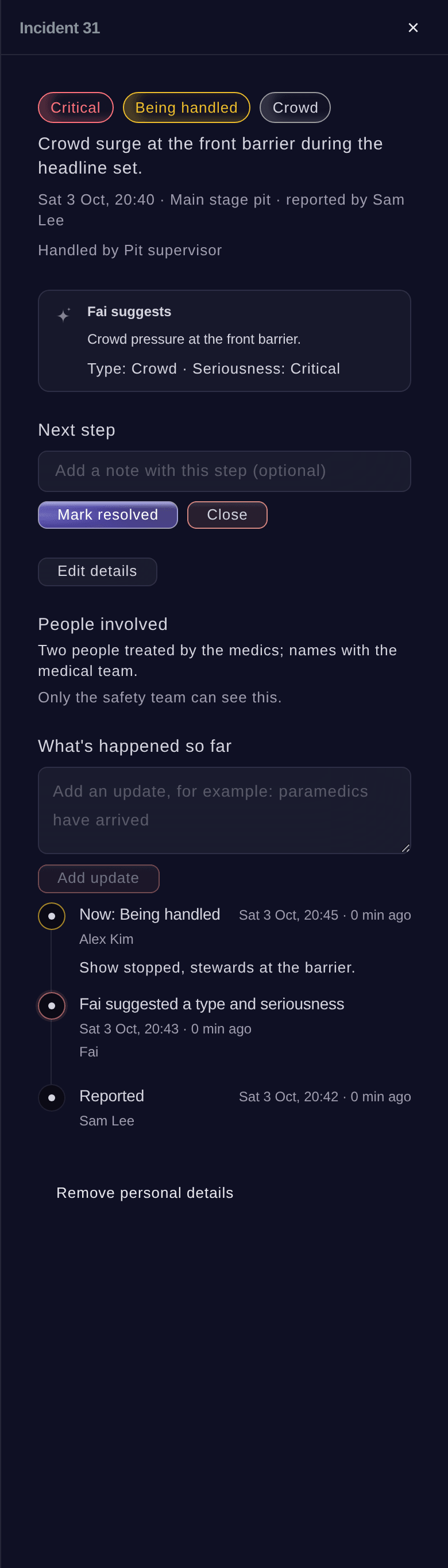
Each entry names who is handling it, so the control room never sends two teams to the same fall while a fight at the far gate waits. Raise an entry when it gets worse, add updates as paramedics arrive or the area is cleared, and move it from new to being handled, resolved and closed. Every step joins the entry's history with who took it and when, so the person who picks it up at the shift change knows the whole story in seconds.

Updates are added to the history and never written over, and entries are never deleted. An entry logged by mistake is closed with a note saying so, and a closed entry can be reopened if the problem comes back. When your licensing officer, your insurer or a solicitor asks what happened at the main bar at ten past nine, the answer is there, in order, with every name and time.

Fai reads every new report and suggests its type and how serious it is. The person handling it takes her suggestion with one button or keeps their own judgement, and can ask her again once more detail is in. Your team decides; Fai saves them the typing.

  • Who is handling it: one owner for each entry
  • Escalate: raise an entry as it gets more serious
  • Full history: every step and update with who and when
  • Fai suggests: the type and seriousness of each report
Ticket Fairy incident panel for a crowd surge, with its seriousness, the next step, Fai's suggestion, the people involved and what has happened so far

Send Each Job to the Right Team on the Right Channel

Dispatch an entry to the team that covers its zone, on the radio channel that team answers. The channels and call signs come from the radio plan you already keep with your kit, so the control room, the security supervisor and the medics all work from one plan, and nobody has to remember which channel the campsite stewards are on at two in the morning.

Your radio plan lists each channel as it shows on the radio dial, who uses it and the call signs with the person who answers each one. Print a radio sheet to pin up in the cabin and at each gate, and every department's day sheet shows the channels that team uses. When the plan changes, the next dispatch and the next day sheet follow it.

  • Dispatch by zone: to the team that covers the zone
  • Radio plan: channels, call signs and who answers each one
  • Radio sheet: a printed sheet of every channel to pin up
Ticket Fairy radio plan with a Control channel for emergencies and a Security channel, each with its call signs and who answers

Put the Live Log on Your Control Room TV

Open your private control room link on a TV or computer in the control cabin, and the live log shows there with no sign-in. Everyone in the cabin sees new entries arrive, who is on each one and what is still open, so the police liaison, the medical lead and your security director look at the same picture without anyone sharing their own login.

The link is made for the cabin wall. Keep it to your control room, and stop it or make a new one if it travels further than it should. Personal details on sensitive entries stay off it, so the TV can sit where visitors to the cabin can see it.

  • Control room link: the live log on any TV or computer
  • Private link: no sign-in and no shared logins
  • Sensitive details kept off: safe for a TV visitors can see

Know How Full Every Zone Is Before It Fills

A crush at the front of a tent starts long before anyone radios it in. Enter the safe capacity for each zone, from the arena and the main tent to the pit and the fan zone, and its live count sits beside it, built from the scans in and out at your gates. Fai watches each zone fill and warns you before it reaches the level you set, with the step that fits, such as holding an entrance or opening the overflow.

Arrival and departure pace shows how quickly people are coming in and leaving, so you know when to open more lanes, when the headliner crowd is about to move between stages and whether the site is emptying as planned at the end of the night. A heat map lays the counts over your site plan, so the zones running hot stand out at once beside the stages, bars and exits you drew.

You stay in charge of the decision. Fai warns and suggests; your safety lead holds the entrance or opens the overflow, and the steps your emergency plan links to a crowd trigger are ready beside the warning.

  • Zone counts: live, against the safe capacity you set
  • Early warnings: from Fai, with the next step suggested
  • Arrival and departure pace: how fast each zone fills and empties
  • Heat map: every zone coloured by how full it is

Start From the Counts Your Staff Gates Already Keep

Your staff gates already count who is on site and inside each zone, then by pass group or organisation, and On site now updates by itself while it is open. Open any zone's count for a roll call of everyone inside and when they went in, which is exactly the list you need when a structure has to be cleared or a supplier's crew must be accounted for.

Every pass is checked against its zones, days and hours as it scans, and every movement is kept with where, in or out and who scanned it. Going out is never refused, and scanning people out at every staffed exit keeps each count right. The crowd counts your control room relies on are built on the same scans, so the numbers on the cabin TV are the ones your gates recorded.

  • On site now: who is on site and inside each zone
  • Roll call: everyone inside a zone and when they went in
  • Movements: every scan of a pass, in and out
Ticket Fairy On site now for a festival, with the count on site, the count inside each zone and the counts by group or organisation

Look After Every Patient With a Private Medical Log

Your medical and welfare teams see people on their worst day of the event, and their notes deserve better than a clipboard in a tent. Record each patient's triage, treatment and outcome on a private record linked to the incident they came from, so a fall reported at the second bar and the care that followed tell one complete story.

Only people with a Medical role on the event, and its owners and admins, open the details, and every view of a record is logged. You choose how long records are kept for each event, including keeping them permanently, and erasing a record removes the personal details while the counts stay.

Everyone else gets the numbers without the names. The control room, the safety lead's shift report and your debrief all see how busy the medical tent was and what kind of cases came in, and nobody outside the medical team sees who the patients were. Medical, safeguarding and welfare incidents start sensitive in the control log too, so the same care covers the report and the treatment.

  • Triage, treatment and outcome: each patient from arrival to discharge
  • Linked to incidents: each patient beside the report they came from
  • Medical role: details only for the people who need them
  • Counts with no names: for the control room and your debrief

Hear About Serious Incidents the Moment They Are Reported

When a report comes in as high or critical, or is raised to either later, Fai emails your safety lead and the event's owners and admins straight away with how serious it is, the type, where and when, and a link. If a critical incident is still open later, they are emailed again and an urgent task shows your team it is being chased.

Fai also checks the log every hour for patterns. When several incidents of the same kind happen in the same place close together, such as medical calls at the main bar, she drafts an email to your safety lead asking whether the area needs more cover, ready for your team to approve. Alert emails never say what happened or who was involved, so they are safe to land on a phone in a busy crowd.

Anyone on your event's team can ask Fai to report an incident or add an update in their own words, from wherever they are standing. She shows them what she will log and waits for their yes, and the report reaches the control log and the safety lead the same way as one typed in the dashboard.

  • Safety alerts: your safety lead told at once about anything serious
  • Still open: a second email and an urgent task for a critical incident
  • Patterns: the same kind of incident in the same place
  • Report through Fai: for anyone on your event's team

How Event Teams Run Their Control Room

  • A Camping Festival Through the Night

    The overnight control team works from the cabin TV while stewards report from the campsites on their phones. A run of welfare calls in one field shows up as a pattern, Fai drafts the email to the safety lead, and an extra welfare team is sent there before midnight.

  • A Stadium Concert With a Busy Pit

    The pit has its own safe capacity and staff gates count every crew member in and out. When Fai warns that the pit is close to full during the support act, the security director holds the pit entrance until the changeover and the crowd settles.

  • A City Marathon Finish Line

    Medics record each runner they treat on the private medical log, linked to the incident the marshal reported. The race director sees the number of cases by hour with no names, and the medical provider keeps the full records for as long as its policy asks.

  • A Multi-Stage Day Festival

    Each entry goes to the security team for its zone on the channel they answer, from the radio plan the production manager already keeps. The debrief the next morning starts from the full log, in order, with who handled each entry and when it closed.

  • A Venue Running Back-to-Back Shows

    The duty manager keeps the control room link on the office TV for every show. Incidents carry from report to closed with their history, so the venue answers its licensing review with the record itself.

Questions About Your Event Control Room

Control room

They are the same records. Every incident your team reports is an entry in the control log, with its history, and the control log adds the team, the zone and dispatch to it.

No. Open the private link on a TV or computer in your control cabin. Anyone with the link can see the log, so keep it to your control room and stop it if it reaches someone it should not.

From the radio plan in your event's Kit and equipment, where you add each channel as it shows on the radio dial, its call signs and who answers each one. Owners, admins and producers can change it.

Your safety lead, named with their email in Rota rules, and the event's owners and admins, up to 20 people, once for each rise to high or critical. When a critical incident is still open 30 minutes after it was reported, they are emailed again at Fai's next hourly check of the event.

Three or more incidents of the same type in the same place within two hours. Fai drafts an email to your safety lead, or a task when Rota rules name none, and your team decides what to do.

Your safety team, which is the event's owners, admins and producers and your safety lead, and the person who reported it. Everyone else sees only that something happened, when and how serious it is, and every opening of a sensitive entry is recorded.

No. Entries are never deleted, so the record stays complete. Close an entry logged by mistake with a note, or remove its personal details, which clears the people involved and the text of every update and cannot be undone.

From the passes scanned in and out at your staff gates. You enter each zone's safe capacity from your own safety plan and licence conditions, and Ticket Fairy compares the live count with it. Someone who leaves without being scanned out still counts, so scan people out at every exit you staff.

People with a Medical role on the event, and its owners and admins. Every view is logged. You choose how long records are kept for each event, including permanently, and an erased record keeps its counts.

No. Fai suggests the type and seriousness of a report, warns you before a zone fills and suggests a step, and drafts emails for your approval. People on your team make every decision, and Fai waits for a yes before she logs anything for them.

Ready to Build a Stronger Event Business?

Book a live demo, and we will set up your first event on the Event Operating System with your team.

Start Selling Tickets Online

Sign up without a credit card and build a test event before you commit. Go on sale in minutes when you are ready.

No monthly subscription required for ticketing
Start selling tickets immediately
Ticketing tools included in the service fee
Get Started for Free Talk to Fai Now

Ask Fai, our AI assistant, about Ticket Fairy’s features, pricing and how it could work for your event.

No credit card required

Записаться на демо

Посмотрите, как реферальная модель в среднем даёт на 20% больше продаж билетов, узнайте, какие кампании продают билеты, быстрее отвечайте покупателям и поддерживайте движение очередей.

Видеозвонок на 45 минут
Выберите удобное время

The Ticket Fairy, Inc. is a fintech company and technology platform. The Ticket Fairy, Inc. is not a bank, financial institution, or regulated financial services provider. Vault banking services are provided through regulated banking partners. Ticket Fairy Capital financing is provided by third-party private credit partners. The Ticket Fairy, Inc. does not make credit decisions, and all funding terms, approvals and conditions are determined by those lending partners.