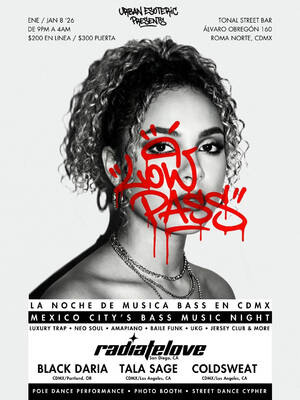
Events and Programming
Tonal is best understood as a small, flexible cultural venue rather than a conventional concert hall. Its programme combines live music, DJ nights, dance parties, poetry, theatre, book presentations, talks, improvisation and community gatherings. The strongest recurring thread is contemporary Latin and global club culture: cumbia, Afrobeat, salsa, electronic music, hip-hop, R&B, electro-folk, tropical sounds, indie pop and experimental work all appear in its calendar.
As of August 29, 2026, the published calendar shows two distinct recurring formats. Ritmia occupies the Street Bar on Thursday, Friday and Saturday, while Club Tonal runs in the main Foro on the same nights. The listings describe both as music-led social events, with access sometimes free before a late-night cover begins. The calendar also lists occasional one-off concerts, cultural parties and artist-led programmes.
Upcoming programming announced beyond the current weekend includes Chamakooo on September 10, Cariñito’s Independence-night edition on September 15, the GRLS Pink Lemonade Tour on September 19 and Prietto on September 30, 2026. These announcements suggest that Tonal continues to alternate between dance-focused nights and more conventional live performance bookings rather than following a single genre policy.
The documented 2024 programme included Meridian Brothers, Frente Cumbiero, Beats Antique, John Primer & The Real Deal Blues Band, Los Espíritus, LA LOM, Pauli The PSM and other independent or internationally connected acts. The 2025 record added artists such as Kazy Lambist, Chiara Oliver, Immasoul, Silver Rose, Petite Amie, French Braids, Brolorizo, Pahua and Sussie 4. These bookings place Tonal between an intimate concert room, a Latin alternative club and a discovery-oriented showcase venue.
Several events show how Tonal extends beyond a standard gig. Pahua’s September 2025 appearance combined an album presentation, listening party, live performance, guest sets and an after-party. A 2025 Bohemia Inmerxiva programme combined live music with dinner, cacao, mezcal, visual elements and incense. The venue has also hosted parties built around tropical music, vinyl culture, community and sensory experiences.
For ticket budgeting, published examples indicate a wide range. Many recurring nights and some special events are advertised as free with registration or before a specified time. Paid event examples have included approximately MXN 150–250 for community parties, MXN 200–400 for smaller concerts or club programmes, about MXN 300 for a headline album event, and MXN 400–650 for larger or more production-heavy shows. VIP or artist-experience packages have occasionally been much higher, but they are event-specific rather than a standard Tonal offering.
Tickets and Booking
Tonal’s official calendar separates events in the main Foro from those in the Street Bar and identifies whether a listing is a concert, party, cultural event or live-music programme. Ticket arrangements vary by promoter. Some events use advance registration, some publish early-bird and later pricing phases, and some state that a cover is collected at the door after a certain hour. There is no single venue-wide ticket price or universal box-office schedule.
For popular shows, the safest strategy is to buy during the first announced pricing phase or complete any required registration as soon as the event is published. Early-bird allocations can be substantially lower than later prices, while a few nightlife events allow free entry only before a deadline. Read the individual event conditions carefully for age limits, opening times, whether door admission is available and whether the event is in the Foro or Street Bar.
Do not assume that a ticket guarantees a reserved chair. Most Tonal programming is designed around standing, dancing or informal movement, and the room may be reconfigured for tables, installations, workshops or a live band. Some special events have advertised VIP or preferential areas, but these should be treated as temporary event layouts rather than permanent seating sections.
About Tonal
Tonal is a restaurant, bar and multidisciplinary cultural forum at Avenida Álvaro Obregón 160 in Roma Norte, Cuauhtémoc. Its street-level identity is deliberately different from its evening identity: by day it offers food, coffee and drinks, while the upper-level forum becomes a setting for concerts, club nights and cultural events. The city’s cultural information directory describes the venue as a space for meeting creators and experimenters, with music, books, poetry and theatre among its activities.
The venue’s public history is relatively recent. There is no reliable, independently documented Tonal programme at this address for 2021, 2022 or 2023. Public references begin in 2024, when event listings appeared and a July review described Tonal as a new multidisciplinary forum. Tonal’s first-anniversary programme took place on August 22 and 23, 2025, which supports a summer 2024 launch period, although a definitive opening day has not been publicly established.
The anniversary programme brought together collectives and promoters associated with the venue’s first year, including Boyanza, Departamento, Diáspora, Fino Club, Flying Ears, Melody Culture, Noche Negra, Popola Club, Ritmia, Sonido Local and Xelva. That is significant because Tonal’s identity has been built not only through headline artists but also through recurring local communities that curate dance floors, showcases and hybrid events.
Public listings commonly describe the venue as accommodating approximately 300 people, but Tonal does not publish an official maximum capacity, certified occupancy figure, room dimensions or detailed floor plan. The 300-person figure should therefore be treated as an approximate concert configuration. Actual capacity can change when tables, art installations, food service, VIP areas or production equipment occupy part of the floor.
Seating and Layout
The usual visitor experience is standing rather than seated. The primary Foro is upstairs, while the Street Bar is a separate programme area within the building. Event descriptions have also presented Tonal as a split-level space with an open-air or retractable-roof configuration for selected daytime and party formats, so the exact atmosphere can vary considerably from one listing to another.
For a concert, the clearest view will normally come from the front half of the standing floor, although that is also the busiest area. For a DJ night, staying slightly to one side can provide more personal space without losing the relationship between the booth and dance floor. Visitors who prefer a calmer experience may find the edges of the room, lower-level restaurant or bar areas more comfortable, but those locations are not guaranteed viewing positions.
Tonal does not publish a permanent seating chart, tiered balcony map, fixed orchestra section or standard VIP plan. There is also no verified public specification for the stage’s width, depth, height or sightline limitations. Event-specific information should take precedence, particularly for concerts with tables, installations, food service or a modified stage arrangement.
Architecture, Sound and Production
The most consistently reported design feature is the contrast between the ordinary-looking street frontage and the more immersive upper-level forum. Independent descriptions highlight organic wood, living plants and a room that changes character after dark. The result is less like a formal auditorium and more like a creative house, café-bar and dance space combined.
Reports from visitors and event coverage are generally positive about the sound, particularly for an intimate room where the audience is close to the performers. The space has hosted full bands, solo artists, DJs, spoken-word events and hybrid performances, so its production needs are varied. Tonal does not publicly identify its loudspeaker manufacturer, mixing console, monitor system, microphones, lighting inventory, projection equipment, acoustic treatment or electrical capacity.
For production managers, the absence of a published technical rider matters. Do not assume that the room includes a particular PA, lighting package, stage plot, rigging capacity, green room, loading route or video system. Those details should be confirmed directly with the event producer before advancing a show. No verified major renovation or technical modernization has been publicly documented since the venue’s launch period.
Getting There and Parking
Tonal is located at Avenida Álvaro Obregón 160, Roma Norte, CP 06700, in the Cuauhtémoc borough. The most straightforward public-transport option is Metrobús Line 1, using the Álvaro Obregón station and continuing on foot along Avenida Álvaro Obregón. The station is officially listed as part of Line 1’s Insurgentes corridor.
Metro Line 1 also serves the wider Roma and Condesa area through Insurgentes, Durango and Chapultepec stations, although the final walk is longer and route conditions can vary. The city’s Metro fare is listed at MXN 5, while the standard Metrobús fare is listed at MXN 6. Carry or reload the integrated mobility card before a late event, since the end of a show may not coincide with staffed station services.
Roma Norte is well suited to walking and cycling, and the city’s ECOBICI network operates throughout the neighborhood. Official parking information identifies Roma Norte I and Roma Norte II within the Roma-Condesa parquímetro zone. The published 2026 rate is MXN 3.40 per 15 minutes, with the listed operating schedule for Roma Norte running Monday through Friday from 9:00 a.m. to 6:00 p.m. Those spaces are not a Tonal parking facility and are unlikely to solve late-night parking by themselves.
No dedicated Tonal visitor parking lot or venue-operated valet service is identified in the public information reviewed. If you drive, allow time to look for an independent commercial garage or legal street space and check its closing time before leaving your car. For taxis or app-based rides, use the full Avenida Álvaro Obregón 160 address and specify Roma Norte, since similarly named locations in the Roma area can cause confusion.
Inside the Venue
The daytime ground floor is built around food and drink. Tonal describes its kitchen as an exploration of local and regenerative ingredients, with food influenced by the mix of cultures found in Roma. Its experimental bar features cacao, kombucha, coffee and plant-based or herbal preparations, while the specialty bar offers cocktails, wine, spirits, vermouth and house-made ferments.
Published kitchen hours are Tuesday and Wednesday from 9:00 a.m. to midnight, Thursday through Saturday from 9:00 a.m. to 2:00 a.m., and Sunday from 9:00 a.m. to 8:00 p.m. Event schedules can run later than the food-service hours, and a programme may use the Street Bar or upstairs Foro rather than the restaurant floor. Arriving early for dinner is sensible on concert nights because the kitchen and bar can become busy before the main set.
The venue’s public materials do not provide a universal bag policy, prohibited-items list, photography rule, coat-check policy, merchandise policy, Wi-Fi specification or standard security procedure. These details may be set by the promoter for a particular event. Check the conditions attached to the individual booking and avoid bringing unnecessary large bags, professional recording equipment or items that could slow entry.
Nearby Amenities
Roma Norte is one of the city’s most walkable nightlife and dining districts, and Avenida Álvaro Obregón is lined with cafés, restaurants, bars and casual food options. Tonal itself is the most convenient pre-show choice when the event is using the upstairs Foro, since visitors can eat and drink in the same building before moving into the performance space.
For a relaxed evening, arrive early enough to have food before doors become busy. For a party that starts late, a short meal or drink nearby can be easier than relying on the venue’s busiest service period. Because many Tonal events continue into the early morning, arrange a return journey before the final set rather than assuming regular Metro service will still be convenient.
What Makes This Venue Special
Tonal’s defining quality is the way it joins several kinds of cultural life without placing them in separate institutions. A visitor may encounter coffee and breakfast in the morning, a poetry or book event in the afternoon, a live band in the evening and a DJ-led dance floor later that night. That continuity gives the venue a social role different from a purpose-built club or ticketed theater.
The programming also reflects Mexico City’s position as a meeting point for Latin American and international artists. Meridian Brothers and Frente Cumbiero connected Colombian tropical experimentation with the local scene; John Primer brought Chicago blues into the room; Beats Antique represented theatrical electronic fusion; and later programmes have paired Mexican artists with independent acts from elsewhere. Tonal’s strongest contribution is not scale but proximity: emerging and established artists share a compact room where audiences can discover work before it reaches larger venues.
No public study was found that quantifies Tonal’s economic impact on Roma Norte. Its cultural effect is easier to document: the venue creates regular work for artists, DJs, promoters, technicians, food and beverage staff, and local creative communities, while bringing event-related spending to a dense neighborhood. That is an observable contribution, but it should not be confused with a formally measured economic-impact assessment.
Visitor Tips and Information
Age rules are event-specific. Published examples include 18-plus concerts and parties, while the 2025 anniversary programme was advertised for people aged 21 and over. Bring a government-issued photo ID that matches the name or age requirement attached to the event. Daytime restaurant service and cultural activities may follow different rules from late-night parties.
There is no published dress code. Comfortable shoes are the practical choice for standing and dancing, while a light outer layer is useful for events using an open-air or partially open configuration. Mexico City evenings can feel cool even after a warm afternoon, and upper-level rooms may feel warmer when crowded or heavily lit.
Accessibility information is limited. The public sources reviewed do not confirm a step-free entrance, elevator access to the upper Foro, wheelchair positions, accessible toilets, hearing assistance, captioning, tactile guidance or an ADA-equivalent accessibility programme. Visitors who need step-free access, seating accommodation or assistance should verify the route and facilities with the event organiser before purchasing, especially when the programme is upstairs.
Finally, distinguish Tonal on Avenida Álvaro Obregón from similarly named businesses elsewhere in Roma. Use the complete address when arranging transport, confirm whether your event is in the Foro or Street Bar, and check whether entry is free only before a stated time. Those small details prevent the most common arrival problems.
Frequently Asked Questions
What events are usually held at Tonal?
Tonal usually presents live concerts, DJ sets, dance parties, album launches, listening sessions, poetry, theatre, book events, talks and community programmes. Its musical identity leans toward Latin alternative, cumbia, Afrobeat, tropical music, electronic fusion, hip-hop, indie pop and experimental sounds. The programme changes frequently, so the room may feel like a concert venue one night and a club or cultural salon the next.
Are Tonal events free?
Some are. The venue’s published calendar regularly marks Street Bar sessions and selected Foro programmes as free admission. Other nights require registration, an advance ticket or a cover after a specified hour. Free entry is not always unconditional: a promoter may limit it to guests who register, arrive before a deadline or meet an age requirement. Always read the individual event notice rather than assuming every Tonal night costs nothing.
How much do tickets at Tonal cost?
Prices vary according to the artist, promoter and event format. Published examples range from free admission and approximately MXN 150–250 for smaller parties to roughly MXN 200–400 for many concerts and club events. Larger bookings have reached around MXN 500–650 for general admission, while special VIP experiences can cost more. These are representative examples, not a fixed Tonal price list.
Can I buy tickets at the door?
Sometimes, but not always. Some Tonal event descriptions state that a cover applies at the door after midnight, while others have specified that no door sales would be available. Advance registration may also be required for free-entry nights. The event’s own conditions take priority, particularly for sold-out concerts, special experiences and events with early-bird phases. Do not travel assuming door admission will be offered.
Does Tonal have a permanent box office?
No permanent public box-office schedule is identified in the information reviewed. Ticketing is handled event by event, with different arrangements for registration, advance admission, door cover and VIP access. If you need to collect, transfer or resolve a ticket, check the instructions attached to that specific event. Tonal’s ordinary restaurant hours should not be treated as box-office hours.
What is Tonal’s capacity?
Public concert listings commonly give Tonal an approximate capacity of 300 people. Tonal does not publish a confirmed maximum occupancy, official floor plan or capacity breakdown for its Foro and Street Bar. The usable number can change when tables, installations, food service, production equipment or VIP areas are added. Treat 300 as a rough standing-concert reference rather than a guaranteed capacity for every event.
Is Tonal seated or standing?
Most music and nightlife events are primarily standing, with dancing and informal movement central to the experience. Some programmes may add tables, chairs or other temporary arrangements, but there is no permanent seating chart published for the venue. If you need a seat for mobility or comfort, confirm the event layout in advance. A ticket generally should not be interpreted as a reserved-seat ticket.
Where is the best place to stand for a concert?
For the strongest visual connection, stand in the front half of the main floor, although that area becomes the busiest. A position slightly off-center often balances sound, sightlines and personal space. For DJ events, the area near but not directly in front of the booth can offer a good view without the densest crowd. Because layouts change, the best position depends on the night’s stage and sound arrangement.
Is Tonal the same as Cine Tonalá?
No. Tonal is the restaurant, bar and cultural forum at Avenida Álvaro Obregón 160 in Roma Norte. Cine Tonalá is a separate cultural and cinema business on Calle Tonalá in Roma Sur. The similar names can confuse visitors, drivers and delivery services. When travelling to a concert or party, use “Avenida Álvaro Obregón 160, Roma Norte” rather than only saying “Tonal.”
What is the age limit at Tonal?
There is no single age limit for every activity. Published nightlife events have used 18-plus and 21-plus requirements, while daytime dining and some cultural programmes may follow different rules. The age printed in the individual event conditions is the rule to follow. Bring government-issued photo identification, even if you registered or purchased admission in advance.
Does Tonal have accessible facilities?
Public information does not confirm the venue’s step-free entrance, elevator, accessible seating, accessible restroom, hearing assistance or other inclusive facilities. Because the principal Foro is upstairs, visitors who require step-free access should verify the route before buying admission. Accessibility arrangements may depend on the event and promoter. Do not assume that an accessible city location guarantees an accessible room inside the venue.
Is Tonal indoors or outdoors?
The venue includes an enclosed restaurant and an upstairs performance area, but some event descriptions have presented parts of the building as open-air or fitted with a retractable roof. The atmosphere can therefore vary by programme and floor. Check the event description if weather, temperature or rain protection matters to you. A light layer is practical because a crowded room and an open configuration can feel very different.
How do I get to Tonal by public transport?
The easiest public-transport landmark is the Álvaro Obregón station on Metrobús Line 1, followed by a walk along Avenida Álvaro Obregón to number 160. Metro Line 1 stations such as Insurgentes and Durango serve the wider area but require a longer walk. Metro and Metrobús fares are separate, so allow time to use the city’s integrated mobility card or another accepted payment method.
Is parking available at Tonal?
No Tonal-operated parking facility is identified in the public information reviewed. Roma Norte has regulated street parking within the Roma-Condesa parquímetro zone, but the published 2026 operating information lists daytime weekday service and does not make it a dependable late-night solution. Private garages may be available nearby, but closing times and prices vary. Public transport or a pre-arranged taxi is usually less stressful for late events.
Can I eat before a Tonal show?
Yes. Tonal operates a daytime and evening kitchen with casual food, specialty coffee, experimental drinks, cocktails, wine and spirits. The menu emphasizes local and regenerative ingredients and includes preparations associated with cacao, kombucha and house-made ferments. Food-service hours are generally longest from Thursday through Saturday. On busy concert nights, arriving early for dinner is more practical than waiting until the room is full.
Does Tonal have a dress code?
No published venue-wide dress code was found. Visitors generally fit the informal, creative nightlife character of Roma Norte, but the practical priority is comfort. Wear shoes suitable for standing or dancing and consider a light layer for open-air or partially open configurations. Individual promoters may set age, theme or entry conditions for special parties, so check the event notice if the programme has a particular concept.
Can I bring a camera or large bag?
Tonal does not publish one universal bag or photography policy covering every event. Promoters may restrict professional cameras, large bags, tripods, recording equipment or other items that affect safety and crowd movement. A small personal bag and a phone are the least complicated choices. If you plan to bring professional equipment, confirm permission before arrival rather than relying on ordinary concert etiquette.
How late do Tonal events run?
Late-night schedules vary by promoter. The restaurant’s published hours extend to 2:00 a.m. from Thursday through Saturday, while event listings have advertised parties running until 3:00 or 4:00 a.m. The end time can also change if an event includes an after-party or extended DJ programme. Arrange a taxi or app-based ride in advance if you expect to stay until closing.
What makes Tonal different from a normal nightclub?
Tonal combines a restaurant, experimental bar, live-music room, club programme and cultural forum in one building. Its calendar includes not only dance nights but also concerts, poetry, books, theatre, talks and sensory collaborations. The upstairs room is intentionally close to the street-level food and drink operation, making the visit feel more like entering a creative community space than attending a standalone nightclub.